

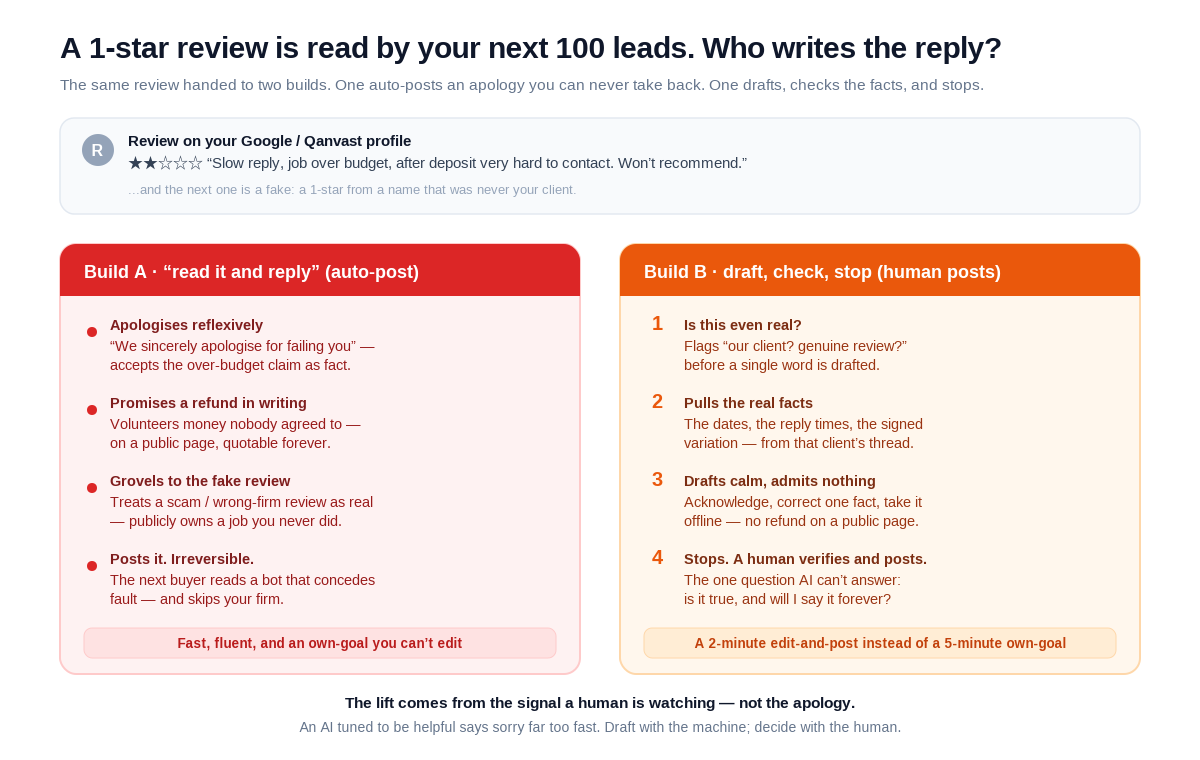
A renovation-firm owner in Subang forwarded me a screenshot last month with a one-line message: "How ah?" It was a two-star Google review on his business profile — "Slow reply, job over budget, after we paid deposit very hard to contact. Won't recommend." He had two instincts, and both were wrong. The first was to ignore it and hope it sank down the page. The second, after it clearly rattled him, was to fire back a long reply explaining that the budget changed because the client kept adding scope. Someone had told him "just use ChatGPT to write a professional reply," so he did — and the draft it gave him opened with "We sincerely apologise for failing to meet your expectations and will make this right."
That draft is the whole problem in one sentence. So I did what this series always does: I built the thing, measured it, and worked out where it earns money and where it quietly sets it on fire.
Why does one public review decide your next renovation lead?
Because in Malaysian renovation, the review is a lead-generation input, not a vanity metric. A buyer about to spend RM40,000–RM150,000 on a terrace or condo reno does not message firms cold. They shortlist first — on Google, on Qanvast, on Recommend.my — and the reviews are the shortlist. Qanvast even cross-checks its reviews against the actual renovation contract and backs deposits up to RM50,000 through its Trust Programme, precisely because, in this trade, a stranger's written experience is the closest thing a nervous buyer has to proof.
Now layer on the climate your next lead walks in with. Renovation-deposit scams are a running headline here: in one 2026 case 18 homeowners reported losing nearly RM1 million to a single contractor who vanished, and an MP has logged around 30 scam complaints running into millions. The buyer reading your profile is already primed to believe the worst about a renovation firm. A one-star complaint you left hanging does not read as "one unhappy customer." It reads as "confirmed — this is one of those firms."
The upside is just as real. BrightLocal's 2024 Local Consumer Review Survey found 88% of consumers would use a business that replies to all of its reviews, versus just 47% for a business that replies to none — and the 2026 edition found 89% now expect owners to respond at all. The reply under a complaint is not for the angry customer. It is for every future lead who reads it while deciding whether you make their shortlist.
So what does ignoring it — or firing back — actually cost?
A renovation firm does maybe 40–60 enquiries a month, closes around 7–8% of them, and every enquiry carries roughly RM1,280 in expected gross profit. Your review profile sits upstream of all of it, because it decides how many of those enquiries you get in the first place. Drop half a star on the shortlist and you are not losing one customer — you are thinning every month of leads that follows.
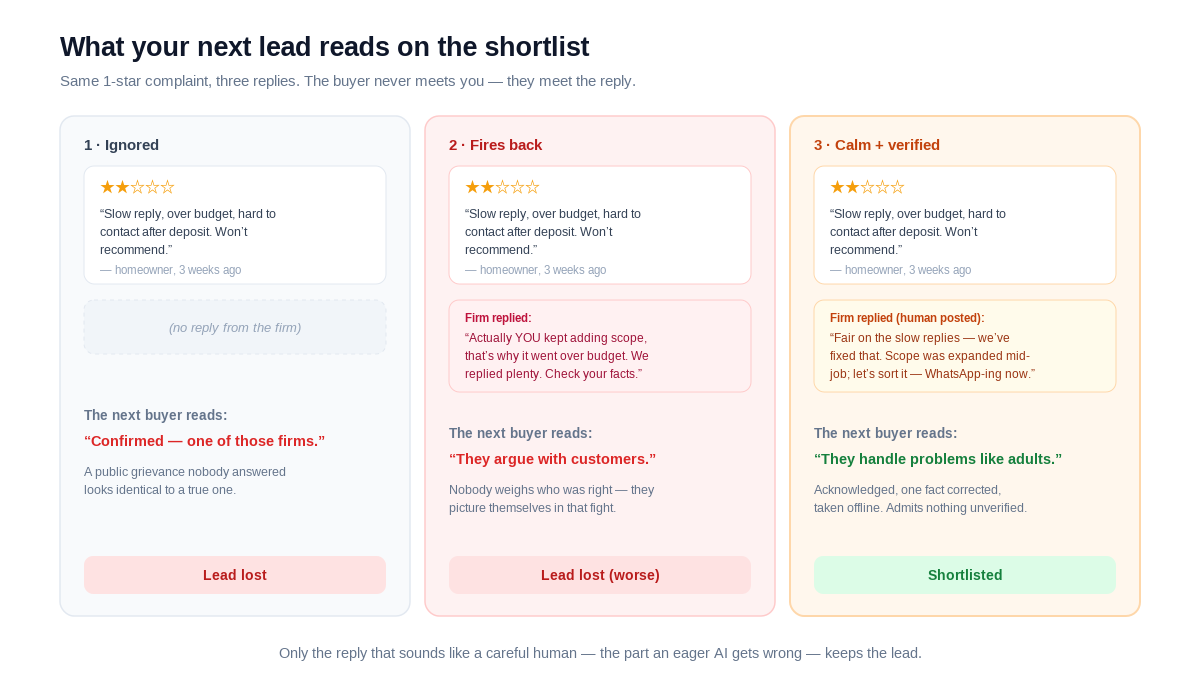
There are three ways to handle a bad review, and two of them cost you leads:
- Ignore it. The complaint stands unanswered as the firm's last word. To the next buyer, a public grievance nobody addressed is indistinguishable from a true one. Given the scam climate above, silence reads as guilt.
- Fire back defensively. The "well, actually, the client kept changing scope" reply feels satisfying and is pure poison. The next buyer does not weigh who was right — they see a firm that argues with its customers in public, and they imagine themselves in that argument.
- Reply calmly, specifically, and take it offline. Acknowledge, correct the record with one fact, offer to sort it out in private. This is the only one that protects the shortlist.
The third is obviously right and genuinely hard to do when you are angry and busy. Which is exactly the kind of job you start wondering if AI can take off your plate.
What I built, and what it cost
The naive build is one step: feed the review in, auto-draft a professional reply, auto-post it. It is almost free. A review reply is a few dozen words, so drafting one through a language model costs a fraction of a sen — cheaper than the electricity to charge the phone you read it on. If cost were the question, this would be a solved problem: point AI at your Google and Qanvast profiles, let it answer everything, done.
Cost is not the question. I ran a batch of real-style renovation reviews — a mix of fair complaints, glowing praise, and a couple of suspicious one-liners — through a plain "write a professional, apologetic reply" prompt, and read what came back as if I were the owner about to hit publish. Two things broke, and both are the kind of break you cannot undo once it is public.
Where it broke: the AI says sorry far too fast
An AI tuned to be helpful is tuned to agree with you — and on a one-star review, agreeing means admitting fault. This is not a quirk of one tool. Anthropic's 2023 study Towards Understanding Sycophancy in Language Models tested five assistants across the major labs and found the same pattern everywhere: models "wrongly admit mistakes," mirror the user's framing, and prefer the agreeable answer over the accurate one — because the preference training behind them rewards responses that go along with whoever is talking.
Point that at "you were slow, over budget and ignored me" and it does precisely what it was trained to do. It opens with "we sincerely apologise for failing you," accepts the over-budget framing as fact, and — in a couple of my runs — volunteered "we would be happy to arrange a refund." On a public page. In writing. For a project where the budget may well have moved because the client added a wet kitchen halfway through, and where no refund was ever discussed. The AI did not weigh the facts, because it did not have them and would not have ranked them above being agreeable if it did.
Then there is the review that should never get an apology at all. In this trade you will get the mistaken-identity review (wrong firm, similar name), the competitor hit, and the straight-up fake. Auto-posting a warm, apologetic reply to one of those is the worst outcome of all: you have publicly accepted a project you never did as your own, rewarded an extortion attempt by treating it as genuine, and conceded fault to a rival. Platforms do not rescue you here — Google removes reviews on its own policy grounds (spam, conflict of interest, off-topic), not on whether a review is fair or true. The machine that is desperate to be helpful is the last thing you want holding the pen on a review that is a trap.
The thing the research says actually works
The value of a reply is not the prose — it is the proof that a real human is paying attention. This is the finding that reframes the whole job. In a 2017 Marketing Science study, Online Reputation Management, Davide Proserpio and Georgios Zervas compared hotels that respond to reviews with those that do not, and measured a 0.12-star rating increase and a 12% rise in review volume once a business started responding. The mechanism is the interesting part: ratings rose not because customers were suddenly happier, but because unhappy customers held back their flimsier complaints once they knew management was reading. (It is hotel data, not renovation — but the behaviour is human, not sector-specific, and it matches what I have seen on reno profiles.)
Read that against the sycophancy finding and the design writes itself. What lifts your rating is the signal that someone is home — a calm, specific, grown-up reply that shows a real firm reads and responds. What an eager AI produces is the opposite signal: a generic grovel that reads like it came from a bot, often conceding things a careful human never would. Speed and fluency, the two things AI is best at, are not the lever. A verified, non-defensive, offline-taking reply that a human stands behind — that is the lever.
The build that actually pays
AI drafts and gathers; a human verifies and posts. Never the other way round. Put the two failure modes together and the safe build is clear — use the machine for the fast, reversible work (drafting a calm first version, pulling the real facts of that job out of your own records) and keep a human on every irreversible judgment (is this even our client, is the draft admitting anything, should this be reported instead of answered).
| Step | Naive build (auto-reply) | The build that pays |
|---|---|---|
| Is it genuine? | Replies to everything, fake or real | Flags "is this our client? is this review genuine?" for a human to judge first |
| The facts | AI invents context to sound specific | AI pulls the real thread, dates and variations from your own record |
| The tone | Apologises reflexively, concedes fault | Drafts calm, specific, non-defensive; admits nothing not verified |
| A refund or promise | Volunteers it to sound helpful | Never promises on a public page; offers to continue in private |
| A fake or scam review | Grovels to it as if real | Flagged to report on policy grounds, not answered emotionally |
| Posting | Auto-posted, irreversible | A human reads it against the facts and posts |
So the reply AI actually earns its keep on is the draft plus the dossier: a measured first version, sitting next to the three or four real facts from that client's history that tell the human whether the complaint is fair, exaggerated, or not theirs at all. That turns a hot-headed five-minute own-goal into a two-minute edit-and-post. The human still owns the single question AI cannot answer — is this true, and am I willing to say it in public forever?
Where HotLead fits — and where it doesn't
Straight, because the Kai lane lives on it: HotLead does not write or post your review replies. Drafting the reply is the experiment in this article, and you can wire it yourself cheaply if you want a first draft to edit. What HotLead does is the part that actually moves your review profile, and it is all upstream of the comment box:
- Keeps the whole client thread on one record, so when a review appears you can pull what actually happened — the dates, the variation order, the real reply times — instead of replying from memory or guesswork.
- Gives each lead one owner, by round-robin, area or custom rule, because "slow reply, hard to contact" — the single most common line in a renovation one-star — is almost always an ownership gap, not a people problem.
- Keeps a next action and an overdue-follow-up nudge, so leads and clients are not quietly dropped into the silence that earns the review in the first place.
- Shows your funnel and per-channel numbers, so you can see whether the Qanvast and Google leads you are winning are worth protecting that rank for.
The pattern underneath every piece in this series holds here too: fix the service the reviews describe, and most of the bad reviews never get written. For the ones that still do, ask your happy clients for reviews so a single sour one is a drop, not the headline — and keep a human on the reply, because that is the one job where sounding helpful and being helpful point in opposite directions.
If the real problem under this is that your profile is thin and your replies are slow, start with the complete guide to managing renovation leads in Malaysia, see how it maps to a renovation firm or an interior-design studio, and read the companions on what AI still can't do in your lead process, what a referred lead is actually worth, and the honest ledger of which AI steps actually paid.
Sources: The share of consumers who would use a business that replies to all its reviews (88%) versus one that replies to none (47%), and the 2026 finding that 89% of consumers expect owners to respond, are from BrightLocal's Local Consumer Review Survey (2024 and 2026 editions). The 0.12-star rating increase and 12% review-volume rise after a business starts responding, and the mechanism (unhappy customers withholding weak complaints once they expect management reads), are from Davide Proserpio and Georgios Zervas, Online Reputation Management: Estimating the Impact of Management Responses on Consumer Reviews, Marketing Science 36(5), 2017 — a hotel study, cited here for its mechanism, not as renovation data. The sycophancy finding (models wrongly admit mistakes and prefer agreeable answers, driven by preference training) is from Sharma et al., Towards Understanding Sycophancy in Language Models (arXiv 2310.13548, 2023; ICLR 2024). Qanvast's review verification against renovation contracts and its Trust Programme deposit protection up to RM50,000 are from Qanvast Malaysia. The 2026 renovation-scam case (18 victims, nearly RM1 million) is from Business Today, and the roughly 30 scam complaints logged by an MP from the New Straits Times. That Google removes reviews on its own policy grounds rather than on fairness or defamation is from this legal guide on handling defamatory reviews; specific legal exposure is a question for a Malaysian lawyer, not covered here. WhatsApp share of these leads (90.7%), typical volume (40–60 enquiries a month), close rate (7–8%) and expected gross profit per enquiry (~RM1,280) are house operating figures reused across this series and labelled as typical, not quoted results. The Subang owner, his review and the drafting experiment are described from practice and are illustrative, not a controlled trial. HotLead is described only by its real features — capture, round-robin/manual/custom-rule routing, one owner per lead, auto-greeting, next-action and overdue follow-ups, and funnel/per-channel and team visibility; it does not draft or post review replies.
Frequently asked questions
Should I let AI automatically reply to my Google or Qanvast reviews?
No. Let AI draft the reply and gather the real facts of what happened with that client from your own records, but keep a human to verify the review is genuinely from your client, check the draft does not admit a fault or promise something that never happened, and post it. A public review reply cannot be taken back, and an AI tuned to be helpful tends to over-apologise — which on a disputed or fake review is an own-goal you cannot undo.
Does replying to bad reviews actually bring in more renovation leads?
Yes, indirectly but measurably. Malaysian buyers shortlist renovation and interior firms on Google, Qanvast and Recommend.my before they message anyone, so the reply under a complaint is read by every future lead. BrightLocal's 2024 survey found 88% of consumers would use a business that replies to all its reviews against 47% for one that replies to none, and a 2017 Marketing Science study found businesses that start responding see their rating rise and their review count grow. The reply is cheap insurance on the most-read page you own.
What should I do about a fake or malicious renovation review?
Do not argue with it in public and never let AI auto-reply to it. Screenshot it with the date, check whether the reviewer was ever your client, and report it to the platform on policy grounds — Google removes reviews for things like spam, conflict of interest or being off-topic, not for being unfair. If it is defamatory, that is a question for a lawyer, not a comment box. A calm one-line public note that you have no record of this project, posted by a human, is safer than an AI apology that treats a scammer as a real customer.
How much does it cost to use AI to draft a review reply?
Almost nothing in tokens — a short reply drafted through a language model costs a fraction of a sen. Cost is not the constraint here, judgment is. The expensive mistake is not the draft, it is posting a draft that concedes a liability, promises a refund you did not agree to, or responds to a fake review as if it were real. The money is saved or lost in the human check before you hit publish, not in the drafting.
Does HotLead write or post my review replies?
No, and I will not pretend otherwise — drafting a review reply is the experiment in this article, not a HotLead feature. What HotLead does is the part that actually moves your reviews, which is upstream. It keeps the whole client thread on one record so you can pull the real facts when a review appears, gives each lead one owner so replies stop being slow (slow replies are what most renovation complaints are really about), keeps a next action and an overdue nudge so leads are not dropped, and shows your funnel and per-channel numbers. Fix the service the reviews describe and the reviews follow.
Keep reading
- Which Lead Signals Actually Predict a Sale? Reverse-Audit Your Own Won JobsMost firms grade a renovation lead on signals that feel predictive — enthusiasm, a long message, a fast reply — and never check whether those signals actually separate won jobs from lost ones. Here is how to run a reverse-audit on your own closed deals, which signals usually survive it, and why your pipeline is too small to pretend the score is more than directional.
- The "I Only Deal With the Boss" Lead: When the Buyer Refuses Your TeamYou finally hired someone to share the load — then the buyer messages "can I deal with you direct ah, boss?" and refuses to engage your staff. Every big lead quietly re-centralises onto the one person already maxed out, and your firm can never grow past the owner. Here's why caving caps you, why a flat "my staff will assist" loses a nervous buyer, and the move that keeps both.
- Can AI Turn a Buyer's WhatsApp Voice Note Into a Renovation Lead You Can Skim? I Built It — and the Flaw Isn't the TranscriptA big slice of renovation enquiries in Malaysia arrive as a 2-minute WhatsApp voice note — rambling, code-switched, impossible to skim. The 2026 reflex is to let AI transcribe them so you can read instead of listen. I built it, and the transcription is cheap and genuinely useful. But the real mistake isn't the words AI gets wrong on Manglish audio — it's that transcribing a voice note quietly throws away the exact signal that made it your highest-intent lead. Here's the build that keeps both.