

An owner in Klang asked me this one with real frustration in his voice: "Half my enquiries come as voice notes now. Two minutes, three minutes, people just talk. I can't read them, can't search them, can't forward them to my designer. By the time I sit down to listen, the day's gone. Can AI just turn them into text so I can deal with them like a normal message?"
Fair, and very Malaysian. So I built it, measured it, and the short answer is: yes, transcription works, it's almost free, and it's genuinely useful — but the mistake everyone makes isn't the words AI gets wrong. It's that the moment you turn a voice note into a tidy transcript and file it, you throw away the one thing that made it your best lead. Here's the build, what it costs, where the transcript quietly lies, and the version that keeps both the speed and the signal.
Why is a voice-note enquiry worth more than a typed one?
Because the buyer chose to stop and talk. Typing a renovation enquiry is cheap and noncommittal — thumbs on a screen while half-watching TV. Recording a two-minute voice note is a deliberate act: they stopped, they explained, they let you hear their actual situation. That higher effort is a higher-intent signal, and it comes loaded with information a text never carries.
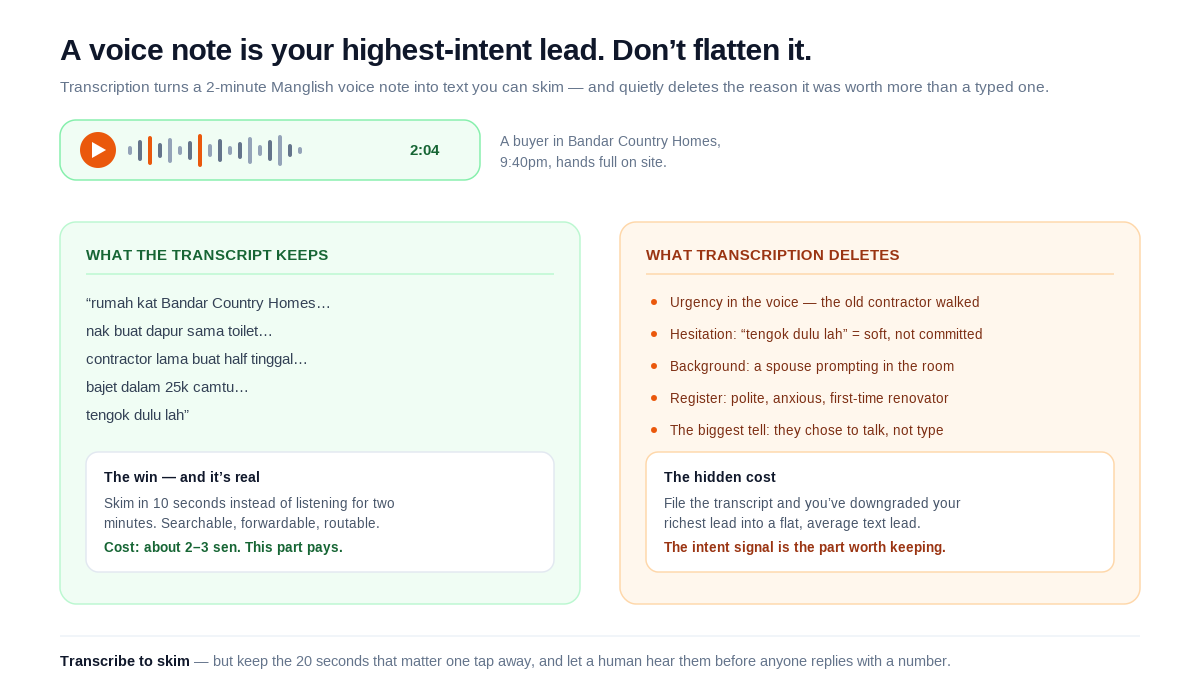
Listen to one and you hear things you could never type: the urgency in a voice that says the last contractor walked off mid-job, the hesitation when a budget is "dalam 25k camtu" rather than a flat number, the spouse prompting in the background (so you already know the real decision is a two-person one), the polite-but-anxious register of a first-timer who's never renovated before. In a WhatsApp-first market — around 90.7% of these leads land on WhatsApp — the voice note is the richest first touch you get.
Here's the cruel part. That highest-intent lead gets your slowest response, because it's the one enquiry you can't deal with in ten seconds between site visits. A text you glance at and reply to on the spot. A two-minute voice note you park — "listen later lah" — and later is after the buyer has already messaged three other firms. It's the same trap as the lead that only messages at 11pm: the enquiry arrives hot and gets answered cold, except here the cause isn't the hour, it's the format.
So what does parking it actually cost you?
The five-minute window, and with it most of the odds of ever connecting. The lead-response research this whole series leans on is blunt: reply within five minutes and you're about 100× more likely to connect than at thirty. A voice note you listen to "when I get a chance" blows that window by default — not because you dropped the ball, but because the format forced a full stop you didn't have time for.
With a renovation enquiry carrying roughly RM1,280 in expected gross profit, the voice note isn't a nuisance to clear off your inbox — it's the single lead you can least afford to park. That's the problem worth throwing AI at. Not to sound clever. To stop the most valuable enquiry you get from being the slowest one you answer.
What I built, and what it cost
A thin transcribe-and-extract step: audio in, a skimmable lead card out. When a voice note lands, it's piped to a speech-to-text model (Whisper-class), the transcript is run through a language model with one instruction — pull out location, scope, rough budget, urgency and language; do not infer anything that wasn't said — and the result is a five-line card the owner can read in ten seconds flat.
The cost is a rounding error. At OpenAI's published Whisper rate of about USD 0.006 a minute — roughly two to three sen at today's exchange — a two-minute note costs well under a dozen sen to transcribe, and the extraction is a fraction of a sen more. Run forty voice notes a month and you've spent the price of one teh tarik. This is the part the series keeps finding pays: a READ job, where the input is sitting right there in the message, speed and volume matter, and the output is a draft a human checks — not a decision AI makes alone. On that test, transcription is a clean win.
So far, so good. Then I stress-tested it on real Malaysian audio, and two things broke.
Where the transcript lies — and why it looks fine
On Manglish, the transcript reads clean and confident exactly where it's wrong. Mixed Malay-English speech is the hard case for every speech recogniser, and the errors cluster at the switch points — the moment a sentence flips from Malay to English and back, which in a Malaysian voice note is every few words. One 2025 evaluation of code-switched Bahasa Malay–English audio, reported in Deepgram's ASR guide, found Whisper's word-error rate roughly tripling — from about 22% on clean monolingual speech to about 59% on code-switched speech — with most of the damage at exactly those switches. A separate study of Malay speech recognition found error rates jumping by around 30% once you cross accents and speaker origins.
And the "just use WhatsApp's built-in transcripts" reflex has its own trap. WhatsApp rolled out in-app voice-message transcripts in late 2024, supporting 20 languages including Malay — but the feature only transcribes cleanly when the voice note's language matches your app's language setting. A Manglish note played under a phone set to English comes out garbled, and nobody tells you it's wrong.
That's why the transcript can never be the thing an irreversible reply is built on — no auto-quote, no auto-classify-and-bin, no AI-sent price off the back of it. It's the same rule that runs through the whole series: AI reads and proposes, a human decides and sends. But a voice note sharpens it, because transcription looks like the safest kind of reading there is — and on Manglish audio, it's the read you most need to double-check.
The real mistake isn't accuracy — it's deletion
Even a perfect transcript throws away why the lead was worth more. This is the part almost nobody flags, and it's the one that actually costs you. Fix every word and you've still converted a rich, loaded, two-minute signal into five flat lines of text — and in the process deleted the tone, the urgency, the hesitation, the person in the background, and the plain fact that this buyer chose to talk instead of type. You've taken your highest-intent lead and downgraded it into a perfectly average text lead.
Think about what you'd do differently if you heard the note versus read the card. Heard it, you catch that the old contractor abandoned the job — so you lead with reassurance and a site visit, not a price. You catch the hedge and know not to push for a deposit yet. You catch the second voice and know to get both decision-makers on the thread. Read the flattened card, you see "kitchen + toilet, 25k, Bandar Country Homes" and fire back a number — treating your most winnable lead like a quote request. The transcript didn't lie there. It just quietly erased the edge.
The build that actually pays
AI does the fast, reversible reading; a human does the part that reads the room. Put the two failure modes together and the design writes itself: use AI to kill the delay and keep the audio, never to replace the listening. Concretely:
| Step | Naive build (transcribe-and-file) | The build that pays |
|---|---|---|
| The instant a note lands | Nothing until someone plays it | Auto-greeting acknowledges in seconds, holding the 5-min window |
| Transcription | The transcript is the lead | A skim aid; the audio stays the source of truth, one tap away |
| Extraction | AI infers budget, scope, intent | AI pulls only what was said, flags hedges and the language used |
| The signal | Deleted — flattened to text | Preserved — urgency and "who's deciding" surfaced, not erased |
| The reply | AI drafts/sends off the transcript | A human who has heard the clip owns the reply and any number |
| Ownership | Note sits in a shared inbox | One named owner, a next action so it's never parked |
The acknowledgement is the quiet hero. An instant auto-greeting the moment any enquiry lands — text, photo or voice note — buys you the whole five-minute window without a human being free, which is exactly the point where a voice-note lead normally dies. The transcript then lets whoever owns it skim and route in ten seconds instead of two minutes. And because the audio is still right there, the person who replies can hear the twenty seconds that matter before they say anything with a price in it. Speed from the machine, judgment from the human — the split that's held up on the first reply, the CRM note and the cross-language bridge, and it holds here too.
Where HotLead fits — and where it doesn't
Let me be straight about the line, because the Kai lane lives or dies on honesty: HotLead does not transcribe your voice notes. That's the experiment in this article, not a product feature, and you can wire a Whisper-class step yourself cheaply if you want the skim aid.
What HotLead does is the part that actually stops a voice-note lead from leaking, and none of it needs transcription:
- Capture every enquiry, whatever the format, so a voice note is a logged lead the moment it lands, not an audio blob that scrolls away.
- An optional auto-greeting that warms a brand-new WhatsApp lead instantly — the one structural fast touch that holds the five-minute window while a human finds two minutes to listen.
- One owner per lead, by round-robin, area or custom rule, so the note isn't sitting in a shared inbox everyone assumes someone else will play.
- A next action and an overdue-follow-up nudge, so the most expensive words in your inbox — "listen later lah" — don't quietly bury your best lead.
- Funnel and per-channel visibility, so if voice-note enquiries are converting worse than typed ones, you can actually see it instead of guessing.
The listening and the reply stay with your human. For a two-minute, high-trust, high-intent voice note, that isn't a limitation — it's the whole point.
If the problem underneath this is really that your fastest-arriving intent gets your slowest reply, start with the complete guide to managing renovation leads in Malaysia, see how it maps to a renovation firm or an interior-design studio, and read the companion builds on the auto-greeting first reply, turning a missed call into a lead and what AI still can't do in your lead process. The honest ledger of which AI steps actually paid will tell you where to start.
Sources: WhatsApp voice-message volume (about 7 billion sent per day) from Meta's March 2022 announcement, as reported by TechCrunch — a 2022 figure, the latest Meta has published. WhatsApp in-app voice-message transcripts (launched late 2024, 20 languages including Malay, requiring the message language to match the app's language setting) from WhatsApp's own announcement and Lowyat's coverage. Transcription cost (about USD 0.006 a minute for Whisper, with cheaper newer models near USD 0.003) from OpenAI's Whisper model page; USD/MYR of roughly 4.07 in November 2026 from OFX, giving about 2–3 sen a minute. The code-switch word-error-rate jump (22% monolingual to ~59% on Malay–English code-switched speech, errors concentrated at switch points) is reported in Deepgram's ASR code-switching guide citing a 2025 Interspeech evaluation — reported, not independently verified by us, but directionally consistent with the broader finding that aggregate error rates rise sharply on code-switched audio (see the Interspeech 2025 work on code-switch ASR for Singapore's languages and the Malay-English TDNN evaluation); the ~30% cross-accent error increase from a study of Malay speech recognition by speaker origin. WhatsApp share of these leads (90.7%), the five-minute/100× connect rule (MIT/InsideSales lead-response research), typical renovation lead volume (40–60 enquiries a month) and the ~RM1,280 expected gross profit per enquiry are house operating figures reused across this series and labelled as typical, not a quoted result. The Klang owner's question, the Bandar Country Homes voice note and the transcribe-and-extract experiment are described from practice and are illustrative, not a controlled trial. HotLead is described only by its real features — capture, optional auto-greeting, round-robin/manual/custom-rule routing, one owner per lead, next-action and overdue follow-ups, and funnel/per-channel and team visibility; it does not ship voice-note transcription.
Frequently asked questions
Can AI transcribe a WhatsApp voice note into text automatically?
Yes, and cheaply. Tools built on models like OpenAI's Whisper transcribe audio for about USD 0.006 a minute — roughly two to three sen — so a two-minute enquiry costs well under a dozen sen to turn into text you can skim in seconds. WhatsApp also added its own in-app voice-message transcripts in late 2024. The catch is accuracy on Malaysian speech and, more importantly, what a transcript silently leaves out. The transcription is the easy, useful part; what you do next is where the money is won or lost.
Is AI transcription accurate on Manglish and code-switched voice notes?
Less than it looks. A transcript of mixed Malay-English speech reads clean and confident even where it's wrong, and research on code-switched speech recognition shows error rates rise sharply at exactly the switch points — one 2025 evaluation reported Whisper's word-error rate roughly tripling on Malay-English audio versus clean monolingual speech. WhatsApp's built-in transcripts add their own trap — the feature only transcribes when the voice note's language matches your app's language setting, so a Manglish note under an English phone setting can come out garbled. Treat the transcript as a skim aid, never as the thing a reply is built on.
Should I let AI reply to a voice-note enquiry on its own?
No. Transcribe it so a human can skim and triage it fast, and send an instant acknowledgement to hold the first-response window — but the actual reply, especially anything with a price or a date, stays with a human who has heard the clip. A voice note carries hesitation, urgency and register that a transcript flattens; a confident-looking transcript that drops a hedge like 'tengok dulu lah' will have AI replying as if a soft maybe was a firm yes.
What's the fastest way to stop losing voice-note leads?
Acknowledge every enquiry the instant it lands — an automatic WhatsApp greeting buys you the five-minute window whether the enquiry is text, a photo or a voice note — then make sure that lead has one named owner and a next action so it doesn't get deferred with a 'listen later lah'. The leak isn't that voice notes are hard to process; it's that they get parked, and a parked highest-intent lead is the most expensive kind to lose.
Does HotLead transcribe my WhatsApp voice notes?
No — transcription is the experiment in this article, not a HotLead feature, and I won't pretend otherwise. What HotLead does is the part that actually stops the leak around a voice note — it captures every enquiry regardless of format, warms a brand-new WhatsApp lead instantly with an optional auto-greeting so the window holds while someone listens, gives each lead one owner by round-robin, area or custom rule, and keeps a next action and an overdue-follow-up nudge so the note never gets parked and forgotten. The listening and the reply stay with your human — which, for your highest-intent lead, is exactly where they belong.
Keep reading
- Can AI Reply to Your Renovation Firm's 1-Star Review? I Built It — and the Risk Is How Fast It ApologisesA 2-star review on Google or Qanvast is the first thing your next renovation lead reads — and most firms either ignore it or fire back and make it worse. The 2026 reflex is to let AI write the reply. I built it, and drafting a calm response costs a fraction of a sen. But an AI tuned to be helpful apologises too fast — it will concede a fault in writing, promise a refund that never happened, and grovel to a fake review from a competitor. Here's the build that protects your rank instead of torching it.
- Which Lead Signals Actually Predict a Sale? Reverse-Audit Your Own Won JobsMost firms grade a renovation lead on signals that feel predictive — enthusiasm, a long message, a fast reply — and never check whether those signals actually separate won jobs from lost ones. Here is how to run a reverse-audit on your own closed deals, which signals usually survive it, and why your pipeline is too small to pretend the score is more than directional.
- The "I Only Deal With the Boss" Lead: When the Buyer Refuses Your TeamYou finally hired someone to share the load — then the buyer messages "can I deal with you direct ah, boss?" and refuses to engage your staff. Every big lead quietly re-centralises onto the one person already maxed out, and your firm can never grow past the owner. Here's why caving caps you, why a flat "my staff will assist" loses a nervous buyer, and the move that keeps both.