

Two renovation firms in Petaling Jaya will both tell you, with total confidence, what a good lead looks like.
The first owner knows it's the enthusiastic ones — "when they're excited and chatty, got energy, that's when I know got chance." The second knows it's the detailed ones — "long message, floor plan, got budget, that's a serious buyer."
They can't both be right, and there's a decent chance neither is. The only way to know is to do the thing almost no small firm ever does: go back through the deals you already won and lost, and check whether the signal you trust actually separated them. That check has a name — a reverse-audit — and it's the difference between a lead score that works and one that just feels like it does.
What is a lead-score reverse-audit?
It's scoring leads whose outcome you already know, to find out which signals genuinely predicted the win. A normal lead score runs forwards: you grade a fresh enquiry, then wait months to learn whether the grade was right. A reverse-audit runs backwards — you take deals that have already closed, score each one on the signals it carried in its first message, and read off which signals were actually more common in the wins than the losses.
The mechanics are simple enough to do with a notebook and your chat history. The lead-scoring playbooks describe the same shape: take, in Clay's words, "your last 30 to 50 closed-won deals and a matched set of closed-lost or no-decision leads," roughly equal in size, and check whether your winners separate cleanly from your losers on the signals you're scoring. If the two groups overlap — if a signal shows up just as often in the jobs you lost as the ones you won — that signal is predicting nothing, however much it feels like it should.
This is the data layer underneath the hot/warm/cold temperature scorecard. That piece gives you a sensible starting set of bands to grade a new lead; this one is how you check whether those bands are true for your firm — and whether the signals feeding them earn their place at all.
Why not just trust a lead-scoring template or your gut?
Because both are tuned on someone else's customers, and the whole point of scoring is to fit yours. There's good evidence that scoring leads on observed signals beats grading them on feel — one analysis put behavioural scoring at roughly 39–40% qualification versus a ~13% baseline, about three times better. But that advantage only shows up when the signals are the right signals for your business. Import a global template's weights and you've just automated a stranger's gut instead of your own.
Your gut is worse than a template in one specific way: it's built almost entirely from the deals you remember, and memory is a survivorship machine. You recall the chatty enquiry that became a great job and forget the five equally chatty ones that ghosted. HubSpot's write-up on survivorship bias puts the general failure plainly — it's "the act of focusing on successful people, businesses, or strategies and ignoring those that failed," and their fix for a sales team is exactly a reverse-audit's fix: review your Closed-Lost deals as closely as your wins. The signal that feels predictive is usually the one you've only ever examined on the winning side.
There's a second trap the template can't save you from, and it's the one that catches careful people. HubSpot's own example: a team's 35% jump in close rate "may have come from several changes" at once — a new hire, a new comp plan, deals that happened to mature — so copying only the email templates won't reproduce it. A signal can look predictive because something else moved alongside it. Which brings us to the single most important rule in this whole method.
Which signals survive the audit — and which ones lie?
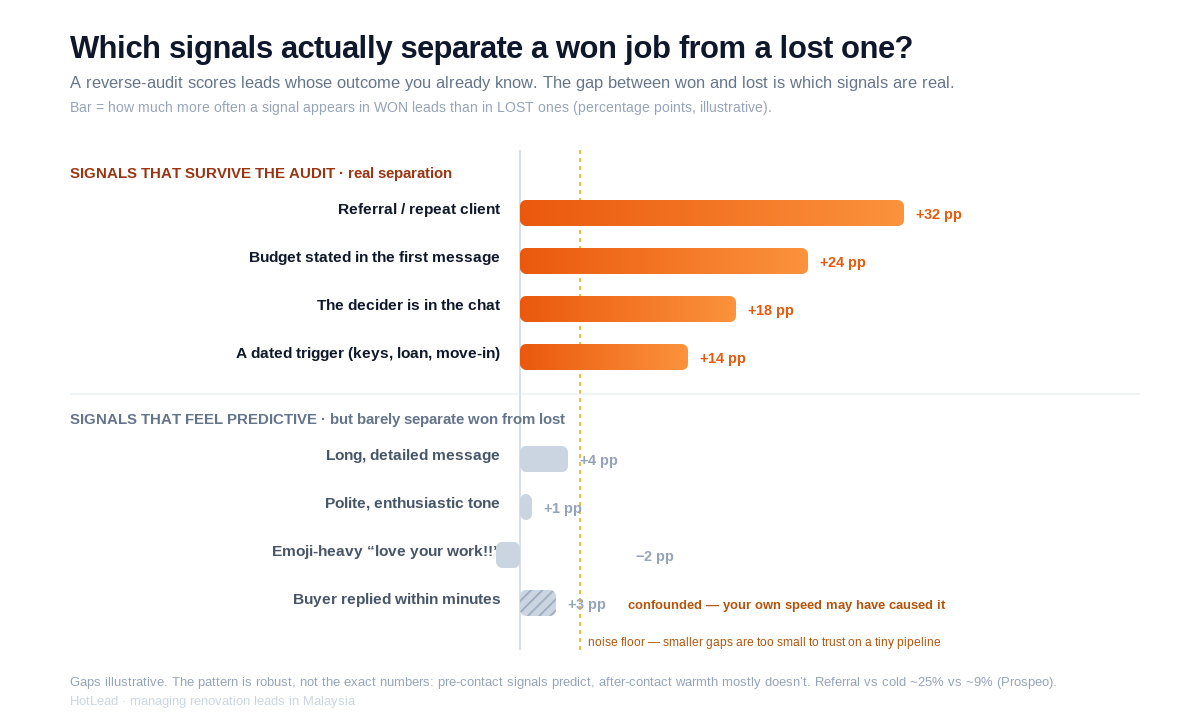
The signals that survive are the structural ones you can read before you reply; the ones that lie are the emotional ones you feel during the conversation. When you actually split won from lost, the same short list tends to separate them — and it's not the list most owners would guess.
| Signal | Can you read it before you reply? | Can your own effort fake it? | Usual verdict |
|---|---|---|---|
| Source (referral / repeat vs cold ad) | Yes | No | Survives — the strongest free signal |
| Budget stated up front | Yes | No | Survives |
| Decider in the chat | Yes | No | Survives |
| Dated trigger (keys, loan, move-in) | Yes | No | Survives |
| Long, detailed message | Yes | No | Weak — real buyers are often terse |
| Enthusiasm / emoji / "love your work!!" | Yes | No | Lies — enthusiasm measures interest, not intent |
| Politeness | Yes | No | Lies — Malaysian buyers are polite by default |
| Buyer replied fast | Only after you reply | Yes | Confounded — see below |
The source result is the robust one across every dataset: referral and repeat leads close several times higher than cold ones — about 25% versus 9% in one sales dataset, 18.9% versus 0.9% in another. The enthusiasm result is the one owners resist, and it's backed by the biggest study we have: in The JOLT Effect, built on 2.5 million recorded sales calls, 40 to 60% of lost deals ended in no decision — the chatty, agreeable buyer who raised no objections very often freezes rather than signs. Sales trainers call the misread "happy ears."
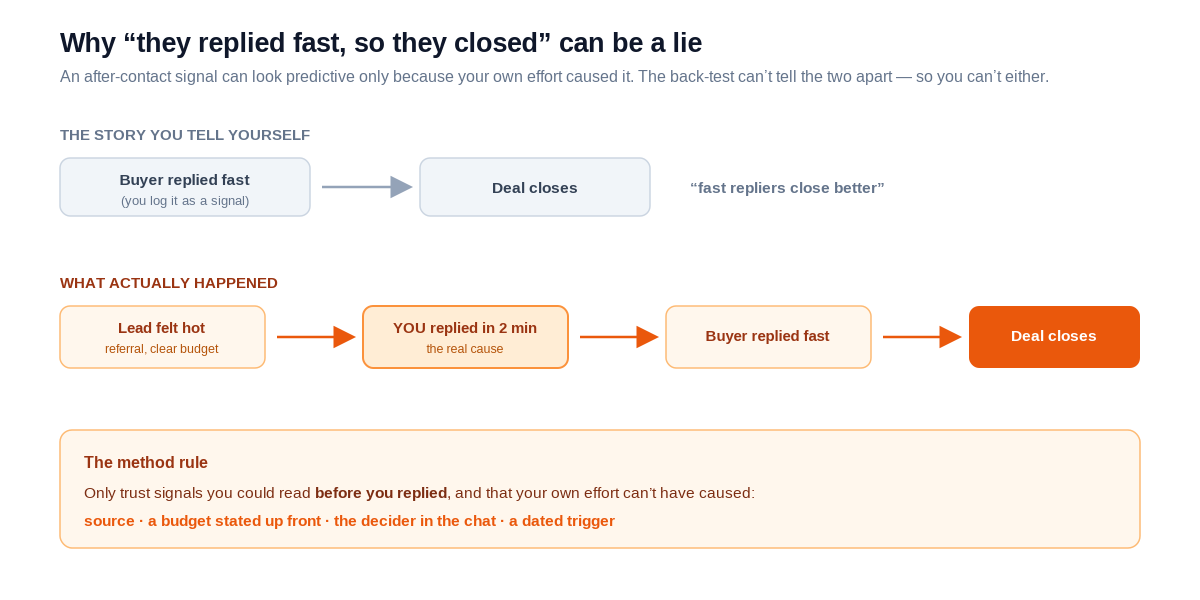
That gives you the sharpest rule in the method: trust the signals you could read before you lifted a finger. The source, a stated budget, the decider, a dated trigger — those were fixed before you did anything, so your behaviour can't have manufactured them. Anything that happens after your first reply is contaminated by how hard you tried, and your effort is not evenly spread — you try hardest on the leads that already looked good.
Your firm is too small for a "real" lead score — and that's fine
Be honest about the maths: a reno firm cannot build a statistically valid predictive score, so don't pretend to. This is where the people selling "AI-powered predictive lead scoring" to small firms are quietly overpromising, and where a bit of data literacy saves you money.
Look at how carefully conversion-rate analysts treat small samples. CXL's Peep Laja: "I typically ignore test results that have less than 250–350 conversions per variation." The popular "100 conversions is enough" rule is widely rejected — one optimisation lead warns that a 100-conversion result has a high chance of being a false positive. Now put a reno firm against that bar. At 3 to 5 won jobs a month, you'd take around two years to accumulate 100 wins, and far longer to split them across eight signals and get a stable read on each. You simply do not have the sample size to earn decimal-point weights.
Two more small-sample traps worth naming, because they quietly flip the result:
- The base-rate trap. If referrals are only 10% of your leads, you might have just two or three won referrals in the whole set. "100% of my referrals closed!" off three deals is a coin landing heads twice, not a law. Weigh a signal's gap against how many deals it's built on.
- Memory contamination. Score each lead from its actual first message in the chat, never from memory. Asked to recall a won job, you'll unconsciously remember it as warmer, clearer and more enthusiastic than it was — which would bake your bias straight back into the "audit." This is the same reason a weekly AI lead report invents trends from noise: at a reno firm's volume, most short-run swings are random, and a confident narrator makes them sound like findings.
The 30-second score you can actually trust
Once the audit has told you which three or four signals survive, the output is a score simple enough to run in your head before you reply. You don't need software to start — you need a scorecard short enough to be honest and a habit of applying it at capture. Here's the shape, using the signals that typically survive:
| Signal (read from the first message) | Point |
|---|---|
| Came from a referral or is a repeat client | +2 |
| States a budget or a clear band | +1 |
| The person messaging is the decider | +1 |
| Names a dated trigger (keys, loan, move-in, festive deadline) | +1 |
Four-plus is a fast-lane lead that earns a same-day call and a site visit; two to three earns a fast reply and hard qualifying before you drive anywhere; zero to one earns a quick, polite holding reply and a light touch or two — no Saturday site visit or custom 3D yet. Note what isn't on the card: enthusiasm, message length, how fast they replied. The audit earned them their place off it.
Where HotLead fits — and where it doesn't
Be precise about the boundary. HotLead does not run a predictive AI score or decide which signals matter for you — that judgement has to be yours, because only you know what a referral from your best client is worth, and because a bought-in score inherits the feedback-loop bias we've been warning about. What HotLead does is make the audit possible instead of theoretical:
- Capture and tag by source at the moment a lead lands — so the single strongest signal, where the lead came from, is recorded while you still know it, not reconstructed from memory a year later.
- One record per lead, first message and all — so when you reverse-audit your year, you're scoring the actual enquiry text, not a contaminated recollection.
- The funnel and per-channel view — so you can read the real close rate of each source and run the audit on clean data instead of guessing.
The reason most firms can't do this isn't that they disagree with it — it's that a shared WhatsApp number and a good memory can't tell a referral from a tyre-kicker once twenty enquiries are stacked up on a Monday, and by year's end the data you'd need is simply gone.
This sits inside the wider system — capture, qualify, score, quote, follow up. Start with the complete guide to managing renovation leads in Malaysia. The natural companions are the temperature scorecard this audit validates, the first-contact mode as another free pre-reply signal, qualifying in the first WhatsApp reply (the script that gathers the facts this scores), and Kai's experiment on AI-qualifying a messy enquiry. If you run a renovation firm or an interior-design studio, the audit is a one-afternoon job that can retire years of a lead-grading habit you never actually tested.
Sources: Back-test method (last 30–50 closed-won + a matched set of closed-lost/no-decision, validate that winners separate from losers, re-run quarterly) — Clay, How to build a lead scoring model; validating a score against closed-won/closed-lost analysis is also standard practice, e.g. The Pedowitz Group. Small-sample caution — CXL, Stopping A/B Tests: How Many Conversions Do I Need? (Peep Laja ignores results under 250–350 conversions per variation; Andrew Anderson on the false-positive risk of a 100-conversion result). Survivorship bias and confounding in sales data — HubSpot, Survivorship Bias (review Closed-Lost as closely as wins; a close-rate gain may come from several changes at once); the feedback loop in which worked/high-scored leads get more attention and so look more predictive is discussed in The Pedowitz Group, What biases exist in predictive revenue models. No-decision and happy-ears — Matthew Dixon & Ted McKenna, The JOLT Effect (2022), 2.5M+ recorded calls, 40–60% of losses ending in no decision. Referral vs cold close rates — Prospeo (25.6% vs ~9.4%) and webtonic (18.9% vs 0.9%). Behavioural scoring vs gut (39–40% vs 13%, roughly 3x) via Data-Mania. These are predominantly US and global sales datasets, so treat the exact numbers as directional shape, not reno-specific law — the robust pattern is that pre-contact structural signals predict and after-contact warmth mostly doesn't. The point-scorecard, the ~24-won/24-lost Klang Valley studio, the signal-gap figures and the 3–5 wins/month and ~7–8% close-rate house figures are illustrative; run the audit on your own closed deals and read back your real numbers.
Frequently asked questions
What is a lead-score reverse-audit?
It is scoring leads backwards — on deals whose outcome you already know. Instead of scoring new enquiries and waiting months to see if the score was right, you take your last 30 to 50 won jobs and a roughly equal set of lost or no-decision leads, score each one on the signals it carried in its first message, and then check which signals actually appeared more often in the won pile than the lost pile. A signal that shows up just as much in your losses as your wins is not predicting anything; a signal that is far more common in wins is a real one. It turns a lead score from a guess into something you have tested on your own history.
Can a small renovation firm really build a lead score with so few deals?
Not a precise, weighted one — and it is worth being honest about that. Conversion-rate testers routinely ignore results built on fewer than 250 to 350 outcomes, and even 100 outcomes carries a high chance of being a false positive. A reno or ID firm closing 3 to 5 jobs a month would take about two years to reach 100 wins. So you cannot compute trustworthy decimal weights for eight signals. What you can do is a directional cohort read — eyeball whether a signal is clearly more common in wins than losses — which is enough to delete one badly misleading signal or confirm one strong one. Treat it as a compass, not a calculator, and re-run it yearly.
Which lead signals actually predict a renovation sale?
Across the sales data, the signals that survive a back-test are the structural ones you can read before you reply — the source (a referral or repeat client closes several times higher than a cold ad), a budget stated up front, whether the person messaging is the decider, and a dated trigger like keys handing over or a loan approved. The signals that usually fail are the emotional ones — enthusiasm, emoji, a long chatty message, politeness. But the real answer is to test your own, because the exact gap depends on your pricing, your area and your channels. The method matters more than the league table.
Why shouldn't I just trust a lead-scoring template or an AI lead score?
Because a template's weights were tuned on someone else's customers, and an AI score bought off the shelf inherits the same problem plus a new one — it learns from the leads you actually worked, so a lead looks high-value partly because you gave it attention, not only because it was good. That feedback loop makes the model look more accurate than it is. On a pipeline as small as a reno firm's, a confident-looking predictive score is selling you precision the maths can't support. Validate a short, explainable scorecard on your own deals instead.
How often should I re-run the reverse-audit?
About once a year for a small firm, or after a real change in where your leads come from — a new Qanvast listing, a big shift in ad spend, dropping a channel. Running it more often than that just reads noise, because you won't have logged enough new wins between runs for the numbers to have meaningfully moved. The discipline that matters weekly is tagging every lead's source and signals at capture, so that when you do run the audit a year's worth of clean data is waiting.
Does HotLead score my leads for me?
No. HotLead does not run a predictive AI score or decide which signals matter — that judgement is yours, because only you know what a referral from your best client is worth. What it does is make the audit possible — it captures and tags every enquiry by source at the moment it lands, keeps the first message and signals on one record per lead instead of lost in the chat scroll, and shows you the real close rate per source in the funnel view — so when you sit down to reverse-audit your year, the data is there to read instead of gone.
Keep reading
- Can AI Reply to Your Renovation Firm's 1-Star Review? I Built It — and the Risk Is How Fast It ApologisesA 2-star review on Google or Qanvast is the first thing your next renovation lead reads — and most firms either ignore it or fire back and make it worse. The 2026 reflex is to let AI write the reply. I built it, and drafting a calm response costs a fraction of a sen. But an AI tuned to be helpful apologises too fast — it will concede a fault in writing, promise a refund that never happened, and grovel to a fake review from a competitor. Here's the build that protects your rank instead of torching it.
- The "I Only Deal With the Boss" Lead: When the Buyer Refuses Your TeamYou finally hired someone to share the load — then the buyer messages "can I deal with you direct ah, boss?" and refuses to engage your staff. Every big lead quietly re-centralises onto the one person already maxed out, and your firm can never grow past the owner. Here's why caving caps you, why a flat "my staff will assist" loses a nervous buyer, and the move that keeps both.
- Can AI Turn a Buyer's WhatsApp Voice Note Into a Renovation Lead You Can Skim? I Built It — and the Flaw Isn't the TranscriptA big slice of renovation enquiries in Malaysia arrive as a 2-minute WhatsApp voice note — rambling, code-switched, impossible to skim. The 2026 reflex is to let AI transcribe them so you can read instead of listen. I built it, and the transcription is cheap and genuinely useful. But the real mistake isn't the words AI gets wrong on Manglish audio — it's that transcribing a voice note quietly throws away the exact signal that made it your highest-intent lead. Here's the build that keeps both.