

A Klang Valley interior-design studio runs one Facebook campaign for a week. The same ad, the same budget, the same audience — but the enquiries arrive three different ways. One person taps "call" and a phone rings. A few others send a WhatsApp — one with a floor-plan photo and "about RM120k, moving in March." And a dozen leave a one-line Instagram DM: "berapa?"
The studio logs all of them as "leads" and treats them the same. That is the mistake. The caller and the "berapa?" DM came from one campaign, cost the same to generate — and are not worth anywhere near the same. The way a lead reaches you is a signal you get for free, before you have replied to anything. Most firms throw it away.
Does the way a lead first contacts you actually predict whether they'll buy?
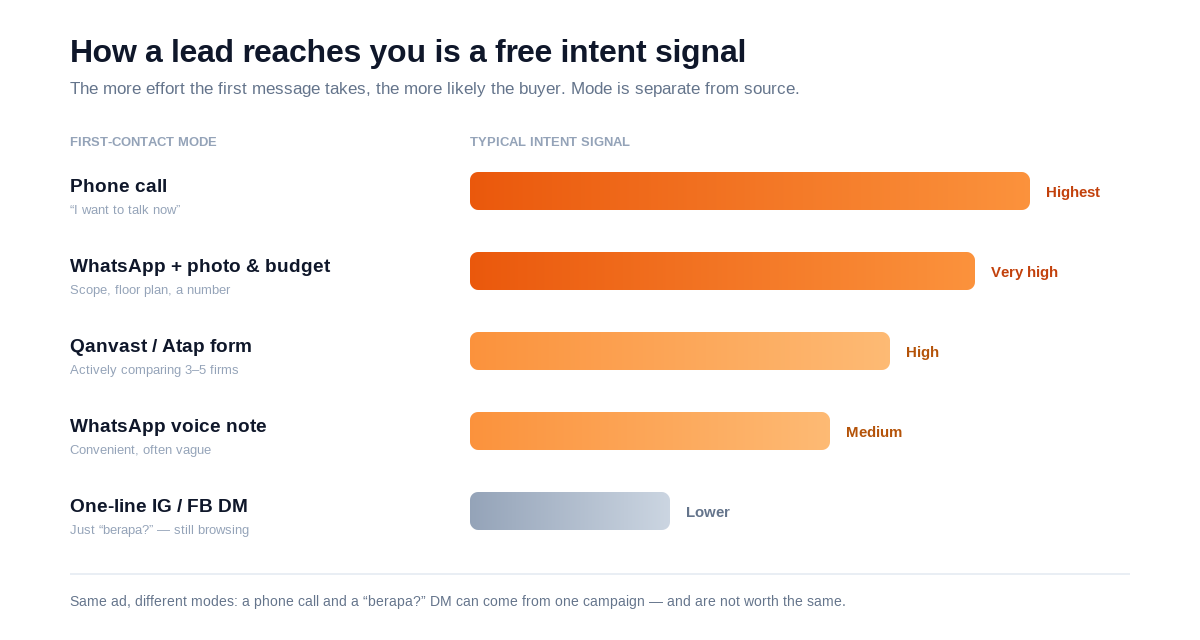
Yes — and it is one of the cheapest signals you own, because it costs you nothing to read. The mode a buyer picks encodes their effort and urgency. Picking up the phone and dialling is more work than tapping out "berapa?" — so the caller, on average, is further along. Effort predicts intent, and the mode is effort made visible.
The data backs the direction, even if you should be careful with the exact numbers. Invoca's 2026 benchmark, drawn from more than 70 million calls, found that about 42% of leads on answered calls convert on the call, while web and click-based conversion typically sits in the 2–5% range across most industries. Ruler Analytics puts the average web-form lead conversion even lower, around 1.7%. An auto-dealer dataset from 2025 found phone leads booking appointments at 74% versus 40% for internet leads. These are different businesses and mostly vendor-measured, so treat them as a direction, not a law — but the direction is consistent: the higher-effort mode converts better.
The five first-contact modes, compared
Here is how the five modes a Malaysian reno or ID firm actually sees stack up — what each signals, how fast it goes cold, and the move it calls for.
| Mode | What it signals | Perishability | Your move |
|---|---|---|---|
| Phone call | "I want to talk now" — highest urgency | Minutes — a missed call rings the next firm | Pick up. If you can't, call or WhatsApp back within minutes, not hours |
| WhatsApp + photo & budget | Serious, has done homework — the MY default | Hours — sits in the chat | Reply fast with a human line and one qualifying question |
| Qanvast / Atap form | Actively comparing 3–5 firms right now | Short — you share it, speed breaks the tie | Be first to reply; a listing fee is wasted if you are slow |
| WhatsApp voice note | Convenient, often vague, mid-urgency | Hours | Listen fully, reply in text with specifics to structure it |
| One-line DM ("berapa?") | Browsing, low effort, price-curious | Fickle — cheap to send, cheap to abandon | Warm reply, move to WhatsApp, qualify before investing real time |
The point of the table is not to rank buyers into "good" and "bad." A "berapa?" DM is still a lead worth a one-minute reply. The point is that your effort should match the mode's signal — and your speed should match how fast the mode rots.
Why the US "phone calls beat web forms" rule is only half-right in Malaysia
Because in Malaysia, WhatsApp has quietly collapsed the whole call-versus-form debate into one dominant mode. The American marketing literature argues endlessly about phone calls versus web forms, because those are the two doors on a typical US business. Here, about 92% of people use WhatsApp (We Are Social's 2025 ranking, which put Malaysia top in the region ahead of Indonesia at 91.3% and Singapore at 82.1%). DataReportal counts 34.9 million Malaysians online. So your dominant first-contact mode is neither a cold call nor a web form — it is a WhatsApp message, which happens to blend the immediacy of a call with the written trail of a form.
That changes what you watch. The real split for a Malaysian firm is not call-vs-form; it is the texture inside WhatsApp — a detailed message with a floor plan and a budget versus a one-word "berapa?" — plus the handful of non-WhatsApp modes (a genuine phone call, a Qanvast form, an Instagram DM). A click-to-WhatsApp ad usually beats a lead-form ad for exactly this reason: Meta's own Lamudi case study found running click-to-WhatsApp alongside lead ads lifted the submitted-conversion rate by about 8%, because it drops the buyer straight into a conversation instead of a form.
Which first-contact mode is the most perishable?
The phone call, by a distance — and this is the single most actionable thing mode tells you. A missed WhatsApp message sits patiently in your chat; you can reply at 9pm and still win the job. A missed call does not wait. CallRail's 2025 data found that of callers who can't get through, only about 42% leave a voicemail, around 24% give up and try chat, and 21% immediately ring another business. Invoca separately found that 44% of callers never reach a person at all. A caller who hits your voicemail is, more often than not, already dialling your competitor.
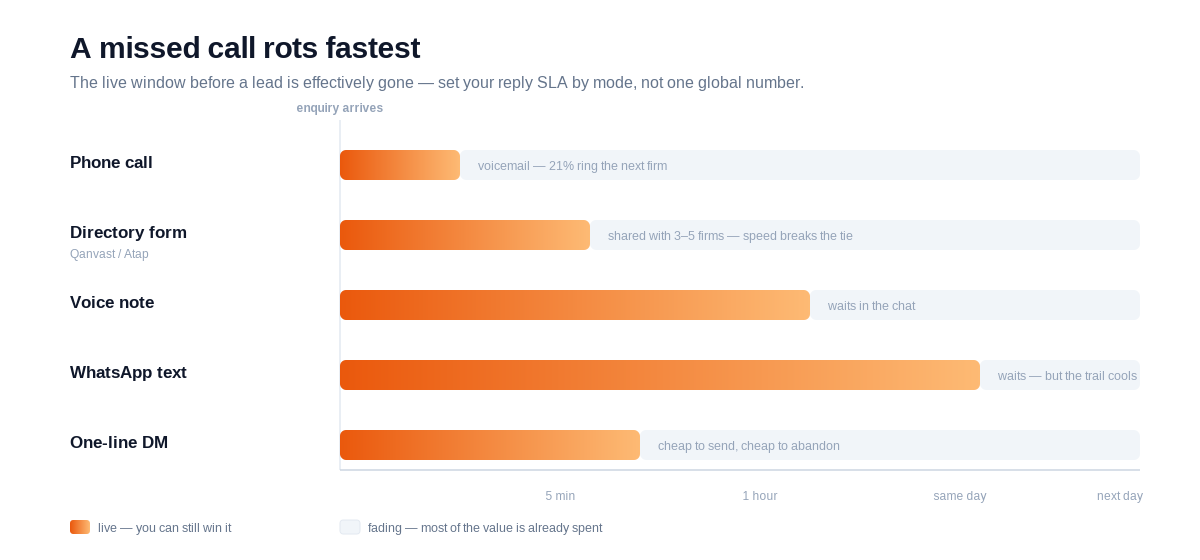
This is why a single blanket "reply within 5 minutes" rule is too blunt. The rule should bend by mode:
- Phone call — answer it, or the firm is bleeding its hottest, most perishable leads. If you genuinely can't pick up on site, a same-minute WhatsApp back ("Saw your missed call, in a meeting — can I help here?") rescues most of it.
- Qanvast / Atap form — nearly as urgent, because the platform handed the same enquiry to several firms and the first competent reply usually wins the shortlist. (More on that in directories vs social ads.)
- WhatsApp text and voice note — fast is still better, but these forgive you. The trail cools over hours, not minutes.
- One-line DM — reply warmly and quickly to look responsive in public, but don't drop a quote and don't over-invest until you've moved it to WhatsApp and qualified it.
The move that beats picking a "best" mode
You don't win by forcing every buyer into your preferred mode — you win by catching every mode on one list and reading the mode as a priority flag. Telling the market "WhatsApp us only" just means the caller and the DM-er leak. A buyer reaches out the way they want to, at the moment they are hottest; your job is to be reachable on all of them and to not lose the signal once it lands. (The capture side of this — leads landing on comments and personal DMs instead of your business line — is its own leak, covered in "Boss, berapa?" the lead on the wrong channel.)
This is where a system earns its keep. HotLead captures your WhatsApp, Facebook and Instagram enquiries into one sorted inbox, assigns each to a single owner, greets every new enquiry instantly so no mode sits unanswered, keeps the follow-ups on a next-action list, and shows you per source which channel actually sends buyers. It is honest about its limits — it does not answer your phone calls, so the call-back discipline stays human — but it makes sure the WhatsApp and DM modes, where the overwhelming majority of Malaysian enquiries land, never fall between the cracks. Read the mode to set your effort and your speed; let the system make sure nothing leaks while you do.
The mode is a free signal sitting on every enquiry before you have typed a word. Reading it is the difference between treating a caller and a "berapa?" scroller as the same lead — and spending your scarce reply time where it actually pays. For the next layer of free signals once the conversation starts, see grading leads hot, warm or cold, and for the speed side, how fast you should really reply. It all feeds the same renovation lead playbook — and matters most for renovation and interior-design firms, where one won job is worth thousands.
The Klang Valley studio above is an illustrative composite; the conversion figures are from the named sources, not from a single firm's books.
Frequently asked questions
Do phone-call leads really convert better than WhatsApp or form leads for a renovation firm?
On average, yes — but the reason is effort, not the channel itself. Someone who dials your number has done more work to reach you than someone who taps out "price?", so they are further along. Large call-tracking datasets show answered calls converting far above web forms (Invoca reports about 42% of leads on answered calls convert, versus 2–5% typical for web and click leads). The practical lesson is not "chase calls" — in Malaysia most enquiries arrive on WhatsApp anyway — it is "read the effort". A detailed WhatsApp with a floor plan and a budget carries the same high-effort signal as a call.
Should I put my phone number or a contact form on my renovation website?
Put both, and put your WhatsApp first. A form captures the lead who wants to think before they talk, and a phone number captures the one who wants to talk now — you want both doors open. But in Malaysia the highest-converting door is usually a click-to-WhatsApp button, because it removes the friction between interest and a real conversation while still leaving you a written trail. A bare phone number alone filters out the large share of buyers who would rather message than call.
A lead just sent "berapa?" as an Instagram DM. Is it worth chasing?
Yes, but cheaply, and do not treat it like a booked job. A one-line DM is the lowest-effort mode, so on average it converts worse than a detailed WhatsApp or a call — the person is still browsing. The right move is a warm, fast reply that moves the conversation to WhatsApp and asks one qualifying question (unit type, rough scope, timeline). That costs you a minute and tells you within one exchange whether this is a real buyer or a price-curious scroller. Reply to it, but spend your real time on the modes that signal more intent.
Does HotLead answer phone calls for me?
No. HotLead is built around your messaging — it captures enquiries from WhatsApp, Facebook and Instagram into one sorted inbox, assigns each to a single owner, greets new enquiries instantly, chases the follow-ups, and shows you per source which channel actually sends buyers. A phone call is not something HotLead answers, so the call-back discipline is yours — but HotLead makes sure the WhatsApp and DM modes, where most Malaysian enquiries land, never leak between the cracks.
What is the difference between a lead's source and its first-contact mode?
The source is where the lead came from — a Facebook ad, a Qanvast listing, a referral, a Google search. The mode is how they chose to reach out — a call, a WhatsApp text, a voice note, a DM or a form. They are different axes. One Facebook campaign can produce all five modes, and a referral can arrive as a call or a WhatsApp. Source tells you which marketing to fund; mode tells you, before you have typed a word back, how hot this particular enquiry probably is.
Keep reading
- Can AI Reply to Your Renovation Firm's 1-Star Review? I Built It — and the Risk Is How Fast It ApologisesA 2-star review on Google or Qanvast is the first thing your next renovation lead reads — and most firms either ignore it or fire back and make it worse. The 2026 reflex is to let AI write the reply. I built it, and drafting a calm response costs a fraction of a sen. But an AI tuned to be helpful apologises too fast — it will concede a fault in writing, promise a refund that never happened, and grovel to a fake review from a competitor. Here's the build that protects your rank instead of torching it.
- Which Lead Signals Actually Predict a Sale? Reverse-Audit Your Own Won JobsMost firms grade a renovation lead on signals that feel predictive — enthusiasm, a long message, a fast reply — and never check whether those signals actually separate won jobs from lost ones. Here is how to run a reverse-audit on your own closed deals, which signals usually survive it, and why your pipeline is too small to pretend the score is more than directional.
- The "I Only Deal With the Boss" Lead: When the Buyer Refuses Your TeamYou finally hired someone to share the load — then the buyer messages "can I deal with you direct ah, boss?" and refuses to engage your staff. Every big lead quietly re-centralises onto the one person already maxed out, and your firm can never grow past the owner. Here's why caving caps you, why a flat "my staff will assist" loses a nervous buyer, and the move that keeps both.