

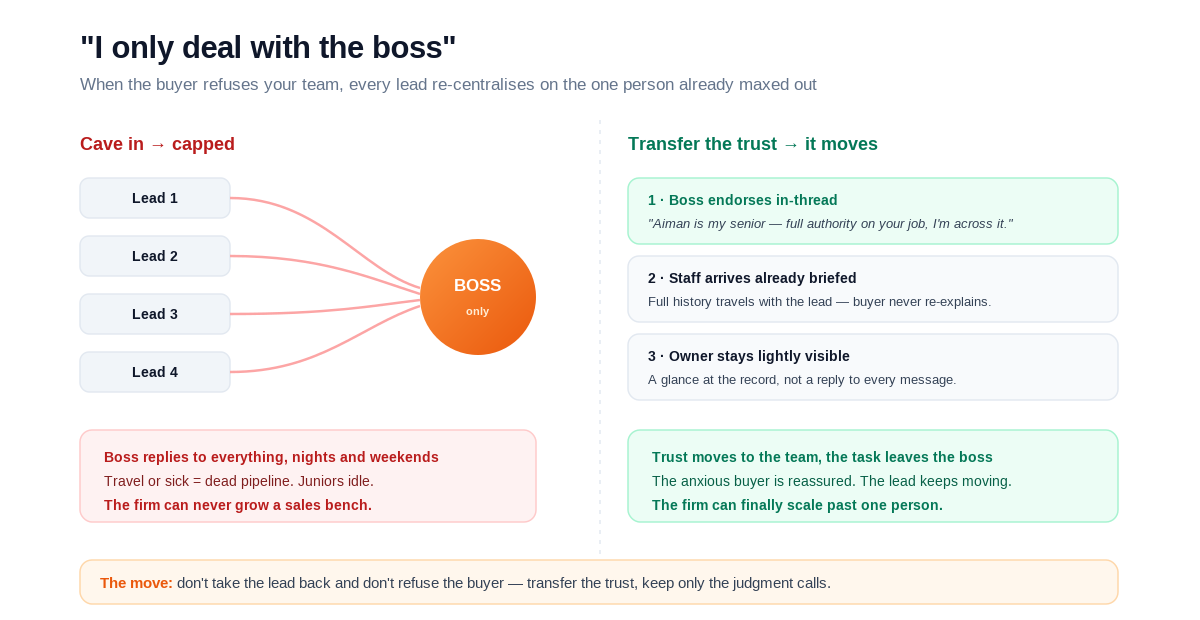
I watched a JB renovation firm nearly talk itself out of growing. The owner — call him Hakim — had finally done the hard thing: hired a senior PM, trained him for a year, trusted him with real jobs. The idea was simple. Hakim keeps the design and the pricing; Aiman carries the leads so the boss can breathe. For small enquiries it worked.
Then the big ones came in, and every one of them did the same thing. "Boss, can I deal with you direct ah? This is a big job, I prefer talk to the owner." And every time, Hakim caved — because it felt like good service, and because the buyer was clearly serious. Six months later he was more buried than before he hired anyone. Aiman was handling the RM30k jobs; Hakim had personally re-absorbed every RM120k one, replying at 11pm from his son's school concert, because the good leads all insisted on him.
That's the trap I want to pull apart here, because it's a different animal from the owner-operator bottleneck. There, the owner chooses to hold everything. Here, the owner tried to delegate — and the buyer dragged the lead back to him. It's a bottleneck imposed from the outside, and it's one of the sneakiest growth ceilings in Malaysian renovation.
What is the "I only deal with the boss" lead?
It's a buyer whose signals and decision-making are perfectly fine, but who refuses to engage anyone except the owner. They'll qualify well, they've got budget and intent — they just won't accept your sales or design staff as the person they talk to. So a firm that has done the right thing and built a team watches its biggest leads re-route, one by one, back onto the single person who's already the constraint.
It's worth being precise, because this gets confused with two other problems in the cluster:
- It is not the owner-operator bottleneck, where the cause is internal — the owner won't let go. Here the owner wants to let go; the buyer won't let them.
- It is not the multi-decision-maker lead, where the wrong person on the buyer's side is in your chat (a spouse messaging while the real budget-holder stays invisible). Here the right person is messaging and deciding — they simply demand the owner on your side.
Why do Malaysian reno buyers insist on the owner?
Mostly because it's rational risk-management on a scary purchase — not snobbery about your staff. A renovation is a large, upfront-payment spend in a market where people genuinely get burned, and dealing with the owner feels like the safest version of the deal. There are usually three reasons underneath it, and only one is really about your team:
- Fear of getting cheated. This is the big one, and it's earned. Works Minister Datuk Seri Alexander Nanta Linggi told Berita Harian that CIDB received 3,201 complaints about contractors doing house construction and renovation between 2018 and 2025, most of them breaches of contract. In one 2026 case alone, 18 victims reported losing close to RM1 million to an alleged renovation scam. When a buyer is about to wire you a five-figure deposit, "I want the boss" means I want the person whose name is on the firm and who pays the price if this goes wrong.
- The towkay reflex. In Malaysian SME culture the founder is the brand. On a relationship-driven, big-ringgit job, buyers want the owner's face and personal word — not because the staff are junior, but because the boss's reputation is the collateral. With 96.1% of Malaysian businesses being MSMEs (DOSM, via OECD), "deal with the boss" is a realistic ask — there usually is one owner, and buyers know it.
- A referral instruction. Half of these start with "my friend said just ask for Boss directly." The referrer handed over their own trust, and the buyer is simply following the map they were given.
Why do both instinctive moves lose?
Because one caps your firm and the other loses the buyer — and most owners oscillate between them. Here's the honest trade-off:
| The instinct | What it feels like | What it actually costs |
|---|---|---|
| Cave — "Ok, I'll handle you personally" | Great service, respecting a serious buyer | You train every buyer and referrer that the boss is the default. The firm is permanently capped at one person's hours; nights and weekends become dead pipeline; your staff stay idle and under-used. You can never grow a sales bench. |
| Refuse — "My staff will assist you" | Boundaries, "I've delegated this" | You lose a nervous buyer who had a real reason to hesitate. To someone who just read about an RM1m scam, a flat brush-off to a stranger reads as the owner can't be bothered with me — on the exact job where they most wanted reassurance. |
The reason caving is so seductive is that these are good leads. Nobody caves for a tyre-kicker. You cave for the serious RM120k buyer — which means the leads pulling you back under are precisely the ones you most want to win. That's how a firm ends up with a trained team and an owner who's still the bottleneck: not through weakness, but through winning the wrong way.
What's the move that keeps both the buyer and your growth?
Transfer the trust, not the task. The buyer isn't really asking you to do every reply — they're asking for the owner's assurance that this won't go wrong. You can give them that assurance and hand off the work, if you do it as a visible, warm endorsement instead of a silent reassignment. Three moves do it:
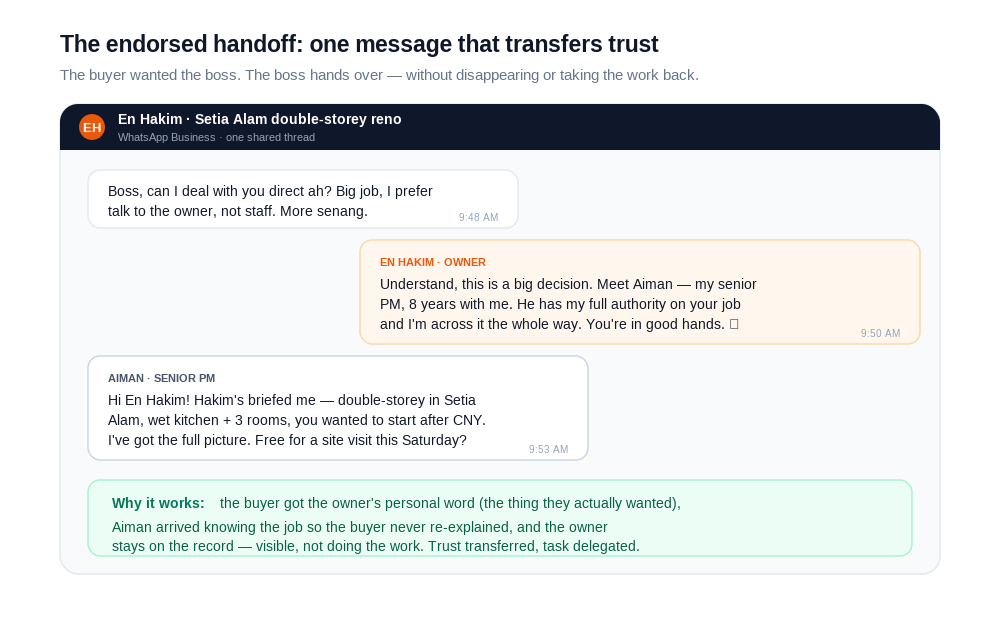
- The owner endorses a named person, in the same thread. Not "my staff will handle you" — a personal vouch with a name and a reason to trust: "Aiman is my senior PM, 8 years with me, he has my full authority on your project and I'm across it the whole way." You're spending your reputation deliberately, lending it to a specific human the buyer can now trust by proxy.
- The handed-off person arrives already briefed. This is the step everyone skips, and it's where handoffs die. If the buyer has to re-explain their double-storey, their wet kitchen, their post-CNY start date, the handoff feels like a demotion and they'll ask for the boss again. When your senior opens with "Hakim briefed me — Setia Alam double-storey, wet kitchen plus three rooms, you wanted to start after CNY", the buyer feels upgraded, not dumped. That only works if the full history actually travelled with the lead — which is a systems question, not a willpower one.
- The owner stays lightly visible. A glance at the record, an occasional "all good with Aiman?", your name still on the thread. The buyer needs to know you didn't vanish the second they agreed — you're overseeing, just not typing every message. You've transferred who does the work without transferring who's accountable.
Notice what the owner keeps: the price, the design direction, the final yes — the judgment calls that genuinely need you. What changes is that your endorsement, given once, lets a trained person carry the relationship, so the next big lead doesn't have to land back in your lap. Done consistently, "boss-only" buyers become some of your best repeat clients and referrers — because they got the owner's genuine care and a responsive team, not one at the expense of the other.
What if the endorsement doesn't work?
A few buyers will still insist, and that refusal is itself a signal worth reading — don't treat it as a failure. Sometimes a genuine "owner-only" hold means the job really is at the very top of your range and does warrant your hand on it; sometimes it's an early warning that this buyer will be high-maintenance all the way through. For the rare genuine case, you can personally hold the key moments — the first meeting, the final number — while your senior still does the legwork, the coordinating and the logging, so the lead never disappears into your memory the way it would have before.
But protect your default. The exception is one buyer; the rule is your whole firm's capacity. If every buyer gets the boss, you don't have a premium service — you have a growth ceiling with good manners. The firms that scale past the founder aren't the ones with a cleverer sales pitch. They're the ones that learned to lend the owner's trust to a name, instead of lending the owner's hours to everyone.
The bottom line
The "boss-only" lead is the bottleneck that survives hiring. It doesn't come from an owner who won't let go — it comes from a serious, scam-wary buyer who won't accept a stand-in on a big, scary spend, and it's rational: in a market with thousands of logged contractor complaints, wanting the person whose name is on the firm is just risk-management. Cave and you cap your firm forever. Refuse and you lose the buyer who most wanted reassuring. The way through is to transfer the trust and keep the task moving — endorse a named senior personally, make sure they arrive already knowing the job, and stay visible on the record while someone else does the work. You keep the decisions that need you. You just stop being the only door every big lead can walk through.
For the full system this sits inside — capture, speed, ownership, follow-up and funnel — start with the complete guide to managing renovation leads in Malaysia, and see the closely-related owner-operator bottleneck, the lead who can't say yes, and why leads die in the team group chat when nobody owns them.
How HotLead helps you transfer trust, not the task
HotLead sits on top of your existing WhatsApp — nothing changes for the homeowner — and makes the endorsed handoff actually work:
- A shared lead inbox with full history, so when you hand a buyer to a senior, the whole thread, quote and notes travel with the lead — they open it already knowing the job, and the buyer never has to re-explain.
- Assign one named owner by a rule — round-robin, manual, or your own rule — so the lead has a clear carrier the moment you endorse them, not a vague "someone will help you."
- Reassign in seconds for the rare genuine owner-only job, with the context intact, so holding a key moment yourself doesn't mean re-absorbing the whole relationship.
- Next action on every lead and overdue follow-ups flagged, so the handed-off lead keeps getting chased on schedule — the endorsement doesn't quietly go cold.
- A team view that shows whether your handed-off leads convert as well as your boss-held ones — so you can prove to yourself the firm is safe to grow past you.
If your best leads keep ending up back on your personal phone, the fix isn't working more hours — it's lending your trust to a name your buyer can rely on. See how HotLead works, or read how it fits a renovation firm or an interior-design studio specifically.
Sources: New Straits Times — "Nanta: Four strategies identified to tackle contractor fraud" (CIDB logged 3,201 complaints on house-construction and renovation contractors 2018–2025, most breaches of contract; breakdown to October 2025 — 130 contract breaches, 86 quality, 50 unregistered; Works Minister Datuk Seri Alexander Nanta Linggi, via Berita Harian, 17 Aug 2026); Business Today — "18 victims lose nearly RM1 million in alleged renovation contractor scam" (Aug 2026); OECD Economic Surveys: Malaysia 2024 — Making MSMEs an engine of growth (MSMEs 96.1% of business establishments, citing DOSM); follow-up and lost-lead figures as cited in the complete guide to managing renovation leads in Malaysia.
Frequently asked questions
Why do some renovation buyers insist on dealing only with the owner?
Usually it is risk-management, not snobbery. A renovation is a large, upfront-payment purchase in a market where people genuinely get burned — CIDB logged 3,201 complaints about house-construction and renovation contractors from 2018 to 2025, most of them breached contracts. When a buyer is about to hand over a five-figure deposit, dealing with the owner feels like the safest version of the deal — they want the person whose name is on the firm and who carries the consequences if it goes wrong. A referral may also have been told "ask for the boss directly." It is rarely a judgement on your staff; it is the buyer trying to lower their own risk on a scary spend.
Should I just handle these leads myself to keep the customer happy?
Only for the judgment calls that genuinely need you — not the whole relationship. The moment you reply "ok, I'll handle you personally" to every buyer who asks, you teach every future buyer and every referrer that the boss is the default, and you permanently cap your firm at one person's hours. You are back to being the bottleneck, now with idle staff you are paying. Keep the price, the design direction and the final yes. Hand off the catching, qualifying, site-visit coordinating and chasing — with your personal endorsement, so the buyer still feels the owner's hand on the job.
How do I hand a "boss-only" buyer to my staff without losing them?
Transfer the trust before you transfer the task, and do it in the same thread where the buyer asked. Send one short message personally vouching for a named senior — "Aiman is my senior PM, he has my full authority on your project and I'm across it the whole way." Make sure that senior arrives already briefed on the job so the buyer never has to re-explain themselves, which is the moment most handoffs feel like a demotion. Then stay lightly visible — a glance at the record, the occasional "all good?" — so the buyer knows you haven't disappeared. You are endorsing a person, not fobbing them off.
Isn't wanting to talk to the owner a good sign — a serious buyer?
Often yes, which is exactly why you can't just refuse them. A buyer who wants the owner on a big job is usually high-intent and high-trust-seeking — the kind that becomes a repeat client and a referrer if handled well. That is exactly the trap — because these are good leads, caving feels justified, and over time they quietly become the leads that keep you chained to your phone. The skill is to honour the seriousness of the buyer (give them the owner's genuine word and oversight) without making yourself the one who does every reply.
What if the buyer still refuses to deal with my staff after I've endorsed them?
A small number will, and that is a real signal worth reading — sometimes it means the job is genuinely at the top of your range and does warrant the owner, sometimes it means the buyer will be high-maintenance throughout. For the rare genuine "owner-only" job, you can personally hold the key moments while your senior still does the legwork and logging, so it never vanishes into your memory. But don't let the exception set your default. If every buyer gets the boss, you don't have a service standard — you have a growth ceiling.
Keep reading
- Can AI Reply to Your Renovation Firm's 1-Star Review? I Built It — and the Risk Is How Fast It ApologisesA 2-star review on Google or Qanvast is the first thing your next renovation lead reads — and most firms either ignore it or fire back and make it worse. The 2026 reflex is to let AI write the reply. I built it, and drafting a calm response costs a fraction of a sen. But an AI tuned to be helpful apologises too fast — it will concede a fault in writing, promise a refund that never happened, and grovel to a fake review from a competitor. Here's the build that protects your rank instead of torching it.
- Which Lead Signals Actually Predict a Sale? Reverse-Audit Your Own Won JobsMost firms grade a renovation lead on signals that feel predictive — enthusiasm, a long message, a fast reply — and never check whether those signals actually separate won jobs from lost ones. Here is how to run a reverse-audit on your own closed deals, which signals usually survive it, and why your pipeline is too small to pretend the score is more than directional.
- Can AI Turn a Buyer's WhatsApp Voice Note Into a Renovation Lead You Can Skim? I Built It — and the Flaw Isn't the TranscriptA big slice of renovation enquiries in Malaysia arrive as a 2-minute WhatsApp voice note — rambling, code-switched, impossible to skim. The 2026 reflex is to let AI transcribe them so you can read instead of listen. I built it, and the transcription is cheap and genuinely useful. But the real mistake isn't the words AI gets wrong on Manglish audio — it's that transcribing a voice note quietly throws away the exact signal that made it your highest-intent lead. Here's the build that keeps both.