

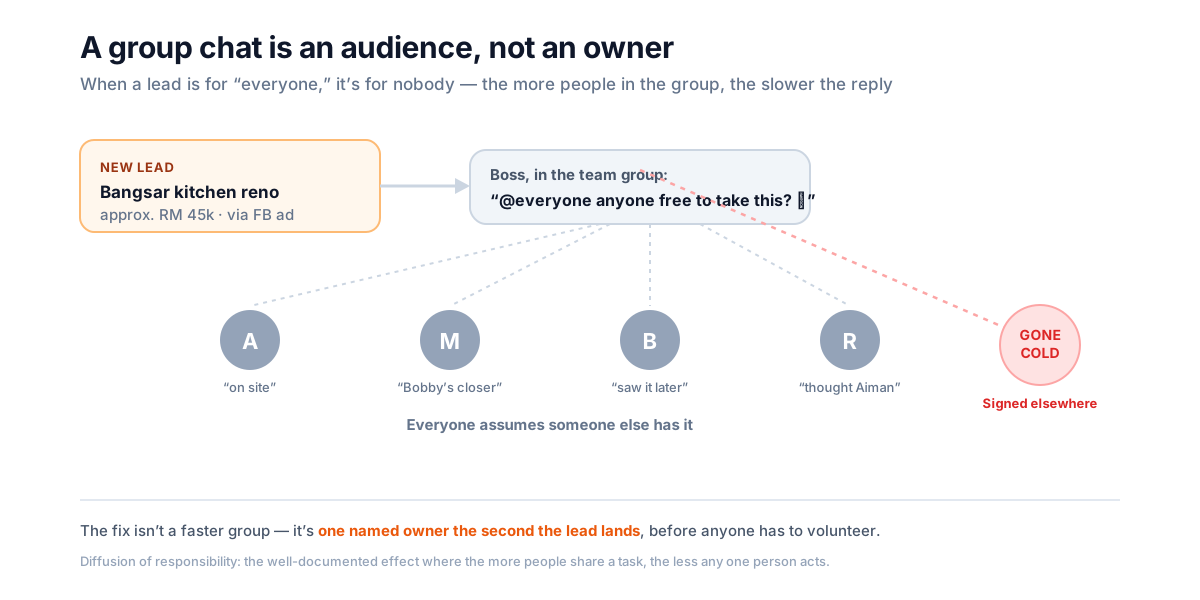
It's 9pm and a renovation firm owner in PJ forwards a fresh enquiry into the team WhatsApp group: "@everyone anyone free to take this Bangsar kitchen reno? 🙏" Three blue ticks. No reply. One salesperson is on a site visit, one assumes the closer will grab it, one sees it the next morning under forty other messages and scrolls past. By Thursday the homeowner has signed with a competitor who simply replied.
If that scene feels familiar, here's the uncomfortable part: the group chat you set up to stop losing leads is one of the reasons you're losing them. A lead posted to "everyone" is owned by nobody.
Why do renovation leads get lost in a team WhatsApp group?
Because in a group chat, seeing a lead and owning it are two different things. When a task belongs to a group, each person quietly assumes a colleague will handle it — so the reply is slow, or never comes at all.
This isn't your team being lazy. It's a well-documented behaviour psychologists call diffusion of responsibility (the same effect behind the "bystander" problem): the more people who share a task, the less likely any single one acts, because the felt obligation is split across everyone. A lead dropped into a five-person group lands on five people who each feel one-fifth responsible — which in practice rounds down to zero.
WhatsApp makes it worse by design. It was built for chatting, not for running a pipeline. The enquiry scrolls up the screen under supplier photos, site updates and "ok noted" — and nothing ever surfaces it again. There's no owner, no status, no reminder. The lead doesn't get rejected; it just gets buried.
Isn't a team group chat better than a shared customer number?
It's a different problem, not a smaller one. Most reno firms graduate from one shared customer-facing WhatsApp number — which causes double-replies and "I thought you got it" gaps — to an internal ops group where the boss forwards leads. That feels like progress. In reality it just moves the same "no clear owner" leak inside the team.
The two setups fail for the identical reason: responsibility is diffuse. On a shared customer number nobody knows whose lead it is on the customer's side. In a team group, nobody knows whose lead it is on your side. Same leak, different room.
"But someone said they'd take it" — the claimed-but-forgotten leak
Even when a teammate does reply "I got this 👍", you're not safe. Claiming a lead in the chat and actually following it up are not the same thing — and the gap between them is a second, hidden leak.
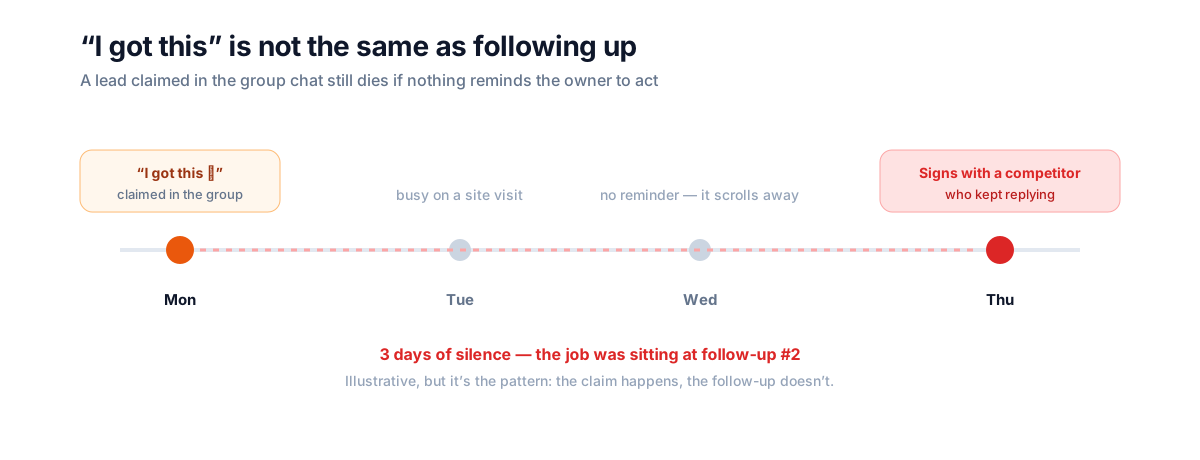
The salesperson genuinely meant to follow up. Then a site visit ran long, the chat scrolled away, and nothing — no next-action date, no overdue flag — ever put that lead back in front of them. The job was quietly sitting at follow-up #2 when the homeowner gave up waiting. The renovation job is usually won at the fifth or later touch; a single "I got this" rarely gets there on memory alone.
The cruel bit: in the group chat this looks handled. There's a message saying so. You won't discover it wasn't until you ask weeks later and hear "oh, that one went cold."
Group-chat handoff vs one assigned owner
Here's the same enquiry, run two ways. The difference isn't effort — it's whether the lead ever had a name on it.
| What happens | Posted to the team group | Assigned to one owner |
|---|---|---|
| Who's responsible | "Whoever's free" — i.e. nobody | One named person, instantly |
| After-hours lead (11pm, Sunday) | Sits unseen till someone scrolls back | Assigned + acknowledged, ready for morning |
| If the owner is on-site | Lead waits for a volunteer that never comes | Reassign in a tap, or auto-move when it goes quiet |
| Follow-up #2 to #5 | Relies on memory; scrolls away | Surfaced by a next-action date and overdue flag |
| Can you see what's stuck | No — it's buried in chat | Yes — every lead has a status |
| What it feels like to the owner | "I thought you got it" | "That one's mine, due Thursday" |
How do you assign leads on a small team without the scramble?
Stop asking who's free. Decide in advance, then let a rule do the assigning the second a lead lands — so there's never a moment where the lead is sitting in limbo waiting for a volunteer.
- Pick an assignment rule. Round-robin is the simplest (leads rotate evenly). Or assign by area — Johor enquiries to the JB closer, Klang Valley to the KL team — or by job type (kitchens to one specialist, full-home to another). The rule matters less than the principle: one lead, one name, immediately.
- Make it instant and automatic. The assignment should happen when the enquiry arrives, not when someone next checks the group. Speed is decisive — the 5-minute reply window is long gone by the time a volunteer steps up.
- Cover after-hours. Most reno enquiries don't arrive at 10am on a Tuesday. A lead that lands at 11pm or on a Sunday still needs an owner waiting for it on Monday — not a cold scroll-back through the weekend's chat.
- Add a reassignment rule. If the assigned owner goes quiet on a lead for, say, 24 hours, it moves to someone else automatically. Ownership without a safety net just relocates the leak from the group to one person's forgotten to-do.
- Put the next action on the lead, not in someone's head. A claimed lead needs a due date and an overdue flag, so follow-up #5 actually gets sent. Memory doesn't scale past a handful of leads.
How HotLead kills the group-chat scramble
HotLead sits as a light layer on top of the WhatsApp your customers already use — no app to install, no number to change. The moment a lead lands, lead routing gives it one owner instantly — round-robin or manual out of the box, plus custom rules (by area or job type) we configure during onboarding — and it's working-hours aware, so an 11pm enquiry is assigned and acknowledged for the morning instead of buried. An auto-greeting goes out the second a lead is assigned, so the customer isn't left waiting while your team decides who's free.
After that, next-action dates and overdue flags keep follow-up #2 to #5 in front of the owner — no more claimed-but-forgotten. You can reassign any lead in a tap if the owner's on-site, and the team view shows reply time and outcome per person, so the leaks stop being a feeling and become a number.
This is one piece of the bigger picture. If you run a reno firm, start with the renovation lead-management hub; to see who's actually letting leads cool once they're owned, read how to tell which salesperson is dropping your leads; and for the full system, the complete guide to managing renovation leads in Malaysia.
Sources: WhatsApp penetration in Malaysia from DataReportal — Digital 2025: Malaysia (WhatsApp reaches ~90.7% of internet users aged 16–64; ~80% messaging-app share). Lead-response data: MIT / Dr. James Oldroyd study via Harvard Business Review, "The Short Life of Online Sales Leads" (5-minute reply window → ~100× to connect). Diffusion of responsibility is a long-established finding in social psychology (Darley & Latané). Named studio scenario and the timeline are illustrative; the shape is the one we see repeatedly. See the complete guide for full context.
Frequently asked questions
Should I forward new leads into a team WhatsApp group?
For coordinating, fine. As your assignment system, no. A lead posted to a group has no single owner — everyone assumes a colleague will take it, so the reply is slow or never comes. Assign each new enquiry to one named person the moment it arrives, instead of asking who's free.
Why do leads get lost in a team group chat even when everyone sees them?
Because seeing a lead and owning it are different things. When a task is shared by a group, each person assumes someone else will act — a well-documented effect called diffusion of responsibility. The bigger the group, the slower anyone moves. The lead scrolls away under other messages and no reminder ever brings it back.
How should a small renovation team assign leads without a group-chat scramble?
Pick a rule and apply it automatically the second a lead lands — round-robin, by area (JB vs Klang Valley), or by job type. One lead, one name, instantly. Add an after-hours rule so 11pm enquiries still get an owner by morning, and a reassignment rule so a lead an owner ignores moves on instead of dying.
Isn't a team group chat better than sharing one customer-facing WhatsApp number?
It's a different problem, not a smaller one. A shared customer number causes double-replies and no owner on the customer's side; an internal group chat moves that same "no clear owner" gap inside your team. Both leak for the same reason — responsibility is diffuse. The fix for both is one named owner per lead, assigned by a rule.
Keep reading
- How Much Cash Does a Renovation Firm Actually Need to Run?A renovation firm can be profitable, fully booked, and still run out of money — because every live job ties up your own cash between the deposit and the final payment, and that buffer grows every time you win more work. Here's how to size the working-capital cushion a Malaysian reno firm needs with real numbers, why growth consumes cash faster than it makes it, and why the size of your buffer quietly decides how many leads you can afford to say yes to.
- The Copy-Paste Quote Request: Telling a Real Shortlist Buyer From a Price-Harvester Blasting Ten FirmsAn identical, detailed WhatsApp lands in ten contractors' inboxes at once — "please quote for full renovation" with a copy-pasted brief. It looks like the best kind of lead — specific, thorough, ready. So you spend a Sunday building a full itemised quote, and never hear back. Here's why a detailed brief blasted to ten firms is not a serious buyer, how to tell a genuine shortlist buyer from a price-harvester or a bank-loan document-seeker, and how to give a fast, useful ballpark that protects your estimating hours without looking unhelpful.
- Handing Over a Warm Renovation Lead: Can AI Catch the Next Person Up on a 40-Message Thread Without Dropping the Promise That Wins the Job?A renovation lead starts, goes quiet for six weeks on the buyer's loan-and-keys clock, then comes back — or the person who owned it goes on Raya leave and someone else picks it up cold. Now they have to scroll forty messages to reconstruct what was quoted, promised and left open. So the reflex is to ask AI to "catch me up on this buyer." I tried it. Summarising a long thread is the job AI is genuinely best at — but the reflex build drops the one thing that wins the job. Here's the version that actually paid.