

Ask a renovation-firm owner how their sales are doing and you will get a conversion number: "we close about one in ten." Ask how long those deals take — the median days from the first WhatsApp enquiry to a signed deposit — and most owners have no idea. That second number is the one they are missing, and it quietly decides their cashflow, their follow-up discipline, and whether they can tell a dead deal from a live one.
Across the home-improvement industry the sales cycle has roughly doubled — from about 30 days to 60 days or more — and a financed Malaysian renovation runs longer still, because the buyer's half of the cycle includes loan approval and getting the keys at vacant possession. This article puts a realistic number on how long a reno deal should take, explains why the popular advice to "shorten your sales cycle" is half-wrong for a high-ticket job, and shows how deal age turns into a diagnostic once you know your own baseline.
What is a renovation sales cycle — and why measure time, not just conversion?
The sales cycle is the elapsed time from a lead's first genuine contact to a closed deal — for a reno firm, from the first WhatsApp enquiry to the signed deposit. Conversion rate tells you how many leads close; cycle length tells you how long they take — and you need both, because they answer different questions. Conversion tells you if your funnel works. Cycle length tells you when the money lands and whether a quiet deal is a problem.
The reason time deserves equal billing is that it is a real lever on revenue, not a footnote. The standard sales-velocity formula makes this explicit:
That formula is why "just improve your conversion rate" is incomplete advice. Two firms with an identical 10% close rate and identical job sizes can earn very different money if one takes 30 days to close and the other takes 90 — the faster firm's pipeline simply produces more revenue per day. Cycle length is doing real work in your business whether or not you are looking at it. Most reno owners are not looking at it.
How long should a renovation deal take in Malaysia?
There is no single number, because it depends almost entirely on job size and whether the buyer is financing. A small, cash-funded job can close in a couple of weeks; a large, financed renovation can take a couple of months — and most of that difference is the buyer's clock, not yours. Here is a realistic breakdown of where the time goes:
| Stage | What is happening | Typical elapsed time | Whose clock |
|---|---|---|---|
| Enquiry → first reply | You respond to the WhatsApp | Minutes to hours | Yours |
| First reply → qualified | Back-and-forth on scope, budget, ownership | 1–3 days | Shared |
| Qualified → site visit | Schedule and travel to measure | 3–10 days | Yours |
| Site visit → quote sent | Measure, cost, prepare the proposal | 3–14 days | Yours |
| Quote → decision | Buyer compares 3–5 firms, discusses at home | 2–8 weeks | Buyer's |
| Decision → signed deposit | Loan approval, keys at VP, arranging funds | 1–8 weeks | Buyer's |
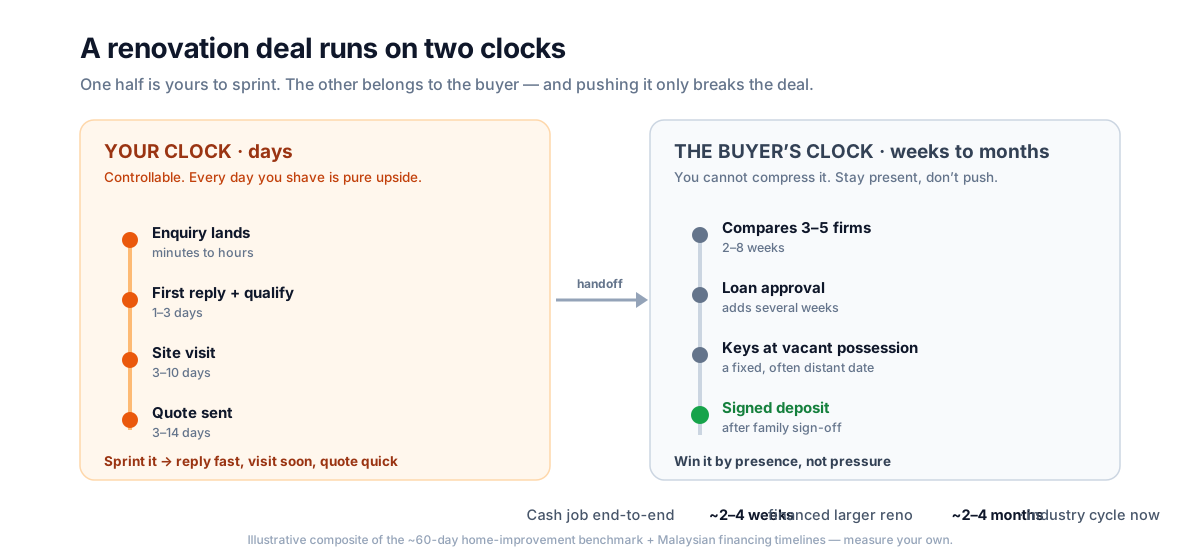
Read the "whose clock" column and a pattern jumps out: the first four stages are almost entirely yours to control, and the last two — which are also the longest — belong to the buyer. That split is the whole story, and it is where the standard advice goes wrong.
Why does a Malaysian reno take longer than the global benchmark?
Because the buyer's half of the cycle is loaded with local, dated events that a generic benchmark never sees. The roughly 60-day home-improvement cycle is a useful starting point, but three Malaysian realities push a financed reno past it:
- Home-loan approval adds weeks. Many reno buyers finance the work. A Malaysian housing loan runs through pre-approval (about 1–2 weeks), application (about 1–2 weeks) and approval (about 2–4 weeks); the Association of Banks in Malaysia notes commercial banks take an average of 2 to 9 working days just to process a complete application, and disbursement can trail by months. That is weeks of the buyer's clock you cannot touch.
- Vacant possession — the keys. A renovation on a newly-bought property cannot begin until the owner takes vacant possession. The enquiry often lands months before the keys do, so the deal is real but dated to a handover date the buyer is waiting on, not stalling.
- The festive freeze and the family vote. Decisions pause around Chinese New Year and Hari Raya, and a household renovation is usually a joint decision, not one person's — a spouse, sometimes parents. Both stretch the "quote → decision" window.
This is also why buyers now arrive later in their own journey than they used to. improveit360's 2026 homeowner research finds buyers are quietly researching, comparing credentials and reading reviews for weeks or months before they ever message a contractor — and that 72% would pay up to 10% more for a firm with a stronger reputation. The considered, slow-burn cycle is not a bug in your sales process; it is how a high-ticket home decision is made now.
Should you try to shorten the cycle?
Only the half you control — and this is the contrarian point. Search "shorten your sales cycle" and you will find dozens of tactics borrowed from software sales: create urgency, streamline meetings, push for the close. Pro Remodeler's own guidance on the doubled cycle leans this way — tighten meetings, set time goals, tell prospects your schedule is filling. Some of that is genuinely good, and all of it applies to your clock. None of it should be aimed at the buyer's clock.
You cannot rush a bank's loan approval. You cannot move a vacant-possession date. You cannot make a couple decide on an RM80,000 commitment faster than they are comfortable with — and if you try, the pressure reads as desperation and costs you the trust that a considered purchase runs on. So the two halves demand opposite behaviour:
- Your clock — sprint it. Reply in minutes, not next morning. Schedule the site visit inside days. Turn the quote around in a few days, not two weeks. Every day you shave here is pure upside with zero downside, and it is where "speed to lead" genuinely pays.
- The buyer's clock — do not sprint it; stay present through it. You win a long decision not by rushing it but by being the firm that is still helpfully in touch when the buyer is finally ready — the one whose follow-up adds a new reason each time instead of nagging.
Come back to the velocity formula with this lens and it clarifies your options. Since you cannot safely cut cycle length on the buyer's side, your levers for more revenue-per-day are the other three terms — win rate and deal size — plus cutting the delay on your half. Trying to force the denominator down on the buyer's side does not speed up revenue; it destroys win rate, which is the term that actually matters.
What is the real payoff of measuring cycle time?
A baseline — and a baseline is what turns deal age from a number into a diagnostic. This is the practical reason to measure, and it is worth more than the vanity of knowing your average. Once you know your normal median cycle, you can finally tell a stalled deal from one that is simply taking its natural course — the single hardest judgement call in a slow-burn sales process.
Without a baseline, every quiet deal looks the same, and you make one of two expensive mistakes: you chase live, marinating deals too hard and annoy good buyers, or you write off deals as dead the moment they go quiet and lose ones that were only waiting on a loan. With a baseline, the picture is clear:
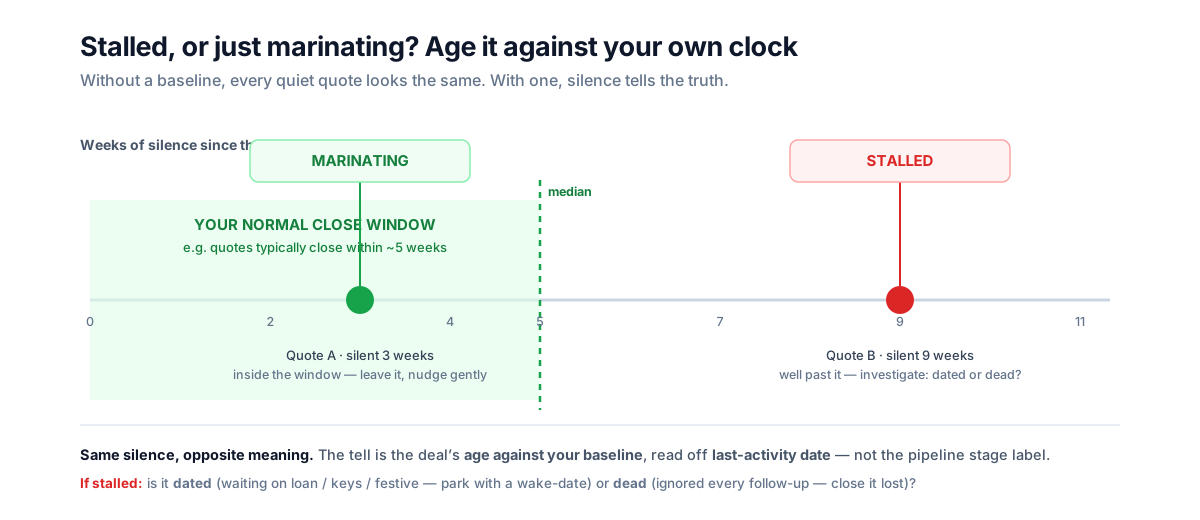
The signal is silence measured against your own clock, and the tool is last-activity date, not stage label. A deal with no genuine two-way contact for two to three weeks early on, or six-plus weeks after a quote, is inactive whatever the pipeline column says. B2B pipeline research is blunt about what dragging does: opportunities that move quickly carry roughly a 47% win rate, falling to 20% or less once they stall (widely cited from Outreach's pipeline data). Treat the exact figures as direction — they come from software sales — but the direction holds for renovation, with one local twist: a stalled reno deal is usually dated, not dead. Split them, and act differently:
- Marinating (inside your normal window, still occasionally replying) — leave it alone or nudge gently; pressure here loses it.
- Dated stall (past your window, but waiting on a known event — loan, keys, festive) — park it with a wake-date so it stops distorting this month's forecast but is not lost.
- Dead stall (well past your window, ignored every follow-up, no reason) — close it lost with a reason, so your close-rate and your cycle stats stay honest.
Beyond spotting stalls, a known cycle length gives you two more things owners badly need. It lets you forecast cashflow — if your median financed job closes in ten weeks, this month's serious enquiries are roughly this quarter's revenue, not this month's. And it lets you set follow-up cadence to the cycle instead of a generic drip — a deal on a three-month buyer's clock needs a different rhythm than one closing in a fortnight.
How do you measure a cycle you cannot currently see?
You need three timestamps on every lead, kept automatically: when it arrived, when it last had genuine activity, and when it closed (won or lost). From those three you get everything above — median cycle length by source, each deal's age against that median, and an honest read on what is marinating versus stalled. The math is trivial; capturing the timestamps reliably is the hard part, and a shared WhatsApp number plus a spreadsheet stops capturing them in exactly the busy months that matter.
That is not a discipline problem you can scold away. The spreadsheet only stays accurate if a busy salesperson updates it religiously, and the timestamps — first contact, last activity, close date — are the very fields that get skipped when leads are pouring in. Without an arrival time you cannot measure cycle length; without a last-activity time you cannot spot a stall; without a close date you never learn your own baseline. So the number you most need in order to run a calm, well-timed follow-up is the one your current setup is worst at giving you. It is the same blind spot behind why a lost lead feels free but is not and why your pipeline total is a fantasy until you age it.
How HotLead makes your cycle time visible
HotLead is built for Malaysian renovation, interior-design and construction firms, on top of the WhatsApp you already use, and it captures the timestamps this whole diagnostic depends on without anyone re-typing them:
- Every lead is time-stamped on arrival and staged — new, contacted, appointment, quoted, won or lost, with full history — so cycle length from first enquiry to signed deposit becomes a number you can actually read, not a guess.
- Next-action and overdue flags on every lead — so a quote that has gone silent past your normal window surfaces on its own instead of hiding in the pile, ready to be judged dated or dead.
- The funnel and per-channel view — so you can see cycle length and close rate by source, and set follow-up rhythm to the real clock each lead is on.
Start with the complete guide to managing renovation leads in Malaysia, then read what your pipeline is actually worth, the stage-by-stage conversion benchmarks or how response time bends your close rate — or see the renovation, interior-design and construction playbooks.
Sources: the home-improvement sales cycle stretching from 30 days to 60-plus, analysis paralysis, and the fast/normal/slow client split — Pro Remodeler, "Shortening the Sales Cycle". The sales-velocity formula (opportunities × deal size × win rate ÷ cycle length = revenue per day) and the definition of sales-cycle length as time from first meaningful contact to closed deal — Outreach, "Sales velocity formula", HubSpot, "Sales Velocity", monday.com, "What Is Sales Velocity?". Malaysian home-loan timelines (pre-approval, application and approval stages, ~2–9 working days to process a complete application, disbursement trailing by months) — RinggitPlus, "Your First Home Loan", Association of Banks in Malaysia, Maybank home-loan FAQs. Homeowners researching for weeks or months before contacting a contractor and 72% willing to pay up to 10% more for a stronger reputation — improveit360, "Major Shifts in How Homeowners Choose Contractors". The 6-to-18-month new-home and remodeling relationship — Builder Lead Converter, "The 5 Stages of the New Home and Remodeling Purchase Process". Deal-ageing win rates (47% for fast-moving deals vs ~20% once they drag) — Outreach pipeline data via Outreach. Malaysian job values (condo ~RM40k–150k, terrace ~RM60k–250k), ~7–8% blended conversion and the ~RM1,280 expected gross profit per enquiry are the house figures from the cost-of-a-lost-lead and funnel-benchmark pieces. The stage-duration ranges in this article are illustrative composites of the industry cycle benchmark and typical Malaysian financing timelines — measure your own first-contact, last-activity and close dates for your real number.
Frequently asked questions
How long does it take to close a renovation lead in Malaysia?
There is no single number, because it depends on job size and financing. A small cash-funded job — a condo touch-up or a single room — can close in about two to four weeks. A larger renovation that the homeowner is financing runs far longer, commonly two to four months, because the buyer's clock includes comparing three to five firms and then waiting on home-loan approval, which by itself adds several weeks. As a benchmark, the home-improvement sales cycle across the industry has stretched from roughly 30 days to 60-plus. The useful move is to measure your own median time from first enquiry to signed deposit and use that as your baseline, rather than chase a generic figure.
What is sales velocity and why does it matter for a renovation firm?
Sales velocity is a standard formula — number of opportunities, times average deal size, times win rate, divided by sales-cycle length in days — and it tells you how much revenue your pipeline produces per day. It matters because it shows cycle length is a real lever on revenue, not just an afterthought behind conversion rate. But for a high-ticket renovation the honest reading is that you cannot safely pull the cycle-length lever on the buyer's side — you cannot rush loan approval or a vacant-possession date — so your velocity gains have to come from lifting win rate and from cutting your own delays, never from pressuring the buyer to decide faster.
Should I try to shorten my renovation sales cycle?
Only the half you control. A renovation cycle splits into your clock — how fast you reply, schedule the site visit and turn around the quote — and the buyer's clock — comparing firms, arranging financing, waiting for keys, getting family sign-off. Compressing your half is pure upside and you should attack it. Compressing the buyer's half by pushing for a signature before they are ready backfires, because a renovation is a considered high-ticket purchase and pressure reads as desperation. The winning move on the buyer's half is not speed but presence — stay useful and in touch through a long decision so you are the firm still standing when they are ready.
How do I know if a renovation deal has stalled or is just taking its normal time?
You compare the deal's age against your own normal cycle, which is exactly why measuring cycle time matters. If your quotes typically close within about five weeks and a particular quote has now sat silent for eight or nine with no reply to any follow-up, that is a stall, not marinating. Without a baseline you cannot tell the two apart, so you either chase live deals too hard or write off good ones too early. Use last-activity date, not stage label — a deal with no genuine two-way contact for two to three weeks early on, or six-plus weeks after a quote, is inactive whatever the pipeline says.
Why does a Malaysian renovation take longer to close than the global benchmark?
Because the buyer's half of the cycle is loaded with local, dated events. Many homeowners finance the work, and a Malaysian home loan runs through pre-approval, application and approval stages that together add several weeks before money is available. Renovations tied to a new property cannot start until vacant possession — the keys — which can be months away and is a fixed date the buyer is waiting on. Add the festive freeze around Chinese New Year and Hari Raya, when decisions pause, and a household that decides jointly rather than one person, and the buyer's clock stretches well past the roughly 60-day industry cycle. The good news is these delays are dated, not random, so they can be diarised rather than chased.
Keep reading
- The Only Three Ways to Grow a Renovation Firm — and Which Lever to Pull FirstEvery renovation firm's revenue comes down to three levers — how many leads you get, how many you close, and how big each job is. They multiply, so a modest lift on each compounds. But they cost wildly different amounts to pull, and most owners reach first for the one they should reach for last. Here's the ranking, with Malaysian numbers.
- Sight Unseen: Winning the Overseas Malaysian Who Renovates a Unit They Can't VisitA Malaysian working in Singapore collects the keys to a KL condo and messages you to fit it out — but they can't come to a site visit, can't walk your showroom, and will wire a deposit to a firm they've never met. Most firms treat this lead like a walk-in, go quiet when the buyer can't pop by, and lose the highest-budget job in the inbox. Here's why the remote buyer is your hardest-trust but best-paying lead, and how to build a remote lane that actually closes it.
- "Ok, Proceed" Isn't Money in the Bank — I Built an AI to Ask for the Deposit the Moment a Renovation Buyer Says YesA Cheras contractor closes a RM62k job on WhatsApp, the buyer says "ok proceed lah", and then the owner — mid-site, phone in a dusty hand — has to stop, pull the bank details, the agreed deposit and the scope, and type a careful money message. In that gap a hot yes quietly cools back to "let me think." The 2026 reflex is to ask AI to detect the yes and auto-fire the invoice. I built it, and it asked a half-committed buyer for 40% to a personal account two seconds after a soft "ok ok". Here's the version that kills the typing delay without asking for money off a misread.