

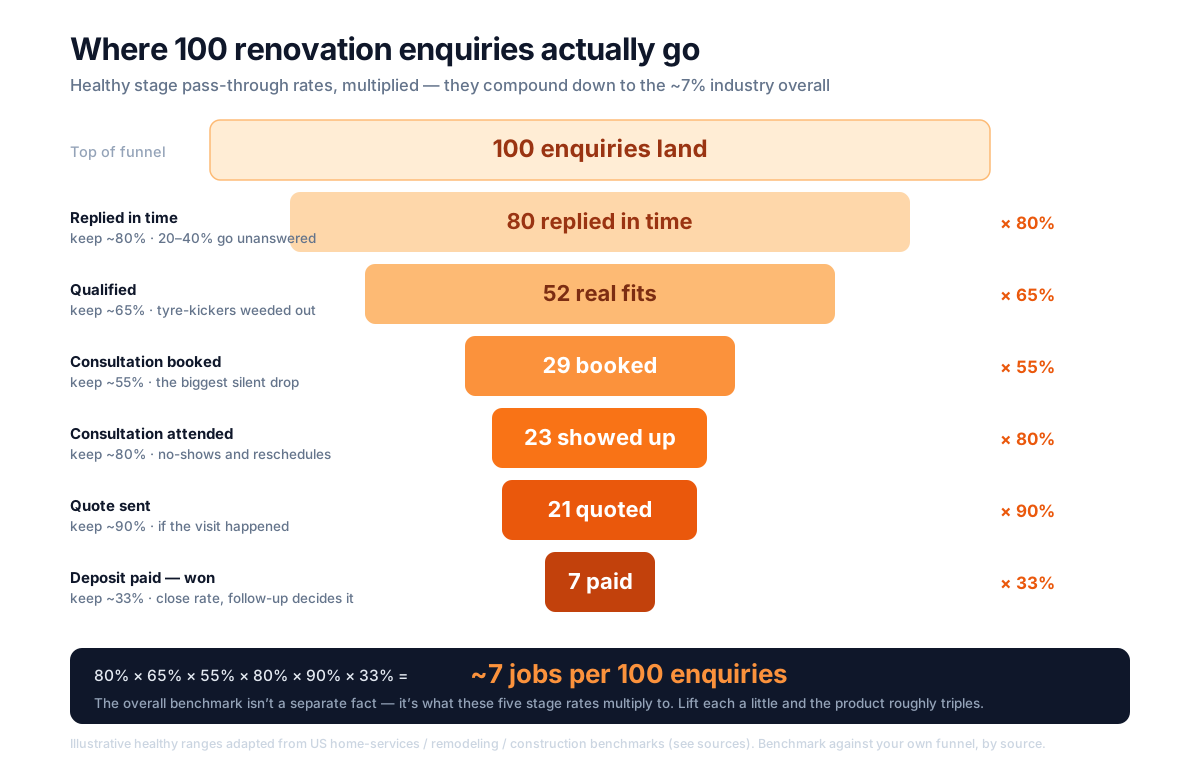
Every renovation-firm owner has heard the number: "you should convert about 7 or 8 percent of your enquiries into jobs." It gets repeated in every marketing deck. And it is almost useless on its own, because a single overall percentage tells you that your funnel leaks without telling you where.
The overall conversion rate is not a fact you measure — it is five or six stage rates multiplied together. Once you see it that way, the interesting question stops being "is 7% good?" and becomes "which of my six stages is dragging the product down?" This article gives you the healthy pass-through band for each stage of a Malaysian renovation or interior-design funnel, shows why they compound to roughly 7%, and explains why your own funnel — not the industry average — is the only benchmark that changes a decision.
Why is renovation conversion "only" 7% when every stage looks healthy?
Because conversion is multiplicative, not additive. A lead does not pass one test — it has to survive six in a row, and you multiply the survival rates together. Even a funnel where every single stage looks healthy ends up in single digits, because you are stacking six fractions.
Here is the arithmetic with realistic, healthy stage rates for a reno pipeline:
That is the whole point. When an owner hears "7%" they picture one big failure. In reality it is six modest, normal-looking losses compounding. Which is oddly good news: it means you do not need to fix one catastrophic stage. You need to nudge several stages up a little, because the product moves fast when the factors move.
This is why the overall funnel view matters more than any single headline conversion figure. The overall number is the output; the stage rates are the dials.
What are the healthy conversion benchmarks at each renovation funnel stage?
Below are rough, defensible bands for each stage, drawn from home-services, remodeling and construction benchmarks and adapted to a WhatsApp-led Malaysian pipeline. Treat them as sanity ranges, not targets carved in stone — your own numbers, by source, always win.
| Stage transition | Healthy band | What a low number means |
|---|---|---|
| Enquiry → Replied in time | ~70–85% answered promptly | You are missing leads — 20–40% of inbound goes unanswered at a typical shop |
| Replied → Qualified (real fit) | ~55–70% | Either poor lead quality, or nobody is asking budget/scope/timeline |
| Qualified → Consultation booked | ~40–60% (avg CSR books ~42%; top ~85%) | The single biggest silent leak — interested people never get an appointment |
| Consultation booked → Attended | ~70–85% | No-shows and reschedules; no reminder or confirmation |
| Consultation → Quote sent | ~80–90% | Quotes promised "next week," then forgotten |
| Quote sent → Deposit paid | ~25–40% remodeling; ~20–25% contractor bid-hit | Weak follow-up, or price-shopping against 3+ firms |
A few of these deserve a closer look, because they are where the ringgit actually goes.
The booking stage is the leak owners never suspect. Across home-services firms the average rate of turning a qualified, interested lead into a booked appointment is only about 42%, while top-quartile operators hit 85% (Built on Tenth's 2026 CSR benchmarks, via Pipeline On). That is a doubling available at one stage. Half of the people who liked you enough to reply and qualify never get a real meeting — not because they lost interest, but because nobody drove the calendar.
The close stage is a follow-up problem wearing a pricing mask. Remodeling close rates on a delivered quote commonly sit around 35% (Pro Remodeler), and if a remodeler is winning much more than 50% of bids their pricing is probably too low. For contractors bidding competitively it is harder still — a 5:1 bid-hit ratio (≈20% win rate) is a normal baseline, and cold, no-relationship bids often land at 15% or less (Sunflower Bank; TrebleHook). But most quotes are not lost on the number. Around 80% of sales need five or more follow-ups while most salespeople stop after one or two — so a big share of "lost on price" quotes were actually lost to silence.
Which renovation funnel stage should you fix first?
Fix the earliest stage that is below its band, because every downstream stage multiplies off it. A lead you never replied to cannot be qualified, booked, quoted or closed — so a speed leak at stage 2 silently taxes all four stages beneath it.
But the compounding cuts both ways, and that is the encouraging part. Watch what happens when a typical funnel and a tuned funnel differ by only modest amounts at each stage:
| Stage | Typical funnel | Tuned funnel |
|---|---|---|
| Replied in time | 60% | 85% |
| Qualified | 60% | 65% |
| Consultation booked | 42% | 60% |
| Attended | 75% | 85% |
| Quote sent | 85% | 90% |
| Deposit paid | 25% | 33% |
| Overall (multiplied) | ~2.4% | ~8.4% |
Neither column contains a miracle. The tuned funnel has no single stage that is extraordinary — it just refuses to be below-average anywhere. Yet the overall result is more than three times better, moving from the bottom of the industry band to the top. That is the case for treating conversion as a chain of dials rather than one big lever: you are not hunting for one heroic fix, you are stacking ordinary ones.
Why shouldn't you benchmark against the industry average?
Because the industry average is a US-derived blend that assumes a funnel your firm does not run. Two reasons it does not transfer cleanly to a Malaysian reno or ID shop:
WhatsApp collapses stages a phone benchmark keeps apart. The US home-services funnel these numbers come from assumes a caller, a CSR who answers, and a separately-booked appointment — three distinct events with their own rates. On WhatsApp, "replied" and "qualified" often happen in the same thread within a few messages. So a stage-by-stage US benchmark does not map one-to-one; the shape of a WhatsApp funnel is genuinely different, and comparing your two-message qualify-and-book against a call-centre's is comparing different machines.
Your sources convert nothing alike. A homeowner who found you on Qanvast or Atap arrives having already shortlisted you — they qualify, book and close several times better than a cold boosted-post lead who is price-shopping five firms. Blend them and the average describes neither channel. This is the same reason cost per lead lies and only cost per won job ranks channels honestly — a blended number hides the flip.
So the benchmark that actually changes a decision is not "the industry does 7%." It is your own funnel, by source, versus last quarter. Did your booking rate move? Did a channel's close rate slip? Those comparisons are apples to apples. The industry figure is only useful as a rough sanity check — a way to know whether a stage is wildly off, not a score to chase.
How do you measure your own stage benchmarks without software?
Run a one-month tally and count the survivors at each stage, tagged by source. You do not need a dashboard to start — you need six columns and the discipline to fill them in:
- Enquiries — every lead in, with its source.
- Replied in time — how many got a prompt human reply.
- Qualified — how many were a genuine budget/scope/timeline fit.
- Consultation booked — how many turned into a set appointment.
- Attended — how many actually happened.
- Quote sent, then Deposit paid — the two money stages.
Divide each stage by the one before it to get your pass-through rate. Compare each rate to the bands above, find your lowest-versus-band stage, and fix that one first. Then re-count next month and see if it moved — that month-over-month shift is your real benchmark.
The honest catch: a shared WhatsApp number and a manual spreadsheet give you none of these reliably, because the spreadsheet only stays accurate if a busy salesperson updates it religiously — which is exactly what collapses in a busy month, precisely when the stage counts matter most. That is the practical case for a lightweight system: not more numbers, just honest ones, captured automatically.
How HotLead makes your stage rates visible
HotLead is built to turn this six-stage funnel from a guess into a screen you can read, for Malaysian renovation, interior-design and construction firms, on top of the WhatsApp you already use. It:
- Captures every enquiry with one clear owner and a timestamped first reply, so your reply and qualify stages stop depending on memory.
- Keeps the next action in front of your team with overdue nudges, so the booking and quote-to-deposit stages — your two biggest leaks — reach the fifth follow-up instead of dying at the first.
- Shows the funnel and per-channel ROI — enquiries, quotes, wins and the drop between each stage, by source — so you benchmark your own funnel over time instead of chasing an industry average.
Start with the complete guide to managing renovation leads in Malaysia, read how the six-stage funnel actually works or the four numbers every owner should track, or see the renovation, interior-design and construction playbooks.
Sources: Estatehub and WebFX 2026 home-services marketing benchmarks (overall enquiry-to-job 7.8%; remodeling 3–7%; median site conversion 4–8%; 20–40% of inbound calls missed); Pipeline On, "Contractor Conversion Rate Optimization — the 6-stage home-service funnel" citing Built on Tenth's 2026 CSR benchmarks (average booking rate ~42% vs top-quartile ~85%; speed-to-lead lift inside 60 seconds); Pro Remodeler, "Getting the right close ratio for your remodeling sales" (35% typical close; over ~50% suggests underpricing); Sunflower Bank, "Is your bid-hit ratio okay?" and TrebleHook on construction RFP win rates (5:1 bid-hit ≈ 20%; cold bids ~15% or less; 25–35% good); industry follow-up research (Invesp / Brevet) on ~80% of sales needing five-plus follow-ups; Harvard Business Review, "The Short Life of Online Sales Leads" on the first-responder advantage; Qanvast and Atap Malaysia on platform lead behaviour. Stage bands are illustrative ranges adapted to a WhatsApp-led Malaysian pipeline — benchmark against your own funnel, by source.
Frequently asked questions
What is a good conversion rate for a renovation firm's sales funnel?
Overall, home-improvement and remodeling firms convert roughly 7 to 8 percent of enquiries into jobs, with remodeling specifically in the 3 to 7 percent band. But that headline number is the product of every stage in your funnel multiplied together, so it is more useful to know the healthy rate at each step — roughly 80 percent replied in time, 65 percent genuinely qualified, 55 percent booked into a consultation, 80 percent attended, 90 percent quoted, and 25 to 40 percent closed to a deposit. Multiply those and you land back at about 7 percent. Your own per-source numbers matter far more than the benchmark.
Which stage of a renovation funnel loses the most leads?
For most firms the two biggest realistic drops are booking the consultation and closing the quote to a deposit. Industry CSR booking rates average only about 42 percent versus 85 percent for top performers, so roughly half of qualified, interested leads never get a real appointment. The close stage then depends heavily on follow-up — around 80 percent of sales need five or more follow-ups, yet most salespeople stop after one or two. Notice both big leaks sit around price, not on it — leads die before and after the number is discussed, not usually because of it.
Why is renovation conversion only around 7 percent when each stage looks healthy?
Because conversion is multiplicative, not additive. If a lead has to survive six stages and each stage keeps a healthy 55 to 90 percent, you multiply those fractions together and the survivors shrink fast. Eighty percent replied, times 65 percent qualified, times 55 percent booked, times 80 percent attended, times 90 percent quoted, times 33 percent closed, equals about 7 percent overall. No single stage is broken — the math of stacking six leaky steps is simply why the final number looks small.
How do I benchmark my renovation firm's funnel?
Count the survivors at each stage for one month, tagged by source, then compare each stage to the rough healthy bands and to your own last quarter — not to the industry average. The industry figure is a US-derived blend that assumes a phone-and-call-centre funnel, whereas a Malaysian firm runs the whole thing on WhatsApp, where reply and qualify happen in one thread. Benchmark the shape of your funnel against itself over time and you will see which stage moved, which is the only comparison that changes a decision.
Do warm platform leads and cold ad leads have the same funnel benchmarks?
No, and blending them is a common mistake. A homeowner who found you on Qanvast or Atap arrives having already shortlisted you, so they qualify, book and close at several times the rate of a cold boosted-post lead who is just price-shopping. A blended stage benchmark averages a great channel and a poor one into a number that describes neither. Track each source through its own funnel — a channel that looks average in the blend is often a star or a drain once you split it out.
Keep reading
- How Much Cash Does a Renovation Firm Actually Need to Run?A renovation firm can be profitable, fully booked, and still run out of money — because every live job ties up your own cash between the deposit and the final payment, and that buffer grows every time you win more work. Here's how to size the working-capital cushion a Malaysian reno firm needs with real numbers, why growth consumes cash faster than it makes it, and why the size of your buffer quietly decides how many leads you can afford to say yes to.
- The Copy-Paste Quote Request: Telling a Real Shortlist Buyer From a Price-Harvester Blasting Ten FirmsAn identical, detailed WhatsApp lands in ten contractors' inboxes at once — "please quote for full renovation" with a copy-pasted brief. It looks like the best kind of lead — specific, thorough, ready. So you spend a Sunday building a full itemised quote, and never hear back. Here's why a detailed brief blasted to ten firms is not a serious buyer, how to tell a genuine shortlist buyer from a price-harvester or a bank-loan document-seeker, and how to give a fast, useful ballpark that protects your estimating hours without looking unhelpful.
- Handing Over a Warm Renovation Lead: Can AI Catch the Next Person Up on a 40-Message Thread Without Dropping the Promise That Wins the Job?A renovation lead starts, goes quiet for six weeks on the buyer's loan-and-keys clock, then comes back — or the person who owned it goes on Raya leave and someone else picks it up cold. Now they have to scroll forty messages to reconstruct what was quoted, promised and left open. So the reflex is to ask AI to "catch me up on this buyer." I tried it. Summarising a long thread is the job AI is genuinely best at — but the reflex build drops the one thing that wins the job. Here's the version that actually paid.