

Here is the moment every renovation and interior-design owner knows in their gut. The quote goes out — RM68k for a wet-kitchen-and-living reno, itemised, sent on WhatsApp at 4pm — and then nothing. No "wah, expensive." No "let me think." Just a read receipt and silence. That RM68k enquiry is now the most valuable lead in your building: the buyer has your number, likes your work enough to have asked, and is sitting there comparing you against two other firms. And the follow-up that decides it is the message you are about to type at 10pm when you finally remember.
So the 2026 question an owner actually cares about is a good one: can I just get AI to write that follow-up? It is a genuinely repetitive, blank-page chore, exactly the kind of thing AI should eat for breakfast. So I built it and measured it. And the first draft AI handed me was so bad it would have cost the job — not because the writing was clumsy, but because it was the single worst strategy for a stalled quote. Here is the problem, what a stalled quote costs before AI, what the reflex build got wrong, the one instruction that fixed it, and what AI still can't do.
What does a stalled renovation quote actually cost before any AI?
A stalled quote costs you in the most expensive place in the whole pipeline — the last one. The buyer has already survived the first reply, the site visit and the quoting hour you'll never bill for. The acquisition is fully sunk. If the deal dies now, it dies with the most money attached, and it dies quietly, mistaken for "the client is still deciding."
This is the stage Sarah's piece on the interior-design quote-to-deposit drop-off is entirely about — the longest, most fragile window in the built-environment business, where the job is lost not to price but to silence after the quote. As the real ringgit cost of a lost lead works out, each winnable enquiry carries roughly RM1,280 in expected gross profit. A quote that has already been sent is further down that funnel than almost any other lead you hold — so losing it hurts more than losing a cold enquiry ever could.
And there are two ways to lose it, not one. The first is the forgotten quote — nobody chases, it goes cold. That leak is real, and it is the subject of our companion build on manual versus AI follow-up, where the fix is making sure no quote is ever forgotten. This piece is about the second, less obvious leak: the quote that does get chased, with a message so generic it actively pushes the buyer away.
So can't AI just write the follow-up? The reflex build — and why its draft loses the deal
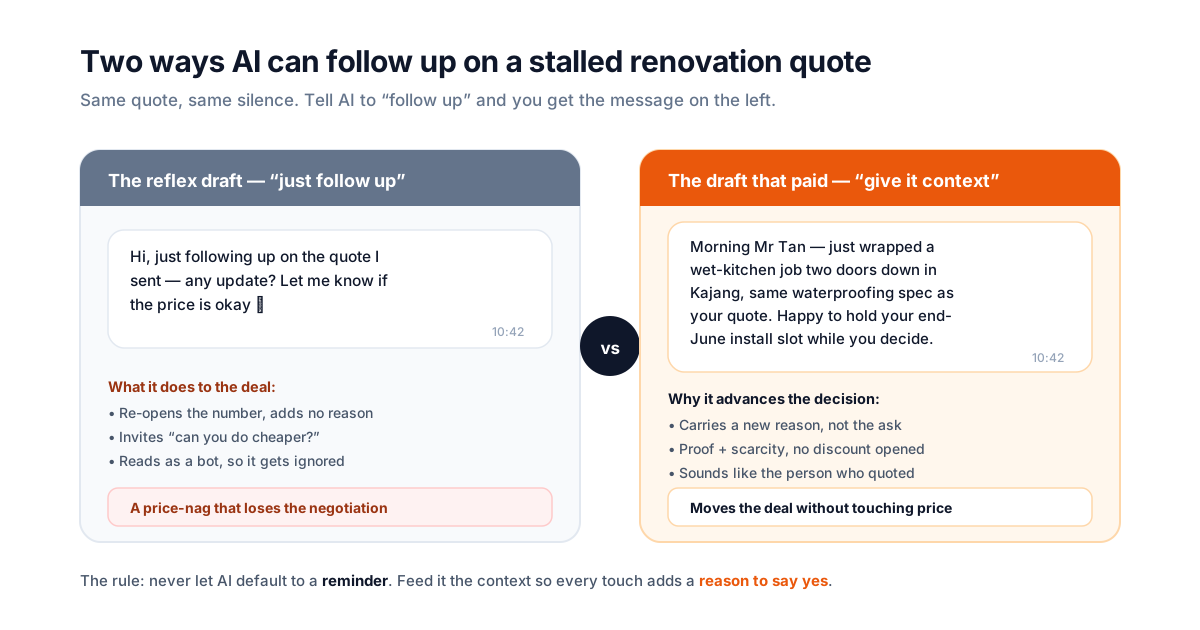
Yes, AI writes a follow-up instantly. The problem is which follow-up. This was the reflex build, and it is the one almost everyone reaches for: paste the quote, tell the model "write a friendly follow-up," and hit go. Here is, near-verbatim, what it gave me — clean, polite, grammatically perfect:
"Hi Mr Tan, just following up on the renovation quote I sent last week. Any update on your side? Do let me know if the price works for you or if you have any concerns. 🙏"
It reads fine. It is also a strategic disaster, for one reason: it carries no new information, so its only content is your price. A follow-up whose entire payload is "here is my number again, react to it" doesn't advance the sale — it hands the buyer the negotiation. At the quote stage the homeowner is comparing you against the two or three other firms they're advised to line up, and silence is itself a well-worn buyer tactic — stay quiet, make the seller fill the void, and let them talk themselves into a discount. A message that says "let me know if the price works" walks straight into it. The natural reply isn't yes — it's "can you do a bit cheaper?", a concession you just invited for free.
The sales data backs this up bluntly. Gong's analysis of follow-up messaging is that "just checking in" and "bumping this up" are noise, not value — a short follow-up whose substance is only "did you see my previous message?" is far less likely to book anything than one that adds something new. The point isn't to avoid talking about price; Gong's own pricing research says confident reps discuss price plenty. The point is that a follow-up whose only content is the price, weeks after the quote, does the opposite of confident — it reads as anxious, and it re-opens a number you should be defending, not re-presenting.
So "can AI write a follow-up cheaply?" is a useless yes. A drafted nudge is maybe 600 input and 120 output tokens — on the order of a tenth of a sen at illustrative GPT-4o mini list pricing, the same rounding error as in the first-reply experiment. The tokens were never the cost. The cost is the deal the default draft talks its way out of.
What actually worked — give AI the context, and make every touch carry a new reason
The build that paid changed the prompt, not the tool. Instead of "write a follow-up," the instruction became: here is the scope I quoted, here is the buyer's likely unspoken objection, here is a similar job we just finished — draft the next touch so it adds one new reason to say yes, and never just ask for an update. That single reframing is the whole difference between a nag and a nudge.
With the context in hand, the model stopped re-presenting the price and started advancing the decision. The same stalled RM68k quote produced this instead:
"Morning Mr Tan — we just wrapped a wet-kitchen job two doors down in Kajang, same waterproofing spec as your quote. Happy to hold your end-June install slot while you decide. Want the after photos?"
Nothing about price. It carries proof (a real similar job), scarcity (a specific slot), and a reason to reply (the photos) — and it sounds like the person who did the quoting, not a bot doing the chasing. That is the message that moves a comparison-shopping buyer, and it is the message AI writes well the moment you stop asking it to "follow up" and start feeding it something to follow up with.
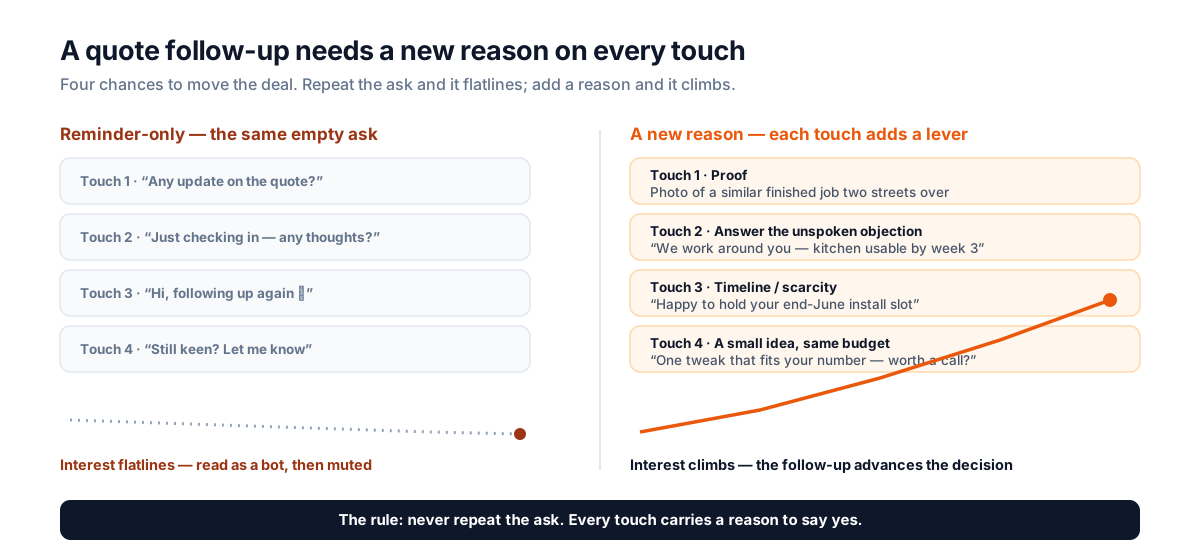
The measurable difference here is in the message, not a send-rate I can honestly claim from a controlled trial — so I'll anchor the direction to the real data rather than invent a number. The reply-rate gap between value-add and reminder-only follow-ups is documented by Gong; what the build adds is a way to produce the value-add version in seconds, every time, without a blank page. The structure that worked was one new lever per touch:
| Touch | Reminder-only (the reflex draft) | New-reason draft (the build that paid) |
|---|---|---|
| 1 | "Any update on the quote?" | Proof — photo of a similar finished job nearby |
| 2 | "Just checking in, any thoughts?" | Answer the unspoken worry — mess, dust, timeline |
| 3 | "Following up again 🙏" | Timeline — offer to hold a specific install slot |
| 4 | "Still keen? Let me know" | A small idea that fits the same budget — invite a call |
| Effect | Re-anchors on price, reads as a bot, gets muted | Adds a reason each time, advances the decision |
What AI still can't do on a quote follow-up
Plenty, and it's the load-bearing part. AI can draft the message; it cannot make the three judgement calls that decide whether the message should be sent at all — and getting those wrong is how the drafting tool starts losing money instead of saving it.
- It doesn't know the buyer's real ceiling. AI can't tell that Mr Tan mentioned on the site visit that RM70k was his absolute limit, so a "we can adjust the scope" angle is on the table while a discount isn't. That lives in a human's memory, not the chat log.
- It can't decide whether to discount. Whether to hold firm, trim scope, or offer a small sweetener is a margin decision. Hand that to an unsupervised model and you'll give away gross profit the buyer never asked for.
- It can't sense a dead deal. Sometimes the silence means they signed with someone else last Tuesday. A human reads that from a curt reply or a mutual contact; AI will cheerfully draft touch four into a grave.
- It can't own the WhatsApp send. Timing and frequency are a real constraint here — after the 24-hour window, business-initiated nudges become templates that Meta frequency-caps, and blocks tank your number's quality rating. That whole mechanic is covered in manual versus AI follow-up; the short version is that a human, not a scheduler, should decide when a message actually goes.
So the honest split is the same one every experiment in this series keeps landing on, applied to the quote stage: AI owns the draft, a human owns the number and the send. The drafting is the cheap, safe, valuable half. The judgement is the half that keeps the deal — and the margin — intact.
Why is this the honest answer for a Malaysian firm right now?
Because here the follow-up is the differentiator, and the market is being sold the shortcut. A homeowner on Qanvast is shortlisted with up to five firms and advised to compare at least three quotes — so at the quote stage you are, by design, in a bake-off. The winner is rarely the cheapest and almost never the one who pinged "any update?" the most. It's the one whose follow-up kept proving, quietly, that they were the safe pair of hands.
Meanwhile a lot of owners are being sold "AI follows up with your leads automatically" as a finished feature. An AWS-commissioned study of 1,000 Malaysian businesses found 27% now use AI but 73% are stuck on basic, off-the-shelf tools, with around half citing a digital-skills gap. Translation: plenty of firms will switch on an AI that blasts the reflex draft at their most valuable leads, with no one on staff to notice it's price-nagging a comparison-shopping buyer into a discount. The grounded move isn't to skip AI on the quote follow-up — it's to point it at the safe, valuable job (drafting a contextual message) and keep a human on the part that isn't (the number, the timing, the send).
What should an owner actually do on Monday?
You can capture most of this upside without building anything — it's a habit and a prompt, not a platform.
- Ban the reflex draft. Make a rule for yourself and your team: no follow-up whose only content is "any update on the quote?" If the message doesn't carry a new reason, it doesn't go.
- Give AI the context, not just the command. If you use a model to draft, feed it the scope you quoted, the buyer's likely worry, and a recent similar job — and tell it to add one new reason per touch. The output goes from nag to nudge instantly.
- Keep the number and the send human. Let AI write; you decide whether to discount, when to send, and whether the deal is even still alive. That's where the margin and the WhatsApp risk both live.
- Make "nothing forgotten" the floor. None of the above matters if the quote never surfaces to be chased. Every quoted lead needs a next action and one owner, so the good message actually gets written and sent.
How HotLead fits — and what it deliberately does not do
I'll be straight, because over-claiming is exactly the hype I keep arguing against. HotLead does not draft your quote follow-ups or fire chasers on its own — and after this experiment, that restraint is the point, not a gap. What it does is guarantee the conditions under which a good follow-up actually happens:
- A next action and an overdue-follow-up nudge on every quoted lead, so no quote silently rots — the memory layer, surfaced to a person, not auto-sent.
- One owner per lead, so the follow-up is written by the human who remembers the budget ceiling, the spouse and the loan — the context AI can't read from the chat.
- A funnel and per-channel view, so you can see whether deals are leaking specifically at the quote-to-deposit stage and fix the right leak instead of guessing.
- An optional AI assistant you can switch on that warms a brand-new enquiry instantly — while the chasing of a quoted lead stays your team's decision, by design.
In other words, HotLead makes sure the quote is never forgotten and reaches the person best placed to write the message that wins it. If stalled quotes are your leak, start with the complete guide to managing renovation leads in Malaysia, see how it fits a renovation firm, or read the companion builds on manual versus AI follow-up and the interior-design quote-to-deposit drop-off.
Sources: Follow-up persistence and drop-off figures (80% of sales need 5+ follow-ups; 44% of salespeople give up after one) from Invesp — The Importance of Sales Follow-Ups (a widely cited compilation; the "five touches" stat has a debated origin and is used here for shape, not precision). Value-add versus "just checking in" follow-up effectiveness, and the reply-rate gap between substantive and reminder-only messages, from Gong — writing the perfect follow-up sales email, according to science; pricing-conversation timing and confidence from Gong — the best time to talk price and budget. Silence as a buyer negotiation tactic from RAIN Group — strategies buyers use to negotiate price. The "compare at least three quotes" homeowner norm from Recommend.my — renovation contractors in Malaysia. Malaysian AI adoption (27% adoption, 73% basic, ~half cite a digital-skills gap, AWS-commissioned study) from Tech Wire Asia — Malaysia's AI adoption paradox. Illustrative compute cost uses GPT-4o mini API pricing (USD0.15 / 1M input, USD0.60 / 1M output). Expected-gross-profit-per-lead and Malaysian renovation cost bands as derived in the cost of a lost renovation lead and the complete guide; WhatsApp template frequency-cap mechanics as cited in manual versus AI follow-up; Qanvast shortlist behaviour as covered in turning Qanvast and Atap enquiries into booked consultations.
Frequently asked questions
Can AI write a good follow-up message for a renovation quote?
It can write an excellent one, but only if you give it context. Told merely to "follow up on this quote," AI defaults to a generic reminder — "just following up, any update on the price?" — which re-opens the number, invites a discount, and reads as a bot. Feed it the scope you quoted, the buyer's likely unspoken objection and a similar finished job, and instruct it to add a new reason on every touch, and it drafts a message that advances the decision in seconds for a fraction of a sen. The tool is fine; the default prompt is the problem.
Why is "just following up on my quote" a bad follow-up message?
Because it carries no new information — it only re-surfaces your price and asks the buyer to react to it. At the quote stage the homeowner is comparing you against two or three other firms, so a naked "any update?" hands them the negotiation. Silence is itself a buyer tactic, and a price-nag invites the reply "can you do a bit cheaper?" A follow-up that advances the deal adds a reason to say yes — a photo of a similar finished job, an answer to the mess-and-timeline worry, a held install slot — without re-anchoring on the number.
Should I automate renovation quote follow-ups with AI?
Automate the drafting and the remembering, never the sending. AI is very good at never letting a quote go cold and at writing a contextual next message in seconds. It is not good at knowing whether now is the right moment for this specific buyer — whether their bank loan has cleared, whether a discount is warranted, or whether the deal is already dead. Those calls stay with a human. A blind auto-drip also gets frequency-capped and can damage your WhatsApp number, which is covered in our companion piece on manual versus AI follow-up.
How many times should you follow up on a renovation quote in Malaysia?
As many as it genuinely takes, provided each touch carries a new reason. The widely cited figure is that about 80% of sales need five or more follow-ups while 44% of salespeople give up after one, so persistence matters — but repeating the same "still keen?" four times is not persistence, it is noise. On a platform like Qanvast a homeowner is shortlisted with up to five firms and is advised to compare at least three quotes, so the firm that stays usefully in touch — not the one that pings emptiest — usually wins the deposit.
Does HotLead send AI quote follow-ups to my leads for me?
No. HotLead keeps a next action and an overdue-follow-up nudge on every quoted lead so nothing is forgotten, gives each lead one owner, and shows you a funnel so you can see if deals are leaking at the quote-to-deposit stage. It does not fire automated drip sequences or send chasers on its own — after this experiment, that is clearly the right call. If you use a separate tool to draft messages, keep a human deciding the wording and the send. The optional AI assistant HotLead offers warms a brand-new enquiry; the chasing of a quoted lead stays a person's decision, by design.
Keep reading
- Can AI Write the Weekly Lead Report a Renovation Owner Will Actually Act On? I Built It, Then Killed ItYou've finally got the dashboard — funnel, per-channel numbers, who's fast. You look at it on Sunday night and think, now what? So the 2026 reflex is to ask AI to read it all and write you a weekly report. I built that bot, ran it for a month, and killed it. Here's why an AI-narrated report is a trap for a small reno firm — it restates what you can see, invents causes it can't know, and calls random noise a trend — and the boring version that actually moved something.
- How Long Does It Take to Close a Renovation Lead in Malaysia? The Sales-Cycle Clock Owners Never WatchMost owners track their conversion rate and ignore the other half of the picture — how long a deal actually takes. In home improvement the sales cycle has doubled from 30 days to 60-plus, and a Malaysian reno runs longer still because of loan approval and vacant-possession keys. Here is what a healthy time-to-close looks like, why you should not try to shorten the buyer's half of it, and how deal age tells you a stalled lead from one that is simply marinating.
- The JMB Enquiry Isn't a Homeowner Lead — Why Contractors Lose Strata Building WorksA WhatsApp from a JMB chairman asking you to quote a condo repaint or waterproofing job looks like any other lead — so contractors answer it like a homeowner, and lose. The buyer is a committee that votes over months, not a person deciding this afternoon. Here's how to win the strata job.