

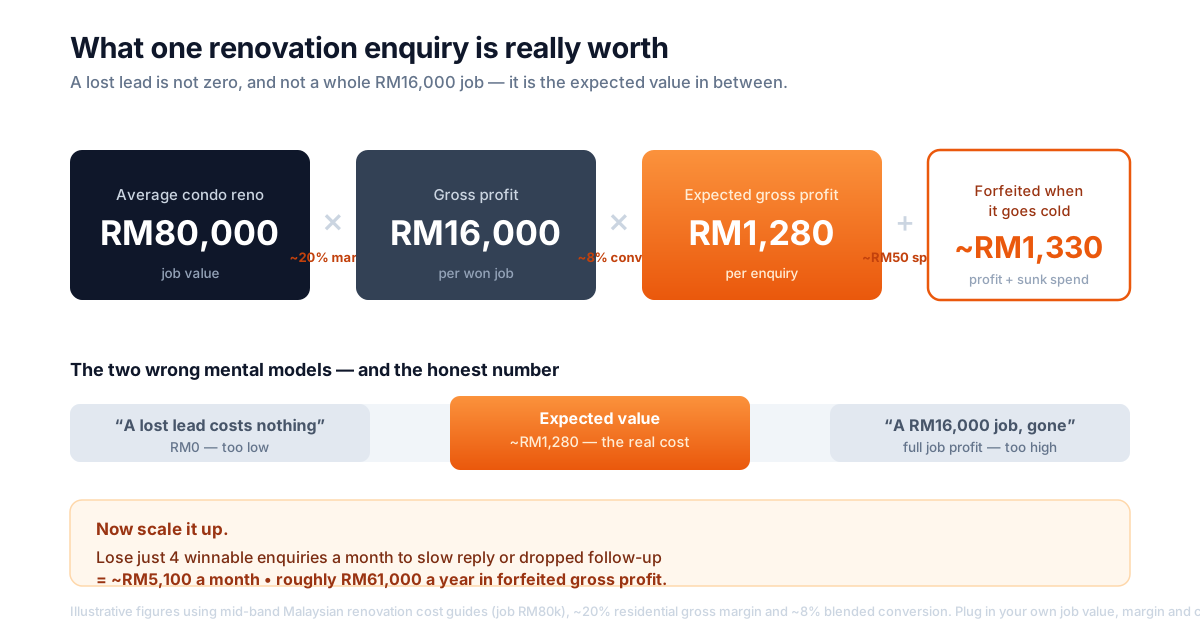
Ask a renovation-firm owner what it costs when a WhatsApp enquiry slips through the cracks, and most will shrug: nothing, really — there's always another one coming. That instinct is the single most expensive belief in the business, because it's wrong by about a thousand ringgit per lead.
A lost lead isn't free, and it isn't a whole job gone either — its real cost is the job's gross profit, weighted by how often that kind of lead actually closes. Get that number right and the maths changes how you run the firm: suddenly a reply that's two days late isn't a minor service slip, it's a line item. Let's work it out with real Malaysian figures.
Why do owners think a lost lead costs nothing?
Because the cost is invisible and deferred, while the next enquiry is right there in the inbox. When a message goes unanswered for a day and the homeowner moves on, nothing breaks, no alarm sounds, and a fresh lead usually lands soon after. The loss never shows up on a statement, so the brain files it under "free."
There are actually two wrong mental models, and owners flip between them:
- "A lost lead costs nothing." The default. It treats every unanswered enquiry as RM0, which is what lets a shared WhatsApp number sit unattended over a long weekend.
- "That was a RM16,000 job, gone!" The panic version, usually after losing one obviously good lead. It's the opposite error — it assumes the lead was a guaranteed job, when most enquiries were never going to convert regardless.
Both are wrong, and they're wrong in opposite directions. The truth sits between them, and you can calculate it.
What is a renovation lead actually worth in ringgit?
The value of a single enquiry is the job's gross profit multiplied by the realistic chance that enquiry becomes a paid deposit. That's its expected value, and it's the only honest way to price a lead. Here's the chain, with Malaysian numbers:
- Job value. A full condo renovation in Malaysia commonly runs RM40,000–150,000, with terraced houses RM60,000–250,000 and larger landed homes well above that, per current Malaysian renovation cost guides. Take a mid-band condo job at RM80,000.
- Gross margin. Residential renovation gross margins typically run 18–25%. Use 20%, and that RM80,000 job carries about RM16,000 of gross profit — the contribution left after materials and subcontracted labour, before fixed overhead you're paying anyway.
- Conversion. Across home-improvement firms, only about 7–8% of enquiries become jobs (remodeling specifically sits in the 3–7% band). At 8%, one average enquiry is worth RM16,000 × 8% ≈ RM1,280 in expected gross profit.
So an ordinary enquiry sitting in your WhatsApp isn't worth nothing, and it isn't worth a RM16,000 job. It's worth roughly RM1,280 — the job's profit, discounted by the odds.
And the per-enquiry value is much higher for your best sources. A warm lead from a referral or from Qanvast — the platform tens of thousands of Malaysian homeowners use to shortlist designers — converts several times better than a cold boosted-post lead. If a referral converts at 20% instead of 8%, the same RM16,000 job makes that enquiry worth RM3,200 — two and a half times more. The blended average hides this completely, which is exactly why some firms casually let their most valuable enquiries go cold. Split your conversion by source and the value of answering the right leads fast becomes obvious.
What are the two costs you pay for every lost lead?
You pay twice. There's the marketing spend already sunk into acquiring the enquiry, and there's the expected gross profit you forfeit by not closing it — and the second is far larger than the first.
| The two costs of a lost lead | What it is | Rough size (one avg enquiry) |
|---|---|---|
| Sunk acquisition cost | The ad or platform spend you already paid to make this enquiry land | ~RM25–RM90+ per lead |
| Forfeited expected profit | The job's gross profit, weighted by conversion odds | ~RM1,280 |
| Total real cost | What letting it go cold actually costs you | ~RM1,300+ |
Most owners only ever feel the first cost, and only vaguely — "leads are getting expensive." The second cost is 15 to 50 times bigger and almost never counted. When you let an enquiry you already paid for die in an unanswered inbox, you're not breaking even by getting a fresh one tomorrow; you've thrown away both the spend and the profit, and you'll pay again to acquire the replacement.
How much is slow reply and weak follow-up costing you in a year?
Scale the per-lead number across a year and the "free" lost lead turns into a serious figure. Suppose a firm loses just four winnable enquiries a month — not all its lost leads, only the ones that genuinely would have converted with a faster reply or one more follow-up. At ~RM1,280 of expected gross profit each:
- ~RM5,100 a month in forfeited gross profit
- ~RM61,000 a year — roughly the profit of a whole extra condo renovation, gone in dropped messages
For an interior-design studio or a contractor working larger projects, the annual figure climbs with job value. The exact ringgit will be yours, but the shape of it is the same everywhere: a handful of dropped leads a month is one of the most expensive line items in a renovation firm, and the only one that never appears in the accounts.
But wouldn't most of those leads have died anyway?
Some would have — which is exactly why the maths uses expected value, not the full job. The honest objection is that you can't win every enquiry, and that's already priced in: multiplying by an 8% conversion rate means we're only counting the realistic share that would have closed. The RM1,280 figure isn't "every lead is a job." It's "the average lead, across all of them, carries this much profit."
The more important point is where winnable leads die. They rarely die on price — they die in silence, before price is even discussed:
- The firm that responds first wins most deals. Research originating from Dr. James Oldroyd's MIT study found the odds of qualifying a lead are roughly 100× higher when you reply within five minutes versus thirty, and around 78% of customers buy from the first business that responds.
- Around 80% of sales need five or more follow-ups, yet most salespeople stop after one or two.
A lead lost to a two-day reply or a follow-up that stopped at the second message didn't pick a cheaper competitor. It went cold while nobody was watching. And that's the good news hiding in this whole calculation: because the cost lives in the silent middle of your funnel rather than in the market's willingness to pay, it's recoverable — with speed and persistence, not a bigger budget.
How do you stop paying the lost-lead tax?
You make the two cheapest fixes in the business — fast first reply and consistent follow-up — actually happen, every time, without depending on a busy person's memory. Concretely:
- Reply fast, by default. A logged, owned first response within minutes is the single highest-return action, and it costs nothing but a system that doesn't let enquiries sit unseen.
- Follow up to the fifth touch. Most jobs are won past the point where most teams give up. Keep the next contact in front of someone so quotes reach the fifth nudge instead of dying at the first.
- Count the leak in ringgit, not in messages. Once a dropped lead reads as "~RM1,300 forfeited" instead of "one message," the priority of answering quickly sorts itself out.
The catch every owner hits is that a shared WhatsApp number and a spreadsheet give you none of this reliably, because the spreadsheet only stays accurate if a busy salesperson updates it religiously — which is exactly what collapses in a busy month, precisely when leads are most valuable. That's the practical case for a lightweight system: it makes the expensive mistakes hard to make.
How HotLead fits in
HotLead is built so Malaysian renovation, interior-design and construction firms stop paying the lost-lead tax — on top of the WhatsApp you already use. It:
- Captures every enquiry with one clear owner and timestamps the first reply, so leads don't die unseen in a shared inbox over a long weekend.
- Keeps the next follow-up in front of your team with overdue nudges, so quotes reach the fifth contact instead of the first.
- Shows the funnel and per-channel ROI — enquiries, wins and drop-offs by source — so you can see your real conversion by channel, and finally price what a lead is worth instead of guessing it's free.
Start with the complete guide to managing renovation leads in Malaysia, see the renovation lead playbook, or read how the six-stage funnel where these leads leak actually works.
Sources: Malaysian 2025–2026 renovation cost guides (Loanstreet, iProperty.com.my, Hin Construction, ZBOM) on typical job values — condo RM40k–150k, terrace ~RM60k–250k; residential renovation and construction gross-margin benchmarks (ServiceTitan, Foundation Software — residential gross margins ~18–25%, construction net margins ~5–12%); Estatehub / WebFX 2026 home-services conversion benchmarks (overall ~7–8%, remodeling 3–7%); Qanvast Malaysia renovation contract guidance (10–20% deposit norm) and Qanvast homeowner reach; MIT / Dr. James Oldroyd and InsideSales on the five-minute response advantage (100× odds); Harvard Business Review, "The Short Life of Online Sales Leads" on the first-responder advantage; industry follow-up research (Brevet / Marketing Donut) on the share of sales needing five or more follow-ups. Ringgit figures in this article are illustrative worked examples — plug in your own job value, margin and conversion-by-source for your real number.
Frequently asked questions
What does a lost renovation lead actually cost a firm?
Its expected value, not zero and not the full job. Take the job's gross profit and multiply by how often that kind of lead converts. For an average Malaysian condo renovation worth around RM80,000 at a roughly 20 percent residential gross margin, that's about RM16,000 of gross profit per won job. At a blended conversion of around 8 percent, each enquiry carries roughly RM1,280 of expected gross profit. Add the marketing spend you already paid to acquire the lead, and that total is what you forfeit when the enquiry goes cold.
Why isn't a lost lead either free or a whole job lost?
Because not every enquiry would have closed, but not every enquiry is worthless either. Treating a lost lead as RM0 is the mistake that lets firms ignore slow replies. Treating each one as a full RM16,000 job gone is the opposite error — it overstates the loss because most enquiries never convert regardless. The honest number sits in between — the job's profit weighted by the realistic chance that lead would have become a paid deposit.
How do you calculate the value of a renovation enquiry?
Expected gross profit per enquiry equals average job value times gross margin times conversion rate. Use your own figures and split conversion by source, because a referral or Qanvast lead converts several times better than a cold boosted-post lead and is therefore worth several times more. The blended average hides that, which is exactly why some firms underinvest in answering their most valuable enquiries quickly.
How much does slow follow-up cost a renovation firm per year?
More than most owners expect. If each winnable enquiry carries around RM1,280 of expected gross profit and a firm loses just four a month to slow reply or forgotten follow-up, that's roughly RM5,100 a month — about RM61,000 a year in forfeited profit. The figure scales with job value, so an interior-design or construction firm working larger projects loses proportionally more per dropped lead.
Are most renovation leads lost on price?
No — most are lost in the silent gaps before price is ever discussed. Research on online leads shows the firm that responds first wins the majority of deals, and that around 80 percent of sales need five or more follow-ups while most salespeople stop after one or two. A lead that never got a fast reply or a fifth nudge didn't choose a competitor on price; it went cold while nobody was looking. That's good news — it means the cost is recoverable with speed and persistence, not a bigger ad budget.
Keep reading
- How Much Cash Does a Renovation Firm Actually Need to Run?A renovation firm can be profitable, fully booked, and still run out of money — because every live job ties up your own cash between the deposit and the final payment, and that buffer grows every time you win more work. Here's how to size the working-capital cushion a Malaysian reno firm needs with real numbers, why growth consumes cash faster than it makes it, and why the size of your buffer quietly decides how many leads you can afford to say yes to.
- The Copy-Paste Quote Request: Telling a Real Shortlist Buyer From a Price-Harvester Blasting Ten FirmsAn identical, detailed WhatsApp lands in ten contractors' inboxes at once — "please quote for full renovation" with a copy-pasted brief. It looks like the best kind of lead — specific, thorough, ready. So you spend a Sunday building a full itemised quote, and never hear back. Here's why a detailed brief blasted to ten firms is not a serious buyer, how to tell a genuine shortlist buyer from a price-harvester or a bank-loan document-seeker, and how to give a fast, useful ballpark that protects your estimating hours without looking unhelpful.
- Handing Over a Warm Renovation Lead: Can AI Catch the Next Person Up on a 40-Message Thread Without Dropping the Promise That Wins the Job?A renovation lead starts, goes quiet for six weeks on the buyer's loan-and-keys clock, then comes back — or the person who owned it goes on Raya leave and someone else picks it up cold. Now they have to scroll forty messages to reconstruct what was quoted, promised and left open. So the reflex is to ask AI to "catch me up on this buyer." I tried it. Summarising a long thread is the job AI is genuinely best at — but the reflex build drops the one thing that wins the job. Here's the version that actually paid.