

Here is a problem every renovation and interior-design firm in Malaysia has, whether they admit it or not: the first WhatsApp reply goes out too slowly, because the person who should write it is on a site visit with no hands free. The lead sits. By the time someone replies, the homeowner has already messaged three other firms off Qanvast.
So the obvious 2026 question: can AI just write that first reply for me? And the honest follow-up an owner actually cares about — can it do that profitably, without quietly costing me jobs? I went and tried it. Here is the problem, what it cost before, what the AI builds actually did, and what you should do on Monday.
What did the first reply cost before AI?
Before any AI, the first reply costs you in two ways: the delay and the drag. The delay is the lead going cold while your best salesperson is up a ladder. The drag is that even when they do reply, writing a good qualifying first message from scratch — read the enquiry, work out strata or landed, pitch a sensible range — takes real attention they are spending thirty times a week.
The delay is the expensive one. The speed-to-lead numbers are brutal and well-established: MIT's analysis of over 15,000 leads (popularised by Harvard Business Review) found that replying within 5 minutes makes you about 100× more likely to connect and 21× likelier to qualify than waiting 30 minutes, and Velocify's look at 3.5 million leads found the first minute alone lifts conversion by around 391% over the second. Meanwhile the average business takes 47 hours to respond, and the first firm to reply wins roughly 78% of the deals.
Put a ringgit figure on it. A mid-range condo renovation in Malaysia runs roughly RM150–280 per sqft; a kitchen-and-two-baths job in an 850 sqft unit lands somewhere around RM45k–RM120k. Lose one of those a month to a slow first reply, and at even a slim margin you have left thousands of ringgit on the table — every month — to save a few minutes of typing. That is the problem worth pointing AI at. Not because AI is exciting, but because the leak is expensive.
So can AI write it? Yes — and the compute is basically free
The first surprise when you actually build this is how little the AI costs to run. This is the part the hype gets backwards: people worry about the bill and ignore the risk.
A qualifying first reply is short — maybe 120 words. Feed the model the incoming enquiry plus a prompt describing your firm and how you qualify (call it ~800 input tokens), and it writes ~180 tokens back. At published GPT-4o mini pricing — about USD0.15 per million input tokens and USD0.60 per million output — that single reply costs on the order of USD0.0002, or roughly a tenth of a sen.
So if the question were only "can AI produce a competent first reply cheaply?", the answer is an easy yes. But that is not the real question. The real question is what happens when it is wrong — because now it is wrong instantly, at scale, in your name.
What happened when we let the AI send it itself?
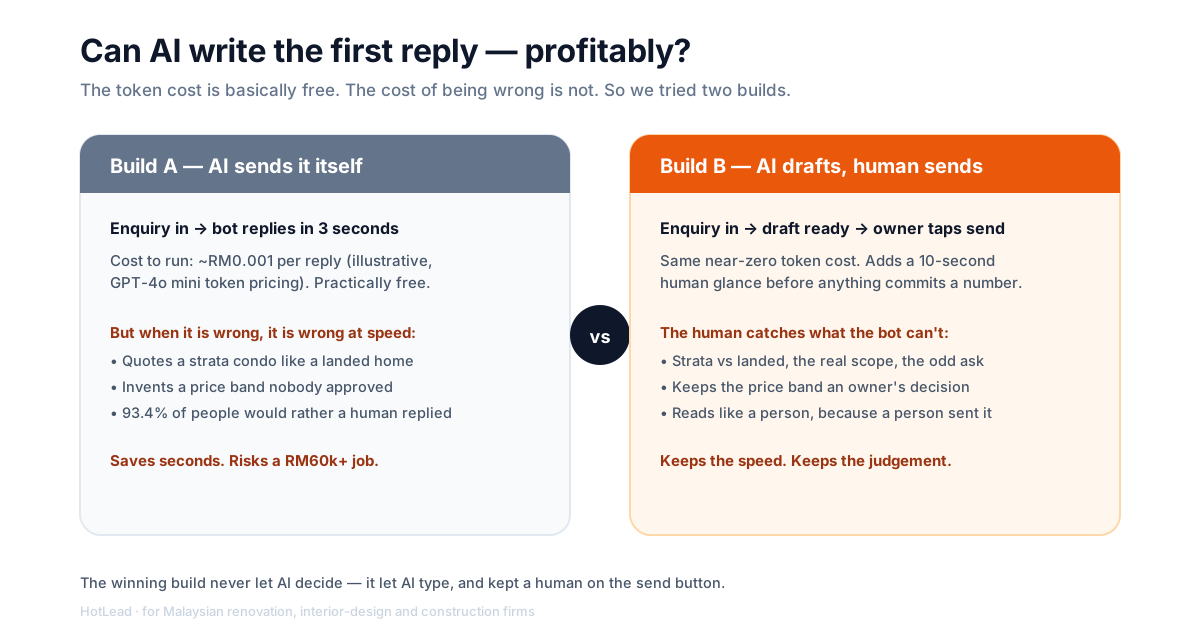
This was Build A: a fully autonomous bot. Enquiry comes in, AI reads it, AI sends the qualifying reply. No human in the loop. Three seconds, every time. And on the easy enquiries, it was genuinely good.
The trouble showed up on the enquiries that actually matter — the ones with a number attached. Three failure modes turned up fast, and I want to be precise that these are the illustrative patterns I saw stress-testing it, not a published trial:
- It misread the property. Given a vague "renovate my place in Mont Kiara, kitchen and 2 baths", the bot happily talked scope and timeline like a landed home — missing that a strata unit needs JMB approval, a renovation deposit and a permit before a tile moves. (More on why that one question matters in how to qualify a renovation lead in the first reply.)
- It invented a price band. Asked "how much?", it produced a confident range nobody at the firm had signed off on. A number in writing, on WhatsApp, from "your firm" — that is a quote you now have to walk back.
- It sounded like a bot, and people clocked it. Which matters more than it sounds, because the trust data is one-sided.
That last point is where the autonomous build really loses money. In a 2025 Kinsta survey, 93.4% of consumers said they prefer interacting with a human over AI; SurveyMonkey's 2025 study found just 8% prefer AI over a person; and reporting on Pegasystems research found 48% of consumers do not trust companies that use AI to completely handle their queries. A first-time renovator about to spend RM80k is exactly the nervous buyer who wants a human. The auto-send bot saved ten seconds and spent the relationship.
What actually worked: AI drafts, a human sends
Build B kept everything good about Build A and removed the part that lost money. The AI still reads the enquiry and drafts the full qualifying reply in seconds — same near-zero cost. But instead of sending, it hands the draft to the salesperson, who glances at it for ten seconds, fixes anything off, and taps send.
That ten-second human glance is the whole product. It is where someone catches "this is strata, not landed," holds the price band as an owner's decision, and makes the message read like a person — because a person sent it. You keep the speed (the draft removes the blank-page delay that caused the original lag) and you keep the judgement. The token cost is identical; the risk profile is completely different.
| Build A — AI sends it itself | Build B — AI drafts, human sends | |
|---|---|---|
| Speed of first reply | Seconds | Seconds to a couple of minutes |
| Compute cost | ~0.1 sen / reply | ~0.1 sen / reply |
| Misreads strata vs landed | Sends it anyway | Human catches it |
| Commits a price band | Unsupervised | Stays an owner's call |
| Reads as human | No — and buyers notice | Yes — a person sent it |
| Cost when it is wrong | A RM60k+ job | A ten-second edit |
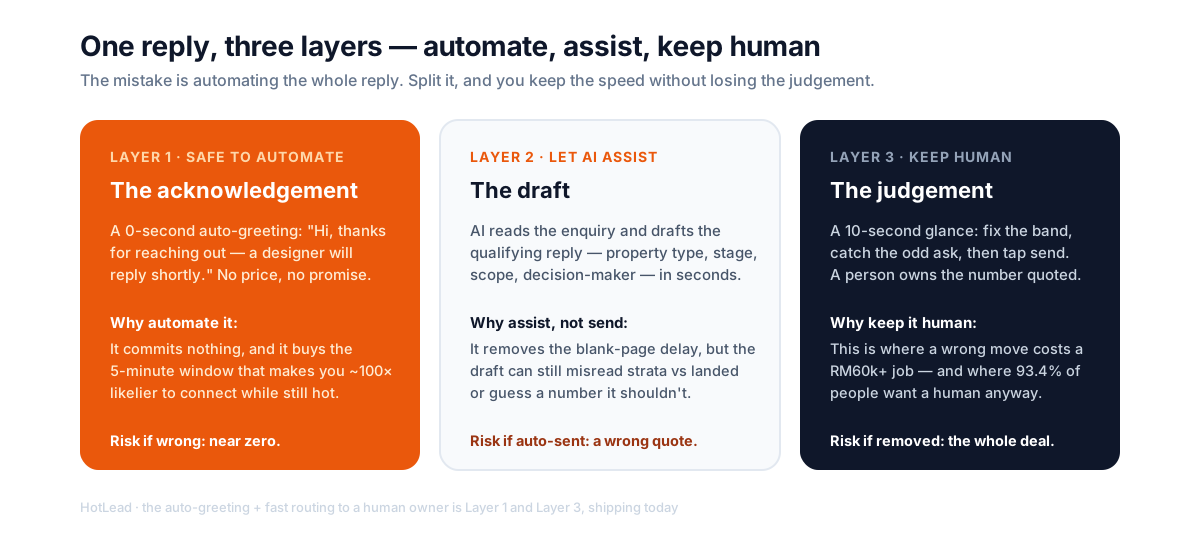
The lesson generalises into a rule I now use for any "should AI do this?" question in a lead process: automate the parts that commit nothing, assist on the parts that take effort, and keep a human on anything that commits a number or a promise. For the first reply, that splits cleanly into the three layers in the diagram above.
Why is this the honest answer for a Malaysian SME right now?
Because most Malaysian SMEs are at exactly the stage where the wrong AI build does real damage. An AWS-commissioned study of 1,000 Malaysian businesses found 27% now use AI (up from 20%), but 73% are stuck on basic, off-the-shelf applications and only 10% are doing anything advanced — and about half (52%) cite a lack of digital skills as the main barrier. Translation: a lot of owners are being sold "AI auto-replies to your leads" as a finished feature, with no one on staff to notice when it quietly quotes the wrong job.
The grounded move is not to skip AI — it is to point it at the part of the job where being wrong is cheap. Drafting is cheap to get wrong (a human catches it). Sending a price is expensive to get wrong (the customer catches it). So you automate the acknowledgement, you let AI draft, and you keep the human exactly where the money is.
What should an owner actually do on Monday?
You do not need to build an AI pipeline this week to capture 90% of the upside. In order:
- Automate the acknowledgement, not the answer. Put an instant auto-greeting on every WhatsApp enquiry that commits nothing — "Hi, thanks for reaching out, a designer will reply shortly." That alone buys the 5-minute window that does most of the work.
- If you use AI, use it to draft — never to send. Treat any AI reply as a first draft a human approves. The compute is free; the approval is the point.
- Never let AI hold the price band. A number in writing is an owner's decision. Keep it that way.
- Make sure the lead reaches a human fast. A great draft is useless if it sits unseen — the lead still needs one clear owner who gets it in seconds.
How HotLead fits — and what it deliberately does not do
I will be straight about this, because over-claiming is exactly the hype I am arguing against. HotLead does not write AI replies and send them for you, and that is on purpose — this experiment is the reason why. What it does is the part the experiment proved is safe and valuable to automate:
- An instant auto-greeting on every enquiry — Layer 1, the acknowledgement that buys the 5-minute window without committing a price.
- Capture and routing that puts each lead in front of one human owner in seconds, so the real qualifying reply happens fast — by a person.
- Next-action and overdue-follow-up nudges, so the lead a human is meant to reply to never sits unseen.
- A funnel and per-channel view, so you can see whether you are losing leads at the first reply or further down.
In other words, HotLead ships Layer 1 and the fast hand-off to Layer 3, and leaves the judgement to your team — which is the build that actually pays off. If slow, missed first replies are your leak, start with the complete guide to managing renovation leads in Malaysia, see how it fits a renovation firm or an interior-design studio, or read the companion piece on qualifying a lead in the first reply.
Sources: GPT-4o mini API pricing (USD0.15 / 1M input, USD0.60 / 1M output — used for the illustrative drafting cost); Kinsta — Consumers prefer human customer service over AI (93.4% prefer a human) and SurveyMonkey — Customer service statistics (8% prefer AI); CX Dive — Consumers prefer human-led customer service (48% distrust full-AI handling, per Pegasystems); Tech Wire Asia — Malaysia's AI adoption paradox (27% adoption, 73% basic, 52% cite a digital-skills gap as the main barrier, AWS-commissioned study). Speed-to-lead and follow-up figures (MIT / Dr James Oldroyd, Harvard Business Review, Velocify) and the Malaysian renovation cost bands are as cited in the complete guide and the qualifying guide.
Frequently asked questions
Can AI write the first WhatsApp reply to a renovation lead?
It can draft one well, in seconds, for a few hundredths of a sen in compute. What it should not do unsupervised is send it — the first reply to a renovation enquiry often commits to a scope reading or a price band, and that is exactly the kind of judgement an AI gets wrong at speed. The build that pays off has AI draft and a human approve and send.
How much does it cost to have AI draft renovation replies?
Almost nothing in compute. At published GPT-4o mini token pricing (about USD0.15 per million input tokens and USD0.60 per million output), a typical qualifying reply works out to roughly a tenth of a sen — under RM1 a month even at thirty enquiries a week. The real cost is never the tokens; it is what a wrong auto-sent reply does to a deal worth tens of thousands of ringgit.
Should I use an AI chatbot to auto-reply to renovation enquiries?
Use it for the instant acknowledgement — a greeting that buys you the five-minute window but commits nothing. Do not use it to send the actual qualifying reply unsupervised, because it cannot reliably tell a strata condo job from a landed one or hold the line on a price band. Surveys are blunt here too — 93.4% of people prefer a human, and 48% distrust companies that let AI handle queries completely.
What part of the first reply is safe to automate?
The acknowledgement layer. A 0-second auto-greeting ("Hi, thanks for reaching out, a designer will reply shortly") commits no price and no promise, so the downside of getting it wrong is near zero, while it captures the speed advantage that makes you about 100 times likelier to connect. The draft is a good assist; the price band and the send stay human.
Does HotLead use AI to reply to my leads for me?
No. HotLead automates the part that is safe to automate — an instant auto-greeting on every enquiry — then captures and routes the lead to a human owner with the next action in front of them, fast. The actual qualifying reply, with any number in it, stays a person's decision. That is the same split this experiment landed on.
Keep reading
- Can AI Write the Weekly Lead Report a Renovation Owner Will Actually Act On? I Built It, Then Killed ItYou've finally got the dashboard — funnel, per-channel numbers, who's fast. You look at it on Sunday night and think, now what? So the 2026 reflex is to ask AI to read it all and write you a weekly report. I built that bot, ran it for a month, and killed it. Here's why an AI-narrated report is a trap for a small reno firm — it restates what you can see, invents causes it can't know, and calls random noise a trend — and the boring version that actually moved something.
- How Long Does It Take to Close a Renovation Lead in Malaysia? The Sales-Cycle Clock Owners Never WatchMost owners track their conversion rate and ignore the other half of the picture — how long a deal actually takes. In home improvement the sales cycle has doubled from 30 days to 60-plus, and a Malaysian reno runs longer still because of loan approval and vacant-possession keys. Here is what a healthy time-to-close looks like, why you should not try to shorten the buyer's half of it, and how deal age tells you a stalled lead from one that is simply marinating.
- The JMB Enquiry Isn't a Homeowner Lead — Why Contractors Lose Strata Building WorksA WhatsApp from a JMB chairman asking you to quote a condo repaint or waterproofing job looks like any other lead — so contractors answer it like a homeowner, and lose. The buyer is a committee that votes over months, not a person deciding this afternoon. Here's how to win the strata job.