

A reno firm owner asked me a very 2026 question over kopi: "Everyone's got an AI that reads the lead. Can it just look at each WhatsApp enquiry and send it to the right salesperson — the one who's best for that job?" His team is four people. Right now he eyeballs every new enquiry himself and forwards it — which means at 11pm, or when he's on a site in Rawang with no signal, leads just sit there with nobody's name on them.
It's a fair question, and it's the assign step of the lead chain — the quiet one between "a lead came in" and "someone replied." So I did what I always do: can AI actually solve this profitably, or does it just feel modern? I built the clever version — AI reads each lead and picks the best-fit rep — and the boring version — AI tags the lead, a plain rule assigns it — and I measured both. The result surprised me enough to write it down, because the assign step turns out to be the one place in the whole pipeline where a dumb rule beats smart AI, and there's a clean reason why.
What does the assign step actually have to do?
Three things, and none of them is "be clever." Assignment exists to make sure every lead has one owner, instantly, and on a basis everyone trusts — so nothing sits unclaimed and no two reps double-reply. That's it. It's a plumbing step, not a genius step.
Hold that in mind, because it's the whole answer. We covered the group-chat version of this problem before — a shared number where "everyone assumes someone else replied" and leads rot with no name on them. Assignment is the fix for that, and its job is to be reliable, not brilliant. Speed is why: about 78% of deals go to the first responder (the InsideSales.com/MIT lead-response study), and companies that make contact within the hour are roughly seven times more likely to qualify a lead than those who wait longer (the classic Harvard Business Review lead-response findings). Assignment is upstream of that first reply — so if it's slow or unclear, every downstream number suffers.
Can AI pick the best salesperson for each lead?
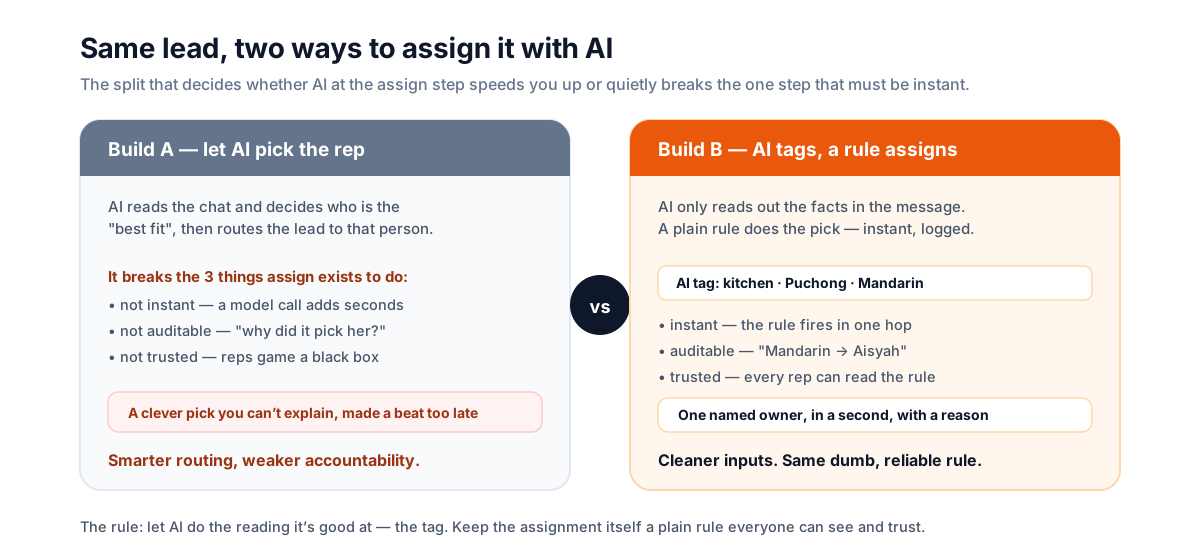
Technically yes — and that's the trap. I gave a model the incoming enquiry and each rep's strengths and told it to route to the best fit. It made sensible picks: the Mandarin-speaking condo kitchen job to the designer who does those, the big landed-house build to the senior. On a spreadsheet it looked smart.
Then I looked at what it cost the three things assignment is for:
- It stopped being instant. A model call is a beat of latency and a new point of failure. When the pick has to happen in the second the lead lands, "usually fast, occasionally thinking, and down if the API is down" is a downgrade from a rule that just fires.
- It stopped being auditable. When a rep asks "why did that lead go to Aisyah and not me?", the honest answer was "the model weighed some things." You can't run a fair team on that. A rule — Mandarin → Aisyah, Johor site → the JB rep — answers the question in one line.
- It stopped being trusted. The moment reps sense a black box is handing out leads, they assume it's handing them the junk — and they start gaming it or ignoring it. A visible rule everyone can read kills that instantly.
None of those failures is about AI being bad at picking. It picked fine. They're about the assign step needing properties that a probabilistic decision can't offer. That's the crux, and it's the opposite of the CRM-update experiment, where AI's reading was the safe part and its verdict was the dangerous part. Here it's the same shape: the reading is where AI belongs; the decision stays mechanical.
So what should AI do at this step?
The tag, not the pick. This is where AI genuinely earns its fraction of a sen. The hard part of a good routing rule isn't the rule — it's having clean facts to route on the instant a lead lands, before any human has read it. A Malaysian WhatsApp enquiry rarely arrives as clean fields. It arrives as:
"hi, saw ur ig — nak buat kabinet dapur for condo kat puchong, around 25k boleh? boleh cakap mandarin ah?"
A human reads that in a second: kitchen cabinetry, Puchong, ~RM25k, Mandarin-speaking. AI reads it just as well, instantly, for about 0.1 sen — the same rounding-error cost we measured back in the first-reply experiment — and drops it into structured tags: { job: kitchen, area: Puchong/Selangor, value: ~RM25k, language: Mandarin }. Now a plain, visible rule has something to route on: Mandarin opener → the Mandarin-speaking designer; Selangor site → the Klang Valley team.
That's the honest division of labour: AI does the reading it's good at, and hands a dumb rule cleaner inputs than it's ever had. The pick stays a rule — instant, one line to explain, readable by every rep. (To be clear about the product: this tagging layer is an experiment you'd wire up, not something I'm claiming HotLead ships — HotLead's routing is the rules you set, which I'll come back to.)
Why does "always route to the best rep" backfire?
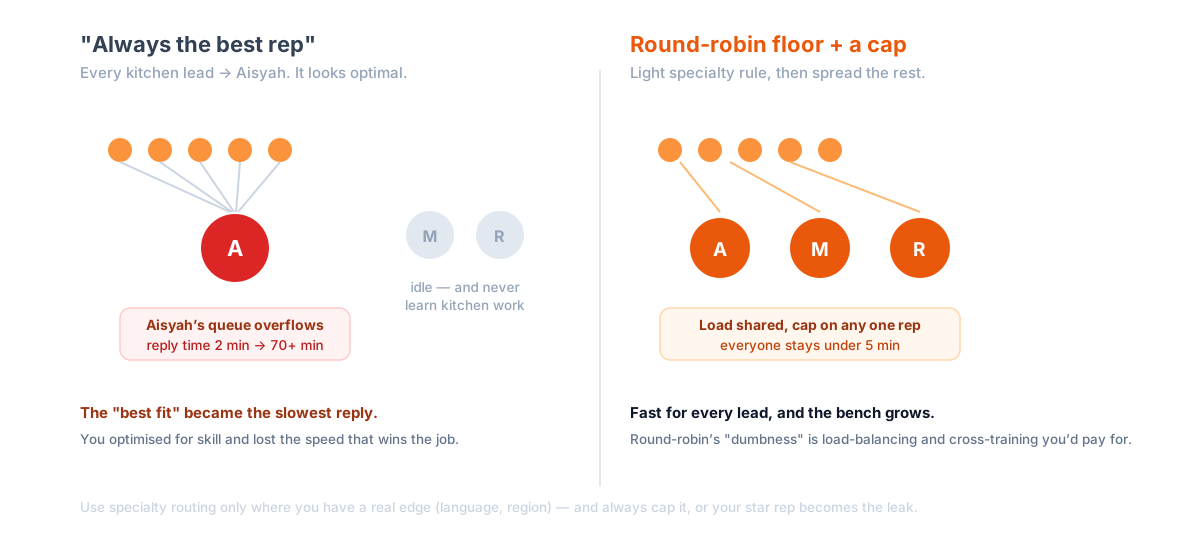
Because it quietly overloads your best person and starves everyone else — and it costs you the exact speed you were trying to buy. This was the most useful thing the test taught me, and it's a genuinely counter-intuitive operator point.
Say Aisyah is your best kitchen closer. "Smart" routing sends her every kitchen lead. Feels optimal. But leads don't arrive one at a time politely — they cluster (a boosted post lands, three condo owners message within an hour). Now Aisyah has a queue, her reply time slides from two minutes to over an hour, and the speed advantage that wins jobs is gone — on your best rep, on your best leads. Meanwhile the other two sit idle and, worse, never build kitchen experience, so your bench gets thinner over time, not deeper.
When is a specialty rule actually worth it?
When the match changes the outcome, not just the tidiness — and in a Malaysian reno or ID firm, that's mostly two things: language and location.
- Language. This is a real edge here, not a nice-to-have. About 22% of Malaysians are ethnic Chinese and 6.5% Indian (DOSM, 2024), and plenty of buyers open in Mandarin, a Chinese dialect or Tamil precisely to check they'll be understood. A lead who writes "boleh cakap Mandarin?" and gets routed to a rep who can't is a lead you've half-lost at hello. Routing by language is a specialty rule that genuinely pays.
- Location. For anything with a site visit — which is most reno and construction work — the rep nearest the job should own it. A Johor extension shouldn't route to your KL-based closer who then has to hand it over anyway. Region routing means the person who'll drive to the site visit is the one building the relationship from message one.
Notice what's not on that list: "best at kitchens," "most likely to close," "highest performer." Those are exactly the tempting, AI-flavoured criteria that concentrate load and go stale. The rules worth having are the boring, stable ones — language, region — that a human could write on a whiteboard and every rep would nod at.
What should an owner actually wire up on Monday?
Keep the decision boring, and spend your cleverness upstream. The split pays because you keep the speed and the accountability instead of trading one for the other.
- Make round-robin your floor. Instant, perfectly fair, self-load-balancing, and it keeps your whole team sharp. It's the default for a reason.
- Add at most one or two specialty rules — language and region — and cap them. Route Mandarin/Tamil openers and site-visit jobs by who genuinely fits, but put a ceiling on how many any one rep holds so your best closer never becomes the bottleneck.
- Use AI for the tag, never the pick. Let it read the messy Manglish enquiry into clean fields the instant it lands, so your rules have real facts to fire on. That's the fraction-of-a-sen job it's actually good at.
- Put one named owner on every lead, logged, in seconds — after hours included. An auto-acknowledgement buys the owner time; the assignment makes sure there is an owner.
- Watch the assign-to-first-reply gap per rep. If one person's leads consistently wait longer, your rule is concentrating load — fix the rule, don't add more AI. This is the same per-person visibility that tells you who's sitting on quotes.
How HotLead fits — and where it deliberately keeps a rule
I'll be straight, because over-claiming is the hype I keep arguing against. HotLead assigns leads exactly the way this experiment says you should: with rules you control, not a model's private judgement.
- It routes by round-robin, manual, or a custom rule by area or source — so the pick is instant, one line to explain, and visible to the team. No black box deciding who gets what.
- It puts one named owner on every enquiry the moment it lands, even at 11pm when the owner's on a site in Rawang — the exact gap that started this.
- It keeps a next action and an overdue nudge on each lead, and shows a per-person view so the assign-to-reply gap is visible and you can rebalance the rule.
- Its optional AI assistant warms and qualifies a brand-new enquiry — the safe, in-the-chat reading half — while which human owns the deal stays a rule you set, by design.
That restraint is the point, not a gap. The assign step is where a dumb rule genuinely beats smart AI, so HotLead keeps it a rule — and spends the intelligence where it belongs, on reading the lead, not on quietly deciding who owns it. If leaking leads are your problem, start with the complete guide to managing renovation leads in Malaysia, see how it fits a renovation firm or an interior design studio, or read the companion builds on AI first replies and auto-updating the CRM.
Sources: First-responder win rate (~78% of deals to the first firm that responds) from the InsideSales.com/MIT lead-response study (Dr James Oldroyd, MIT), the most-cited primary source for that figure; the response-time-to-qualification relationship (contacting within the hour ≈ 7× likelier to qualify a lead; waiting 24 hours+ sharply less likely) from the related Harvard Business Review analysis of lead-response data, "The Short Life of Online Sales Leads" (Oldroyd, McElheran, Elkington), consistent with the benchmarks in our lead-response-time piece. Automated-routing productivity and sub-minute routing targets are guidance commonly published by lead-routing platforms (e.g. LeanData, Landbase) and are cited here as directional practice, not a single controlled study. Malaysian ethnic composition (2024 citizens: ~22.4% Chinese, ~6.5% Indian, ~70.4% Bumiputera) from the Department of Statistics Malaysia Current Population Estimates 2024, reported via BERNAMA. Illustrative per-lead AI tagging cost derived as in the first-reply experiment; labelled illustrative, not a quoted price. The routing behaviours, bench-starvation dynamic, and Malaysian language-routing scenarios are described from practice with HotLead's real routing model (round-robin, manual, custom rule by area or source), not from a published statistic.
Frequently asked questions
Can AI decide which salesperson should get each renovation lead?
It can, technically — a model can read an enquiry and pick a "best fit" rep. But it shouldn't own that decision, and when I measured it, the clever version lost to a plain rule. Assignment has to be instant, explainable and trusted by the team, and letting AI make the pick weakens all three — it adds a beat of latency, it can't tell a rep why a lead went elsewhere, and people distrust and game a black box. The better use of AI is to tag the lead with the facts it can read — job type, area, language, rough value — and let a simple, visible rule do the actual assigning.
What's the best way to route WhatsApp leads across a small reno or ID team?
Start with round-robin as the floor — it's instant, perfectly fair, and it load-balances and cross-trains your team for free. Add a light specialty rule only where you have a genuine edge — route Mandarin or Tamil openers to someone who speaks the language, or route by region so the person nearest the site handles the visit. Keep the rule short enough that every rep can read it, put one named owner on every lead the second it lands, cap how many any one rep can hold so your best closer doesn't become the bottleneck, and watch the gap between assignment and first reply per person.
Isn't round-robin too dumb — it ignores who's actually best for the job?
That "dumbness" is doing more work than it looks. Even spread means no one rep drowns while others idle, everyone keeps their reply time low, and your whole team keeps getting reps at every job type instead of one specialist hoarding the kitchen jobs. Smart, always-best-fit routing does the opposite — it concentrates load and skill on one person until their speed collapses and the bench goes stale. Use specialty routing only where the match genuinely matters — mainly language and location — and always with a capacity cap.
Does HotLead use AI to assign leads?
HotLead assigns with rules you control — round-robin, manual, or a custom rule by area or source — because the assign step should be instant, auditable and trusted, and a rule is all three. It puts one named owner on every enquiry the moment it lands, even after hours, keeps a next action and an overdue nudge on each lead, and shows a per-person view so you can see who's fast and who's sitting on quotes. Its optional AI assistant warms and qualifies a brand-new enquiry; it doesn't secretly decide which human owns the deal.
How fast does a lead actually need to be assigned?
In seconds, not minutes — assignment is upstream of the reply, and the reply is where the money is. About 78% of deals go to the first firm that responds (InsideSales.com/MIT lead-response research), and contacting a lead within the hour makes you roughly seven times likelier to qualify it than waiting longer (HBR). The best teams route a new lead to a named owner inside about a minute of capture. That speed requirement is exactly why the pick has to be a rule — a rule fires the instant the lead lands, every time, with no thinking and nothing to go down.
Keep reading
- The Only Three Ways to Grow a Renovation Firm — and Which Lever to Pull FirstEvery renovation firm's revenue comes down to three levers — how many leads you get, how many you close, and how big each job is. They multiply, so a modest lift on each compounds. But they cost wildly different amounts to pull, and most owners reach first for the one they should reach for last. Here's the ranking, with Malaysian numbers.
- Sight Unseen: Winning the Overseas Malaysian Who Renovates a Unit They Can't VisitA Malaysian working in Singapore collects the keys to a KL condo and messages you to fit it out — but they can't come to a site visit, can't walk your showroom, and will wire a deposit to a firm they've never met. Most firms treat this lead like a walk-in, go quiet when the buyer can't pop by, and lose the highest-budget job in the inbox. Here's why the remote buyer is your hardest-trust but best-paying lead, and how to build a remote lane that actually closes it.
- "Ok, Proceed" Isn't Money in the Bank — I Built an AI to Ask for the Deposit the Moment a Renovation Buyer Says YesA Cheras contractor closes a RM62k job on WhatsApp, the buyer says "ok proceed lah", and then the owner — mid-site, phone in a dusty hand — has to stop, pull the bank details, the agreed deposit and the scope, and type a careful money message. In that gap a hot yes quietly cools back to "let me think." The 2026 reflex is to ask AI to detect the yes and auto-fire the invoice. I built it, and it asked a half-committed buyer for 40% to a personal account two seconds after a soft "ok ok". Here's the version that kills the typing delay without asking for money off a misread.