

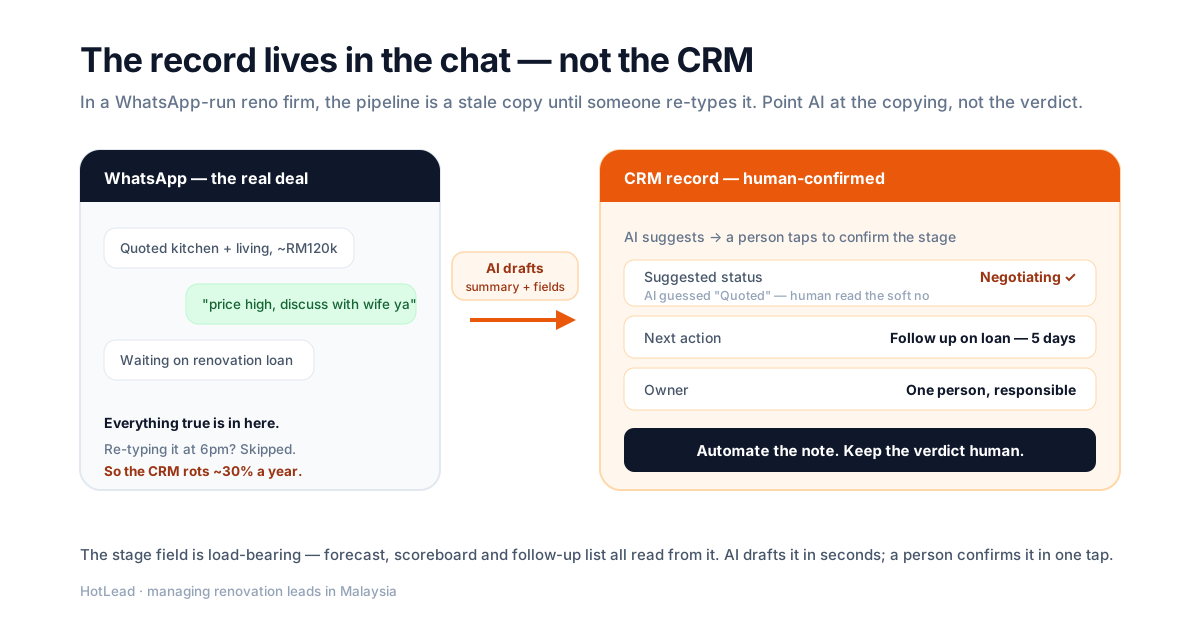
Here is a scene every renovation and interior-design firm in the Klang Valley will recognise. It is 6pm, and a salesperson has just worked through twelve WhatsApp chats — a Kajang semi-D wanting a full reno, a Mont Kiara condo owner comparing three quotes, a walk-in who went quiet after the price. The conversations happened. The follow-ups are half-agreed. And the CRM — or the spreadsheet, or the pipeline board — shows none of it, because updating it means re-typing what is already sitting in the thread, and nobody has the appetite for that at 6pm.
So the honest 2026 question an owner actually cares about: can AI just read each chat and update the record for me — and does that save real hours? And the sharper follow-up I always end up asking: can it do that without quietly wrecking the one field my whole pipeline runs on? I built it and measured it. Here is the problem, what the admin costs before AI, what the two builds did, which hours actually came back, and what the automation got wrong.
What does "updating the CRM" cost a renovation firm before any AI?
Before AI, keeping the CRM current costs you in a way most owners never price properly: it is a second, manual copy of a conversation that already exists in full on WhatsApp. The truth of the deal — what was quoted, what the buyer objected to, what they're waiting on — is in the chat thread. The CRM record only becomes true when a tired human re-reads that thread and re-types the gist into a box. That double entry is exactly the work people skip when they're busy, which is always.
Put numbers on it. Salesforce's State of Sales research has for years found reps spend less than 30% of their time actually selling — the rest goes to admin, internal meetings and, prominently, manual data entry. Sales-productivity compilations put that data entry at around 13 hours a week for the average salesperson, with a big share of reps spending over an hour a day just logging what already happened. In a renovation firm that "admin" isn't abstract — it's the after-chat update that never gets done.
And here's the part that bites later: an un-updated CRM doesn't stay neutral, it rots. The data-quality figure most sources converge on is roughly 30% decay a year — numbers change, deals move, statuses go stale — and that's for records people do maintain. A pipeline that's a manual copy of WhatsApp, updated whenever someone remembers, decays far faster. So the "cost" of CRM updating isn't only the hours; it's that the report you eventually pull to decide anything — who to chase, which channel pays, who on the team is dropping deals — is built on a stale copy.
That is a real, expensive, boring job — the exact profile of work AI should be good at. (Sarah's take on why leads leak in busy season is the human-discipline side of the same problem; this piece asks what happens when you hand the logging to a machine.)
So can AI just read the chat and update the record? The reflex build — and why it backfired
This was Build A, and it's the build almost everyone demos first: full auto. Chat ends, AI reads the whole WhatsApp thread, writes a summary, extracts the fields (budget, scope, timeline), sets the status and pipeline stage, moves the lead on the board, and writes the next action — all committed to the record with no human in the loop. On the clean chats it's magic. You finish a conversation and the CRM is already updated. It feels like the future.
Then you run it on real Malaysian renovation chats, and the failure isn't in the summary — it's in the deciding. Two problems show up fast, and I want to be precise that these are the illustrative patterns I saw building and stress-testing it, not a published trial.
First, AI sets the stage from the words alone — and Malaysian buyers don't put the truth in the words. The homeowner who typed "ok boss, will consider first ah, thanks" has almost certainly said a soft no — anyone who's sold reno here knows that. The model reads polite, non-committal text and logs the lead as an open, mid-funnel opportunity. Meanwhile a genuine buyer closes with a flat "ok can, proceed lah" that reads as low-energy and gets under-ranked. The stage field — the single most important cell in the whole system — ends up populated by a model that took the politeness at face value. It's the same trap the qualification experiment hit from the other end: the message tidiness doesn't match the deal reality.
Second, the field it's writing to isn't a note — it's load-bearing. A summary can be slightly off and no harm done; a human reading it fills the gaps. But the stage drives everything downstream: who lands on the overdue-follow-up list, what the forecast says, which salesperson the team scoreboard flags as dropping deals. AI summary tools are well-documented to hallucinate details, swap owners and dates, and smooth over nuance — the financial-planning community at Kitces flatly advises reviewing AI notes before they hit the CRM for exactly this reason. Let the model auto-commit the stage, and a hallucinated "quoted — awaiting deposit" or an auto-marked "lost" quietly corrupts the one number every decision reads from.
So if the question is "can AI cheaply write a summary of a chat?", the answer is an easy yes — the compute is a rounding error, roughly a tenth of a sen per thread at illustrative GPT-4o mini pricing, same order as the first-reply and follow-up experiments. The tokens were never the cost. The cost is a pipeline full of confident, wrong statuses.
What actually worked: AI drafts the update, a human confirms the stage
Build B kept everything good about Build A and removed the part that corrupted the pipeline. The split is the same one every experiment in this series keeps landing on: automate the work that commits nothing; keep a human on the step that changes the record everyone trusts.
Concretely, after a chat AI still does the whole tedious part in seconds. It drafts a clean, one-screen summary, extracts the fields, and — the useful bit — proposes the update: "Suggested status — Quoted, awaiting decision. Next action — follow up on loan approval in 5 days. Budget signal — ~RM120k, kitchen + living." But it never commits the stage on its own. The salesperson glances at the card, and with one tap either confirms the suggested move or corrects it. The 60-to-90 seconds of re-typing collapses into a five-second review; the load-bearing decision stays human.
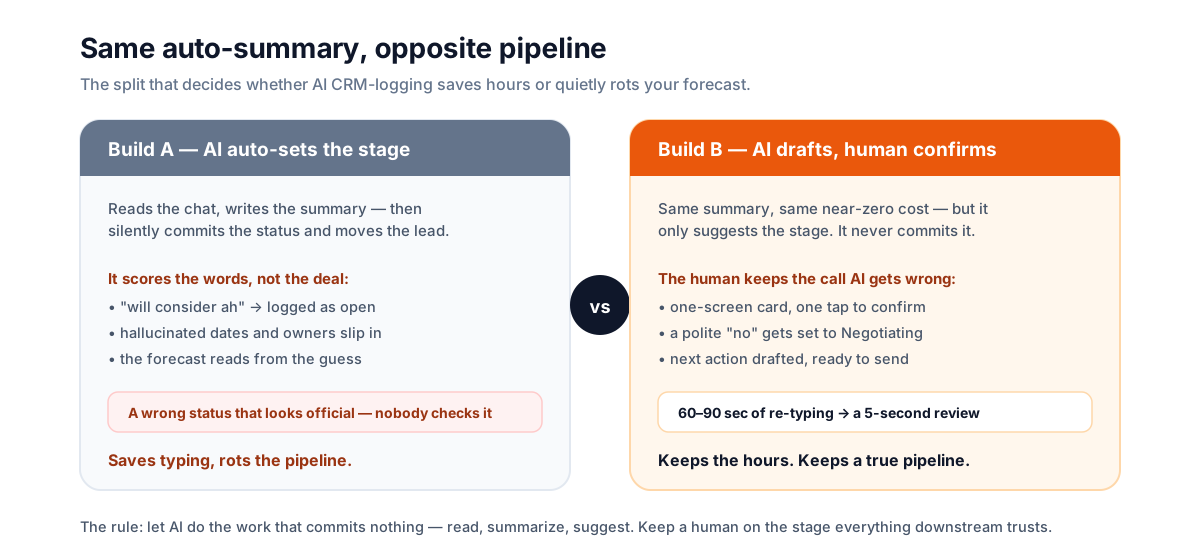
That distinction — AI drafts, a human commits the stage — is the whole product. You keep the hours, because the re-typing is gone. You keep a clean pipeline, because the one field your forecast and follow-up list depend on is set by someone who was actually in the conversation and knows "will consider ah" means goodbye. And you remove the one thing AI is genuinely bad at here: reading a polite, thin Malaysian chat and deciding, unsupervised, what the deal really is.
| Build A — AI auto-updates the stage | Build B — AI drafts, human confirms | |
|---|---|---|
| Drafts the summary & fields | Yes — seconds | Yes — seconds |
| Compute cost | ~0.1 sen / chat | ~0.1 sen / chat |
| Re-typing saved | ~60–90 sec → 0 | ~60–90 sec → ~5 sec review |
| Reads a polite "will consider" correctly | No — logs it as open | Yes — human sets it |
| Who sets the load-bearing stage | The model | A human, one tap |
| Failure mode | Silent — forecast rots on guesses | Visible — a person confirmed it |
Which hours actually came back — and what the automation got wrong
Across the stress-test the pattern was clear enough to state plainly, even though the exact figures are illustrative: the hours came back on the logging, not on the deciding. The after-chat admin — the summary, the field extraction, the drafted next action — is genuine dead time, and AI erased almost all of it. That's the win, and it's a real one: a salesperson doing a dozen chats a day gets most of an hour back, and it goes back into selling instead of typing.
What the automation got wrong, every time, was the thing that lives outside the words: tone, politeness, and the local context the buyer never spells out. A model scoring the stage on chat text alone is blind to the exact variable that decides a renovation deal — is this a real yes, a polite no, or a genuine maybe? A human who was in the conversation carries that for free. So the honest measure isn't "AI updates the CRM X% faster." It's narrower and more useful: AI converts the logging from a skipped chore into a five-second review, and a human converts a drafted guess into a stage that's actually true. Take the human off the stage, and you've automated a rotten pipeline — worse than the blank one you started with.
Why is this the honest answer for a Malaysian firm right now?
Because here the CRM will always be a copy of WhatsApp, and the market is at exactly the stage where the wrong build does quiet damage. Roughly 90.7% of Malaysians use WhatsApp, and for a reno or ID firm it's not one channel — it's the channel where the whole deal actually happens. That means the CRM is structurally a second copy, and anything that keeps that copy honest with less human effort is worth real money. But it also means the stage field is being guessed from the most context-dependent, politeness-loaded medium there is.
And most local SMEs aren't staffed to catch a machine getting it wrong. An AWS-commissioned study of 1,000 Malaysian businesses found 27% now use AI but 73% are stuck on basic, off-the-shelf tools, with around half citing a digital-skills gap. Translation: plenty of owners are being sold "AI updates your CRM automatically" as a finished feature, with nobody on staff to notice when the forecast is quietly built on hallucinated statuses. The grounded move isn't to skip AI on CRM admin — it's to point it at the safe, valuable half (the summary and the draft) and keep a human on the half that isn't (the stage that everything downstream trusts).
What should an owner actually do on Monday?
You don't need to build an auto-logging engine this week to get most of the upside. In order:
- Let AI draft the update, never commit it. If you point a model at your chats, have it produce a summary, extract the fields and suggest a status and next action — and stop there. The draft saves the hours; the draft is the win.
- Keep a human on the stage. The pipeline stage is load-bearing — forecast, scoreboard, follow-up list all read from it. One tap to confirm or correct is cheap; an auto-set wrong status is expensive and invisible.
- Treat the summary as a draft, not a record. AI notes swap dates and smooth over nuance. A five-second glance from the person who was in the chat is what turns a plausible summary into a true one.
- Fix "one record, one owner" first. A perfect AI summary is useless if it lands in a shared inbox with no one responsible. Every lead still needs one owner and a next action, or the group-chat leak swallows it regardless of how tidy the note is.
How HotLead fits — and what it deliberately does not do
I'll be straight, because over-claiming is the hype I keep arguing against. HotLead does not silently rewrite your pipeline stages or mark deals won and lost from chat text with AI — and after this experiment, that's clearly the right call. What it does is the part the experiment proved is safe and valuable:
- One structured record and one owner per lead, with a status in your pipeline your team keeps true — not a field a model quietly overwrites on a guess.
- A next action on every lead so the update actually turns into a follow-up, instead of a tidy note that no one acts on.
- An optional AI assistant you can switch on that warms a brand-new enquiry and collects budget and scope into the record — gathering and structuring, not committing your stages. You can take over any chat at any time.
- A funnel and per-channel view and a team scoreboard that are only as honest as the stages behind them — which is exactly why those stages should be human-confirmed, not auto-guessed.
In other words, HotLead keeps one clean record your team owns, and leaves the load-bearing verdict with a person — the build that actually pays. If a stale, half-updated pipeline is your leak, start with the complete guide to managing renovation leads in Malaysia, see how it fits a renovation firm, or read the companion experiments on AI lead qualification and manual vs AI follow-up.
Sources: Reps spend under a third of their time selling from Salesforce — State of Sales research; manual data-entry time (13 hours/week for the average salesperson; large share of reps spending 1+ hour/day logging) from sales-productivity compilations including AskElephant — why reps spend 25% of time on CRM and EverReady — statistics for CRM data-entry automation. CRM data decay (30% per year the figure most sources converge on; classically traced to SiriusDecisions/Marketing Sherpa) from Verum — CRM data decay rate and SparkDBI — CRM data decay rates by industry. AI summary/note error profile (hallucinated details, swapped owners and dates, dropped qualifiers; review before saving to the CRM) from Kitces — the risks of AI meeting notetakers and Circleback — how AI meeting notes actually work. Malaysian AI adoption (27% adoption, 73% basic tools, half cite a digital-skills gap; AWS-commissioned study) from Tech Wire Asia — Malaysia's AI adoption paradox. Illustrative compute cost uses GPT-4o mini API pricing (USD0.15 / 1M input, USD0.60 / 1M output). WhatsApp penetration (90.7% of Malaysians) and Malaysian renovation cost bands as cited in the complete guide.
Frequently asked questions
Can AI update my CRM automatically after a WhatsApp chat?
It can do the drafting half very well — reading the thread and producing a tidy summary, a suggested status and a next action in seconds for a fraction of a sen. What it should not do unsupervised is commit the stage change — silently moving a lead to "quoted" or "lost". It reads only the words in the chat, and Malaysian buyers are polite and vague, so a soft "let me think first ah" gets logged as a live opportunity while a real yes hides behind "ok can". Use AI to draft and suggest; keep a human on the one tap that changes the record everyone trusts.
Does auto-updating the CRM with AI actually save time?
Yes, on the part that is pure admin. Sales reps spend well under a third of their time actually selling and lose hours a week to manual data entry, and after-chat logging is a chunk of that. Handing the summary and the draft update to AI collapses that re-typing to a few seconds of reviewing. The saving is real — it just should not extend to letting the model set the pipeline stage on its own.
Why is it risky to let AI set a lead's status or stage?
Because the stage field is not a note — it is the number your forecast, your team scoreboard and your overdue-follow-up list all read from. AI meeting-note and summary tools are known to hallucinate details, swap owners and dates, and smooth over nuance, so an auto-set stage can quietly be wrong. In a WhatsApp renovation chat the signal is especially thin and polite, so a model guessing "lost" or "won" from the words alone will misclassify the exact deals that pay the rent. A wrong status that looks official is worse than a blank one.
How much does it cost to have AI summarize a WhatsApp chat?
Almost nothing in compute. A full enquiry thread plus a prompt is on the order of a couple of thousand input tokens and a short structured summary back; at illustrative GPT-4o mini list pricing (around USD0.15 per million input tokens and USD0.60 per million output) that is roughly a tenth of a sen per chat. The cost that matters was never the tokens — it is a mis-set stage that hides a live RM120k job or inflates a forecast built on guesses.
Does HotLead auto-update my CRM with AI?
HotLead gives every lead one structured record, one owner, a status in your pipeline and a next action — the record your team keeps true, not one a model silently rewrites. The optional AI assistant you can switch on warms a brand-new enquiry and collects budget and scope into that record, and you can take over any chat at any time. It gathers and structures; it does not quietly move your pipeline stages or mark deals lost on a guess. That split is exactly what this experiment landed on.
Keep reading
- How Much Cash Does a Renovation Firm Actually Need to Run?A renovation firm can be profitable, fully booked, and still run out of money — because every live job ties up your own cash between the deposit and the final payment, and that buffer grows every time you win more work. Here's how to size the working-capital cushion a Malaysian reno firm needs with real numbers, why growth consumes cash faster than it makes it, and why the size of your buffer quietly decides how many leads you can afford to say yes to.
- The Copy-Paste Quote Request: Telling a Real Shortlist Buyer From a Price-Harvester Blasting Ten FirmsAn identical, detailed WhatsApp lands in ten contractors' inboxes at once — "please quote for full renovation" with a copy-pasted brief. It looks like the best kind of lead — specific, thorough, ready. So you spend a Sunday building a full itemised quote, and never hear back. Here's why a detailed brief blasted to ten firms is not a serious buyer, how to tell a genuine shortlist buyer from a price-harvester or a bank-loan document-seeker, and how to give a fast, useful ballpark that protects your estimating hours without looking unhelpful.
- Handing Over a Warm Renovation Lead: Can AI Catch the Next Person Up on a 40-Message Thread Without Dropping the Promise That Wins the Job?A renovation lead starts, goes quiet for six weeks on the buyer's loan-and-keys clock, then comes back — or the person who owned it goes on Raya leave and someone else picks it up cold. Now they have to scroll forty messages to reconstruct what was quoted, promised and left open. So the reflex is to ask AI to "catch me up on this buyer." I tried it. Summarising a long thread is the job AI is genuinely best at — but the reflex build drops the one thing that wins the job. Here's the version that actually paid.