

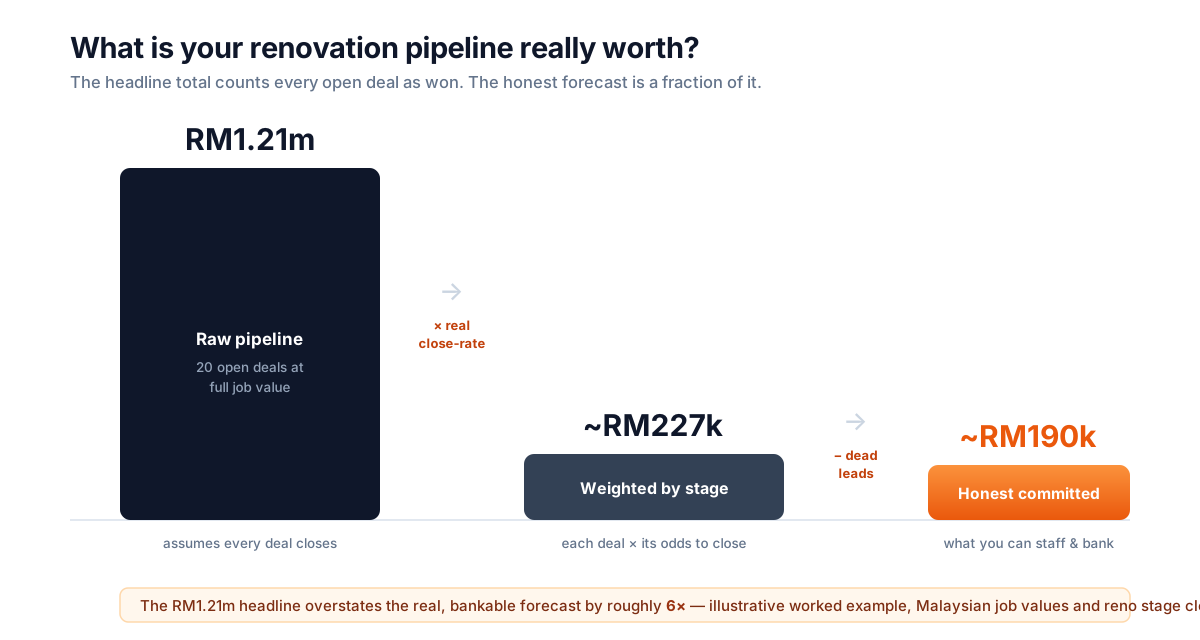
Ask a renovation-firm owner how business is looking and you will often get a number: "solid — I've got maybe half a million in the pipeline." It sounds precise. It feels reassuring. And it is almost always a fantasy, because that half-million counts every open enquiry and every sent quote as though it were already a won job.
The raw pipeline total assumes a 100% close rate on everything in it — which is why it is always far too high. The honest number is that total weighted by each deal's real chance of closing, and for a renovation firm it is usually five or six times smaller than the figure in the owner's head. This article shows you how to get to the real number, using Malaysian job values and reno close-rates — and why the biggest error is not the weighting at all, but the dead deals still sitting in the total.
Why is the number in your head wrong?
Because "the pipeline" as most owners say it is just the sum of every open deal at its full job value — and that quietly assumes all of them close. They will not. Malaysian home-improvement firms convert only about 7 to 8% of enquiries into jobs, so a pipeline of twenty open enquiries is not twenty jobs waiting to happen. It is, on average, one or two.
There are two separate errors baked into the headline number, and they compound:
- No weighting. A brand-new enquiry and a quote the buyer is actively negotiating are counted the same — both at full value. One is a maybe; the other is nearly a deal.
- No ageing. A lead that went silent six weeks ago still sits in the "open" column at full value, propping up the total even though it is, in practice, gone.
Fix the first and you get a weighted pipeline. Fix the second and you get an honest one. Most owners have done neither, which is how a firm with RM1.2 million of raw open deals is really staring at a forecast closer to RM190,000.
How do you weight a renovation pipeline properly?
Apply the weighted-pipeline formula: multiply each deal's value by its probability of closing from its current stage, then add up the weighted values. The formula itself is standard — weighted pipeline = the sum of (deal value × stage probability). What makes it right or useless is the probabilities you feed it.
Here is the trap. Most weighted-pipeline advice online tells you to slot in round numbers — 20% at discovery, 50% at proposal, 80% at contract. Paste those into a renovation pipeline and you have swapped one fantasy for another, because reno conversion is nothing like a SaaS deal. The fix is to use your own stage odds — the realistic chance a deal at each stage eventually becomes a paid deposit. From the Malaysian reno stage benchmarks (reply ~80% × qualify ~65% × book ~55% × attend ~80% × quote ~90% × close ~33%), the odds of eventually closing from each stage work out far lower than the SaaS defaults:
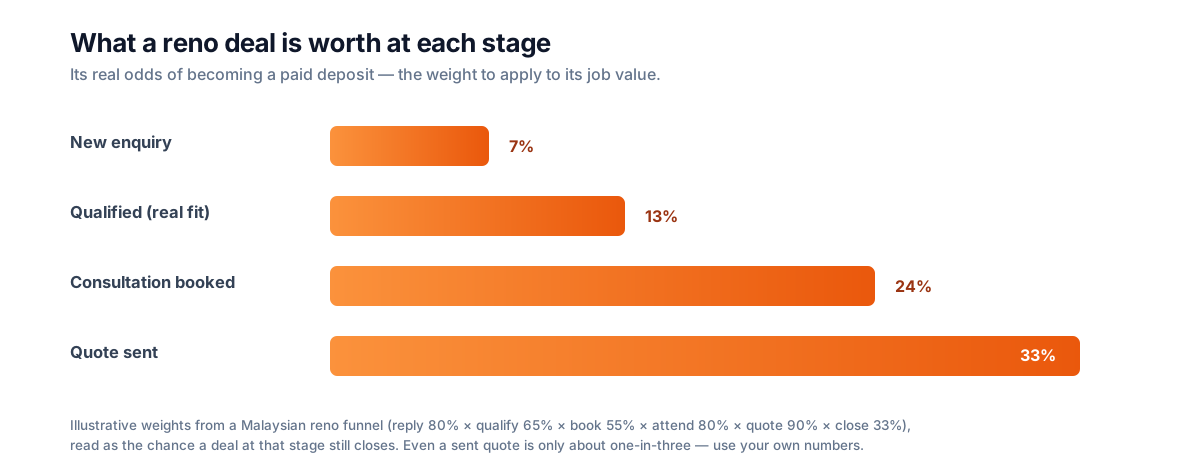
Notice how low these are. Even a quote already sitting with the buyer is only about a one-in-three chance — because in renovation the buyer is comparing three to five firms and the deal is genuinely up for grabs until the deposit lands. Now weight a real pipeline with those odds instead of gut feel:
| Stage | Open deals | Avg job value | Raw value | Odds to close | Weighted forecast |
|---|---|---|---|---|---|
| New enquiry | 8 | RM45,000 | RM360,000 | ~7% | ~RM25,000 |
| Qualified | 5 | RM60,000 | RM300,000 | ~13% | ~RM39,000 |
| Consultation booked | 3 | RM70,000 | RM210,000 | ~24% | ~RM50,000 |
| Quote sent | 4 | RM85,000 | RM340,000 | ~33% | ~RM112,000 |
| Total | 20 | — | RM1,210,000 | — | ~RM227,000 |
Why does value-weighting matter as much as probability-weighting?
Because in renovation the job values are wildly unequal, so a few big deals decide your number. A condo touch-up might be RM40,000 while a landed-home renovation runs RM250,000 — the typical spread is condo RM40k to 150k and terrace RM60k to 250k. That fivefold range means a reno pipeline is not a smooth average of many similar deals the way a SaaS pipeline often is; it is dominated by its biggest few.
Look back at the table. The four sent quotes contribute ~RM112,000 of the ~RM227,000 weighted forecast — nearly half — from just four deals, because they are both further along and larger. One RM200,000 landed-home job at the quote stage is worth more to your forecast than a dozen fresh RM45,000 enquiries. This has a practical edge:
This is why the highest-return place to spend your attention is rarely the newest, most exciting enquiry — it is the big quote that has stalled, because that single deal is carrying a disproportionate slice of your real forecast.
What is the bigger error — the weighting, or the dead weight?
The dead weight. Weighting fixes the "assumes everything closes" problem, but it still counts deals that stopped moving weeks ago. A stalled renovation deal that has gone silent is not worth its stage odds — it is worth close to zero, and leaving it in the pipeline at full weight is the more dangerous lie, because it hides inside an otherwise sensible-looking weighted number.
Use last activity, not stage, to spot them. The signal that a deal is dead is silence, not its label:
- No genuine two-way reply for two to three weeks at an early stage.
- Six weeks or more after a quote with no response to any follow-up.
B2B pipeline research is blunt about what stalling does to a deal: opportunities that move quickly carry roughly a 47% win rate, dropping to 20% or less once they drag on (widely cited from Outreach's pipeline data), and stale deals "inflate your coverage ratio and distort forecasts." The numbers are from software sales, so treat them as direction, not gospel — but the direction is exactly right for renovation, where a quote the buyer has ignored for two months is not a live one-in-three deal any more.
Here is the renovation-specific twist, and it is good news: a stalled reno deal is usually dated, not dead. Unlike a random B2B stall, a Malaysian homeowner who has gone quiet is very often waiting on a specific, knowable event — loan approval, getting the keys at vacant possession, the year-end bonus, or after the festive season. So the honest move is a split, not a delete:
- Dated (a real "not yet, because of X") — pull it out of the active forecast and park it with a wake-date, so it stops inflating this quarter but is not lost.
- Dead (silent, no reason, ignored every nudge) — close it lost, with a reason, so your close-rates stay honest.
Do that, and the ~RM227,000 weighted figure in our example drops again — to roughly RM190,000 of genuinely committed, staffable pipeline — once you strip out the three new enquiries that never replied and the one quote that has ignored a month of follow-ups.
So what is the honest pipeline number?
It is the raw total run through two filters — weighted by real stage odds, then aged to remove the dead. That is the number you can staff a team against, plan cashflow around, and compare to what actually closes. Set against professional benchmarks, an honest small-firm number is a genuine achievement: Gartner finds median sales-forecast accuracy sits at just 70 to 79%, with only about 7% of teams hitting 90% or better, and CSO Insights found nearly 60% of forecasted deals slip to a later period. You will not beat trained sales teams with a spreadsheet — the goal is honest, not perfect.
| The three numbers | What it is | Our example |
|---|---|---|
| Raw pipeline | Every open deal at full job value | RM1,210,000 |
| Weighted pipeline | Each deal × its real odds to close | ~RM227,000 |
| Honest committed | Weighted, minus dead and dated deals | ~RM190,000 |
How do you get these inputs without guessing?
You need three things on every open deal, kept current: a clear stage, a real close rate by source, and a last-activity date. The math is easy; the honest inputs are the hard part — and a shared WhatsApp number plus a spreadsheet stops supplying them in exactly the busy months when the forecast matters most.
That is not a discipline problem you can scold your way out of. The spreadsheet only stays accurate if a busy salesperson updates it religiously, which is the first thing that collapses when leads are pouring in. Without a live stage on each lead you cannot weight; without a last-activity timestamp you cannot age; without a source tag you cannot use real per-channel odds instead of a blended guess. So the pipeline you most need to trust is the one your current setup describes least well.
This is the same reason a lost lead feels free but is not, and the same reason cost per lead lies while cost per won job tells the truth — in every case the honest number requires data the spreadsheet quietly stops capturing.
How HotLead makes your pipeline number honest
HotLead is built to turn this from a guess into a screen you can read, for Malaysian renovation, interior-design and construction firms, on top of the WhatsApp you already use. It gives you the three inputs the weighted-forecast math needs:
- A clear stage on every lead — new, contacted, appointment, quoted, won or lost, with full history — so you can weight the pipeline by where deals actually sit instead of by feel.
- The next action and overdue flags on every lead — so a stalled quote surfaces as silent for six weeks instead of hiding in the total at full value, ready to be aged out or woken up.
- The funnel and per-channel close rate in ringgit — so the probabilities you weight with are your real ones, by source, not borrowed gut-feel percentages.
Start with the complete guide to managing renovation leads in Malaysia, read the stage-by-stage conversion benchmarks or what a lost lead really costs, or see the renovation, interior-design and construction playbooks.
Sources: weighted-pipeline methodology and the sum-of-(value × stage-probability) formula — Forecastio, "The Weighted Pipeline", DealHub, "What is Weighted Pipeline?", Drivetrain, "Pipeline-weighted sales forecasting"; the pitfall that gut-feel 20/50/80 probabilities make a weighted pipeline as misleading as a raw total — iSEEit, "The problem with weighted pipeline"; forecast-accuracy benchmarks — Gartner Sales Glossary, "Forecast Accuracy" and industry summaries of Gartner and CSO Insights (median accuracy 70–79%, ~7% of teams at 90%+, ~60% of forecast deals slip, data hygiene lifts accuracy up to ~30%) via GetAccept and Forecastio; deal-ageing and stall win-rate (47% for fast deals vs ~20% once they drag, no-activity-for-14-days as an inactivity signal, stale deals distorting forecasts) — Outreach pipeline-ageing data and pipeline-health guides via Outreach and Weflow. Malaysian job values (condo ~RM40k–150k, terrace ~RM60k–250k), ~18–25% residential gross margin and ~7–8% blended conversion are the house figures from the cost-of-a-lost-lead and funnel-benchmark pieces (Loanstreet, iProperty, ServiceTitan, Estatehub/WebFX). The pipeline figures in this article are illustrative worked examples — plug in your own job values, stage close-rates by source, and activity dates for your real number.
Frequently asked questions
How do you calculate the real value of a sales pipeline?
Multiply each open deal's value by its probability of closing from its current stage, then add those weighted values up — the classic weighted-pipeline formula, the sum of deal value times stage probability. The raw pipeline total assumes every deal closes, which is why it is always far too high. For a renovation firm, use your own stage close-rates rather than generic percentages, because reno conversion is low — a brand-new enquiry is worth only about 7 percent of its job value and even a sent quote about a third — so an honestly weighted reno pipeline is often five or six times smaller than the headline figure.
What is a weighted pipeline and why is it more accurate?
A weighted pipeline applies a closing probability to each deal based on how far it has progressed, so an early enquiry counts for a little and a sent quote counts for much more. It is more accurate than the raw total because the raw total silently assumes a 100 percent close rate on everything. The catch is the probabilities must reflect your actual conversion by stage — if you paste in gut-feel numbers like 20, 50 and 80 percent that do not match reality, the weighted pipeline becomes just as misleading as the raw one.
Why is a renovation pipeline different from a normal sales pipeline?
Two reasons. First, job value swings about fivefold — a condo touch-up might be RM40,000 and a landed-home renovation RM250,000 — so the forecast is dominated by a few big deals, and value-weighting matters as much as probability-weighting. Second, renovation deals stall on a known calendar rather than dying randomly — a buyer is waiting on loan approval, on getting the keys at vacant possession, or on the year-end bonus — so a stalled deal is often dated, not dead, and the ones that truly are dead can be identified by silence rather than guessed at.
How do you know if a deal in your pipeline is dead?
Use last activity, not stage. A deal with no genuine two-way contact for two to three weeks in an early stage, or six weeks after a quote with no reply to any follow-up, is effectively inactive no matter what its pipeline stage says. B2B research finds that deals which stall are far less likely to ever close — one widely-cited figure puts the win rate at about 47 percent for opportunities that move quickly versus 20 percent or less once they drag on. Ageing these out of your open pipeline is what turns a flattering total into a forecast you can actually staff and cashflow against.
What is a good sales forecast accuracy for a small firm?
Most sales teams are not very accurate — Gartner research finds median forecast accuracy sits around 70 to 79 percent and only about 7 percent of teams hit 90 percent or better, and CSO Insights found nearly 60 percent of forecasted deals slip to a later period. A small renovation firm will not beat professional sales teams with a spreadsheet, so the goal is not a perfect number but an honest one — weight your pipeline, age out the dead, and compare your forecast to what actually closed each month so the gap shrinks over time. Improving basic data hygiene alone can lift forecast accuracy by up to about 30 percent.
Keep reading
- How Much Cash Does a Renovation Firm Actually Need to Run?A renovation firm can be profitable, fully booked, and still run out of money — because every live job ties up your own cash between the deposit and the final payment, and that buffer grows every time you win more work. Here's how to size the working-capital cushion a Malaysian reno firm needs with real numbers, why growth consumes cash faster than it makes it, and why the size of your buffer quietly decides how many leads you can afford to say yes to.
- The Copy-Paste Quote Request: Telling a Real Shortlist Buyer From a Price-Harvester Blasting Ten FirmsAn identical, detailed WhatsApp lands in ten contractors' inboxes at once — "please quote for full renovation" with a copy-pasted brief. It looks like the best kind of lead — specific, thorough, ready. So you spend a Sunday building a full itemised quote, and never hear back. Here's why a detailed brief blasted to ten firms is not a serious buyer, how to tell a genuine shortlist buyer from a price-harvester or a bank-loan document-seeker, and how to give a fast, useful ballpark that protects your estimating hours without looking unhelpful.
- Handing Over a Warm Renovation Lead: Can AI Catch the Next Person Up on a 40-Message Thread Without Dropping the Promise That Wins the Job?A renovation lead starts, goes quiet for six weeks on the buyer's loan-and-keys clock, then comes back — or the person who owned it goes on Raya leave and someone else picks it up cold. Now they have to scroll forty messages to reconstruct what was quoted, promised and left open. So the reflex is to ask AI to "catch me up on this buyer." I tried it. Summarising a long thread is the job AI is genuinely best at — but the reflex build drops the one thing that wins the job. Here's the version that actually paid.