

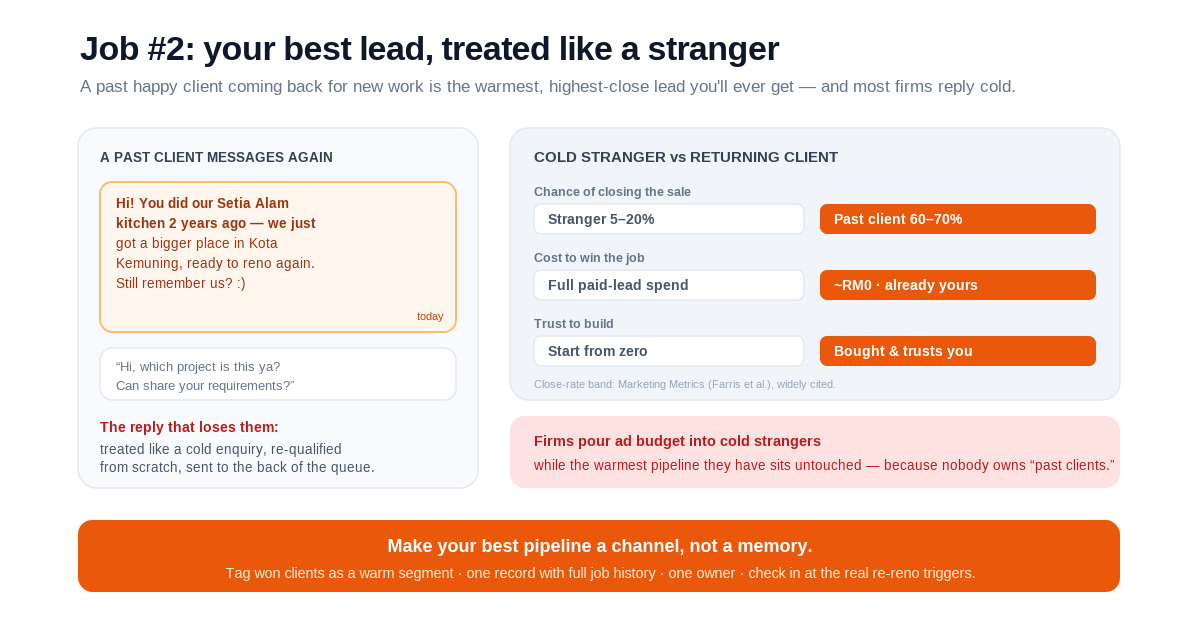
Here's a message that should be the easiest win of your month, and usually turns into a small embarrassment instead.
A name pops up on the business WhatsApp: "Hi! You did our Setia Alam kitchen two years ago — we just got a bigger place in Kota Kemuning, ready to renovate again. Still remember us?" This is a person who already paid you, already trusts you, and is now raising their hand for a second, probably bigger, job. There is no warmer lead in the entire market.
And here's the reply that goes out in most firms, because the chat lands in the same busy inbox as forty cold enquiries and nobody is sure who this is: "Hi, which project is this ya? Can share your requirements?"
In one line, you've told your best customer they're a stranger to you. You've handed them the same cold form you'd give a tyre-kicker who found you on a boosted post. And more often than you'd think, that warm, ready, high-budget client quietly messages two other firms instead — because if you don't remember doing their kitchen, why would they assume you're the obvious choice for the new place?
A past client coming back for job #2 is the best lead your firm will ever get — and because it arrives unlabelled in a WhatsApp inbox that nobody curates, it's the one most firms fumble. Worse, the lead you fumble by replying cold is the small version of the problem. The big one is the client you never hear from, because you went silent the day the first job finished.
Why is a returning past client the best lead you'll ever get?
Because they've already passed every test a cold enquiry still has to clear, and then they came back to you on purpose. A fresh WhatsApp from a stranger is someone you have to win from zero — prove you're competent, earn a reply, qualify them, survive the price comparison against four other firms. A past client skips the entire gauntlet. They've seen your work in their own home every day for years. They know you turn up, they know your finishing, they know what it's like to pay you. The hard, expensive part of selling is already done — you did it the first time, and you don't pay for it twice.
The numbers everyone in sales quotes for this come from the marketing textbook Marketing Metrics (Farris and colleagues) and are repeated across the industry: the probability of selling to an existing customer sits around 60–70%, while a new prospect is 5–20%. Separately, the long-standing rule of thumb — traceable to Frederick Reichheld's customer-loyalty research at Bain and Harvard Business Review — is that winning a new customer costs several times more than keeping an existing one. You don't need to treat those as precise Malaysian figures to act on the direction, which is overwhelming: your returning client is three to ten times likelier to buy and costs a fraction to reach.
Now put that against what a repeat client is actually worth over time. As we covered in what a renovation client is really worth over their lifetime, the value isn't one job — it's the second and third job plus the referrals a happy client sends you. And that pipeline is not a rounding error. ProRemodeler's industry survey found repeat business and referrals together supply roughly two-thirds to 80% of remodeler leads — near 35% referrals and 32% repeat. For a lot of Malaysian renovation and ID firms, your best channel by far is the clients you already have, and it costs almost nothing to run.
Why do firms treat their warmest lead like a cold stranger?
Because a WhatsApp inbox has no memory, and in most firms neither does anyone else. A returning client's message arrives looking exactly like a new enquiry — same green bubble, same busy inbox, no label that says "this is the Setia Alam kitchen from 2024." So it gets whatever the inbox happens to serve up, which on a busy day is a cold, generic reply.
Three things break, and they stack:
- The history is gone. The record of what you did for them — the unit, the scope, the price, that they loved the island counter and hated the first tile sample — lives in a WhatsApp thread buried under hundreds of newer ones, or in a quotation PDF in a folder nobody can find. So even a well-meaning reply starts from zero and asks the client to re-explain their own renovation.
- Nobody owns "past clients." The salesperson who built the relationship may have left, taking the history (and sometimes the actual number) with them. Won jobs get marked closed and vanish from everyone's attention — there's a queue for new leads, but no one is responsible for the people who already paid. The message lands in a shared group chat where everyone assumes someone else knows who this is.
- It's triaged like a cold lead. Unrecognised and out of sequence, it drops to the back of the queue behind today's fresh enquiries — when it should be jumping straight to the front, because it's closer to signing than any of them.
But replying cold to a client who did message you is the visible leak. The bigger, silent one is the client who never messages at all — because you gave them no reason to think of you, and no nudge at the moment they were ready.
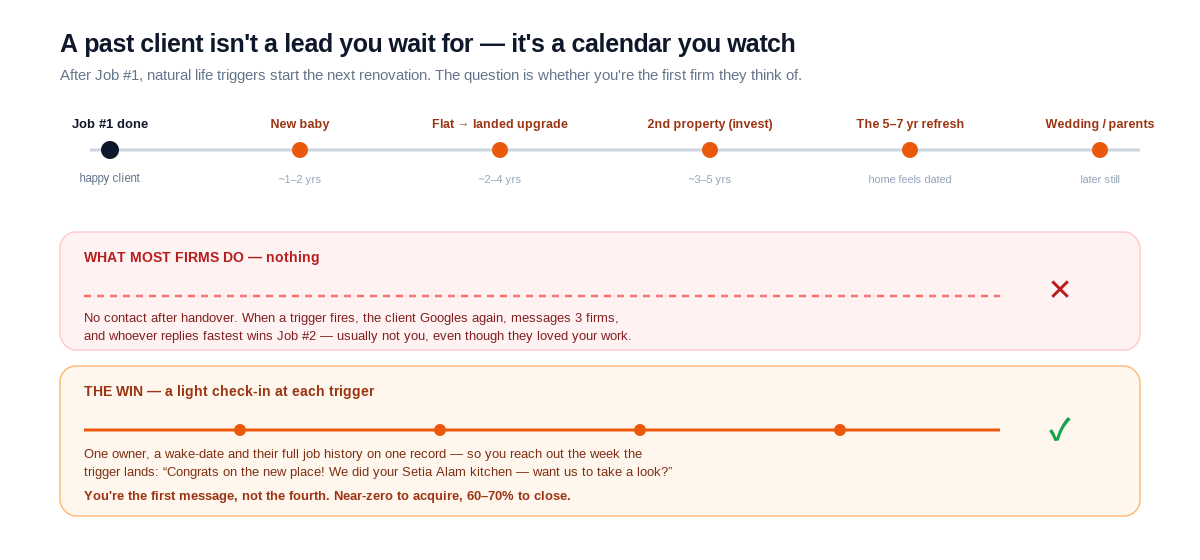
When does a renovation client actually come back — and are those moments predictable?
More predictable than firms assume. People don't renovate at random; they renovate when life changes, and a handful of those changes are common enough to plan around. A renovation isn't a one-off transaction — it's the start of a relationship with someone who will almost certainly spend on their home again. The question is whether you're the first firm they think of when the next trigger hits.
The ones worth watching for a Malaysian homeowner:
- The flat-to-landed (or starter-condo-to-bigger) upgrade. The classic Malaysian property ladder — a young couple does up their first condo with you, then two to four years later buys the terrace house in Setia Alam or Kota Kemuning and needs a whole home done. This is the single biggest repeat opportunity, because the second job is usually larger than the first.
- The second property bought as an investment — a unit to rent out, an Airbnb/short-stay play, or a place for ageing parents. Each one is a fresh renovation, and an investor who liked your work on their own home is an easy yes.
- The 5–7-year refresh. First renovations start to feel dated, finishes wear, tastes change, and a kitchen or bathroom that was perfect in 2020 wants a refresh by the late 2020s. A home refreshed every several years is the quiet backbone of repeat renovation demand.
- Life events. A new baby needs a room reconfigured. A child's wedding means doing up the house for the dinner and the relatives. Parents moving in means an accessible bathroom or an extra room. Each is a renovation with a date attached — and a date you can sometimes see coming.
None of these require you to guess or stalk anyone. They require you to stay lightly in contact so that when the trigger lands, you're the warm, obvious first message — not a firm they have to re-find on Google alongside three strangers.
How should you handle a returning client, step by step?
Recognise them instantly, pick up where you left off, and fast-track it — the opposite of the cold-form reply. The move has two halves: handling the client who comes back on their own, and reaching out to the ones who haven't yet.
When a past client messages you:
| Cold-stranger reply (the leak) | Recognise + fast-track (the win) | |
|---|---|---|
| Opening | "Hi, which project is this ya?" | "Eh, of course — the Setia Alam kitchen! Congrats on the new place." |
| What they re-explain | Everything, from scratch | Nothing — you pull up their history |
| Where it sits in the queue | Behind today's cold enquiries | Straight to the front — they're ready |
| How they feel | Like a number | Like a valued client coming home |
| Likely outcome | They quietly message two other firms | They give you the job, often without shopping |
For the clients who haven't messaged yet, the play is a light, well-timed, human check-in — never a mass promo blast. A spammy "RENOVATION PROMO 20% OFF" to everyone you've ever quoted is worse than silence, because it teaches your best clients to mute you. One warm, relevant message timed to a real moment does the opposite: "Hi Mr Tan! Saw you moved — congrats. We did your old kitchen back in 2024; whenever you're ready to look at the new place, we'd love to help." That's not marketing. That's a firm they already trust, remembering them.
How do you turn past clients into a channel instead of a memory?
You stop relying on anyone remembering, and you make won clients a thing the firm actively owns. Four moves, and all four are about structure, not willpower:
- Tag every won client as their own warm segment. The moment a job closes, the client shouldn't disappear into a done pile — they should join a list the firm treats as a real, nameable channel: past clients. If you can't filter your contacts down to "everyone who has paid us for a job," you can't work the channel at all.
- Keep the full job history on one shared record. Unit, scope, what you were paid, their preferences, the photos, the little things they loved and hated. Not in a head, not on a personal phone that leaves with the staff member — on a record the next person can open cold and sound warm. This is the same discipline that wins the lead that goes quiet and comes back months later; a repeat client is that, except they already bought.
- Give past clients one named owner. Someone whose job is to recognise them and pick the relationship back up — ideally the person who did the first job, but if they've left, someone who can see the history and step in without the client feeling handed around.
- Set a light check-in at the real triggers, not a blast. A wake-date on the record — "check in around handover of their new place," "6-year refresh nudge," "ask after the second unit" — so a relevant, human message goes out at the right moment. One or two well-timed touches a year, not twelve generic ones.
Do this and your repeat pipeline stops being luck. It becomes something you can see, measure and grow — which, as we covered in reading your firm's leading trust numbers, is exactly the free pipeline most firms only notice once it dries up. It's also why the highest-return marketing ringgit is often not another ad but protecting the referral-and-repeat engine you already have.
The bottom line
The client who comes back is the market handing you the warmest, cheapest, highest-closing job you will ever quote — a person who already paid you, already trusts you, and is ready to spend again, usually more. Firms lose this lead not on price or quality but on handling: they reply to their best customer like a cold stranger because the history vanished the day the first job finished, or they never reach out at all and let a faster firm win the second job they'd already three-quarters earned.
None of that is necessary. Tag your won clients as a channel, keep their full history on one owned record, and set a light check-in at the moments a Malaysian home naturally wants new work. Treat the people who already love you as your best pipeline — because they are — and "still remember us?" stops being the question that catches you out and becomes the one you've already answered.
For the whole system this sits inside — capture, qualify, visit, quote and follow up — start with the complete guide to managing renovation leads in Malaysia. This piece is about the won client who returns; read it alongside what a renovation client is worth over their lifetime, the inbound lead that goes quiet and comes back months later, and the leading trust numbers that forecast your free pipeline.
How HotLead helps you keep your best clients
HotLead is a lead-management tool, not a loyalty programme or a marketing blaster — it won't run a rewards scheme, auto-message dormant clients, or decide who's worth re-contacting. The outreach and the judgement stay yours. What it does is make sure your repeat pipeline is seen and owned instead of lost in a busy inbox:
- One record for every won job, so a returning client is recognised in seconds — you see who they are, what you did, and what you were paid, instead of asking your best customer to re-explain their own renovation.
- Tag and filter won clients as their own segment, so "past clients" becomes a real channel you can see and work, not a pile of closed chats nobody opens.
- A next action with a wake-date, so a light check-in at a real trigger — a new place, the 6-year refresh — resurfaces on schedule rather than depending on anyone's memory.
- One named owner per lead, so the relationship survives a salesperson leaving and the client deals with a firm that knows them, not a blank slate.
If your warmest clients keep getting a cold "which project is this?" — or you never hear from them again after handover — the leak isn't your work, it's that your best pipeline lives in people's heads. See how HotLead works, or how it fits a renovation firm or an interior-design studio.
Sources: Marketing Metrics (Paul Farris, Neil Bendle, Phillip Pfeifer, David Reibstein) — the widely-cited 60–70% probability of selling to an existing customer versus 5–20% for a new prospect; Frederick Reichheld / Bain & Company, as popularised in Harvard Business Review ("Zero Defections," 1990) — the customer-loyalty research behind the rule that acquiring a new customer costs several times more than retaining one, and that small retention gains lift profits disproportionately; Professional Remodeler (ProRemodeler) industry survey — repeat business and referrals together supply roughly two-thirds to 80% of remodeler leads (near 35% referral + 32% repeat), as cited in the trust-numbers that predict your pipeline; ZenWeb Malaysia discovery-channel data (word-of-mouth ~36% for construction, interior-design word-of-mouth falling from ~28% to ~18% of discovery 2022→2026) and the ~RM1,280 expected gross profit per winnable enquiry, as cited in the referral channel's real worth and the real cost of a lost renovation lead. Close-rate and cost figures are general-business benchmarks used directionally, not precise Malaysian measurements.
Frequently asked questions
A past client just messaged us for another renovation — do we really need to treat it differently from a new enquiry?
Yes, and the difference is money. A returning client has already cleared every test a cold enquiry still has to pass — they know your work, they trust you, and the expensive top-of-funnel effort is already spent. Industry figures widely cited from Marketing Metrics put the probability of selling to an existing customer at 60–70%, versus 5–20% for a new prospect, and acquiring a new customer is commonly estimated to cost several times more than keeping one. Replying with a generic "which project is this?" throws that advantage away and makes your warmest buyer feel like a stranger. Recognise them, pull up their history, and fast-track it.
How do I recognise a repeat client when everything runs on WhatsApp and the old chat is buried?
That's exactly why repeat work leaks — the history lives in a thread buried under hundreds of newer ones, or on the phone of a salesperson who left. The fix is structural, not better memory. Keep every won job on one shared record — the client's name, unit, what you did, their preferences and what you were paid — so when they message again, whoever picks it up sees "Setia Alam kitchen, 2024, loved the island, RM48k" instantly and can reply warmly in seconds instead of asking them to re-explain their own history.
Isn't proactively messaging past clients just spamming them?
Only if you blast them. The leak isn't too much contact — it's none. A spammy monthly promo to everyone you've ever quoted is worse than silence, because it trains your best clients to mute you. A light, relevant check-in timed to a real trigger is the opposite — "Congrats on the new place! We did your old kitchen, happy to take a look whenever you're ready." That's a human message from a firm they already like, not a marketing blast. One or two well-timed touches a year beats twelve generic ones.
What are the natural moments a Malaysian homeowner comes back for more renovation work?
A handful are predictable enough to plan around. Upgrading from a flat or starter condo to a landed home; buying a second unit as an investment or for ageing parents; the 5–7-year refresh when the first renovation starts to feel dated or wear shows; and life events — a new baby needing a room, a child's wedding, multi-generational living as parents move in. Each is a new renovation waiting to happen, and the firm that did the first job has a natural head start if it stays in light contact instead of vanishing after handover.
Does HotLead automatically win back my past clients or run a loyalty programme?
No — HotLead is a lead-management tool, not a loyalty or marketing-automation platform. It won't run a rewards scheme, blast promos, or decide who to re-contact. What it does is make sure your repeat pipeline is seen and owned instead of lost — every won job sits on one record so a returning client is recognised instantly, you can tag and filter won clients as their own warm segment, a next action with a wake-date lets you set a light check-in at a trigger date, and one named owner holds the relationship so it survives a staff change. The outreach and the judgement stay yours; the context and the reminders stop depending on memory.
Keep reading
- Can AI Reply to Your Renovation Firm's 1-Star Review? I Built It — and the Risk Is How Fast It ApologisesA 2-star review on Google or Qanvast is the first thing your next renovation lead reads — and most firms either ignore it or fire back and make it worse. The 2026 reflex is to let AI write the reply. I built it, and drafting a calm response costs a fraction of a sen. But an AI tuned to be helpful apologises too fast — it will concede a fault in writing, promise a refund that never happened, and grovel to a fake review from a competitor. Here's the build that protects your rank instead of torching it.
- Which Lead Signals Actually Predict a Sale? Reverse-Audit Your Own Won JobsMost firms grade a renovation lead on signals that feel predictive — enthusiasm, a long message, a fast reply — and never check whether those signals actually separate won jobs from lost ones. Here is how to run a reverse-audit on your own closed deals, which signals usually survive it, and why your pipeline is too small to pretend the score is more than directional.
- The "I Only Deal With the Boss" Lead: When the Buyer Refuses Your TeamYou finally hired someone to share the load — then the buyer messages "can I deal with you direct ah, boss?" and refuses to engage your staff. Every big lead quietly re-centralises onto the one person already maxed out, and your firm can never grow past the owner. Here's why caving caps you, why a flat "my staff will assist" loses a nervous buyer, and the move that keeps both.