

Two enquiries land in your WhatsApp on the same Tuesday morning.
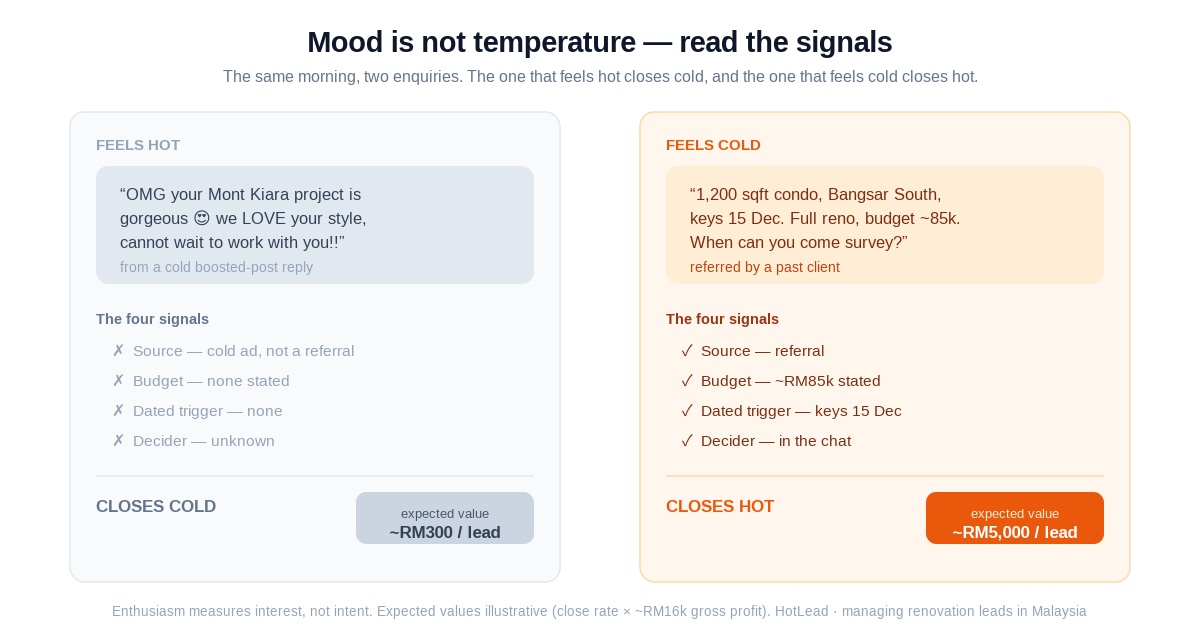
The first is warm and chatty: "OMG your Mont Kiara project is gorgeous 😍 we LOVE your style, cannot wait to work with you!!" The second is three blunt lines: "1,200 sqft condo, Bangsar South, keys 15 Dec. Full reno, budget around 85k. When can you come survey?"
Which one do you reply to first — and which one gets the site visit on Saturday?
If your gut reached for the excited one, you just read the mood. And the mood is one of the worst predictors of a sale we have. This piece is about reading the other thing — the temperature — which is not how a lead feels but how likely it is to become a paid job, and which you can grade from a handful of facts that are already on your screen before you type a word back.
What actually makes a renovation lead hot, warm or cold?
A lead's temperature is how likely it is to turn into a signed job, and you can read it from four observable facts before you reply: where it came from, whether it states a real budget, whether it names a dated trigger, and whether the person messaging is the one who decides. Not how friendly it sounds, not how many emojis it uses.
Here are the four signals, in order of how much they tell you:
- Source — the strongest free signal. A referral or a returning client arrives pre-trusted. A contract-verified Qanvast or Atap shortlist enquiry is warm — the buyer is comparing a handful of vetted firms. A cold Facebook or Instagram boosted-post reply, or an identical mass-blasted quote request, is cold by default.
- Budget stated. A real number or band ("around 85k", "we set aside 120k") is a buyer who has done the maths. "Berapa?" or "cheapest price please" with no figure is someone still browsing.
- A dated trigger. The hottest word in a renovation enquiry is a date tied to something real — keys 15 Dec, loan approved, moving in before CNY, VP next month. A dated trigger means the clock is already running. "Maybe next year" or "just checking first" means it isn't.
- The decider is in the chat. "My wife and I decided to go ahead" is a different lead from "asking on behalf of my friend" or "need to check with my husband / the JMB committee first."
A lead carrying three or four of those is hot almost regardless of its tone. The blunt Bangsar South message above has all four. The gushing one has none of them — just warmth.
Why is an enthusiastic buyer so often a cold lead?
Because enthusiasm measures interest, not intent — and in high-ticket sales the two come apart constantly. A renovation is a big, scary, once-a-decade decision for most Malaysian homeowners, and the research on why those decisions stall is the single most useful thing an owner can internalise here.
In The JOLT Effect, Matthew Dixon and Ted McKenna analysed more than 2.5 million recorded sales conversations and found that 40 to 60% of lost deals end in "no decision" — the buyer simply doesn't act — rather than being lost to a competitor. Medium-to-high indecision showed up in about 87% of deals. The enemy of your warmest lead usually isn't the firm down the road; it's the buyer freezing.
And enthusiasm is no defence against freezing — it's often a symptom of it. Sales trainers have a name for the trap: "happy ears" — reading a buyer's friendliness as a buying signal, skipping the hard questions, and watching the "sure thing" evaporate. One widely repeated (if secondary) finding is that buyers who respond with heavy enthusiasm and raise few objections are less likely to buy, because the enthusiasm is covering for a decision they haven't actually made. The person firing hard, slightly awkward questions — who waterproofs the yard, can you finish before my tenant moves in, what's not included — is usually closer to signing than the one saying "wow, love everything!"
Which single signal predicts a sale best?
The source. Where a lead came from tells you more about whether it will close than anything the buyer says in the first message. This is the one temperature read you get completely free, before any conversation, and the data behind it is consistent even if the exact numbers vary by study:
- In one sales-call dataset, referral leads closed at about 25.6% versus 9.4% for cold-call leads (Prospeo) — the warm source closed nearly three times better.
- Franchise outbound data shows an even wider gap: 18.9% for internal-network referrals versus 0.9% for internet-sourced leads (webtonic).
- Invesp's widely cited figure is that referrals convert about 30% better than other channels, and referred deals are often reported to close around four times faster.
For a Malaysian reno or ID firm, that ranks your inbox for you before you lift a finger:
- Hot: a referral from a past client or trade, or a returning client coming back for job two.
- Warm: a Qanvast or Atap enquiry, where the listing is contract-verified and the buyer is working a short shortlist (the verification is a genuine moat — see how many reviews a firm actually needs).
- Cold: a reply to a boosted post, a comment-section DM, or an identical message blasted to ten firms.
This is also the one signal most firms throw away, because nobody tags the source at capture — so by week's end the referral and the tyre-kicker look identical in the chat list. (The companion piece on whether AI can tag lead sources without lying is about recovering exactly this.)
What is each temperature band actually worth?
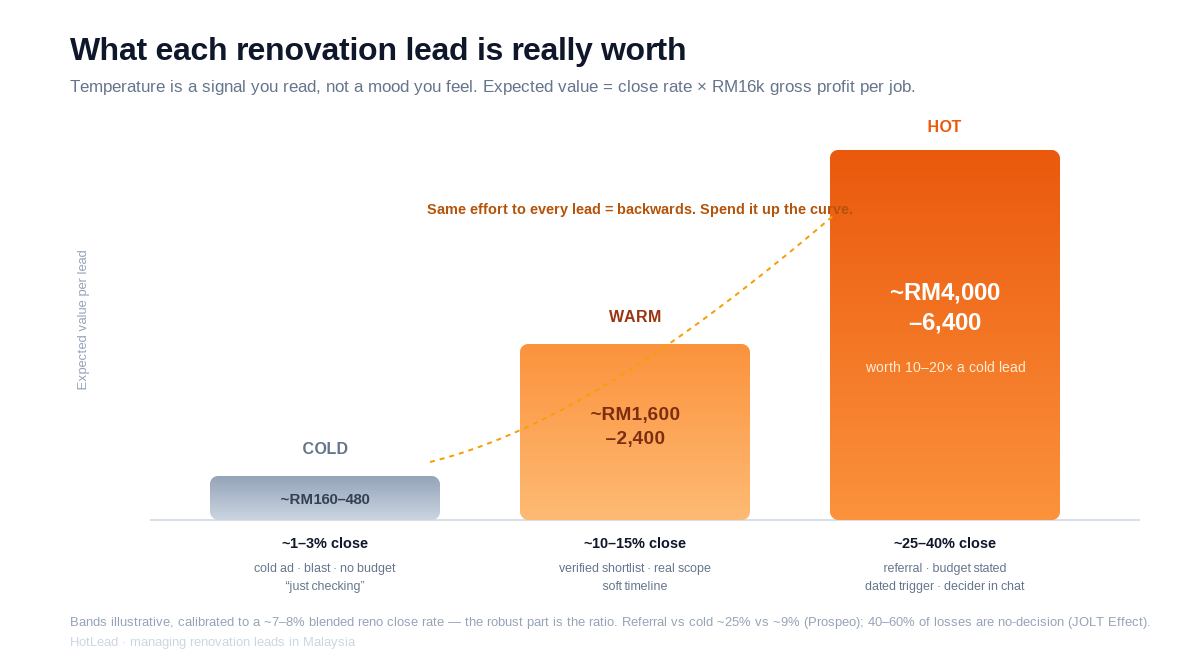
Put a close rate and a ringgit value on each band and the whole decision changes, because a hot lead can be worth ten to twenty times a cold one — so it deserves ten to twenty times the effort, not the same reply template. The expected value of a lead is simply its close rate times the gross profit of a won job. On an illustrative RM80,000 job at a ~20% margin (about RM16,000 gross profit), the bands look like this:
| Band | What it looks like | Close rate | Expected value per lead | Effort it earns |
|---|---|---|---|---|
| Hot | Referral or repeat; budget stated; dated trigger; decider in chat | ~25–40% | ~RM4,000–6,400 | Reply in minutes, call same day, book the visit, senior owner handles it |
| Warm | Verified shortlist (Qanvast/Atap); real scope; soft timeline | ~10–15% | ~RM1,600–2,400 | Fast reply, qualify hard, earn the visit, steady follow-up |
| Cold | Cold ad / blast / comment DM; vague; no budget; "just checking" | ~1–3% | ~RM160–480 | Fast auto-acknowledge, one or two light touches, no site visit yet |
Notice what the table does not have a column for: how excited the buyer sounded. That's the point. The expected value is built from the four signals and nothing else.
This is a different cut from two neighbouring pieces, and it's worth keeping them straight. The cost of a lost renovation lead works out the expected value of one average enquiry; this one splits that average into bands so you can see which leads are dragging it down. And the diminishing returns of follow-up applies exactly this value-times-close-odds logic to the single question of how many times to chase — this scorecard is the upstream classification that feeds it.
How should the scorecard change what you actually do?
Price your effort to temperature, not your politeness. Every lead gets the same fast, courteous acknowledgement; only your scarce, expensive effort gets rationed by expected value. Those are two different resources and most firms confuse them.
The cheap resource is speed. A fast first reply is capital — you set up an instant acknowledgement once and it then fires on every lead, hot or cold, at near-zero ongoing cost (why reply speed is a one-time fix and follow-up isn't). So there is never a reason to be slow or rude to a cold lead; it costs you nothing to be fast.
The expensive resource is everything that takes an hour of a human: a same-day phone call, a Saturday site visit, a custom 3D render, a seventh follow-up. That is what you spend by temperature:
- Hot — reply in minutes, call the same day, book the visit, put a senior person on it. An expected value of RM4,000+ per lead easily justifies an hour of the owner's time.
- Warm — fast reply, qualify hard in the first exchange, earn the site visit with a reason, follow up steadily. Worth real effort, but make them show intent before you drive across the Klang Valley.
- Cold — fast auto-acknowledge, a holding reply with a ballpark range, one or two light touches. No site visit and no custom render until a signal warms it up.
How do you set your own temperature bands?
Don't borrow my percentages — measure yours. The bands above are a starting scaffold; the version that actually fits your pricing, your area and your crew is the one you read back from your own won-and-lost history. This is where the data genuinely beats the gut.
Firms that score leads on observed behaviour and attributes rather than a salesperson's feel convert markedly better — one analysis put behavioural scoring at around 39–40% MQL-to-SQL versus a ~13% industry average, roughly three times. You don't need software to start; you need two disciplines:
- Tag at capture. Record the source and the four signals the moment a lead lands, while you still know them. A source you don't capture is a source you can't learn from.
- Read it back quarterly. After a quarter, split your closed-won and closed-lost by band and compute the real close rate for each. Now your scorecard is yours, not a blog's.
And treat temperature as a starting read, not a permanent label — re-grade on behaviour:
- A cold lead warms the moment it states a budget, names a date, or books a visit. Promote it and raise the effort.
- A hot lead cools when it goes silent on a real external clock — a loan in underwriting, keys not yet handed over, a spouse not yet on board. That lead isn't dead; it's dated. Park it with a wake-date rather than nagging it, and spend the freed effort on a fresh hot one.
This is also the honest line between a scorecard and an algorithm. You can run this whole system on a notebook. The point of scoring — human or, as in Kai's experiment on AI-qualifying a messy enquiry, machine-assisted — is only ever to point your limited hours at the leads most likely to pay.
Where HotLead fits (and where it doesn't)
Be clear about the boundary. HotLead does not score your leads with AI or decide a lead's temperature for you — you set the rule, because only you know what a referral from your best client is worth. What it does is make the scorecard usable instead of theoretical:
- Capture and tag by source — so the single strongest signal, where the lead came from, is recorded at the moment it lands instead of lost in the chat scroll.
- One owner per lead, with next-action and overdue flags — so a hot lead gets the fast lane and never sits, and a parked lead has a wake-date instead of being forgotten or nagged.
- The funnel and per-channel view — so after a quarter you can see the real close rate of each source and band, and replace the illustrative numbers in this article with your own.
The reason most firms can't price effort to temperature isn't that they disagree with the idea — it's that a shared WhatsApp number and a memory can't tell a referral from a tyre-kicker once twenty enquiries are stacked up on a busy Monday.
For the whole system this sits inside — capture, reply, qualify, quote and follow up — start with the complete guide to managing renovation leads in Malaysia. From here, the natural next reads are what one lost lead is really worth, how many follow-ups actually pay, and the funnel-stage conversion benchmarks that this scorecard feeds the top of. If you run a renovation firm or an interior-design studio, this is the one scorecard worth pinning above the desk — and reading more honestly than the mood of the message in front of you.
Sources: No-decision and indecision figures — Matthew Dixon & Ted McKenna, The JOLT Effect (2022), built on an analysis of more than 2.5 million recorded sales conversations; the 40–60% of lost deals ending in "no decision" and 87% medium-to-high indecision figures are stated by Dixon in this CustomerThink interview and summarised by Challenger and the Learnit podcast. "Happy ears" and enthusiasm-is-not-intent — HubSpot, J. Barrows and Peady's Selling Engagement; the finding that heavily enthusiastic, low-objection buyers are less likely to buy is a single secondary report and is treated as directional. Referral-versus-cold close rates — Prospeo (25.6% referral vs 9.4% cold call), webtonic franchise data (18.9% internal-network vs 0.9% internet), and Invesp (referrals convert ~30% better, widely cited). Behavioural lead scoring vs gut (39–40% MQL-to-SQL vs ~13% average, roughly 3x) via Data-Mania, with the ~13% MQL-to-SQL baseline attributed to Salesforce / First Page Sage data and SQL-to-customer ~6% (Implisit via Outfunnel). WhatsApp's ~90% share of Malaysian internet users via DataReportal. These are predominantly US and global sales datasets across mixed industries, so treat the exact percentages as directional shape rather than reno-specific law — the robust part is the ratio between bands. The close-rate bands, the RM80,000 / 20% margin / RM16,000 gross-profit job and the per-band expected values are the illustrative house figures used across this series; tag your own leads by source and signal for a quarter and read back your real numbers.
Frequently asked questions
What makes a renovation lead hot, warm or cold?
How likely it is to become a paid job, read from four observable facts rather than the buyer's mood. The strongest signal is the source — a referral or a returning client is hot, a contract-verified Qanvast or Atap shortlist enquiry is warm, a cold Facebook or Instagram boosted-post reply is cold. On top of that, add whether they state a real budget, whether they name a dated trigger (keys handing over, loan approved, a move-in or festive deadline), and whether the person messaging is the one who actually decides. A lead carrying three or four of those is hot almost regardless of how it is worded.
Isn't a chatty, enthusiastic buyer a hot lead?
Usually not, and this is the most expensive misread in a small reno firm. Enthusiasm measures interest, not intent, and the two come apart all the time. The research on lost deals is blunt — roughly 40 to 60% of them end in no decision rather than a competitor winning, and medium-to-high indecision shows up in about 87% of deals (the JOLT Effect). A buyer who gushes and raises no objections is often avoiding the hard decision, not racing toward it. Read the signals, not the emojis.
Should I ignore or drop cold leads?
No — you answer every lead fast and politely, because a quick acknowledgement is cheap and set up once, and because a cold lead can warm up. What you ration is your expensive effort. A cold, vague, no-budget enquiry does not earn a same-day site visit, a custom 3D render or an eighth follow-up when a hot referral is waiting for the same hours. Give cold leads a fast reply and one or two light touches; spend your real selling time where the expected value is highest.
How is this different from qualifying a lead in the first reply?
Qualifying is the conversation you run to gather the facts; the temperature scorecard is the decision you make with them. Our guide to qualifying a renovation lead in the first WhatsApp reply covers the questions to ask. This piece is the data layer on top — once you have the facts, what close rate and what ringgit value does each band carry, and therefore how much effort is it worth spending. One is the script, the other is the scorecard.
What close rate should each temperature band have?
Use the illustrative bands here as a starting point — roughly 1 to 3% for cold, 10 to 15% for warm, and 25 to 40% for hot — but replace them with your own numbers as soon as you can. Tag your leads by source and signal for a quarter, then read back your real close rate for each band. Firms that score leads on observed behaviour rather than gut feel convert far better (one analysis found about three times the industry-average qualification rate), and the only bands that will actually fit your pricing, your area and your crew are the ones measured from your own won-and-lost history.
Keep reading
- Can AI Reply to Your Renovation Firm's 1-Star Review? I Built It — and the Risk Is How Fast It ApologisesA 2-star review on Google or Qanvast is the first thing your next renovation lead reads — and most firms either ignore it or fire back and make it worse. The 2026 reflex is to let AI write the reply. I built it, and drafting a calm response costs a fraction of a sen. But an AI tuned to be helpful apologises too fast — it will concede a fault in writing, promise a refund that never happened, and grovel to a fake review from a competitor. Here's the build that protects your rank instead of torching it.
- Which Lead Signals Actually Predict a Sale? Reverse-Audit Your Own Won JobsMost firms grade a renovation lead on signals that feel predictive — enthusiasm, a long message, a fast reply — and never check whether those signals actually separate won jobs from lost ones. Here is how to run a reverse-audit on your own closed deals, which signals usually survive it, and why your pipeline is too small to pretend the score is more than directional.
- The "I Only Deal With the Boss" Lead: When the Buyer Refuses Your TeamYou finally hired someone to share the load — then the buyer messages "can I deal with you direct ah, boss?" and refuses to engage your staff. Every big lead quietly re-centralises onto the one person already maxed out, and your firm can never grow past the owner. Here's why caving caps you, why a flat "my staff will assist" loses a nervous buyer, and the move that keeps both.