

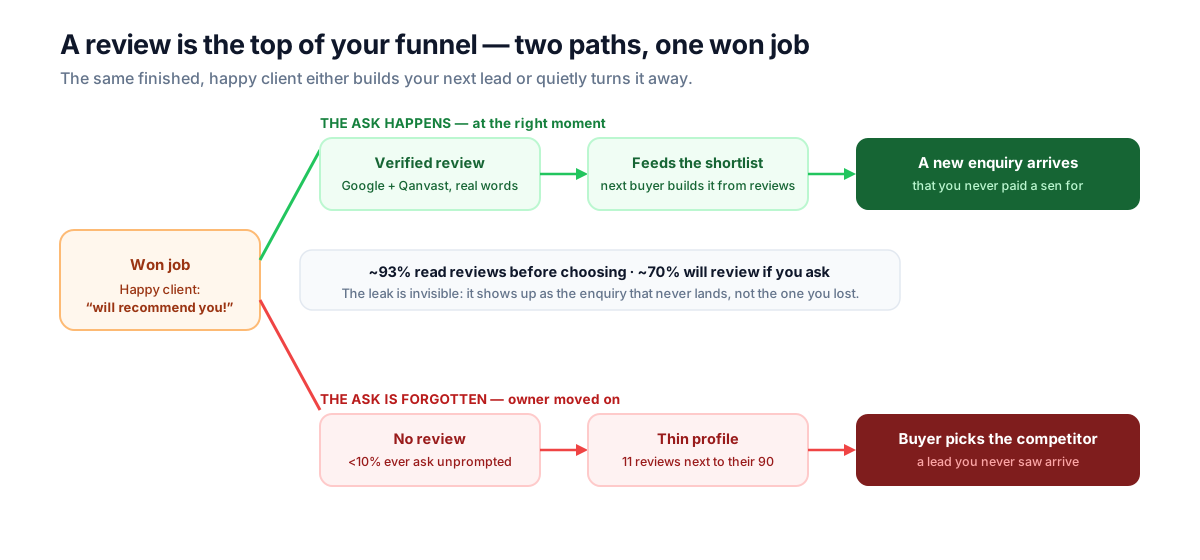
Here is a leak no renovation owner puts on a whiteboard, because it never shows up as a lost enquiry — it shows up as an enquiry that never arrives. You just finished a beautiful job. The client in Bangsar loves her new kitchen, sent you a photo of her family using it, said "thank you so much, will definitely recommend you." And then... nothing. You never asked her to write it down anywhere. Six months later a colleague of hers is Googling "interior designer KL," scrolls your profile, sees eleven reviews next to a competitor's ninety, and messages the competitor. You lost a lead you never knew existed, to a job you did right.
That is the review problem, and it is squarely a lead-management problem — reviews are the very top of your funnel, the shortlist a buyer builds before they ever land in your WhatsApp. We have spent this series on the leads you can see. This one is about the leads a thin profile silently turns away. And the 2026 question worth asking honestly, because the AI tools are already pitching it: can AI actually get you more reviews profitably — or does the obvious build quietly make it worse?
I put AI on it. Here is the problem, what it costs before any AI, the build that backfires, the build that pays, and what an owner should do on Monday.
Why is a review-generation article in a lead-management series?
Because the review is a lead source — the earliest and cheapest one you have. Long before anyone messages you, they build a shortlist, and reviews are what they build it from. Around 93% of consumers read online reviews before choosing a business and roughly 81% read them on Google, per BrightLocal's 2024 survey; in home improvement specifically, about 91% of homeowners rely on online reviews before picking a contractor, per ACHR News. Your review profile is doing sales work while you sleep — or failing to.
And in Malaysia the stakes are sharper, for two reasons. First, buyers here are trained to check reviews hard, because the renovation-scam warnings they read — from Recommend.my, iHome.my and RumahHQ — literally tell them to scan reviews for "went quiet after the deposit" patterns before paying a sen. A high-ticket, trust-heavy purchase makes reviews load-bearing. Second, on Qanvast — where a huge share of Malaysian ID and reno buyers shop — reviews are not decoration, they are the gate: reviews are verified against your actual renovation contract, and firms rated below 3.5 stars are simply not recommended. A firm that never asks doesn't just look quieter; on the platform your buyers use, it can drop off the shortlist entirely.
What does the "we never ask" habit cost before any AI?
It costs you your best channel, for free, and the numbers are brutal. Fewer than 10% of satisfied customers leave a review unprompted — but about 70% will if you simply ask and make it easy, per BrightLocal and echoed across home-services data at Grade.us and Pipeline On. Sit with that gap. The difference between a starving profile and a thriving one is not the quality of your work — you already did great work — it is one act you keep skipping.
And why do you skip it? Not laziness. Structure. A renovation ends the way it always ends: the owner is exhausted, three live sites are on fire, the client has been handed the keys, and the very next enquiry is already buzzing. "Ask for a review" is a soft, non-urgent task with no deadline, so it loses every single time to a hard one with a deadline. The ask doesn't get declined — it gets forgotten. Multiply that by every won job in a year and you have built, then abandoned, the channel that closes best and costs least: a referral converts at roughly 15–25% versus about 1% for a cold lead, at near-zero acquisition cost, as we worked through in cost per lead versus cost per won job and what a new client really costs.
So this is a real Kai problem: a clear, recurring, money-losing gap in the lead chain — right at its source. The kind AI should be able to close. So can it?
So can I just automate review requests? (Build A)
This is the build every tool pitches: connect it, mark a job "done," and it fires an automated review request — often a cheerful "Thanks for choosing us! Please leave us a 5-star review here [link]." Sometimes it sweetens the ask with "leave a review and get RM50 off your next project." Set and forget. And on paper the timing data backs firing fast — home-services benchmarks show a request sent within two hours of job completion pulls around a 42% response, decaying to about 6% after two days, per Pipeline On and Better Bunch. So blast immediately, right?
Wrong — and this is where the reflex quietly hurts a renovation firm in two ways.
The first is the incentive. "Leave a review, get RM50 off" is an incentivised review, and it is banned — by Google's content policy, which prohibits offering anything of value for a review, and by the FTC's 2024 final rule, in force since 21 October 2024, which makes buying or incentivising reviews finable at up to about USD 51,744 per knowing violation (Alston & Bird, FTC). The FTC is US, but Google's policy is global — an incentivised-review pattern gets your reviews stripped or your profile suspended in Malaysia just the same. A "helpful" automation that adds the incentive by default is a liability wearing a convenience.
The second failure is subtler, more common, and specific to renovation. It is a timing trap — and it is the reason "just fire within two hours" is the wrong rule for your trade.
Why is "ask within two hours" the wrong rule for a renovation?
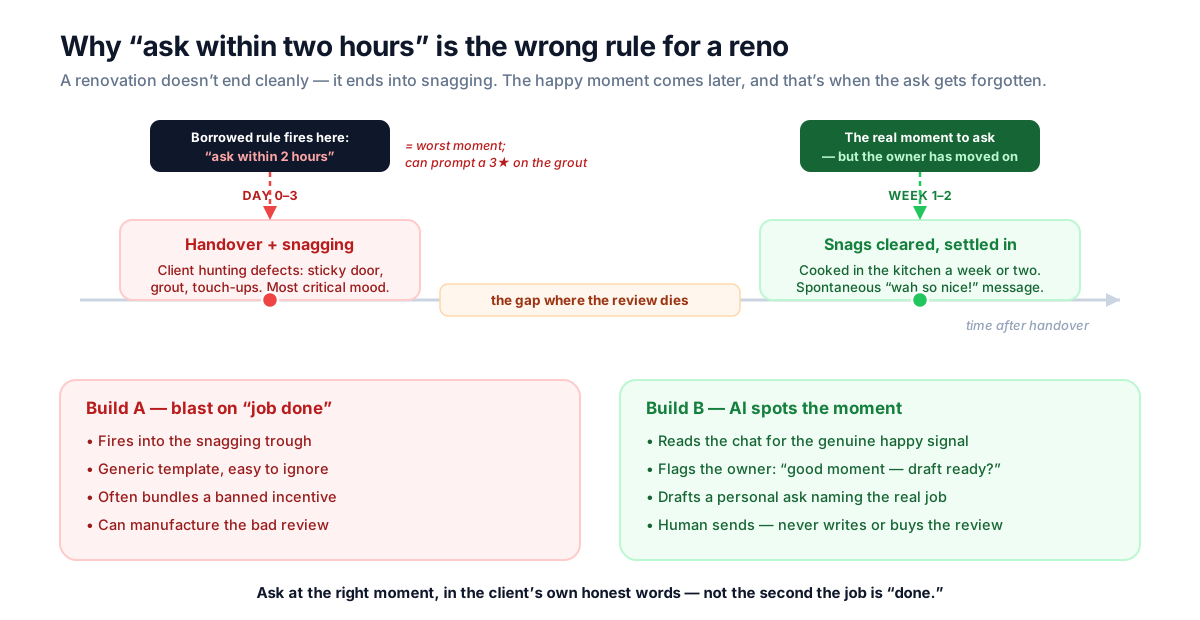
Because a renovation does not end cleanly, and the two-hour rule assumes it does. That benchmark comes from plumbing, HVAC, pest control — jobs that finish: the tap works, the aircon is cold, the customer is relieved, the moment is warm, so you ask while it is. A reno is different. It ends into snagging — the defect walkthrough where the client is, by design, in her most critical frame of mind, hunting for the door that sticks, the uneven grout, the paint touch-up, the socket in the wrong spot. Handover is not the happy peak. For many clients it is the anxious trough.
Fire an automated "please give us 5 stars!" into that trough and you have picked the single worst moment in the whole project to ask. Best case, it is ignored. Worst case, you prompted the review — and it is three stars about the grout, permanently, on the profile your next buyer reads. The borrowed "ask immediately" rule doesn't just underperform in renovation; it can actively manufacture the bad review you were trying to avoid.
The genuinely happy moment comes later — after the snags are cleared, after she has cooked in the kitchen for a week or two and the family photos are going up. That is when the "thank you, we love it" message arrives unprompted. And that is exactly the moment the owner has long since moved on and forgotten to ask. The gap between "job done" and "job loved" is where the review dies — too early is tone-deaf, and by the time it is right, nobody remembers to ask.
That gap is the real problem to solve. Not "send faster" — "ask at the right moment, and don't let the owner forget by the time it comes." Which turns out to be a job AI is genuinely good at, as long as you point it at the right half.
What actually worked: AI spots the moment and drafts the ask (Build B)
Build B threw out the blast and the incentive and kept the two things AI does well — reading the thread and drafting a message. It never writes the review, never offers a cent, and never fires on "job done." Instead it does three grounded things:
- It watches the WhatsApp thread for the genuine happy signal. After a job is marked won, AI reads the ongoing conversation for the real marker — the client sends a photo of the finished space, writes "wah so nice," "terima kasih, sangat cantik," "we love it." That spontaneous warmth is the right-moment signal a snagging-day timer can't see — and it is sitting right there in the chat, which is exactly the kind of fact AI can read.
- It surfaces one flag to the owner, not a bot to the client. "The Bangsar kitchen client just said she loves it — good moment to ask for a review. Draft ready?" The owner glances, agrees (or says "not yet, still a snag open"), and moves on. Two seconds.
- It drafts a personal ask the owner sends from their own number. Not a template blast — a real message that names the actual job: "Hi Mei Ling, so glad the kitchen turned out the way you hoped! If you have two minutes, it would genuinely help us if you shared a few words here [direct Qanvast/Google link] — no pressure at all." Personal, specific, one tap, no incentive. That personalisation and friction-removal is precisely what lifts response from under 10% toward 70%.
That is the whole product, and notice what it deliberately is not. It does not author the review. It does not offer a discount. It does not decide, on its own, that the moment is right — it suggests, and the owner confirms, because only the owner knows whether that "so nice!" came before or after the still-open bathroom snag. AI spotted the moment and wrote the ask for a tenth of a sen; the human kept the timing verdict and the send. Same split as every honest AI-in-the-lead-process build lands on: AI reads and drafts, a human judges and sends.
| Build A — auto-blast on "job done" | Build B — AI spots the moment, human sends | |
|---|---|---|
| When it fires | Instantly, on job marked done | After the genuine happy signal in the chat |
| Timing on a reno | Lands in snagging — the critical trough | After snags clear — the actual happy peak |
| Who writes the review | Risk of AI drafting it (fabrication) | The client, always — AI never writes it |
| Incentive | Often bundled in ("RM50 off") — banned | None — honest ask only |
| The message | Generic template blast | Personal, names the real job, one tap |
| Human role | None — set and forget | Confirms the moment, sends it |
| Failure mode | Prompts a bad review, or a policy strike | Owner occasionally says "not yet" — safe |
The two lines you never cross — and why AI makes them easy to cross by accident
Because being anti-hype cuts both ways, the honest warning: AI lowers the effort of the two things you must never do here, so name them and hard-code them out.
- Never let AI write the review itself. A model can produce a glowing, plausible five-star review in seconds — and it is a fabrication, banned by Google's policy and the FTC's 2024 rule, and on Qanvast it gets caught anyway because reviews are cross-checked against the renovation contract. The client's words must be the client's.
- Never offer anything for a review. No RM50 off, no free service call, not even "and we'll enter you in a lucky draw." Incentivised reviews are banned regardless of sentiment, and they read as bought to the exact buyer who is scanning reviews to avoid being scammed.
Neither line is about capability — AI can do both effortlessly. It is about what you point it at. Build B is safe precisely because it is aimed at the one job that is both legal and valuable: reminding you to ask a real person, at the right moment, in your own honest words.
What should an owner actually do on Monday?
You do not need to buy anything to close most of this leak. You need to turn "ask for a review" from a hope into a step:
- Make the ask a tracked task on every won job — never a good intention. The single highest-leverage change. Put "review ask" as a next action the moment a job is won, so it surfaces later instead of evaporating. This is the same next-action and overdue mechanic that stops quotes going cold — pointed at the finish line.
- Ask at the reno-right moment, not the home-services moment. After snags are cleared and the client is visibly happy — not at handover. If you use AI, aim it at spotting that happy signal in the chat, not at a "job done" timer.
- Make it one tap and personal. A direct Google or Qanvast link, a message that names their actual job, sent from a human number. That is the whole difference between under-10% and 70%.
- Never fabricate, never incentivise. If a tool offers to write reviews or dangle discounts for them, that is the feature to switch off, not on.
- Close the loop. Track which won jobs got asked, and watch your referral and platform-sourced leads in your per-channel view. Reviews are the top of the funnel — measure them like a channel, because they are one.
How HotLead fits — and what it deliberately doesn't do
I will be straight, because over-claiming is the hype I keep arguing against. HotLead does not run a review-blast engine, does not write reviews, and does not dangle incentives — and after this experiment, that restraint is the point, not a gap. What it does is the part the experiment proved actually closes the leak:
- Every won job keeps one owner and a next action, so "ask for a review at the right moment" becomes a tracked step with an overdue nudge — the exact fix for the "we always forget to ask" leak that starves your referrals.
- The full WhatsApp history sits on the lead record, so when the happy moment comes, the ask can reference the real job instead of a generic template.
- A funnel and per-channel view, so referral and platform-sourced leads show up as the channel they are — you can finally see whether your best, cheapest source is growing or starving.
- The judgment stays yours — whether the client is genuinely happy, whether the snag is really closed, whether now is the moment — because that is the call a timer gets wrong and an owner gets right.
In short: HotLead makes sure you remember to ask the right client at the right moment, and keeps you honest about never faking or buying the review — the build that actually pays. If your finished, happy jobs aren't feeding your next enquiries, start with the complete guide to managing renovation leads in Malaysia, see how it fits a renovation firm or an interior-design studio, or read the companion piece on turning Qanvast and Atap enquiries into booked consultations.
Sources: review-reading behaviour (93% of consumers read reviews before choosing a business; ~81% read on Google; ~70% will leave a review when asked) from BrightLocal's Local Consumer Review Survey 2024; homeowner-specific reliance on reviews (91% before picking a contractor) from ACHR News; the "fewer than 10% review unprompted" figure and the timing-decay benchmark (42% response within two hours of completion, ~6% after two days) as reported in home-services review data from Grade.us, Pipeline On and Better Bunch — the two-hour rule is drawn from clean-ending trades and is discussed here as the wrong fit for renovation's snagging window. The ban on fake and incentivised reviews from Google's content policy and the FTC's final rule (in force 21 October 2024; civil penalties up to ~USD 51,744 per knowing violation), summarised by Alston & Bird and the FTC Q&A. Qanvast's verified-against-contract reviews, 3.5-star recommendation floor and vetting from Qanvast Reviews. Malaysian renovation-scam warning culture (buyers told to scan reviews for "quiet after the deposit" patterns; anything above a 25% deposit a red flag) from Recommend.my, iHome.my and RumahHQ. Referral close rates (15–25% vs 1% cold), expected gross profit per lead (RM1,280) and illustrative per-draft compute (~0.1 sen) are as established across this series — see cost per lead versus cost per won job and the customer-acquisition-cost piece; illustrative figures are labelled as such.
Frequently asked questions
Should I use AI to write Google or Qanvast reviews for my renovation clients?
No — that is a fabricated review, and it is exactly the line you must not cross. Google's content policy bans fake and company-authored reviews outright, and the FTC's 2024 rule makes writing or buying reviews a finable offence in the US with penalties of up to about USD 51,744 per knowing violation. Qanvast verifies reviews against the actual renovation contract, so a made-up one gets stripped anyway. The safe and useful role for AI is to draft the personal ask you send to a real client — never the review, and never the client's words.
Can I offer a discount or a small gift for a review?
No. Incentivised reviews — anything of value conditioned on leaving a review, positive or otherwise — are banned by Google's user-generated-content policy and by the FTC's 2024 final rule. Beyond the rules, incentives poison the signal — a review your client felt paid to leave is neither honest nor persuasive to the next buyer, who reads reviews precisely to sniff out exactly that. Ask for honest feedback, make it one tap, and leave it there.
When is the right time to ask a renovation client for a review?
Not the moment the job is "done" — that is the trap. A renovation ends into a snagging and defect-check window, which is the client's most critical, most nitpicky moment, so a review request during it lands badly and can even prompt a poor rating. The right window is after the snags are cleared and the client has lived in the finished space happily for a week or two — often marked by a spontaneous thank-you message. That is later than the two-hour rule home-services marketers quote, because a reno's ending is not clean like a plumbing call's.
How many clients will actually leave a review if I ask?
Far more than leave one unprompted. Industry surveys put unprompted reviewing at under 10% of satisfied customers, while around 70% will leave a review when a business simply asks and makes it easy. The lift is almost entirely about asking at all, asking at the right moment, and removing friction — a direct link, one tap, a personal message that names their actual job. AI helps with the drafting and the reminder so the ask stops getting forgotten; it does not and should not manufacture the review.
Does HotLead send review requests automatically?
No — and this experiment is why. A blind auto-blast on "job done" fires during snagging and reads as spam, and anything that writes or incentivises the review crosses a policy line. What HotLead does is keep every won job with one owner and a next action, so "ask for a review at the right moment" becomes a tracked step instead of a good intention the owner forgets — the exact leak that starves referrals. The full WhatsApp history sits on the record so the ask can reference the real job. It does not fabricate, blast, or incentivise reviews, by design.
Keep reading
- Did We Already Say RM68k? Using AI to Stop Quote Drift Across a Long Renovation ThreadOver a weeks-long WhatsApp thread with two or three quote revisions, a rep re-states a number that contradicts an earlier promise — and re-opening a settled price quietly invites a discount that eats a whole job's profit. So I pointed AI at the drift. It works beautifully as a flag, and dangerously as an auto-corrector.
- The Warranty as a Closing Lever: Why a Longer Guarantee Beats a Discount on a Renovation DealA quote is stalling and the buyer wants a reason to say yes. Before you drop the price, look at the other lever in your hand — a longer workmanship warranty. It is the same expected-value decision as a discount, but the math runs the opposite way — a price cut costs you thousands with certainty, while extending the defects cover costs you a couple of hundred ringgit in expectation, for arguably more trust with a scam-wary buyer. Here is the EV case for the non-price concession, the trap that turns it into a hidden liability, and which leads it actually moves.
- "Can You Just Build It, My Neighbour Also Did" — Handling the Renovation Lead That Needs Council Approval FirstSome renovation enquiries can't legally start next month, no matter how ready the buyer is — a kitchen extension, a hacked-through wall, a roofed-over air well all need the council's written approval first. Quote a fast build price to win the job and you either lose it to a "boss, can start" cowboy, or win it and inherit the stop-work order, the RM50,000 fine and a client who later can't sell the house. Here's how to spot the permit-first lead and sell the approval as protection.