

A renovation quote is sitting quiet. The buyer liked you, the number is fair, but they haven't signed — and when a deal stalls, the reflex in every Malaysian reno firm is the same: reach for the price. "Okay lah, I give you 5 percent."
Before your thumb hits send, look at the other lever in your hand. You can offer a longer workmanship warranty instead of a lower price — and on the math, it is almost always the better trade.
This is the same decision our companion piece frames for a price cut: treat a discount as an investment with an expected value, not a reflex. A concession pays only when the extra win-probability it buys, multiplied by the job's profit, beats what the concession costs you. The difference is what each concession costs. A discount comes straight off your thin margin, with certainty. A warranty costs you only the expected value of a few extra callbacks — which, on a job you run well, is close to nothing. Same lever, opposite math.
Is a warranty a better concession than a discount to close a renovation deal?
Usually yes — because it buys the buyer a similar reason to commit at a tiny fraction of the cost to you. Both a discount and a warranty are concessions: things you give up to lift the odds of winning. The question an owner should ask about any concession is the same one negotiation researchers call finding the elegant negotiable — something low in cost to you but high in value to the other side. A price cut fails that test badly. A warranty passes it.
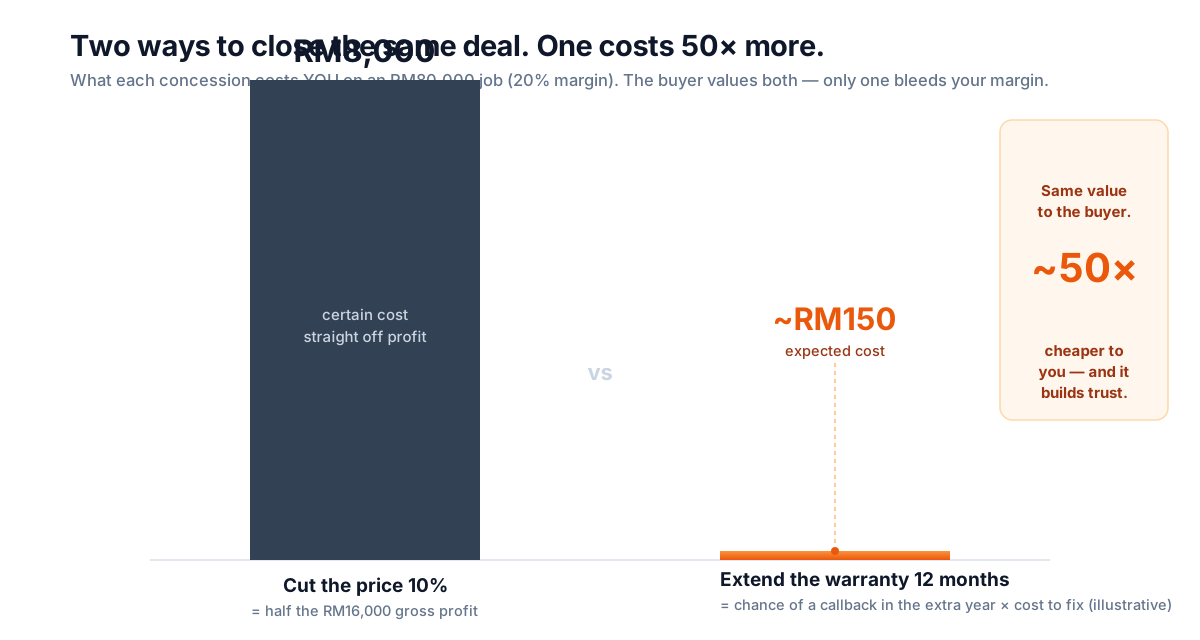
Here's the comparison on this series' standard job — a mid-band condo renovation at RM80,000, a 20 percent gross margin, RM16,000 of gross profit:
| Cut the price 10% | Extend the warranty 12 months | |
|---|---|---|
| What the buyer gets | RM8,000 off the price | 24-month workmanship cover instead of 12 |
| What it costs you | RM8,000 — certain, straight off profit | chance of a callback in the extra year × cost to fix |
| Illustrative cost | RM8,000 (half the profit) | ~RM150 (about 1% of the profit) |
| What it signals | "my price had room" — invites more pushing | "I stand behind my work" — builds trust |
| Reversible? | No — resets the anchor for the deposit and every variation | Yes — costs nothing at all unless a defect actually appears |
The two concessions can land as roughly equal in the buyer's mind — both are "the firm gave me something to close" — but one bleeds half your profit for sure, and the other bleeds a couple of hundred ringgit only if something goes wrong. That gap is the whole article.
Why does extending the warranty cost so little?
Because most renovation defects surface early — inside the cover you already carry — so the extra window you give away sits in the thin tail of the curve. The expected cost of any warranty is simply the probability a defect appears in that window multiplied by the cost to fix it. Extend the window into a period where almost nothing goes wrong and you have added almost nothing to the expected cost.
The construction data backs this up. The Construction Industry Institute puts direct field rework at around 5 percent of total project cost, with a range of 2 to 20 percent, and research on actual corrections found post-completion rectification averaging under 1 percent of contract value. The important part is when it lands: snagging and early workmanship faults dominate the first months after handover, and the rate tapers hard after the first year. Loose tile grout, a door that drops, a paint line that cracks as the unit settles — these show up in weeks, not in year two.
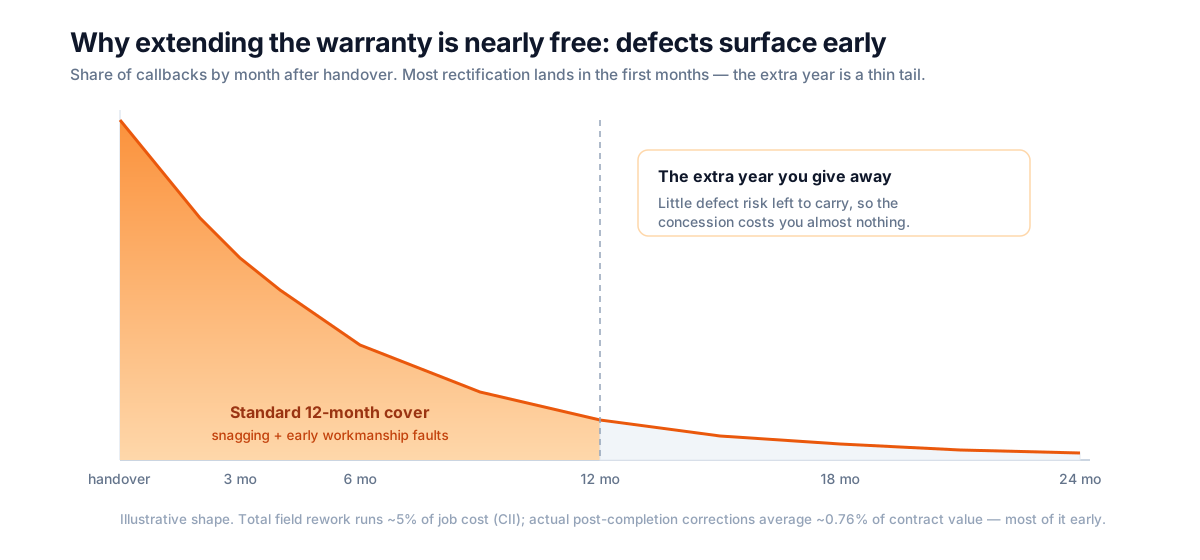
So if your standard cover is already a 12-month workmanship warranty — in line with the defects liability period in the PAM and PWD standard contracts, which obliges a contractor to make good defects for about a year after practical completion — then extending to 24 months hands the buyer a doubling of the headline number while adding only the small latent-defect tail to your expected cost. On our RM80,000 job, if the whole liability period carries perhaps RM800 of expected rectification (about 1 percent of the job) and the second year holds a fifth of that, you are risking roughly RM150 in expectation to offer a concession the buyer reads as substantial. Set that against RM8,000 given away with certainty.
What does a warranty signal that a discount doesn't?
Confidence. A discount and a warranty send opposite messages about your price. The moment you cut the number, you have told the buyer your original price had room — which, as our margin-math piece shows, invites them to push again at the deposit, at every variation order, and at the retention. You have trained your own client to keep asking.
A longer warranty says the reverse: I am so sure this job is done right that I will carry the risk on it for two years. You cannot credibly say that about work you expect to fail. So the warranty doubles as a signal the lowball bid can't send — and in Malaysia, that signal lands on fertile ground.
Malaysian buyers are trained by a thick ecosystem of renovation-scam content to treat the cheapest quote as a warning, not a bargain. Recommend.my and iHome.my both flag the far-below bid as a classic red flag, and real cases anchor the fear — The Star has reported homeowners losing over RM127,000 to a fake contractor. That same anxiety is what a written warranty answers directly. PropertyGuru's guidance to Malaysian homeowners is explicit: draw the contract up in detail and put the warranty terms in writing. A firm that hands over a clear, written workmanship guarantee is doing exactly what the buyer's own scam checklist told them to look for.
When does the warranty lever NOT work?
Two situations, and both matter more than the upside.
First: when your quality control is weak. The entire case above rests on the extra callbacks being rare. If your jobs routinely generate defects — if you already dread the snagging list — then extending the warranty is not a cheap concession, it is a bet on workmanship you know will cost you. The expected cost stops being RM150 and becomes real money you will spend, month after month, in the second year. You are not giving away a warranty; you are pricing a wager on your own crew. If you can't take that bet honestly, the fix isn't a shorter warranty — it's fixing the callbacks first. A firm with genuinely tight quality control can offer the longest warranty in the room precisely because it costs them the least.
Second: when the buyer's only objection is genuinely the number. A warranty is a trust lever, so it moves buyers who are hesitating on risk. A pure price-shopper who has decided they will sign with whoever is cheapest may not budge for a longer guarantee — they want ringgit off, full stop. Even then, offering the warranty first is rarely wasted: it reframes the conversation from price onto risk, which is the ground you'd rather compete on, and it quietly exposes the cheap bid that carries no written cover at all.
Which leads should you offer it to?
This is where the concession meets your inbox — and, as with a discount, the right move depends on the lead, not the job. The warranty lever sorts cleanly by where the enquiry came from:
- Cold, first-time, scam-anxious buyers — a boosted-post or marketplace lead who has never renovated and is visibly nervous about being cheated. This is the warranty's home turf. Their objection is risk, and the written guarantee answers it for almost nothing. Lead here with the warranty, not the price.
- Warm referrals and repeat clients — they already trust you; that's why they came. A longer warranty adds little because the risk objection isn't live. Don't spend a concession solving a problem the referral already solved for you.
- Pure price-shoppers comparing five quotes — the mass-blast quote-shopper whose only axis is the bottom line. The warranty may not close them, but it costs you nothing to try and it changes the comparison — so offer it before you ever consider the number.
The pattern is the mirror image of the discount lesson: the discount is worth least on the warm referral who'd sign anyway, while the warranty is worth most on the cold, anxious buyer a discount would only make more suspicious ("why is it suddenly cheaper?"). To play either lever well you need to know, at the moment you're quoting, where the lead came from and how much they already trust you.
That's a lead-management question. A system like HotLead captures and tags every enquiry by source, so when a deal stalls you can see at a glance whether this is a nervous first-timer who needs the written warranty or a warm referral who needs nothing at all — and its per-channel and team-performance views show you which concessions actually convert, so you learn whether your warranty-led closes hold their margin better than your discount-led ones. HotLead doesn't write your contract or manage the warranty claim itself — that's your commercial and quality-control craft — but its next-action and overdue reminders keep the stalled quote a tracked task instead of a forgotten one, so the concession conversation actually happens before the lead goes cold.
The renovation firms that protect their margin aren't the ones who refuse to give anything to close a deal. They're the ones who reach for the cheap lever first — the one that costs a couple of hundred ringgit in expectation and signals confidence — before they ever touch the one that costs them thousands with certainty.
Working out the economics of your pipeline? Start with the complete guide to managing renovation leads in Malaysia, then read the price-concession companion — should you discount to close a stalled deal? — and what a discount really costs your margin.
Frequently asked questions
Is a warranty a better concession than a discount to close a renovation deal?
Usually yes, on the math. Both are investments you make to lift the chance of winning the job, but they cost you very differently. A discount comes straight off your thin margin with certainty — a 10 percent cut on an RM80,000 job at a 20 percent margin gives away about RM8,000, half the profit. Extending the workmanship warranty costs you only the expected value of extra callbacks in the added window, which on a well-run job is a couple of hundred ringgit at most. So the warranty buys a similar reason for the buyer to commit at a tiny fraction of the cost, and it signals confidence in your work rather than admitting your price had room. The exception is a buyer whose only objection is the number itself, or a firm whose quality control is poor enough that the extra cover is a real liability.
How long is a renovation workmanship warranty in Malaysia?
For homeowner renovation, a workmanship warranty of roughly 12 to 24 months is the norm that trustworthy contractors offer, and it should be written into the contract, not promised verbally. The related contractual concept is the defects liability period (DLP) used in Malaysian construction contracts such as the PAM and PWD standard forms, which typically runs about 12 months after practical completion and obliges the contractor to make good defects at their own cost during that window — with the second half of the retention money released only after the defects are rectified. Materials such as tiles, sanitaryware and appliances usually carry their own separate manufacturer warranties, so a firm's own guarantee should be scoped to workmanship.
What does it actually cost a contractor to extend the defects liability period?
Far less than owners assume, because most defects surface early. Studies of construction rework put total field rework at roughly 5 percent of project cost on average — with a wide 2 to 20 percent range — while actual post-completion corrections average under 1 percent of contract value. Crucially, the bulk of that lands in snagging and the first few months after handover, inside the standard cover you already carry. The extra year you add as a concession sits in the thin tail of the curve, so its expected cost is the small probability of a latent defect appearing late multiplied by the cost to fix it — illustratively a couple of hundred ringgit on a mid-band job, not thousands. That is the whole reason the warranty clears the expected-value bar a discount cannot.
When does offering a longer warranty NOT work?
In two cases. First, if your quality control is weak, the extra window stops being a cheap concession and becomes a real liability — you are effectively betting on workmanship you know will generate callbacks, so the expected cost is no longer small. Fix the recurring defects before you extend the guarantee. Second, if the buyer's only objection is genuinely the price — a pure price-shopper comparing five quotes purely on the bottom line — a warranty may not move them, because they want ringgit off, not reassurance. Even then it is worth trying, because it reframes the conversation from price to risk and quietly exposes the cheap bid that offers no written cover at all.
Should a renovation warranty be verbal or written?
Written, always. In a market where buyers are actively warned about renovation scams and coached to distrust the lowest bid, a verbal "don't worry, we guarantee our work" carries almost no weight — it is exactly what the buyer fears is empty. A short, written warranty clause that states the period, what it covers (workmanship), what it excludes (wear and tear, misuse, third-party changes, materials under their own manufacturer warranty) and how to make a claim turns the reassurance into something real and comparable. It is also what lets the warranty do its trust work against a cheaper competitor who offers nothing in writing.
Keep reading
- The 'Quick Question Ah?' Lead: When a Buyer Uses You as a Free Second Opinion for Someone Else's RenoSome of your busiest WhatsApp threads are with buyers who already have a builder — a cousin, a part-time reno friend — and are messaging you only to sanity-check his price, his tile, his scope. Every question you answer in full is a free consult that de-risks the other guy's job. Here's how to spot the sanity-check lead, why answering everything loses you the work, and how to convert a real doubt without becoming the unpaid QA department.
- Did We Already Say RM68k? Using AI to Stop Quote Drift Across a Long Renovation ThreadOver a weeks-long WhatsApp thread with two or three quote revisions, a rep re-states a number that contradicts an earlier promise — and re-opening a settled price quietly invites a discount that eats a whole job's profit. So I pointed AI at the drift. It works beautifully as a flag, and dangerously as an auto-corrector.
- "Can You Just Build It, My Neighbour Also Did" — Handling the Renovation Lead That Needs Council Approval FirstSome renovation enquiries can't legally start next month, no matter how ready the buyer is — a kitchen extension, a hacked-through wall, a roofed-over air well all need the council's written approval first. Quote a fast build price to win the job and you either lose it to a "boss, can start" cowboy, or win it and inherit the stop-work order, the RM50,000 fine and a client who later can't sell the house. Here's how to spot the permit-first lead and sell the approval as protection.