

You have a quote out on an RM80,000 condo renovation. The site visit went well, the buyer was warm, and then the WhatsApp went quiet. Three days, five days, a week. The job is slipping and you can feel it, so your thumb drifts toward the message you send when a deal goes cold: "Okay lah, for you I give 5% discount."
Stop before you send it. A discount is an investment with an expected value, not a reflex — and on a renovation firm's thin margin, the arithmetic says most price cuts to un-stick a deal lose money, even the ones that win the job. This piece is the test you run before you cut: what a discount is actually worth in expected ringgit, why the deal probably didn't stall on price in the first place, and the one narrow situation where cutting your price is genuinely the right move.
This is the decision layer that sits on top of the pure margin math of a discount. That piece answers what a cut costs you. This one answers the harder question: given what it costs, is this specific cut, on this specific stalled deal, a move worth making at all?
Should you discount to close a stalled renovation deal?
Almost never as a reflex, and only after the math clears. A discount is worth giving only when the extra probability of winning that it buys, multiplied by the full job's profit, is greater than the smaller profit you keep after the cut. On a thin renovation margin that condition is very hard to meet — which is why a price cut aimed at a quiet buyer is usually a losing trade dressed up as a closing move.
The trap is that discounting feels like it's working, because you often do win the job after you cut. But "won the job" is the wrong scoreboard. The right one is expected profit — the job's profit weighted by how likely you were to win it — and on that scoreboard the cut has to earn its keep against the version of you that held firm and won a decent share of the time anyway.
There are two ways a discount destroys expected value, and you have to rule out both before you touch the price:
- It shrinks the prize. The whole discount comes off your profit, not your cost (that's the leverage math: profit lost equals discount divided by margin). So even when the cut wins, it wins a smaller job.
- It's usually solving the wrong problem. Most stalled deals didn't stall on price — so the extra win-probability the cut actually buys is close to zero, and you're handing over certain margin to move an outcome that wasn't really moving.
Deal with the second one first, because it's the one owners never check.
Why is a stalled renovation deal almost never a price problem?
Because silence after a quote is far more often logistics or indecision than a rejection of your number. The most-cited research on why deals die — Matthew Dixon and Ted McKenna's analysis in The JOLT Effect — found that 40 to 60 percent of lost B2B sales go to "no decision," not to a competitor. And the larger share of those, they found, comes from buyer indecision — the fear of making a wrong, hard-to-reverse choice — rather than a preference for someone cheaper. A renovation is exactly that kind of decision: expensive, irreversible, lived-in for a decade. People freeze on it, and a freeze is not a price objection.
In the Malaysian market the "no decision" pause has a very concrete, un-Googleable driver: the home-renovation loan. Banks require an itemised contractor quotation for renovation-purpose loans above RM50,000, and approval typically runs one to three weeks (personal loans can be faster, three to seven days), per RinggitPlus and PropertyGuru Malaysia. Read that again: the buyer often needs your quote to apply for the loan that pays for your job. So the week of silence right after you send the quote is frequently the buyer sitting in a bank queue — not shopping your price. Cutting it there just means you'll fund the same loan-approval wait with less margin.
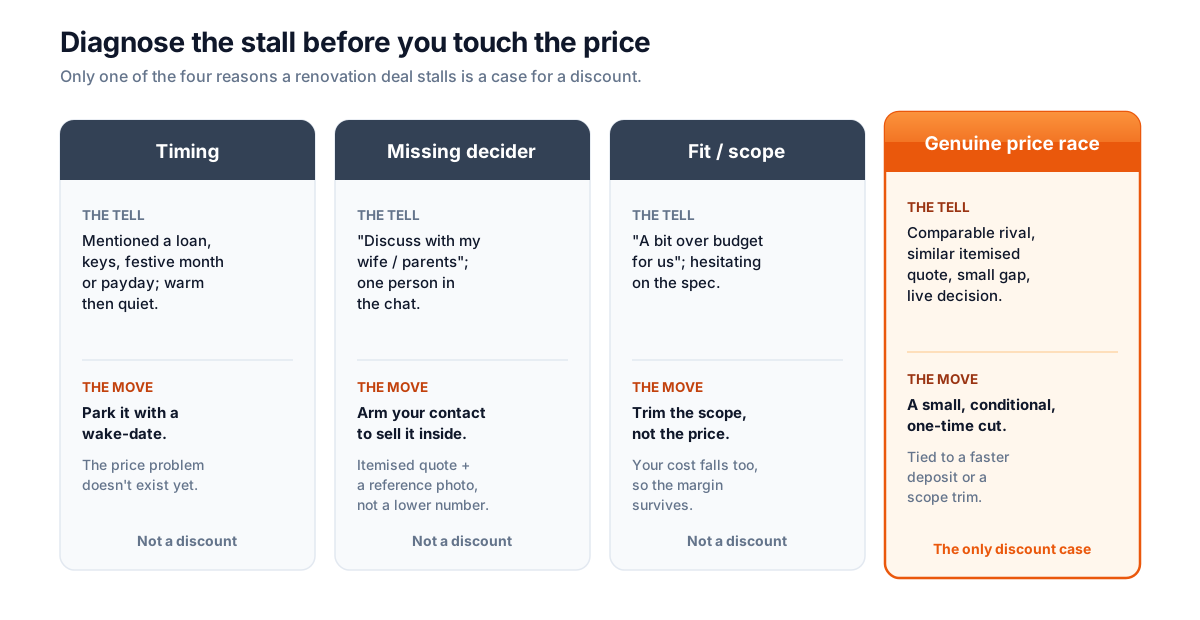
A stalled reno deal has four common causes, and only one of them is price:
- Timing — a loan approval, VP keys, a festive-month cash squeeze, payday. The most common, and the one a discount can't fix. This is the same clock behind the ghosted-after-a-quote decision: silence is dated, not a no.
- A missing decider — a spouse, parents, or a co-owner who wasn't in the chat and hasn't said yes.
- Fit — the scope or spec is slightly beyond what they want to spend, so the number feels wrong for this job.
- Price — a genuine, close, side-by-side competitive comparison where a real rival's comparable quote is genuinely cheaper.
Diagnose which one you're in before you decide anything about the price. If it isn't the last one, a discount is margin donated to a problem it can't solve.
What is a discount actually worth? The expected-value test
Run the deal through this one line: the cut only pays if your new win-probability times the smaller profit beats your current win-probability times the full profit. Rearranged, the discount has to lift your odds to at least (your current odds × the full profit) ÷ (the profit left after the cut). On a thin renovation margin, that hurdle is far higher than it looks, because the cut shrinks the profit at the same time it's supposed to lift your odds.
Put real numbers on it. Take that RM80,000 job at a 20 percent gross margin — RM16,000 of gross profit, consistent with the figures across this series. Say you're in a genuine 50/50 competitive race: you and one comparable firm, and it's a true coin-flip.
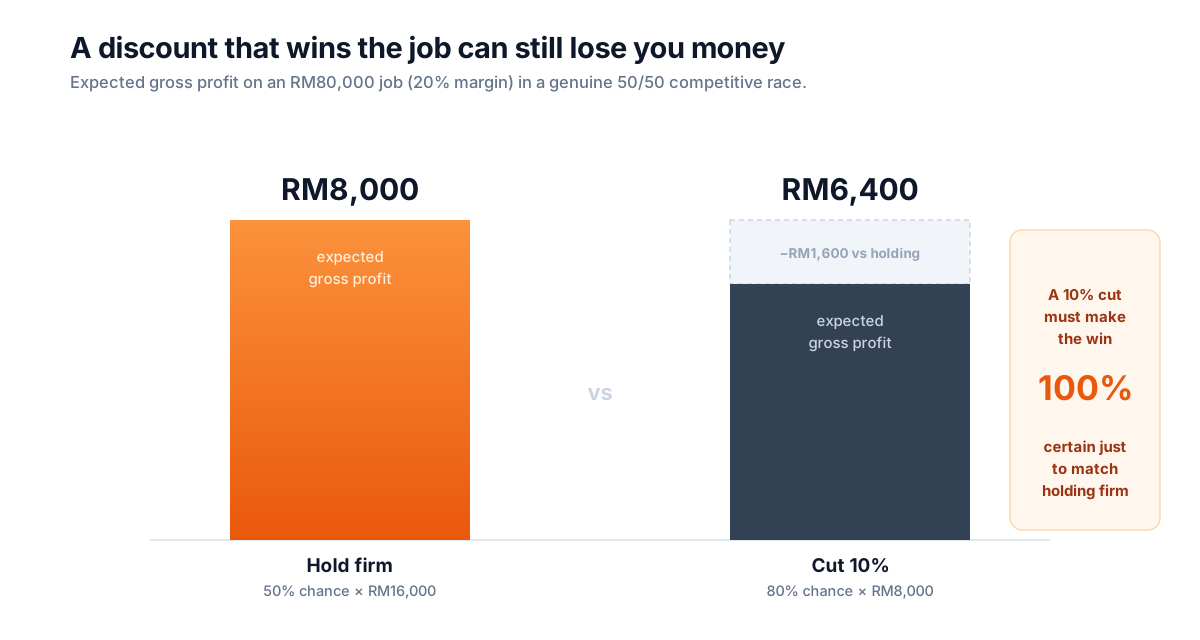
- Hold firm. Expected gross profit = 50% × RM16,000 = RM8,000.
- Cut 10% (RM8,000 off). Your cost doesn't move, so the job's profit drops to RM8,000. Even if the cut lifts your odds to 80%, expected gross profit = 80% × RM8,000 = RM6,400 — less than holding firm.
That's the counter-intuitive core: a 10 percent cut that lifts a coin-flip all the way to 80/20 in your favour still loses you money versus holding your price. To merely break even with holding firm, an RM8,000 cut would have to make the win a dead certainty. Here's the full hurdle table, from that 50/50 start:
| The cut you give | Profit left if you win | Win-probability needed just to beat holding firm | Realistic? |
|---|---|---|---|
| 5% (RM4,000 off) | RM12,000 | ~67% (from 50% → +17 pts) | Sometimes — a small conditional cut can tip a genuine close race |
| 10% (RM8,000 off) | RM8,000 | 100% — the win must be certain | Almost never |
| 15% (RM12,000 off) | RM4,000 | 200% — impossible | Never — the job can't clear the hurdle |
| 20% (RM16,000 off) | RM0 | infinite | Never |
And that table is the best case — a true 50/50 price fight. In the far more common stalls (timing, a missing decider), your real odds of winning at full price are already high and the cut adds almost nothing, so the extra win-probability is near zero and the discount is pure, guaranteed margin given away. That's the same lesson the sales-research world keeps landing on: Korn Ferry finds top sellers close without discounting by communicating value, and SaaStr notes that selling at a discount can cut the long-term value of the relationship by roughly 30 percent. Reviews of "competitive" discounts consistently find that fewer than 30 percent are genuinely strategically justified — the rest were threats the seller overstated or could have answered with value instead of price.
So when is a discount genuinely the right move?
In one narrow case: a real, close, price-comparable competitive stall — and even then only as a small, conditional, one-time concession you get something back for. If the buyer is genuinely choosing between you and a comparable firm on a similar itemised quote, and the gap is small, a modest 5 percent that tips a true coin-flip can be positive expected value on the table above. That's the only clean case.
Four rules keep even that discount honest:
- Small. Stay in the 5 percent zone where the math can still clear. A double-digit cut on a thin margin almost never does.
- Conditional. Tie it to something you get back — a faster or larger deposit, a trimmed scope, a flexible start date that fills a quiet crew-week. A discount that improves your cashflow or utilisation is a trade; a naked drop is a giveaway.
- One-time and framed. Name it as a specific, closing concession, not a new price. The moment you signal the number is soft, the buyer pushes again at the deposit and every variation order — so a reflex cut today re-prices the whole job downward.
- From data, not fear. Only cut when you've diagnosed a genuine price stall, not because the silence made you anxious.
What to do instead, by stall type
Match the move to the reason, not to your anxiety. Here's the decision framework — diagnose the stall, then reach for the lever that actually fits it:
| Why it stalled | The tell | The right move (not a discount) |
|---|---|---|
| Timing | Mentioned a loan, keys, festive month, payday; warm then quiet | Park the lead with a wake-date; the price problem doesn't exist yet. Aim the next touch at their milestone, not a price cut. |
| Missing decider | "Need to discuss with my wife / parents"; one person in the chat | Arm your contact — itemised quote, a reference photo, a clear scope — so they can sell it internally. A lower number doesn't win a room you're not in. |
| Fit / scope | "A bit over budget for us"; hesitating on spec | Trim the scope so your cost falls with the price. Margin survives; the giveaway doesn't. |
| Genuine price race | Comparable rival, similar itemised quote, small gap, live decision | The only case for a discount — small, conditional, one-time, tied to a faster deposit or scope trim. |
Notice that three of the four moves cost you almost nothing and protect your margin entirely, and the fourth is tightly bounded. That's the whole point: the reflex cut isn't one option among four — it's the wrong answer to three of the four situations you'll actually be in.
Where a lead system fits
The expensive part of this decision isn't the arithmetic — it's diagnosing the stall correctly, and doing it at the moment a deal goes quiet across dozens of live enquiries. That's a lead-management problem, not a spreadsheet one.
A system like HotLead captures and tags every enquiry by source, so when a deal stalls you can see at a glance whether this is a warm referral you'd win at full price anyway or a cold price-shopper in a genuine race — and its funnel and per-channel views show you which sources and which stages your deals actually stall at, so you decide from data instead of the fear the silence creates. The next-action and overdue-follow-up prompts keep a quiet deal moving with a value-led touch aimed at the buyer's real clock, instead of a reflexive price cut to break the silence. And because the per-channel ROI view shows whether discounted jobs actually close better or just come in thinner, you find out — with real numbers — whether the discounting you already do is buying anything at all. The tool doesn't set your price or cut it for you. It makes sure you've diagnosed the stall before you ever reach for the discount.
The renovation firms that keep their margin aren't the ones who refuse to ever discount. They're the ones who run the expected-value test first, diagnose why the deal stalled, and cut their price only in the one narrow case where the math — and the reason — actually clear.
Working through the economics of your pipeline? Start with the complete guide to managing renovation leads in Malaysia, then see what a discount really costs your margin and whether to chase or wait on a quiet quote.
Frequently asked questions
Should I give a discount to close a renovation deal that has gone quiet?
Usually no, and the math shows why. A discount is worth it only if the extra probability of winning it buys, times the full job's profit, is greater than the smaller profit you keep after cutting. On an RM80,000 job at a 20 percent margin, holding firm in a 50/50 race gives you an expected RM8,000 of gross profit; a 10 percent cut leaves only RM8,000 of profit on the job, so even lifting your odds to 80 percent earns an expected RM6,400 — less than holding firm. The cut has to make the win almost certain just to break even. Before discounting, work out why the deal actually stalled, because most quiet deals were never stalled on price at all.
How much does a discount have to improve my odds to be worth it?
More than owners expect, because the discount shrinks the prize at the same time. The break-even win-probability equals your current odds times the full profit, divided by the profit left after the cut. From a genuine 50/50 competitive start on a 20 percent-margin job, a 5 percent cut needs to lift you to about 67 percent to break even, a 10 percent cut needs to make the win effectively certain, and a 15 percent cut can never clear the hurdle because the discounted job no longer carries enough profit to beat holding firm. Only small, conditional cuts in a real close race have any chance of paying.
Why do most stalled renovation deals have nothing to do with price?
Because silence after a quote is usually logistics or indecision, not a rejection of your number. Research on lost B2B sales attributes 40 to 60 percent of them to no decision rather than to a competitor, and the larger share of that is buyer indecision and fear of a wrong choice, not a preference for someone cheaper. In Malaysian renovation specifically, a warm buyer often goes quiet because they are waiting on a home-loan approval, need a spouse or parent to agree, or are timing the work to vacant possession. A discount does nothing for any of those, so it burns margin on a problem the buyer does not have.
When is it actually worth giving a discount on a renovation quote?
In one narrow case — a genuine, close, price-comparable competitive stall — and even then only as a small, conditional, one-time concession tied to something you get back, like a faster deposit or a trimmed scope. If the buyer is genuinely deciding between you and a comparable firm on a similar quote, a modest 5 percent that tips a true coin-flip can be positive expected value. A naked price drop to answer a reflexive "boleh kurang?", or a cut on a deal you would have won anyway, is almost always negative — it hands over certain margin to move an outcome that was not really moving.
What should I do instead of discounting to un-stick a deal?
Match the move to the reason it stalled. If it is timing (a loan, keys, a festive month), park the lead with a wake-date instead of cutting — the price problem does not exist yet. If a decider is missing, arm your contact with an itemised quote and a reference photo they can show the spouse or parent, not a lower number. If it is a scope-fit gap, trim the scope so your cost falls alongside the price and your margin survives. Only a real, close price stall justifies a small conditional concession — and it should come with a faster deposit or reduced scope, never as a bare number drop.
Keep reading
- Did We Already Say RM68k? Using AI to Stop Quote Drift Across a Long Renovation ThreadOver a weeks-long WhatsApp thread with two or three quote revisions, a rep re-states a number that contradicts an earlier promise — and re-opening a settled price quietly invites a discount that eats a whole job's profit. So I pointed AI at the drift. It works beautifully as a flag, and dangerously as an auto-corrector.
- The Warranty as a Closing Lever: Why a Longer Guarantee Beats a Discount on a Renovation DealA quote is stalling and the buyer wants a reason to say yes. Before you drop the price, look at the other lever in your hand — a longer workmanship warranty. It is the same expected-value decision as a discount, but the math runs the opposite way — a price cut costs you thousands with certainty, while extending the defects cover costs you a couple of hundred ringgit in expectation, for arguably more trust with a scam-wary buyer. Here is the EV case for the non-price concession, the trap that turns it into a hidden liability, and which leads it actually moves.
- "Can You Just Build It, My Neighbour Also Did" — Handling the Renovation Lead That Needs Council Approval FirstSome renovation enquiries can't legally start next month, no matter how ready the buyer is — a kitchen extension, a hacked-through wall, a roofed-over air well all need the council's written approval first. Quote a fast build price to win the job and you either lose it to a "boss, can start" cowboy, or win it and inherit the stop-work order, the RM50,000 fine and a client who later can't sell the house. Here's how to spot the permit-first lead and sell the approval as protection.