

Here is a scene that will make any renovation or interior-design owner in the Klang Valley wince. A Cheras condo owner enquired about a kitchen and wet-works job in early August. Your salesperson quoted RM68,000 on 12 August. Then life happened — the client added a feature wall, dropped the island, asked to swap tiles, went quiet for a week, came back. Three weeks and forty messages later, your rep types a fresh reply to close it, glances at nothing, and writes "so the total is RM72,000, when can we start?" The client scrolls up, finds the old number, and replies: "eh, tapi you said 68 earlier?" You have just re-opened a settled price — and the only direction it moves now is down.
So the honest 2026 question an owner actually cares about: can AI watch a long thread and stop us contradicting our own quote — profitably? And the sharper follow-up I always end up asking: can it do that without "helpfully" over-writing a price we changed on purpose? I built both versions and measured them. Here is the problem, what the drift costs before any AI, what the two builds did, and what an owner should actually do on Monday.
What does quote drift actually cost a renovation firm?
Quote drift is a margin problem wearing an admin costume. The damage is not the awkward moment — it is that re-stating a different number re-opens a price the buyer had already accepted, and at renovation margins even a small concession to "fix" it can wipe the profit on the whole job. This is the leak worth pointing AI at, because it is silent and it compounds.
Put real numbers on it. A renovation firm running a healthy 20% gross margin nets only around 5% after overhead — a point the gross-versus-net-margin breakdown makes with the same house example, and one that matches general-contractor benchmarks (Projul and industry sources put GC gross margins in the mid-teens, well below the headline remodeling figures people quote). On a RM68,000 job that is roughly RM13,600 of gross profit and about RM3,400 of net. Now let the contradiction surface and concede RM4,000 to look organised: that RM4,000 comes almost entirely off the top, so it is nearly a third of the gross profit and more than the entire net. One careless number, and you have run the whole project for free.
McKinsey's classic Power of Pricing work says the same thing from the boardroom: for a large company a 1% change in price swings operating profit by around 8% — pricing is the single most sensitive lever there is. A renovation firm re-opening a settled RM68,000 quote is not nudging price by 1%; a slip to RM64,000 is a ~6% cut, straight off the most profitable rupee in the job.
And there is a behavioural tax on top. Decades of negotiation research since Kahneman and Tversky show the first number sets the anchor — the buyer calibrates every later expectation around it. When you contradict yourself, you do two harmful things at once: you hand the client a lower figure to anchor on, and you signal that your prices are soft and worth pushing. The discount-to-close math is unforgiving even when the discount is deliberate; a discount you back into by accident is worse.
Why does the load-bearing number get lost in a long thread?
Because the one figure that matters sits buried in the middle of a weeks-long conversation, and both humans and AI are bad at retrieving from the middle. A renovation thread is not a tidy quote document — it is scope changes, voice notes, "let me discuss with wife," tile links and a public holiday, with the real number stated once, early, and never repeated.
That "middle" is not a throwaway word. Stanford's widely-cited "Lost in the Middle" study (Liu et al., 2023) found that language models retrieve information most reliably when it appears at the very start or end of their input, and significantly worse when it sits in the middle of a long context — even for models built for long inputs. Which is exactly where a load-bearing quote lives after three weeks of chat. So the naive fix — "just paste the whole thread into AI and ask what we quoted" — can fail on the precise number you care about, for the same reason your rep missed it scrolling.
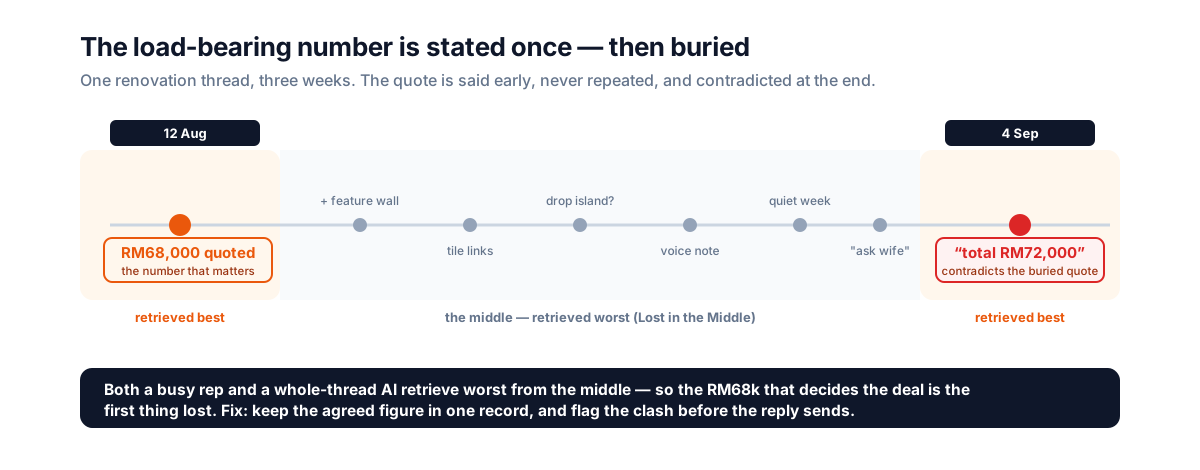
Before any AI, firms "solve" this two ways, both leaky. Some keep a separate quote spreadsheet — which is always one revision stale, because updating it after every scope tweak is the chore nobody does. Others trust memory — which is how RM68k becomes RM72k becomes an argument. The information exists; it is just in the worst possible place to retrieve it under pressure. That profile — a real, expensive, boring retrieval problem — is exactly where AI should earn its keep.
The reflex build: AI auto-fixes the price — and why it backfired
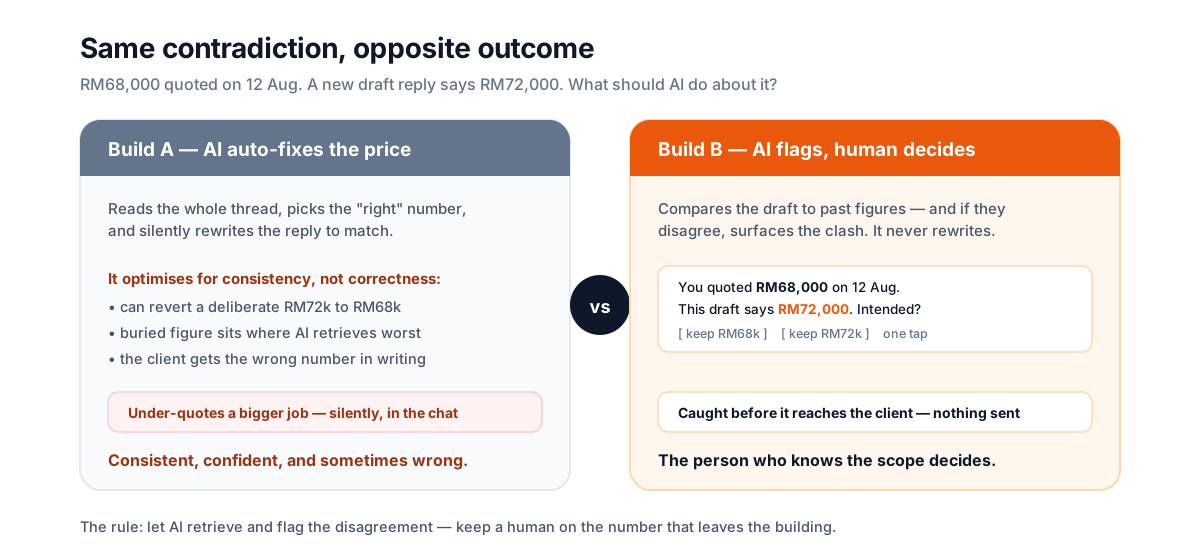
This was Build A, and it is the build everyone demos first: full auto-correct. Before a reply sends, AI reads the thread, finds the "right" price, and silently rewrites the message so the number is consistent. Clean and magical on a slide. Then you run it on real Malaysian renovation threads and it fails in two specific, expensive ways. To be precise: these are the illustrative failure patterns I saw building and stress-testing it, not a published trial.
First, it cannot tell a mistake from a deliberate revision. Half the time the new number is the correct one — the client added a feature wall, so RM72,000 is the real, updated price. An auto-corrector told "make it consistent" has no way to know that, so it reverts the reply to the old RM68,000 and quietly under-quotes a bigger job. It optimised for consistency when what you needed was the correct number — and only the person who ran the site visit knows which that is.
Second, fed the whole thread, it hits Lost in the Middle itself. Ask the model to scan a 200-message dump for "the quote," and the buried 12-August figure is sitting in exactly the low-retrieval zone the Stanford work describes. So Build A doesn't just risk picking the wrong number on purpose — it risks missing the real one by accident, then rewriting the reply with false confidence. An auto-corrector that is sometimes wrong, always silent, and reads as authoritative is worse than no tool at all.
What actually worked: AI flags the contradiction, a human decides
Build B kept everything useful about Build A and removed the part that made decisions. The split is the same one every experiment in this series keeps landing on: let AI do the retrieval and the flag; keep a human on the number that leaves the building.
Concretely, as a rep drafts the closing reply, the assistant checks the new figure against the record of past agreed figures and, if they disagree, surfaces a small, un-ignorable flag: "You quoted RM68,000 on 12 Aug. This draft says RM72,000. Intended?" — with both source lines and their dates, one tap to keep either. It never rewrites the message and never sends. The rep, who knows the feature wall went in, confirms RM72,000 is right and sends; or catches a genuine typo and fixes it. Either way the contradiction surfaced before it reached the client, and the human made the call.
Two design choices make Build B reliable where Build A was not. It is fed a focused window — the past figures and the current draft, not the raw thread — which sidesteps Lost in the Middle instead of walking into it. And its job is narrow: spot that two numbers disagree, not decide which is right. Narrow retrieval-and-compare is what today's models are genuinely dependable at. The compute is a rounding error either way — on the order of a tenth of a sen per check at illustrative GPT-4o mini pricing, the same trivial cost as the first-reply and CRM-update experiments. The tokens were never the cost; the wrong number was.
| Build A — AI auto-fixes the price | Build B — AI flags, human decides | |
|---|---|---|
| Spots the contradiction | Yes | Yes |
| What it does next | Silently rewrites the reply | Surfaces both lines + dates, one tap |
| Handles a deliberate scope-up revision | No — may revert a real RM72k to RM68k | Yes — human confirms the new price |
| Input it reads | The whole 200-message thread | A focused window: past figures + draft |
| Lost-in-the-Middle risk | High — can miss the buried number | Low — never asked to scan the dump |
| Failure mode | Silent, confident, in the client's chat | Visible — a person confirmed the number |
| Compute cost | ~0.1 sen / check | ~0.1 sen / check |
Why is this the honest answer for a Malaysian firm right now?
Because here the quote lives on WhatsApp by default, and the market is at the stage where the wrong build does quiet damage. Roughly 90.7% of Malaysians use WhatsApp, and for a reno or ID firm it is not one channel — it is the channel where the whole negotiation happens, revisions and all. That structurally guarantees the load-bearing number ends up buried in a long thread, which is precisely the retrieval problem AI could help with.
But it also means an owner is being sold "AI reads your chats and keeps your quotes consistent" as a finished feature, with nobody on staff to notice when the model reverts a deliberate revision. At renovation margins that is not a small error — it is a re-opened price and a lost job's profit. The grounded move is not to skip AI here; it is to point it at the safe, valuable half (retrieve the past figure, flag the disagreement) and keep a human on the half that is not (decide which price is real, and send it). The same draft-don't-decide line runs through the handover catch-up and quote follow-up experiments — this is that split applied to the number itself.
What should an owner actually do on Monday?
You do not need to build a contradiction-detector this week to stop most of the drift. In order:
- Put the current agreed figure in one place. The single biggest fix is the least clever one: keep the live quote in a structured lead record, not scattered across 200 messages. If your rep can see "current quote — RM72,000, updated 4 Sep" at a glance, the drift mostly never happens.
- If you use AI, make it flag, not fix. Have it compare the new number to past ones and surface a contradiction for a human — never let it rewrite a price or send. The flag is the win; the auto-correct is the risk.
- Feed it a focused window, not the whole thread. Give the model the past figures and the current draft. Dumping the raw conversation invites the Lost-in-the-Middle miss on the exact number you care about.
- Treat a re-opened price as a live threat, not an admin slip. The moment two numbers are on the table, you are in a negotiation you did not choose, anchored low. Catch it before it reaches the client, or you will discount to close a deal that was already yours.
How HotLead fits — and what it deliberately does not do
I will be straight, because over-claiming is the hype I keep arguing against. HotLead does not ship an AI that scans your chats for quote contradictions — that flag is an experiment about where AI could help next, not a feature. What HotLead does is the plumbing that stops most of the drift before AI is even in the picture:
- One structured record per lead where the status, scope and figures live — so the current agreed number sits in one place your team maintains, not buried in a long thread.
- One owner and a next action on every lead, so the person replying is the person who knows what was quoted and why — the human context that tells a deliberate revision from a slip.
- A funnel and per-channel view and a team scoreboard that stay honest only because the numbers behind them are human-kept, not machine-guessed — the same reason the price decision should stay human.
In other words, HotLead removes the cause of most quote drift (a number with no home), and this experiment is honest about where an AI guardrail could sit on top: flagging, never fixing. If a leaking, disorganised quote trail is your problem, start with the complete guide to managing renovation leads in Malaysia, see how it fits a renovation firm, or read the companion pieces on the slow-quote leak and why a busy firm can still feel broke.
Sources: Language models retrieve worst from the middle of a long context from Liu et al., 2023 — "Lost in the Middle: How Language Models Use Long Contexts" (Transactions of the ACL, 2024). The disproportionate profit sensitivity of price (a 1% price change swings operating profit ~8% for the average large company) from McKinsey — The Power of Pricing. Price anchoring — the first number sets the reference the buyer calibrates around — traced to Kahneman and Tversky and summarised by the Harvard Program on Negotiation — What is Anchoring in Negotiation?. Renovation gross-vs-net margin figures (a ~20% gross margin nets ~5% after overhead; general-contractor gross margins in the mid-teens) from the companion gross-versus-net-margin breakdown and general-contractor benchmarks including Projul — construction profit margins. Illustrative compute cost uses GPT-4o mini API pricing. WhatsApp penetration (90.7% of Malaysians) and Malaysian renovation cost bands as cited in the complete guide.
Frequently asked questions
Can AI catch when we contradict an earlier quote in a long WhatsApp thread?
Yes, and this is the narrow job it is genuinely good at. Point it at the current draft reply plus the record of past figures and it will spot that RM72,000 today contradicts RM68,000 quoted three weeks ago, and surface both lines with their dates for a human to check. That is a reliable, valuable flag. What it should not do is decide which number is correct and rewrite the message on its own — that call needs a human who knows whether the scope actually changed.
Should I let AI automatically correct the price to the right number?
No. The trap is that AI cannot tell a genuine revision from a slip. If the scope grew and RM72,000 is the new, deliberate price, an auto-corrector that "helpfully" reverts it to the old RM68,000 has just quietly under-quoted a bigger job. It optimises for consistency when what you want is the correct number, and only the person who ran the site visit knows which that is. Use AI to flag the disagreement; keep the human on the decision.
How much does one wrong price actually cost a renovation firm?
Far more than the number suggests, because it comes straight off the thinnest part of the job. A renovation firm running a healthy 20% gross margin nets only around 5% after overhead. On a RM68,000 job that is about RM13,600 of gross profit and roughly RM3,400 of net. If a contradiction re-opens the price and you concede RM4,000 to look organised, that RM4,000 is almost a third of the gross profit and more than the whole net — you have worked the entire project for nothing. McKinsey's pricing research puts the same point at portfolio scale — a 1% change in price swings operating profit around 8%.
Does feeding the whole chat to AI make it more accurate?
Counter-intuitively, often the opposite. Stanford's "Lost in the Middle" research found that language models retrieve information best when it sits at the very start or end of their input and noticeably worse when it is buried in the middle of a long context — the exact place a load-bearing quote lives after three weeks of chat. So dumping the entire thread in can make the model miss the number you most need it to see. The reliable pattern is to feed it a focused window — the past agreed figures and the current draft — not the raw 200-message dump.
Does HotLead have an AI that checks quotes for contradictions?
No, and I want to be straight about that rather than sell a feature that does not ship. What HotLead does is the plumbing that prevents most of the drift in the first place — one structured record per lead where the current status and figures live, a next action on every lead, and an owner accountable for it — so the agreed number sits in one place instead of scattered across a long thread. The contradiction-flag in this piece is an experiment about where AI could help next, labelled as such, not a HotLead capability.
Keep reading
- The Warranty as a Closing Lever: Why a Longer Guarantee Beats a Discount on a Renovation DealA quote is stalling and the buyer wants a reason to say yes. Before you drop the price, look at the other lever in your hand — a longer workmanship warranty. It is the same expected-value decision as a discount, but the math runs the opposite way — a price cut costs you thousands with certainty, while extending the defects cover costs you a couple of hundred ringgit in expectation, for arguably more trust with a scam-wary buyer. Here is the EV case for the non-price concession, the trap that turns it into a hidden liability, and which leads it actually moves.
- "Can You Just Build It, My Neighbour Also Did" — Handling the Renovation Lead That Needs Council Approval FirstSome renovation enquiries can't legally start next month, no matter how ready the buyer is — a kitchen extension, a hacked-through wall, a roofed-over air well all need the council's written approval first. Quote a fast build price to win the job and you either lose it to a "boss, can start" cowboy, or win it and inherit the stop-work order, the RM50,000 fine and a client who later can't sell the house. Here's how to spot the permit-first lead and sell the approval as protection.
- You Have 300 Dead Renovation Leads. Can AI Tell You Which 15 Are Worth Reviving?A Cheras reno owner sits on 280 dead WhatsApp contacts, and every Deepavali the reflex kicks in — blast them all a "we have a promo!" message and hope. It wins a handful of jobs, annoys the other 270, and quietly tips his WhatsApp number toward a quality-rating downgrade that throttles the messages he actually needs to send. So the 2026 question lands on my desk — can AI read the dead pile and tell me who's genuinely worth one human re-approach? I built it. The auto-score-and-blast version is a faster way to burn the same goodwill. The version that paid does the opposite of what the pile makes you want to do — it tells you who NOT to contact. Here's the build, and the arithmetic that makes "message fewer" the profitable move.