

A renovation firm owner in Cheras has 280 dead leads sitting in WhatsApp, and every festive season he does the same expensive thing with them.
They're not customers — they're enquiries that went cold. People who asked for a quote in 2024 and never replied. The couple who said "next year lah, after we collect keys." The ones who ghosted after a good site visit. They pile up, a few every week, and by the time Deepavali or Chinese New Year comes around he's staring at a contact list of a few hundred names that all feel like money left on the table. So the reflex fires: broadcast a "we have a renovation promo this month!" message to all of them, and hope.
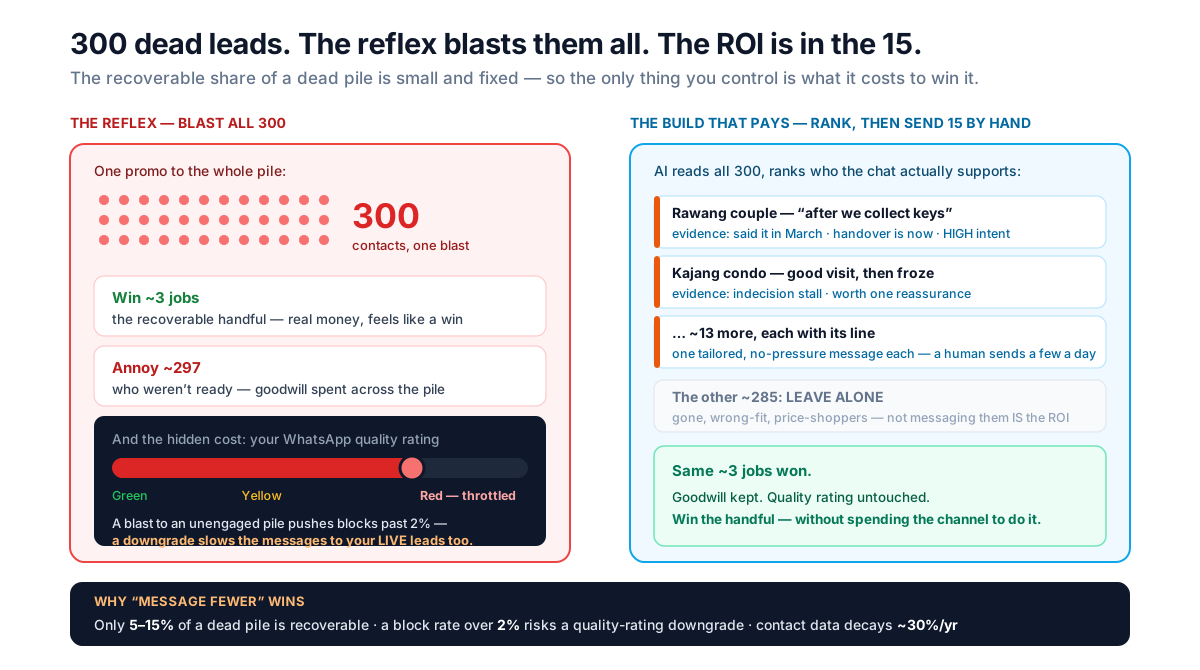
It's the wrong move, and not for the reason you'd think. It's wrong even when it works. A blast to 280 people might win two or three jobs — real money, so it feels like a win. But it also annoys the other 277, and on the WhatsApp Business Platform it quietly pushes his number toward a quality-rating downgrade that throttles the messages he actually needs to send to live buyers. He's spending the health of his main sales channel to win three jobs he could have won with fifteen targeted messages.
So he asked the 2026 question I keep getting: "Can't AI just read my whole dead pile and tell me who's actually worth chasing?"
I built it. And the honest answer is the most useful thing AI does here is the opposite of what the pile makes you want to do — it tells you who NOT to message. The version that auto-scores every contact and fires off a revival blast is just a faster way to burn the same goodwill. Here's the build that actually paid, and the arithmetic behind why "message fewer" is the profitable move.
Why does blasting the whole dead pile lose money?
Because a mass revival blast has two costs that never show up on the invoice: the goodwill you burn with everyone who wasn't ready, and the damage to the WhatsApp number your live pipeline runs on. Count only the jobs you win and it looks free. Count what it costs the channel and it's usually negative.
Start with the channel, because it's the part owners never see. On the WhatsApp Business Platform, your business number carries a quality rating — green, yellow or red — that Meta recalculates over a rolling seven-day window based on how people react to your messages: blocks, spam reports, and whether anyone replies. Send a promo to hundreds of cold contacts and a chunk of them will block or mute you, because they'd forgotten who you are. Practitioner guides to the platform report that a block rate above 1% starts to degrade your rating, above 2% risks a tier downgrade, and above 3% drops you to Low — while the best-run senders keep block rates at 0.1–0.3% by only messaging engaged people. A downgrade throttles how many messages you can send — which means the blast that was supposed to win back old leads can choke the messages you send to the live, paying ones.
Now the goodwill. A renovation is a big, personal, once-a-decade decision. Someone who enquired eighteen months ago and chose another firm doesn't want a "promo!" — they want to not hear from a firm they already decided against. Every irrelevant blast trains the people who might have come back to see your name as noise. This is the same trap the nurture piece warns about: a mass-promo blast is worse than sending nothing, because "nothing" keeps the door open and "buy now!" slams it. So the reflex spends two real assets — channel health and goodwill — to chase a handful of replies. The math almost never works, and I'll show it below.
So what's actually in a dead pile?
Four very different kinds of lead, wearing the same "cold" label — and the entire ROI of revival is in telling them apart, because three of the four should be left alone. Reading them as one undifferentiated list is what makes the blast feel reasonable.
| What's in the pile | What it looks like | Worth reviving? |
|---|---|---|
| Recoverable indecision | Good meeting, then froze — "let me think," then silence | Yes — this is the biggest recoverable slice (JOLT: most stalls are indecision, not a rival) |
| Real "not now", wake-date arrived | "Next year after we collect keys / loan cleared" — and now it's next year | Yes — the highest-intent revival there is: they told you when |
| Warm-then-ghosted | Engaged, got a quote, went quiet — reason unknown | Maybe — worth one human re-approach, not a blast |
| Genuinely gone | Chose a rival, moved, wrong-fit, or a price-shopper who never qualified | No — contacting them costs goodwill and buys nothing |
The point of this table is the right-hand column. A blast treats all four identically. But the money is concentrated in the top two rows — the indecision stalls the JOLT Effect found make up 40 to 60 percent of lost deals (recoverable with reassurance, not pressure), and the real "not now" leads whose wake-date has finally come around. The bottom rows are where goodwill goes to die. Any revival that doesn't sort the pile first is just a blast with extra steps.
What happened when I let AI auto-score and blast the pile?
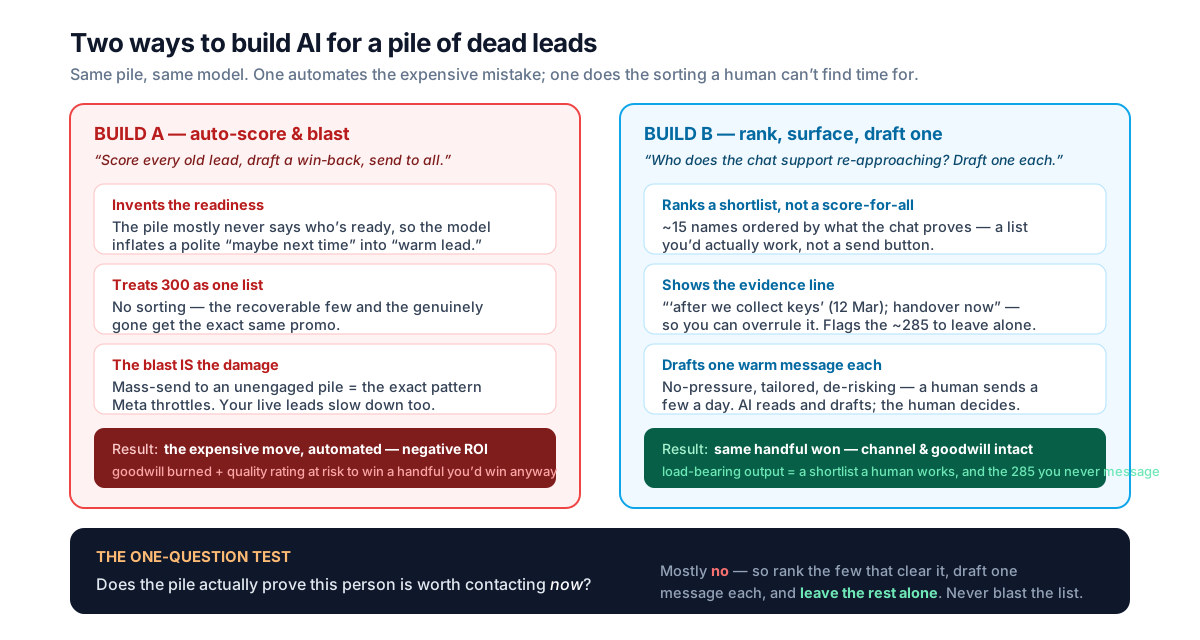
It confidently ranked all 280 as "revival-ready" to some degree, drafted a promo, and would happily have fired it at everyone — which is the expensive thing, done faster and with a data-shaped justification bolted on.
I gave a model the dead threads and the instruction any owner would type: "Score each old lead on how likely they are to buy now, and draft a win-back message for the whole list." Two things went wrong, and they're the same two failure modes that show up every time you ask AI to decide instead of read.
First, it invented the readiness. Most of a dead pile never states whether the buyer is ready to come back — they just went silent. Told to produce a score for every contact, the model produced one for every contact, because "unknown" doesn't feel like a score. So it reached for whatever the chat gave it something to point at — a polite "maybe next time," an old "looks nice" — and inflated it into "warm, likely to convert." It's the same fabrication I hit with the auto loss-reason tagger and the weekly-report narrator: asked for a verdict the data can't support, a language model writes a fluent guess and dresses it as insight.
Second, the blast itself was the damage. Even if the scoring were perfect, the bulk-send is the part that trips the WhatsApp quality-rating penalty. Build A doesn't just risk contacting the wrong people — its whole mechanism is the mass-send-to-unengaged pattern that gets numbers throttled. The automation makes the mistake cheaper to commit and therefore more likely.
What did the build that actually paid look like?
The one that flips the job from sending to sorting: AI reads the whole dead pile, RANKS the handful genuinely worth a human re-approach, surfaces the exact evidence line behind each pick, and drafts ONE tailored, no-pressure message per top-ranked lead — and a human sends a few a day. Same division of labour that's earned its keep at every step of this chain: AI reads and drafts, the human decides and sends.
- It ranks, it doesn't blast. The output is a shortlist of maybe ten to twenty names, ordered by how much the chat actually supports a re-approach — not a score slapped on all 280 and a send button. Working a short, high-confidence list is the whole point.
- Every pick comes with its evidence line, never a bare score — "'do it after we collect keys, end of year' (said 12 March); handover window is now — high intent" or "good site visit, then silent after quote — indecision stall, worth one reassurance." You see exactly why it's on the list, so you can overrule it.
- It flags the leave-alone majority explicitly. The genuinely-gone, the wrong-fit, the price-shoppers who never qualified — surfaced as don't contact, because not messaging them is the ROI. That flag is a feature, not a gap.
- It drafts one tailored message per top pick — a warm, specific, no-pressure re-open the owner can send in a tap, not a promo template. The JOLT finding is that the fix for a stalled buyer is de-risking the decision, not pressure — so the draft reassures ("no rush, here's a similar condo job we finished") rather than sells.
The load-bearing output here isn't a score — it's a shortlist a human will actually work. And that's the thing AI genuinely helps with: reading 280 threads you'd never re-read, remembering the couple who named a wake-date six months ago, and drafting the awkward re-opener so you'll actually send it. It just doesn't get to send, because sending to the wrong people is where all the cost is.
The counterintuitive part: the ROI is in NOT contacting most of the pile
Here's the arithmetic that makes "message fewer" the profitable move, and it's the opposite of the "more messages, more revivals" instinct. Reactivation benchmarks put the recoverable share of a dormant pile at roughly 5 to 15 percent on average, with cold old enquiries at the bottom of that band. So the pile's value is real but thin — and it's destroyed by spreading it across everyone.
| Mass-blast all 280 | AI-triaged shortlist of ~15 | |
|---|---|---|
| People contacted | 280, all with the same promo | ~15, each with a tailored message |
| People annoyed | ~270 who weren't ready | Close to zero — only genuine fits |
| Reply quality | Low — a cold audience, mostly ignored | High — reasons the chat actually supports |
| WhatsApp quality rating | At real risk (mass-send-to-unengaged) | Unaffected — normal 1:1 conversations |
| Goodwill | Spent across the whole pile | Preserved |
| Owner effort | One click, then damage control | A few sends a day, all warm |
The blast column wins on reach and loses on everything that costs money. Because the WhatsApp quality rating is shared across your whole number, the downside of the blast isn't contained to the dead pile — a downgrade throttles the messages to your live, paying leads too. A 280-blast that wins three jobs but tips you into a yellow rating for a fortnight can cost you more in delayed replies to hot leads than the three jobs are worth. The triaged shortlist wins those same three jobs — the recoverable ones were always going to be a small number — without spending the channel to do it.
Are dead-pile revivals actually cheaper than fresh leads?
Yes — but only if you're surgical, and the "only if" is the whole point. A dead lead's acquisition cost is already sunk: you already paid the ad spend or the Qanvast fee to find them, already spent the time to quote them. They know your name, your work and roughly your price. Bain's much-cited retention research puts the cost of acquiring a new customer at 5 to 25 times that of keeping an existing relationship — and while a dead lead isn't a past customer, the same logic points the right way: re-approaching someone who already engaged should cost less per job than sourcing a stranger.
The catch is that this only holds when you re-approach the right handful. Blast the whole pile and you've thrown away the advantage — you've reinvented cold outreach on a stale list (remember, contact data decays around 30 percent a year, so a two-year-old pile is full of changed numbers and moved-on buyers) and added channel-health risk that fresh leads don't carry. The economics of revival are genuinely good; the economics of blasting revival are genuinely bad. The per-channel ROI view is how you actually check which is true for your firm — track cost-per-job on triaged revivals against cost-per-job on fresh leads, and let the number, not the instinct, decide how much energy the dead pile deserves.
What should an owner actually do with a dead pile?
Treat it as a sorting problem, not a sending one. Most of the win here is a habit and a bit of restraint, not an AI.
- Never blast the whole pile. It's the single most unengaged audience you own, so it's the most dangerous one to broadcast to. If you do nothing else, don't do this.
- Sort before you send. The four kinds of dead lead need four different treatments — and three of them need silence. AI can do the first-pass sort; you confirm it.
- Prioritise the wake-dates. The highest-intent revival is the "not now" lead whose "now" has arrived — keys collected, loan cleared, bonus season. Those are scheduled leads, not dead ones. Flag them when they go quiet so they resurface on time.
- Send few, send warm, send by hand. A tailored, no-pressure message to ten to twenty people, a few a day, from a human. No promo template, no bulk send.
- Let AI rank and draft — never score-and-blast. A ranked shortlist with evidence is a tool. An auto-sent revival campaign is the mistake this piece is about.
- Measure revival cost-per-job against fresh cost-per-job. If triaged revivals come cheaper, do more of them. If they don't, stop — and put the energy into not letting leads die in the first place.
How HotLead fits — honestly
I'll be straight, the way I try to be in all of these, because over-claiming is the exact hype I keep arguing against. HotLead does not ship an AI that scores your dead pile and blasts a revival campaign — that's the experiment in this piece, and the piece is the argument for why it shouldn't run unattended. What HotLead gives you is the groundwork that makes a surgical, honest revival possible in the first place:
- Every enquiry captured on one record. So when you do go back to a dead lead, the whole thread — the quote, the "after we collect keys," the silence — is right there to read, not scattered across three reps' phones. You can't triage a pile you can't see.
- One owner per lead, by rule. The human who worked the deal is the one who remembers "oh, that's the Rawang couple waiting on handover" — the memory signal no model has. Round-robin, manual, or a custom rule by area or source.
- A next action and overdue nudge. So "circle back when their keys are handed over" becomes a tracked step that actually happens, instead of a good intention that decays with the rest of the pile. This is how a "not now" stays a scheduled lead instead of becoming a dead one.
- A funnel and per-channel ROI view. So you can check whether dead-pile revivals genuinely come cheaper than fresh leads — the only honest way to decide how much the pile is worth.
The judgment — who to re-approach, and who to leave alone — stays with you, because the value is entirely in the restraint. If a pile of dead leads is the problem underneath all this, start with the complete guide to managing renovation leads in Malaysia, see how it fits a renovation firm, an interior design studio or a construction contractor, or read the companion builds on nurturing the not-ready leads, reading why a deal actually died, and how many follow-ups actually pay.
Sources: The WhatsApp Business Platform quality-rating mechanic — a green/yellow/red rating recalculated over a rolling ~7-day window from blocks, spam reports and user response — is documented by Meta (About Your WhatsApp Business Phone Number's Quality Rating). The block-rate thresholds (degradation above ~1%, tier-downgrade risk above ~2%, drop to Low above ~3%, with best-in-class senders at 0.1–0.3%) and the "mass-send to an unengaged audience" penalty pattern are as reported by WhatsApp Business Platform scaling guides (Chatarmin, asisteclick) and quality-rating references (Brevo help centre). Database-reactivation recovery of ~5–15% of a dormant pile (cold old enquiries at the low end) and the ~30%/yr contact-data decay figure are from database-reactivation benchmark write-ups (automatetogrow, Cometly). The retention-vs-acquisition economics — acquiring a new customer costing 5 to 25 times more than keeping an existing relationship — is Bain & Company's, widely cited (e.g. Invesp); it's applied here as directional logic, since a dead lead is not a past customer. The finding that 40–60% of lost deals end in "no decision" rather than a competitor win, ~56% of it driven by indecision, is from The JOLT Effect by Matthew Dixon and Ted McKenna (Portfolio/Penguin, 2022), based on ~2.5 million recorded sales conversations. The ~90.7% WhatsApp-for-business figure for Malaysia is reused from earlier pieces in this series (aggregated Malaysian messaging-usage reporting). Renovation lead-volume, close-rate and job-value figures are typical operating numbers reused from the funnel-benchmarks and cost-of-lost-lead pieces, labelled typical rather than a single quoted study; the AI experiment and the Cheras/Rawang scenarios are described from practice and labelled illustrative, not a controlled trial. No revival, reply or conversion percentage here is invented.
Frequently asked questions
Can AI tell me which of my old renovation leads are worth reviving?
It can read the whole dead pile, rank who is most likely worth one human re-approach, and show you the evidence line behind each pick — "said 'next year after we collect keys' in March, handover was last month" — so you work a short shortlist instead of guessing. What it must not do is auto-score every contact and bulk-send a revival blast, because most of a dead pile never states whether the buyer is ready, so the model invents that readiness, and the blast itself trips the WhatsApp quality-rating penalty. Let AI rank and draft; keep the send human and few-a-day.
Why is mass-blasting my whole dead lead list a bad idea?
Because it costs more than it looks. On the WhatsApp Business Platform your number carries a quality rating recalculated over a rolling seven days from blocks and spam reports, and a block rate above 2 percent risks a downgrade that throttles how many messages you can send — including the ones to your live, paying leads. A promo blast to hundreds of cold contacts is precisely the mass-send-to-unengaged pattern Meta reads as spam. So a 300-contact blast that wins three jobs can annoy nearly 300 people, burn goodwill, and damage the channel your real pipeline runs on. The wins rarely cover that.
Are old renovation leads cheaper to revive than buying new leads?
They can be, because the cost of finding and qualifying them is already spent — Bain's research puts the cost of acquiring a new customer at 5 to 25 times that of keeping an existing relationship. A lead who once got a quote from you already knows your name, your work and your price. But this only pays if you re-approach the right handful. If you blast the whole pile, you've reinvented cold outreach with a stale list (contact data decays roughly 30 percent a year) and added channel-health risk on top. The saving is real only when the targeting is surgical.
How many old leads should I actually try to revive at once?
Far fewer than the pile tempts you to. Database reactivation campaigns typically recover only about 5 to 15 percent of dormant leads, and cold old enquiries sit at the bottom of that range. So the goal isn't reach, it's precision — a ranked shortlist of maybe ten to twenty of the most genuinely-worth-it contacts, re-approached a few a day with a tailored, no-pressure message a human sends. Working fifteen well beats blasting three hundred badly, on both replies and channel health.
Does HotLead automatically revive dead leads for me?
No, and the auto-score-and-blast version is the experiment in this piece — the whole article is the argument against running it unattended. What HotLead ships is the groundwork that makes an honest, surgical revival possible — every enquiry captured onto one record so the whole dead thread is there to read; one owner per lead so someone remembers the deal; a next action and overdue nudge so "circle back when their keys are handed over" becomes a tracked step instead of a forgotten promise; and a funnel plus per-channel ROI view so you can check whether dead-pile revivals actually come cheaper than fresh leads. The judgment of who to re-approach — and who to leave alone — stays human.
Keep reading
- Did We Already Say RM68k? Using AI to Stop Quote Drift Across a Long Renovation ThreadOver a weeks-long WhatsApp thread with two or three quote revisions, a rep re-states a number that contradicts an earlier promise — and re-opening a settled price quietly invites a discount that eats a whole job's profit. So I pointed AI at the drift. It works beautifully as a flag, and dangerously as an auto-corrector.
- The Warranty as a Closing Lever: Why a Longer Guarantee Beats a Discount on a Renovation DealA quote is stalling and the buyer wants a reason to say yes. Before you drop the price, look at the other lever in your hand — a longer workmanship warranty. It is the same expected-value decision as a discount, but the math runs the opposite way — a price cut costs you thousands with certainty, while extending the defects cover costs you a couple of hundred ringgit in expectation, for arguably more trust with a scam-wary buyer. Here is the EV case for the non-price concession, the trap that turns it into a hidden liability, and which leads it actually moves.
- "Can You Just Build It, My Neighbour Also Did" — Handling the Renovation Lead That Needs Council Approval FirstSome renovation enquiries can't legally start next month, no matter how ready the buyer is — a kitchen extension, a hacked-through wall, a roofed-over air well all need the council's written approval first. Quote a fast build price to win the job and you either lose it to a "boss, can start" cowboy, or win it and inherit the stop-work order, the RM50,000 fine and a client who later can't sell the house. Here's how to spot the permit-first lead and sell the approval as protection.