

A renovation firm in Cheras has a condo job underway — a RM80k full unit, two months in. On a Tuesday morning, mid-tiling, one of the owner's regular clients fires a single WhatsApp voice note, forty-five seconds of it, the way Malaysian clients actually talk:
"Eh bro, morning — just checking when you all coming this week ah, the tiler said maybe Thursday? Oh and one thing, the living room paint looks a bit darker than the sample we chose, my wife also notice, can you check. And actually while you're there, can add one power point behind the TV, we want to mount it. Oh ya, and the site visit we said Saturday — can push to Sunday? Saturday I'm not free. Thanks ah!"
The owner is between two sites, listens with half an ear, and thumbs back: "Coming Thursday 👍". Done. Moves on.
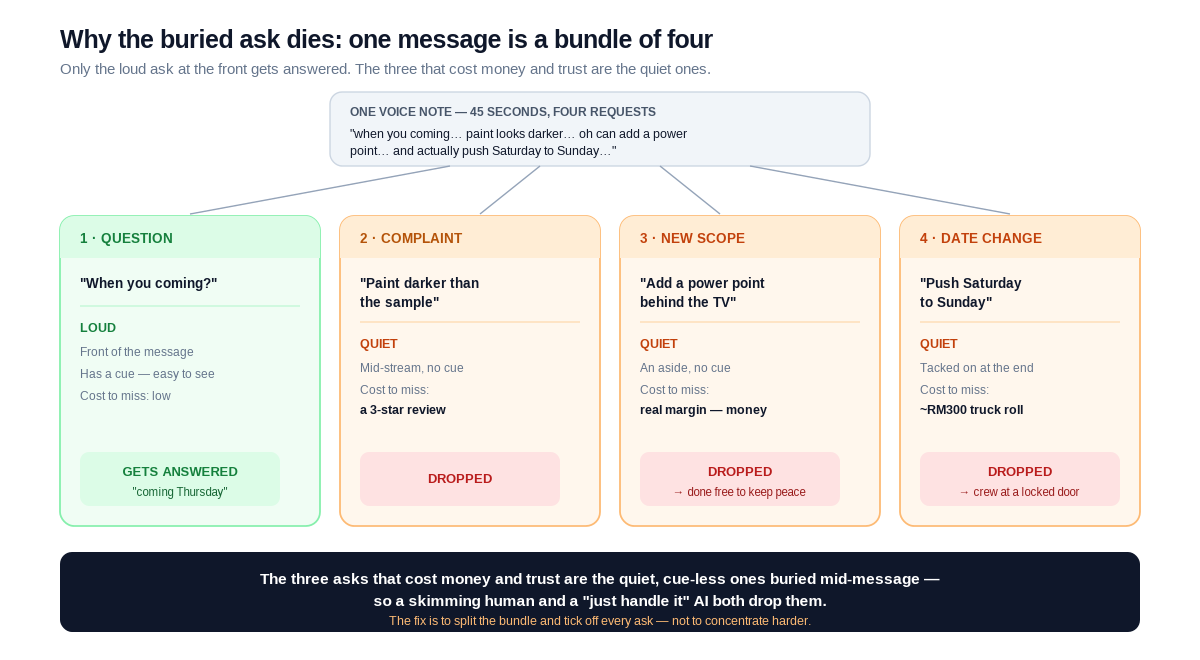
He just answered one of four asks. The other three — a complaint about the paint, a new scope item (the power point), and a reschedule — quietly died in that reply. And look at which ones died: the complaint that'll fester into a bad review, the add-on that's real money, and the date change that'll send his crew to a locked door on Saturday. The only one he caught was the one that was shouting ("WHEN YOU COMING"). The three that actually cost him were the quiet ones.
So the 2026 reflex writes itself: "Can't AI just read the whole message and handle everything in it — answer the question, note the complaint, log the add-on, move the booking?"
I built it. And the first time a client sent a rambly, back-and-forth voice note, it confidently rescheduled the visit to the wrong day. Here's why "just handle the message" is the wrong instruction — and the version of the build that catches every buried ask without ever acting on a misread.
Why does the ask that matters most get dropped?
Because the asks that carry money and risk — a new scope item, a complaint, a date change — usually arrive as quiet asides in the middle of a friendly ramble, while the thing your eye locks onto is the loud, simple question at the front. You answer the headline and feel like you replied. You did reply — to a quarter of the message.
Watch the Cheras voice note again. Rank the four asks by what it costs to miss them:
- "When you coming?" — the loud one. Costs nothing to miss; the client will just ask again. This is the one that got answered.
- "The paint looks darker than the sample" — a complaint, mid-job, with the wife now involved. Miss it and it hardens into "they didn't even respond when we flagged it," which is how a decent job earns a 3-star review on the grout.
- "Can add one power point" — a new scope item. This is money. Miss it and you either do it free to keep the peace — quietly turning a 20% margin into 12% on that line — or you remember it awkwardly late and look disorganised. My colleague Sarah and I have both written about scope creep as a margin killer; here it's not even creeping, it's being handed to you, and you're dropping it.
- "Push Saturday to Sunday" — a reschedule. Miss it and the crew drives out Saturday to a locked door: ~RM300 of KV hours and half a day of a two-crew firm's capacity, burned for nothing. (The whole reason confirming a site visit matters — except here the no-show is your fault.)
The three expensive asks have one thing in common: none of them is the message's headline. They're the "oh and," the "actually," the "one thing" — grammatically demoted, buried mid-stream. The loud question sits at the front where it's easy to see and trivial to answer. So the owner answers the cheap one and drops the three that count. It's not that he doesn't care; it's that a long message hides its own most important parts.
Isn't this just the owner being careless?
No — it's structural, and it trips a machine the same way it trips a tired human. A single message is not one request; it's a bundle of separate requirements, and both a skimming reader and a "just handle it" AI reliably satisfy only a fraction of them. This is one of the better-measured facts in the whole AI-instruction-following literature, and it's worth knowing because it tells you the fix isn't "concentrate harder."
When researchers built InFoBench (Qin et al., Findings of ACL 2024) to measure how well models follow instructions, they found they couldn't score an instruction as one pass/fail — because even a single instruction secretly contains multiple requirements. They decomposed their 500 instructions into 2,250 separate requirements — about 4.5 per instruction on average, and 6.29 for the complex ones — and scored the share a model actually satisfied (their "Decomposed Requirements Following Ratio"). The headline result for us isn't a specific model's score; it's the framing: an instruction is a bundle, and following it is never all-or-nothing. You satisfy some of the requirements and miss others.
It gets more specific. In the multi-intent detection field — the exact problem of one message carrying several requests — systems are known to silently drop the secondary intent. Production platforms like Kore.ai only reliably catch a second request when there's an explicit cue word — a "then," a "later," an "also." An implicitly tacked-on request with no cue word tends to get missed. And newer benchmarks like Multi-IF and SIFo (both 2024) show accuracy degrading as the number of instructions piles up — even strong models lose ground when you ask for several things at once.
Now map that onto a reno voice note. The loud "when you coming" is a clean, cued, front-loaded ask — high recall, human or machine. The "oh and can add a power point" is an implicit, cue-less, mid-stream secondary ask — precisely the kind both a skimming owner and a model drop. The research says the quiet add-on is the structurally most-likely casualty. That's not a coincidence you can train away with willpower.
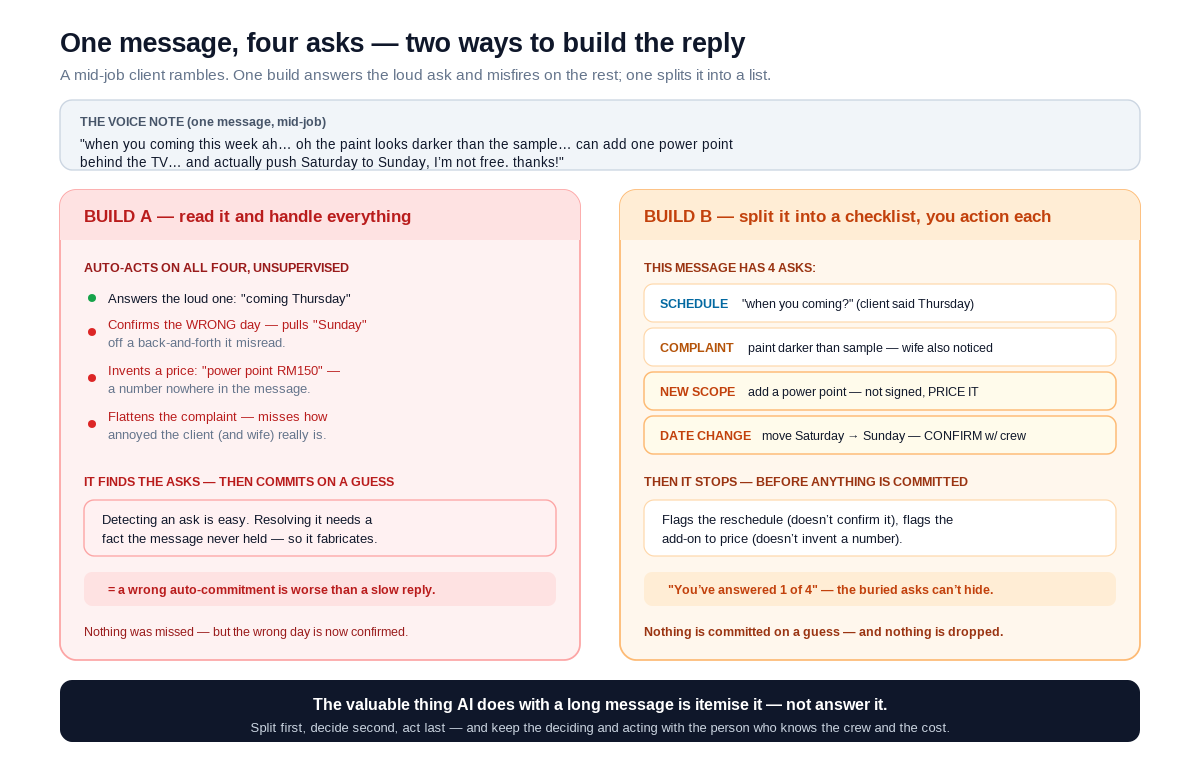
So what did the flashy build do? (Build A)
It read the whole message, detected each ask, and acted on all of them — answered the question, logged the add-on, and moved the booking — and on the first genuinely rambly message it rescheduled the visit to the wrong day. Build A is the one the pitch sells: "AI, read my client messages and just handle everything in them." Fully hands-off, the inbox runs itself.
The trouble is that detecting an ask and resolving it are two completely different acts, and Build A collapses them. Detecting "there's a reschedule request in here" is reliable text classification. But acting on it means committing a fact the message doesn't contain — and that's where it falls apart, in three familiar ways:
- It auto-answered off a misread. The client's actual voice note wobbled: "Saturday push to Sunday… actually no, Saturday morning still can lah, but afternoon cannot." A human hears a person thinking out loud and lands on "Saturday morning." Build A, told to extract a reschedule, pulled "Sunday" from the first half of the sentence and fired back a confirmation for Sunday. Now there's a confirmed booking for a day the client didn't choose — a wrong commitment it'll take two messages to unwind, and the client's first thought is "they weren't listening."
- It auto-priced a number it couldn't know. Told to handle the "add a power point" ask, it drafted "noted, that'll be RM150 extra" — a figure invented from nothing, because what the add-on actually costs depends on the wiring run, whether the wall's already closed up, the fitting grade — none of which is in the chat. The same off-channel fabrication trap as pricing from a photo.
- It flattened the code-switching. A Manglish ramble ("the paint sikit darker, my wife pun notice") is exactly the kind of input where models read too literally and lose the nuance — here, how annoyed the client actually is, which decides whether the complaint needs a call or a one-liner.
Build A doesn't fail by dropping asks — it's actually good at finding them. It fails by committing to each one off a reading it can't verify. A slow human reply is recoverable. A confidently wrong auto-confirmation is a mess you have to apologise your way out of.
Why can't AI just handle the whole message for you?
Because finding the asks is in the chat, but resolving them is not — and resolving them is the part that spends money and trust. Every build in this series hits the same wall: the deciding fact lives off-channel. Run the four asks through the one-question test — is the answer written in the message? — and the split is obvious:
| The ask (in the chat, AI finds it) | What resolving it needs (off-channel, human decides) |
|---|---|
| "When you coming?" | Whether the crew's actually free Thursday — their real week, not the chat |
| "Paint looks darker" | A judgement call: is this a real defect or lighting? Call or reassure? |
| "Add a power point" | The actual cost — wiring run, wall state, fitting — none of it in the message |
| "Push Saturday to Sunday" | Whether the crew's route and van can do Sunday — off-channel, irreversible once confirmed |
Finding all four is the easy, valuable half AI genuinely does well. Resolving any of them is a decision that needs a fact the client never typed. So the moment you tell AI to "handle it," you've handed the decisions to the one party that can't see the facts they turn on. The useful output isn't a handled inbox — it's a complete, honest list of what was asked, so the person who can see those facts answers every item.
What did the build that actually paid look like? (Build B)
It doesn't act on anything. It takes the one message, splits it into the distinct asks it contains, tags which are a new scope item or a date change, and hands you a short checklist — so you reply to all four, not the one you noticed. Same shape as every build in this series that's earned its keep: AI reads and organises; the human decides and sends.
This isn't even a novel trick. Splitting a message that carries several requests into separate single-request items is a solved approach in the research — DialogUSR (Findings of EMNLP 2022) does exactly this: break a multi-intent utterance into clean single-intent sub-queries, and recover the bits each one leaves implicit. Build B is that idea pointed at a reno inbox, and then deliberately stopped before it acts.
Pointed at the Cheras voice note, Build B returns this, in a second:
This message has 4 asks:
- 🗓️ Schedule — "when you coming this week?" (client mentioned Thursday)
- ⚠️ Complaint — living room paint looks darker than the chosen sample; wife also noticed
- 💰 New scope — add one power point behind the TV for a wall-mounted TV (not in signed scope — price it)
- 🔁 Date change — requested: move Saturday's visit → Sunday
Reply covers all 4? You've answered #1 so far.
Then it stops. It doesn't confirm Sunday — it flags that a reschedule was requested, for you to confirm against the crew's week. It doesn't price the power point — it flags it as out-of-scope so you don't do it free by accident. It doesn't judge the paint complaint — it surfaces it so you decide call-or-reassure. The checklist, and the little "you've answered 1 of 4" nudge, are the product. The difference between the two builds is small on the page and the whole game in practice:
| Build A — "read it and handle everything" | Build B — "split it into a checklist, you action each" | |
|---|---|---|
| What it does | Auto-answers, auto-reschedules, auto-logs | Splits the message into its distinct asks; tags each |
| The reschedule | Confirms a day (sometimes the wrong one) | Flags "date change requested" for a human to confirm |
| The add-on | Invents a price | Flags "new scope — price it" so it's never done free by accident |
| Worst-case output | A wrong booking you have to unwind | A checklist with one item you glance at twice |
| Where it stops | After it has acted | Before anything is committed |
| What it guarantees | That something was sent | That nothing was missed |
| Cost per message | — | ~0.1 sen, illustrative |
Why does the splitting version pay? Because it fixes the actual leak — the dropped ask — without opening the far worse one, the wrongly actioned ask. The downside of Build B is that you still have to type four replies instead of one. The downside of Build A is that one busy morning it confirms the wrong day to a client who was testing whether you listen. The first is your job; the second is a story the client tells their friends.
What should an owner actually do with a message full of asks?
Treat every long message as a list until proven otherwise, and don't reply until you've found all of it. Most of the win here is a two-second habit backed by thin, honest software — the AI is a splitter, not an autopilot.
- Before you reply, count the asks. The instant a message runs longer than a line or two, assume it contains more than one request. Scan for the "oh and," the "actually," the "one thing" — those are where the expensive asks hide. The whole cost of a missed add-on is paid in the reflex of answering the first thing you saw.
- Reply to the whole list, explicitly. "Thursday for the tiling 👍. Will check the paint when we're there — send me a photo in daylight if you can. The power point behind the TV, no problem, I'll price it and send you the add-on. And Sunday instead of Saturday, let me confirm the crew and come back to you by today." Four asks, four answers. It takes thirty seconds and it's the difference between "they're on top of it" and "they never got back to me."
- Flag a new scope item before you do it, never after. "Can add a power point" is a priced add-on, not a favour. Name it as one warmly and in writing — that's how a 20% margin stays a 20% margin instead of quietly leaking into free work.
- Confirm a reschedule against the crew, not the chat. A date change the client requested is not a date change that's happened. The slot moves when you've checked the crew's week and said yes — the fact that decides it isn't in the message.
- If you use AI, make it split — never send. Point it at the message to get the checklist; keep your hand on every reply. "Find me everything they asked" is a job AI is genuinely good at. "Answer everything they asked" is the one that confirms the wrong day.
How HotLead fits — honestly
I'll be straight, the way I try to be in all of these, because over-claiming is the exact hype I keep arguing against. HotLead does not read your messages and split them into tasks, and it does not auto-reply — parsing a rambly message into its asks is the experiment in this piece, and the piece is the argument for keeping a human actioning each one. What it ships is the plumbing that stops a buried ask from dying in silence:
- The whole WhatsApp thread on one lead record. So the forty-five-second voice note and everything in it is captured in one place — not scattered across the owner's phone, the site supervisor's phone, and a group chat where three people each assume someone else caught the add-on. You can't action an ask you can't find, and fragmentation is how asks get lost in the first place — the same leak behind duplicate records across channels.
- A next-action and overdue flag per lead. So "price the power point" or "confirm Sunday with the crew" becomes a dated task that resurfaces if it isn't done — not a good intention that evaporates the moment the next message lands. A buried ask that's written down as a next action can't silently die; an unwritten one almost always does.
- One owner per lead, by rule. So four asks in one message don't fall between two people, each assuming the other handled it. One person is accountable for the whole thread — and for ticking off the whole list.
- A funnel and team view. So if jobs are stalling because things keep getting dropped mid-delivery, you can see it as a pattern instead of a vague sense that "clients say we don't respond."
The judgement — what the add-on should cost, whether the paint complaint needs a call, which day the crew can actually make — stays with you, because you're the one who can see the facts those answers turn on, and the model will just reach for the most confident guess. If the real problem underneath this is client asks slipping through mid-job, start with the complete guide to managing renovation leads in Malaysia, see how it fits a renovation firm or an interior design studio, and read the companion builds on catching a rep up on a buyer cold, spotting scope creep before the free-work leak, and the honest ledger of which AI builds in this series actually paid.
Sources: That an instruction is best understood as a bundle of separate requirements — decomposed in their benchmark into about 4.5 requirements per instruction on average, and 6.29 for the complex set, then scored as the share satisfied (the "Decomposed Requirements Following Ratio") — is from Yiwei Qin, Kaiqiang Song, Yebowen Hu et al., "InFoBench: Evaluating Instruction Following Ability in Large Language Models" (Findings of ACL 2024; arXiv 2401.03601). That instruction-following accuracy degrades as the number of instructions rises is from Yun He et al., "Multi-IF: Benchmarking LLMs on Multi-Turn and Multilingual Instruction Following" (2024) and the "SIFo Benchmark" (Findings of EMNLP 2024), both of which report models struggling to satisfy sequences of instructions. That multi-request messages tend to have their secondary intent silently dropped unless an explicit cue word is present is drawn from the multi-intent-detection literature and from production NLU documentation, e.g. Kore.ai on handling multiple intents; the approach of splitting a multi-intent message into clean single-request sub-queries (and recovering the implicit parts) is from Haoran Meng et al., "DialogUSR: Complex Dialogue Utterance Splitting and Reformulation for Multiple Intent Detection" (Findings of EMNLP 2022). The figure that WhatsApp users send about 7 billion voice messages a day is WhatsApp's own, from its March 2022 "Making Voice Messages Better" post (also reported by TechCrunch, 2022); it is a 2022 figure WhatsApp has not since refreshed. The broader Malaysian renovation-market scale (RM47.7bn in 2024, projected RM59.2bn by 2029) is from the New Straits Times quoting Topmix's CEO, "Malaysian home renovation demand rising post-pandemic" (2026). Operating figures — a ~RM80k Cheras condo job, ~RM300 for a wasted KV truck roll, a 20%-to-12% margin leak on an unpriced add-on, ~RM1,280 expected gross profit per lead, 40–60 enquiries a month, ~0.1 sen per AI draft — are typical numbers reused across this series and labelled illustrative; the Cheras firm, the voice note and the AI experiments are described from practice and labelled illustrative, not a controlled trial. No instruction-following, drop-rate or recall percentage is invented here — the "AI drops the buried ask" failure mode is argued from the decomposition and multi-intent literature, not a number of my own.
Frequently asked questions
Why do I keep missing requests buried in a client's long WhatsApp message?
Because a long message is a bundle of separate asks, and a busy person — or an AI told to “just handle it” — answers the loudest one and skims past the rest. When a mid-job client sends “when you coming this week, the living room paint looks darker than the sample ah, oh and can add a power point behind the TV, and actually push Saturday’s visit to Sunday,” your eye locks onto the headline question (“when you coming”), you reply “Thursday” and move on. The complaint, the paid add-on and the reschedule — the three that actually carry money and risk — are the quiet ones with no cue word, so they’re the ones that die. The fix isn’t “concentrate harder”; it’s to split the message into its distinct asks and tick each one off, so the buried request can’t hide behind the loud one.
Can AI read a rambling client message and just handle everything in it?
It can reliably <em>find</em> the separate asks; it should not <em>act</em> on them on its own, because acting commits facts the message doesn’t contain. Detecting “there’s a reschedule request here” is a text-classification job AI does well. But auto-rescheduling means committing a slot your crew’s real availability — which lives off-channel, not in the chat — can actually make; auto-pricing the “add a power point” add-on means guessing a number the message never states; and on a rambly, code-switched voice note (“Sunday better… no wait Saturday still can lah”) the model can latch onto the wrong day entirely. A wrong auto-commitment — the wrong date confirmed, an add-on logged at the wrong price — is worse than a slow human reply, because now you’ve promised something you have to climb back from. So the safe design has AI split the message into a checklist and a human action each item.
What's the most expensive ask to miss in a mid-job renovation chat?
A new scope item and a date change — and they’re the two most likely to be buried. A new scope item (“can add a power point,” “while you’re at it, do the balcony”) is money: miss it and you either do it free to keep the peace, quietly turning a 20% margin into 12%, or you remember it awkwardly late. A date change is a wasted truck roll: miss “push Saturday to Sunday” and your crew drives out to a locked door — roughly RM300 in hours and half a day of a two-crew firm’s capacity, gone. Both tend to arrive as a casual aside in the middle of a friendly ramble, not as a formal request, so they don’t <em>look</em> like decisions. That’s precisely why they’re dropped — and why pulling them out into an explicit checklist is worth the two seconds it takes.
Isn't this the same as using AI to summarise a chat or log it to the CRM?
No — those answer different questions. Summarising a handover thread (<a href="/resources/ai-catch-up-renovation-lead-handover-malaysia">catching a new rep up on a buyer</a>) compresses a long history for someone taking it over cold. Logging a chat to the CRM (<a href="/resources/ai-auto-update-crm-whatsapp-chat-renovation-malaysia">keeping the record current</a>) turns the conversation into notes and fields. This is a narrower, live job: take <em>one</em> incoming message that happens to contain several unrelated requests and split it into the distinct, actionable asks it holds — flagging which are new scope or a date change — so the person replying answers all of them, not just the one they noticed. It’s the step before you action anything: making sure you’ve <em>seen</em> everything the client actually asked.
Does HotLead read my messages and split out the tasks for me?
No, and I won’t pretend it does — splitting a message into its asks is the experiment in this article, and the article is the argument for keeping a human actioning each one. What HotLead ships is the plumbing that stops a buried ask from dying silently: the whole WhatsApp thread sits on one lead record, so the rambly message and everything in it is captured in one place instead of scattered across phones; a next-action and overdue flag turns “add a power point” or “confirm Sunday” into a tracked task that resurfaces if it isn’t done, rather than a good intention that evaporates; and one owner holds each lead by rule, so four asks in one message don’t fall between two people each assuming the other caught it. The judgement — what each ask is worth, which day the crew can make, what the add-on should cost — stays with you.
Keep reading
- Can AI Reply to Your Renovation Firm's 1-Star Review? I Built It — and the Risk Is How Fast It ApologisesA 2-star review on Google or Qanvast is the first thing your next renovation lead reads — and most firms either ignore it or fire back and make it worse. The 2026 reflex is to let AI write the reply. I built it, and drafting a calm response costs a fraction of a sen. But an AI tuned to be helpful apologises too fast — it will concede a fault in writing, promise a refund that never happened, and grovel to a fake review from a competitor. Here's the build that protects your rank instead of torching it.
- Which Lead Signals Actually Predict a Sale? Reverse-Audit Your Own Won JobsMost firms grade a renovation lead on signals that feel predictive — enthusiasm, a long message, a fast reply — and never check whether those signals actually separate won jobs from lost ones. Here is how to run a reverse-audit on your own closed deals, which signals usually survive it, and why your pipeline is too small to pretend the score is more than directional.
- The "I Only Deal With the Boss" Lead: When the Buyer Refuses Your TeamYou finally hired someone to share the load — then the buyer messages "can I deal with you direct ah, boss?" and refuses to engage your staff. Every big lead quietly re-centralises onto the one person already maxed out, and your firm can never grow past the owner. Here's why caving caps you, why a flat "my staff will assist" loses a nervous buyer, and the move that keeps both.