

A Klang Valley ID studio owner told me about the Mont Kiara condo job she lost after she'd already won it. The enquiry was perfect: a professional couple, new keys, a nice unit, "we love your Instagram, can you quote to renovate the whole place?" She replied fast, did the site visit, sent a lovely RM95k quote with an open-plan kitchen, a feature wall where the dividing wall used to be, and a glass-enclosed balcony reading nook. They said yes. Deposit paid. She was thrilled.
Then the building's management got the renovation application. No to hacking the wall between the kitchen and living (it sat near the structural line). No to the balcony enclosure — it changes the facade. Wet works only in the existing wet zones. Noisy work weekdays 9 to 5, nothing on Sundays. By the time the JMB finished, her signature open-plan design was gone, the timeline had doubled, and the couple — who'd fallen for a render that could no longer be built — quietly went cold and asked for their deposit back.
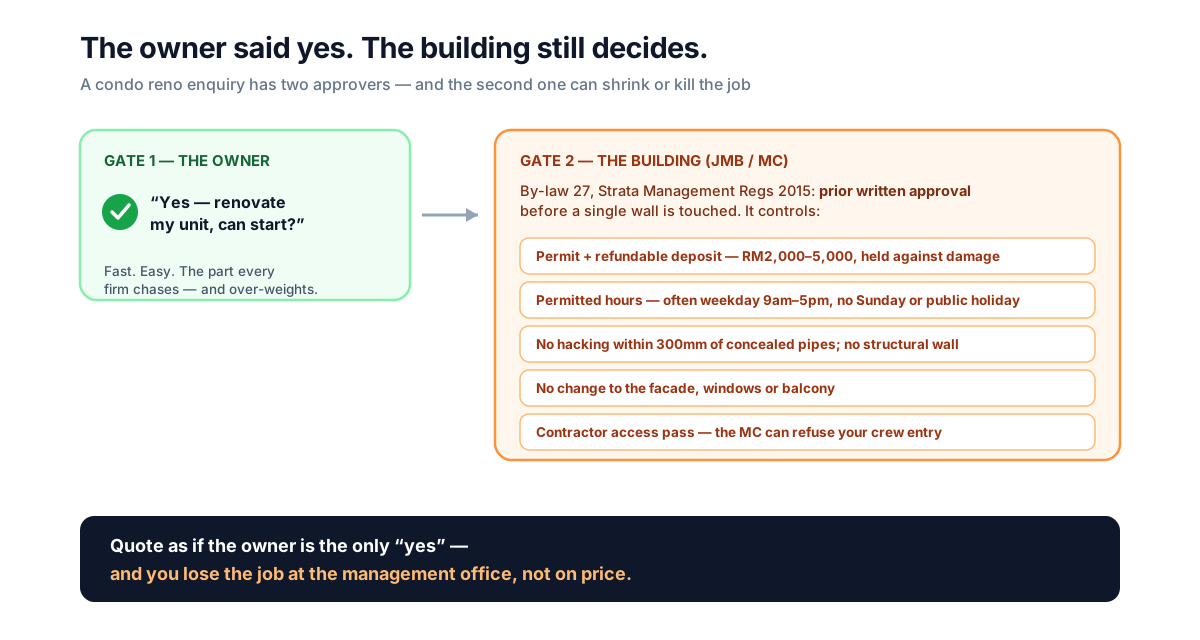
She didn't lose on price or on taste. She lost because she'd quoted a condo reno as if the owner was the only person who had to say yes. In a high-rise, there's a second approver sitting between you and the job, and it can veto work the owner already loves.
Why does a condo reno enquiry have two approvers, not one?
Because the owner can hire you, but only the building can let you build. In any stratified property — condo, serviced apartment, SoHo — the walls, pipes, slab and facade are entangled with shared property and the neighbours around them, so the law gives the management a say over what happens inside a private unit. The person who WhatsApps you is one yes. The Joint Management Body (JMB) or Management Corporation (MC) is the other, and it's the one that can stop you.
This isn't a house rule someone invented. Under By-law 27 of the Strata Management (Maintenance and Management) Regulations 2015, a proprietor shall not carry out any renovation works to his parcel without first obtaining prior written approval from the management corporation — and, where needed, from the appropriate authority. The same by-law lets the management attach conditions, require a deposit to secure compliance, and set a deadline for finishing the work. Break the by-laws and the owner must remedy the damage at their own cost, and the MC can even refuse your crew access to the building. It all sits under the Strata Management Act 2013, overseen by the local Commissioner of Buildings.
What can the building actually say no to?
More than most firms check before they quote. The owner points at a Pinterest board; the building points at the house rules. Here's the control panel a JMB or MC sits behind, and every item on it can change your scope, your price or your schedule:
- The permit and the deposit. No written approval, no work — and the owner (or you, on their behalf) lodges a renovation application with drawings, your contractor details, sometimes CIDB registration and an indemnity form, plus a refundable deposit, commonly RM2,000–RM5,000, held against damage to lifts, corridor tiles and the lobby.
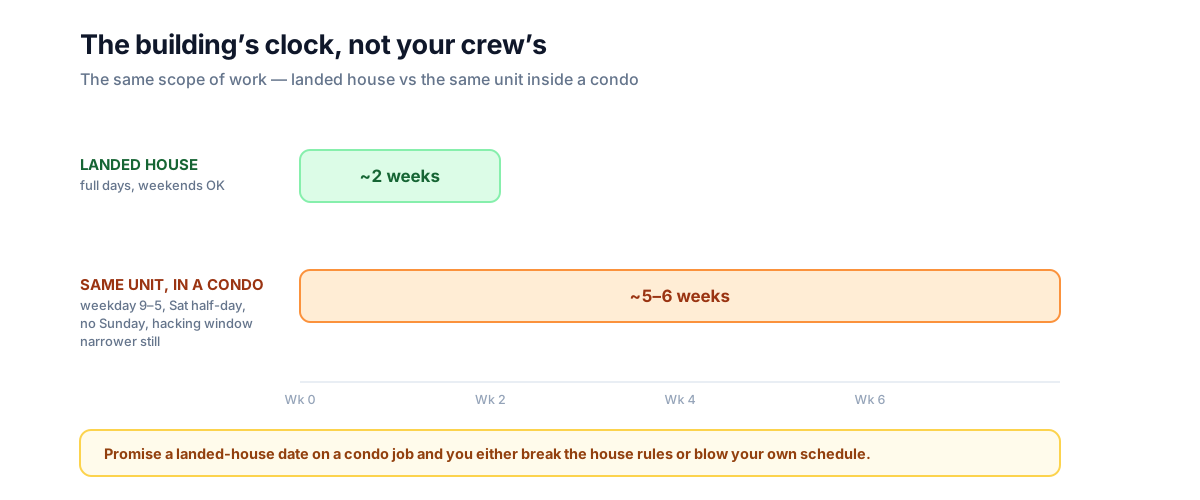
- Permitted hours. Often weekday 9am–5pm with a Saturday half-day, no Sunday or public-holiday work, and hacking squeezed into an even tighter window. Some allow 7am–7pm Monday to Saturday. Either way, it's shorter than a landed-house day.
- Hacking and wet works. Hacking a structural or load-bearing wall is usually a flat no; even a non-load-bearing one may need an engineer's letter. Drilling and hacking are typically banned within 300mm of concealed pipes and electrical conduits — which quietly rules out a lot of "let's just move this point here."
- Moving the wet areas. Shifting a kitchen or bathroom over a neighbour's dry space below is the classic rejection — it's an inter-floor leak waiting to happen, and buildings know it. (We've written about what an inter-floor leakage lead really involves.)
- The facade and balcony. Enclosing the balcony, changing windows, grilles or anything that alters the building's external look is commonly refused to keep a consistent facade — DBKL guidance restricts balcony enclosures in strata buildings too.
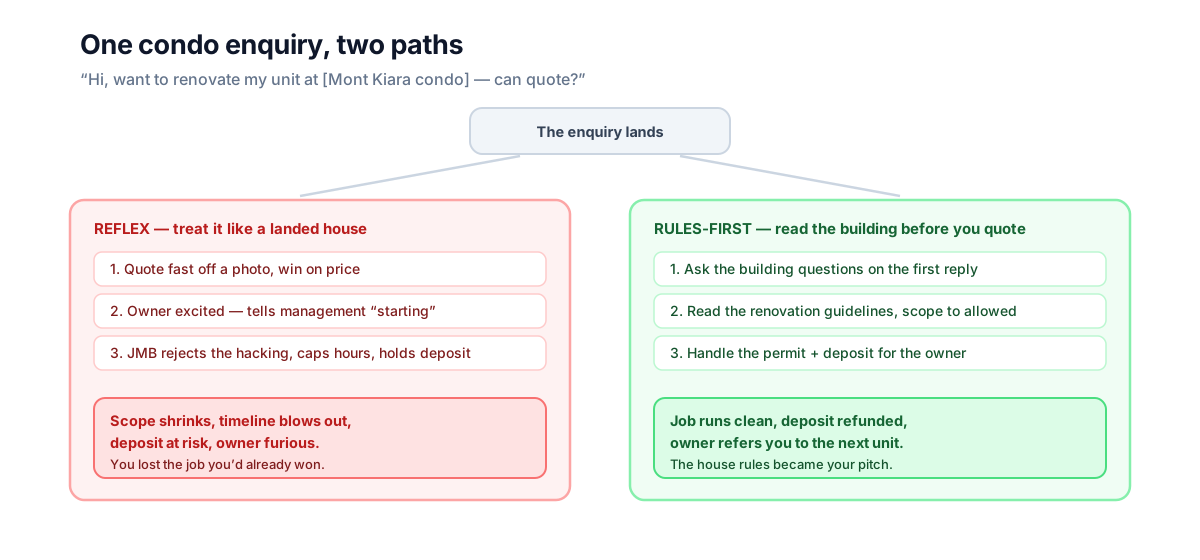
Quote a scope off a photo without knowing which of these the building will allow, and your number isn't a quote — it's a wish. The firm that wins is the one that already knows the no-go list before the owner even sends the floor plan.
Why do your best homeowner reflexes lose the condo job?
Because every reflex that wins a landed-house lead ignores the second approver. The habits are good habits — they're just pointed at the wrong gate:
- You quote fast off a photo. Speed wins a homeowner. But a fast quote built on a scope the building will veto isn't a head start — it's a promise you can't keep, discovered after the owner's heart is set on it.
- You promise a landed-house timeline. "Two to three weeks, boss" is fine for a terrace. In a condo on weekday-only daytime hours, that same job can run five or six weeks. Promise the short date and you either break the house rules (and risk the deposit and a stop-work order) or blow your own schedule and the owner's trust.
- You treat the management as the owner's problem. "You settle with your JMB first, then we start" sounds reasonable. It also hands the hardest, most intimidating part of the job back to a nervous first-timer — who then calls the firm that offered to handle it.
Isn't the management just red tape to route around?
No — and this is the part that flips the whole job in your favour. The house rules are your best sales pitch. Here's the thing almost every firm misses: a high-rise owner's real fear isn't your price. It's the process. They've heard the horror stories — the neighbour who complained, the stop-work order mid-job, the forfeited deposit, the fine, the awkward emails from the building manager. For a first-time condo renovator, that dread is the single biggest reason they hesitate to commit.
So the firm that opens with "I've done three units in your block, I know your renovation guidelines, I'll lodge the permit, sort the deposit and brief my crew on your hours and floor protection" isn't quoting red tape. It's removing the exact anxiety the owner couldn't name. You've just become the safe choice — and in a market where a reno buyer is comparing up to five firms, being the one who makes the scary part disappear is worth more than being the cheapest.
How is this different from the other "approval" leads?
Three different animals, and running them through the same reflex is how firms lose all three. This is also why it helps to tag the lead type the moment it lands — a high-rise unit reno is not a landed-house reno, and it is not a whole-building committee job.
| Landed-house reno lead | Condo / high-rise unit reno (this piece) | JMB / MC building-works job | |
|---|---|---|---|
| Who pays you | The homeowner | The unit owner | The committee, from the sinking fund |
| Who else approves | Local council / authority, for structural works | The building's JMB or MC — gatekeeper over the unit | N/A — the committee is the buyer |
| The real gate | Your quote and rapport | The house rules — hours, hacking, facade, deposit | The committee's vote and procurement process |
| What kills the lead | Slow reply, weak quote | Quoting a scope the building won't allow | Treating a committee like a homeowner |
| Timeline driver | Your crew | The building's permitted hours | The committee's meeting cycle |
If the whole building (not a unit) is hiring you to repaint, waterproof or re-do the facade, that's a committee sale with its own rules — we cover it in why contractors lose strata building works. If it's a landed house where the gate is the local authority, that's the permit-and-authority-approval lead. This piece is the one in between — a private unit, a private owner, and a building that still holds a veto.
So what do you actually do with a condo reno enquiry?
Read the building before you price the job. The fix isn't more hustle — it's a short, calm checklist that most firms skip, run by one person who owns the lead from enquiry to deposit refund:
- Ask the building questions on the first reply. Before the site visit, before the quote: "Which condo is this — and do you have the building's renovation guidelines? What's the deposit, and the permitted working hours?" It takes one message, it tells you half of what you need, and it already makes you sound like the firm that's done this before. (It's the same qualify-on-the-first-reply discipline, pointed at the building.)
- Get the renovation guidelines before you design. Most JMB/MC have a written pack — hours, deposit, the no-go list, contractor registration, lift and floor protection. Read it. It tells you what you can and can't promise.
- Scope to what's allowed, and flag the no-go items early. If the wall can't come down or the balcony can't be enclosed, the owner needs to hear it from you in week one — framed as "here's what we can do beautifully" — not discover it from the building after they've paid a deposit on a design that's now illegal.
- Quote the real number, on the real clock. Fold in the refundable deposit, management admin, lift and floor protection, debris disposal, and a timeline that fits the permitted hours. A condo quote that ignores all of that is lower than reality and sets up a fight later.
- Offer to handle the permit and deposit. This is the differentiator. Make it part of the pitch, not an afterthought.
- Run the whole building checklist to the end — permit approved, deposit paid, access passes, works within hours, and the deposit-refund inspection at handover. That last one is real money sitting with the building; the firm that chases the refund inspection for the owner is the firm they call for unit number two.
Where HotLead fits — and where it doesn't
Let's be honest about the tool. HotLead doesn't know your building's house rules, it can't lodge a renovation permit, and it won't argue with a building manager about your deposit — that's your expertise and your relationship. What it does is make sure a high-rise lead never leaks at the capture-and-chase step while you're busy doing the real work:
- Capture and tag the enquiry as a condo / high-rise reno the moment it lands, so it's handled as a two-gate job from the start, not as a landed-house lead.
- One owner, by rule (round-robin, manual or a custom rule), so the person who knows that building — or has the house-rules read for it — picks it up, and the pitch stays consistent.
- Next-action and overdue reminders so the building checklist — guidelines requested, permit lodged, deposit paid, access passes, refund inspection booked — never gets dropped across a job that runs weeks longer than a landed one.
- Funnel and per-channel reporting so you can see whether high-rise enquiries convert better or worse than landed ones, and which channels (Qanvast, IG, your condo-block referrals) actually send them.
None of that designs the unit or handles the JMB for you. It just means the lead, the follow-ups and the deposit refund don't fall through the cracks while you earn the job on competence.
A condo reno is two sales, not one. You still have to win the owner — fast reply, good taste, a fair price. But you also have to win the building, and the firms that keep losing high-rise jobs are the ones who only noticed the first gate. Read the house rules before you quote, scope to what's allowed, and carry the permit-and-deposit weight the owner is dreading — and the thing you thought was red tape becomes the reason they chose you.
Start with the full renovation-lead playbook, and if you work high-rise and condo units, see how it ties into the interior-design and renovation lead playbooks for the rest of the journey.
Frequently asked questions
Does a condo owner really need management approval to renovate their own unit?
Yes. Under By-law 27 of the Strata Management (Maintenance and Management) Regulations 2015, a parcel owner can't carry out renovation works without first getting the management corporation's prior written approval — and the appropriate authority's approval where structural or external work is involved. The management can attach conditions, require a deposit, and set a completion deadline. It's the owner's unit, but the walls, pipes and structure touch shared property, so the building gets a say.
How much is a condo renovation deposit in Malaysia, and is it refundable?
Commonly RM2,000 to RM5,000, though smaller buildings may ask less. It's a refundable bond the management holds against damage to common areas — cracked lift or corridor tiles, a stained lobby, debris left behind — and it's returned after a completion inspection, minus any deductions. It's real money and it's contested — in a 2025 Penang case the High Court upheld a tribunal order for a JMB to refund a RM1,000 deposit, ruling the works weren't the kind that required it.
What can a condo management stop me from doing in a unit renovation?
Plenty, and you need to know before you quote. Typical house rules prohibit hacking a structural or load-bearing wall (a non-load-bearing one may need an engineer's letter), hacking or drilling within 300mm of concealed pipes and electrical conduits, moving wet areas over a neighbour's dry space, enclosing the balcony or changing the facade and windows, and working outside permitted hours. Quote a scope the building won't allow and the permit gets rejected after the owner is already excited.
What are typical condo renovation working hours in Malaysia?
It varies by building, but a common pattern is weekdays around 9am–5pm plus Saturday mornings, with no work on Sundays or public holidays; noisy works like hacking are often squeezed into an even narrower window. Some buildings and local-authority conditions allow 7am–7pm Monday to Saturday. The point for your quote — these hours, not your crew's pace, set the timeline, so always read them before you promise a completion date.
How is this different from a JMB building-works job or a landed-house permit?
Three different animals. In a JMB or MC building-works job the committee is the buyer, hiring you to repaint or waterproof the whole block. A landed-house reno gets approval from the local council or authority. This one is an individual unit owner's reno where the JMB or MC is the gatekeeper, not the buyer — the owner pays you, but the building decides what you may build.
Keep reading
- "Can Also Do The Balcony Ah?" — I Built an AI to Catch Mid-Job Scope Creep Before It Ate the MarginThree weeks into a RM80k condo job, the client messages "while you're already here, can also do the balcony ah?" The reflex is "boleh boleh, later settle" — and you've just agreed to build it for free. The 2026 reflex is to ask AI to watch your job chats, spot the extra work, price it and add it to the invoice. I built it. It invented a number. Here's the version that catches the scope creep without guessing a price it can't know.
- Quote Turnaround Time — The Renovation Benchmark (and What Each Day Costs)You measure how fast you reply in minutes. You never measure how fast you quote in days — yet that's where the money actually moves. Here's the quote-turnaround benchmark for a Malaysian renovation firm, and the ringgit value of every day you shave off it.
- "Boss, Berapa?" The Renovation Lead That Lands on the Wrong ChannelYour hottest organic leads often arrive where they found you — a comment under a project post, or a DM to your personal account — not the business WhatsApp you actually watch. Here's why those leads leak at the capture step, why an ignored public comment costs more than a missed message, and how to catch a lead no matter which door it walks in.