

Here is a number almost no renovation firm in Malaysia can tell you off the top of their head: their median quote turnaround time — the days between a finished site visit and the detailed quote actually reaching the buyer.
Owners can usually quote their response time to the minute ("we reply within the hour, lah"). They track revenue, they count enquiries. But the gap between "great site visit on Tuesday" and "quote sent" — the stretch where the job is actually won or lost — sits in a blind spot. That's a problem, because unlike response time, quote turnaround has a direct, measurable ringgit value per day, and it's one of the few win-rate levers that costs you nothing to pull.
This is the benchmark piece for that number. What a good turnaround looks like, what the data says each day of delay costs, and how to set a target you can actually drive. It's the metric counterpart to the field story of the slow-quote leak — here we put the arithmetic under it.
What is quote turnaround time, and why measure it apart from reply speed?
Quote turnaround time is the number of days between the site visit being done and the detailed, itemised quote reaching the buyer. It's a distinct funnel stage from response time, and for a renovation firm it's usually the more expensive one to get wrong. Response time decides whether you make the shortlist; quote turnaround decides whether you win off it.
The two are easy to blur, so keep them separate on purpose:
- Response time is measured in minutes. It's the first WhatsApp reply, and the close-rate curve for it is brutal in the first hour — the odds of even connecting fall around 100× between a 5-minute and a 30-minute reply (MIT / Oldroyd). It gets you into the race.
- Quote turnaround is measured in days. It's the gap after the visit, while the buyer sits with a shortlist and waits for real numbers. It decides who wins the race.
The reason the quote stage costs more than the reply stage is simple: by the time you're quoting, you've already spent the reply, the qualifying call and the whole site visit. You've paid almost the entire cost of winning the job. Leaking it at the quote step throws away all of that sunk effort — which is exactly why it deserves a number of its own.
What's a good quote-turnaround benchmark in Malaysia?
For a straightforward job, the winning target is an accurate itemised quote within two to three working days of the visit, with an instant holding range the moment you leave. The published "industry norm" is far slower — and that gap is your opening. The norm describes what most firms do; the benchmark is what wins.
Here's the difference laid out:
| Job type | Common industry turnaround | Winning target (MY, competitive shortlist) |
|---|---|---|
| Condo kitchen / single room | 1–2 weeks | Same-day range, detailed quote in 2–3 working days |
| Full condo / small landed reno | 1–2 weeks | Detailed quote in 3–5 working days |
| Whole-home gut / landed rebuild | 2–4 weeks | Detailed quote in 5–7 working days |
| Any job | — | Acknowledge + rough range: same day, every time |
The one-to-two-week figure for a remodel and two-to-four weeks for a whole-home job are real reported norms. But they're measured in markets and eras where a buyer might patiently wait on one contractor. That is not how a Malaysian reno buyer shops. They post on Qanvast or Recommend.my, or message a few firms off Instagram — and Qanvast openly shortlists them with up to five firms while Recommend.my tells them to compare at least three quotes. An Arcsite homeowner survey found 95% get more than one bid, most get three or more, and 28% expect a quote on the spot or the same day as the visit. The moment you leave that site, you're in a race against three or four other vans — and the norm is a losing pace.
How much does each day actually cost you?
Put a ringgit figure on it and the answer stops being "quote faster when I can" and becomes a line on your P&L. On a RM80k job at a 20% margin, a ten-point swing in win rate is about RM1,600 of expected gross profit per quote. Here is the arithmetic, step by step.
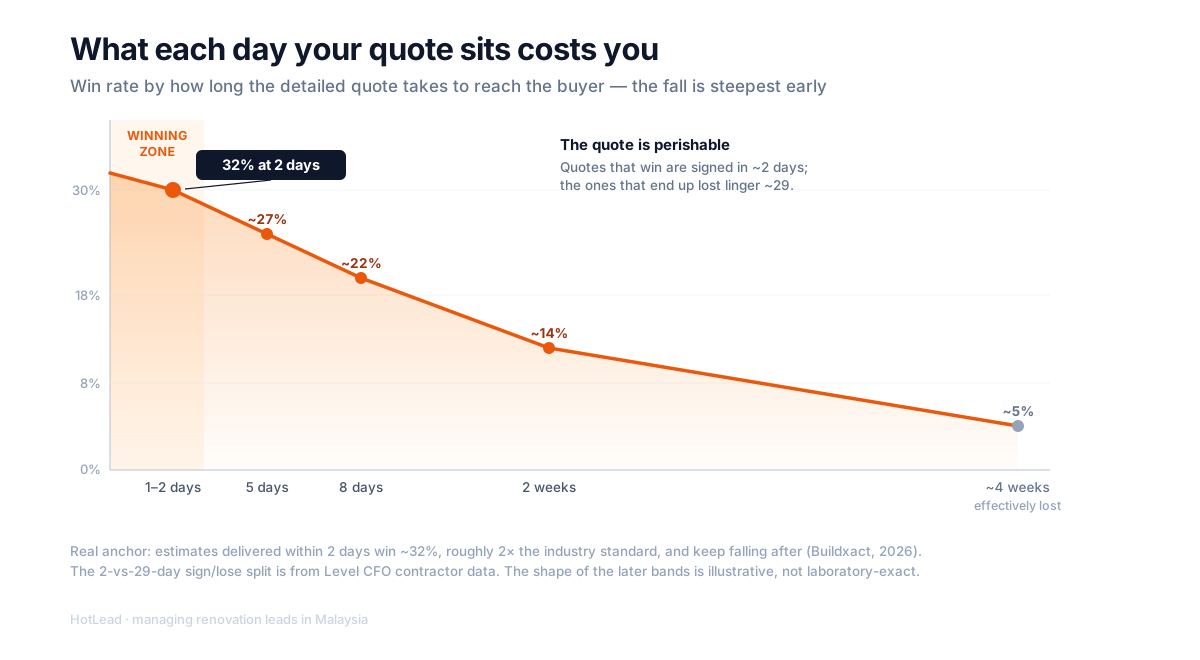
Start with the one hard anchor. Buildxact's 2026 analysis of its contractor customers found estimates delivered within two days win at about 32% — roughly double the industry standard — and the win rate keeps falling at a steady pace after the two-day mark. That's vendor data, not an independent study, so treat the exact number as directional. But the direction is corroborated everywhere: Level CFO's contractor data shows quotes that convert get signed in about two days, while the ones that end up lost linger for around 29 — a quote that's a week old and unanswered isn't "pending," it's almost certainly gone.
Now turn the win rate into money. A won RM80k job at 20% gross margin is RM16,000 of gross profit. So each quote you send is worth, in expectation:
Expected gross profit per quote = win probability × RM16,000
If a slow turnaround drops your win probability from ~32% (quoting in two days) to ~22% (quoting in eight) — a ten-point fall, well within the decay the data describes — then each quote loses about 0.10 × RM16,000 = RM1,600 of expected profit. Multiply by the quotes you send:
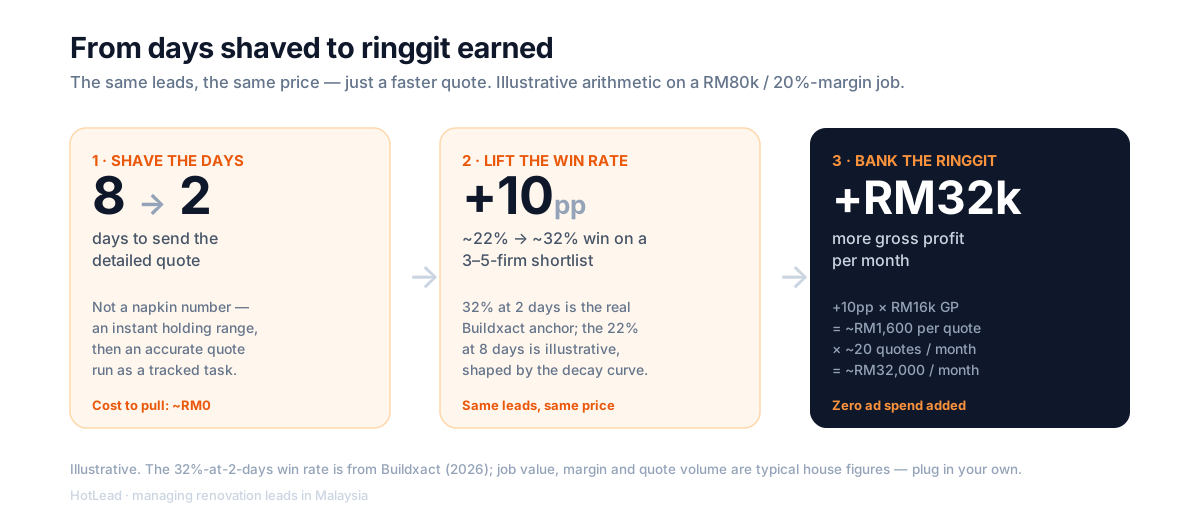
A firm sending 20 quotes a month is leaving roughly RM32,000 of gross profit on the table every month — not to a cheaper competitor, but to a faster one. No extra ad spend, no discount, no new leads. Just the quote going out on day two instead of day eight.
Why is the decay front-loaded, not a gentle slope?
Because a renovation quote is perishable, and it rots fastest at the start. The honest "cost per day" is not a flat number — the first few days carry almost all of the damage. It's tempting to divide the RM1,600 swing over six days and say "a day costs me ~RM270." That's a useful gut-check, but it flatters the later days and punishes the early ones too lightly.
The real shape is the one on the cover chart: steep early, then flattening into a dead zone. The Level CFO split makes it concrete — wins get signed around day two, losses drag to day 29. That means:
- Days 1–3 are where the job is decided. Your quote is competing to be the first complete number in front of a buyer who's actively comparing. The first clear, itemised quote tends to win even when it isn't the cheapest, because it anchors the decision.
- By week two you're mostly fighting for scraps — the buyer who hasn't signed yet is either stalled on their own clock (loan, keys, a spouse) or already leaning elsewhere.
- Past ~four weeks the quote is effectively lost. Not "pending." Lost.
So the dangerous sentence isn't "I'll quote next week." It's "I'll get to it this weekend." That one casual slip — site visit Tuesday, quote the following Monday — already spends most of the expected value, because it moves you out of the days-1-to-3 window where the decision actually happens.
Isn't faster always better? Where's the floor?
No — there's a floor, and crashing through it costs you too. A wrong number sent in an hour loses worse than an accurate one sent in two days, because now you've either underpriced a job you'll resent or spooked the buyer with a figure you have to walk back. Speed is the lever; accuracy is the guardrail. The win is both, structured in two parts.
This is where the metric needs nuance, not a stopwatch:
- Instant acknowledgement + a rough range (same day, near-free on WhatsApp). This holds your place in the shortlist and signals you're responsive. It is explicitly not a quote — "for a kitchen this size, you're likely looking at the RM45k–60k range; I'll have the detailed breakdown to you by Thursday."
- The accurate, itemised quote (two to three working days). This is what the buyer signs. It needs real takeoffs, current supplier pricing and honest labour — which genuinely takes a few focused hours, not two weeks.
The number you drive down is the median turnaround on part two, not part one. Part one should be near-instant and automatic. If you find yourself racing to send a rushed detailed quote in an hour, you're optimising the wrong metric — you'll win the speed contest and lose on a margin mistake or a credibility walk-back. Fast acknowledgement, prompt accurate quote. Not fast everything.
How fast is fast enough — and how do you find your number?
Fast enough is "before your second competitor," which in Malaysian reno practice means two to three working days for a straightforward job. But don't borrow that figure — derive your own from your records. The borrowed benchmark gets you in the right range; your own data tells you exactly where your wins stop happening.
Here's the decision framework:
- Set the target from the buyer's clock, not your comfort. If buyers hold three to five quotes and the first complete one tends to win, your deadline is set by the competition, not by when your evening frees up. That almost always lands at two to three working days for a clean job.
- Find your real stale cut-off from your own won-vs-lost quotes. Look back at the jobs you won and lost this year: how many days did each quote take to send, and how old was it when the buyer decided? Your wins will cluster early; your losses drag. The day your wins stop happening is your honest "if it's older than this, it's almost certainly gone" line.
- Make median detailed-quote turnaround a number you read monthly. Alongside your four core numbers, track it the way you'd track response time or follow-up. A number you watch is a number you can move.
And weigh it against your other levers. Of the three ways to grow a reno firm — more leads, higher close rate, bigger jobs — turnaround speed is pure close-rate. It costs roughly RM0 in ad spend and nothing in margin, unlike buying leads or discounting. That makes it the cheapest win-rate lever you own, which is exactly why it's the first one to fix.
Where HotLead fits (and where it doesn't)
Be clear about the boundary. HotLead does not write your quote or do the estimating — that's your craft, your supplier prices, your margin call. What it does is make the turnaround leak visible and drivable, which is the part that actually rots in a busy month:
- Capture + auto-greeting send the instant acknowledgement and rough range automatically, so part one never waits on a human who's on-site.
- One owner + next-action and overdue flags turn the detailed quote into a tracked task with a deadline, not a memory you lose to the next job fire — the same discipline that catches a forgotten follow-up, applied to the quote.
- The funnel + per-channel view lets you actually measure your median turnaround and see a "visited, not yet quoted" list aging by day — so the ten-day rot becomes a number you drive down instead of a surprise you file under "lost on price."
If you can't see which leads are visited-but-not-quoted, you can't fix this leak. Make it a number, give it an owner and a deadline, and the quietest leak in your firm becomes the cheapest win you'll book this quarter.
For the whole system this sits inside — capture, qualify, visit, quote and follow up — start with the complete guide to managing renovation leads in Malaysia. From here, the natural next reads are the slow-quote leak from the field, your clock versus the buyer's in the sales cycle, and chasing the quote once it's finally out. If you run a renovation firm — or an interior-design studio — this is the number worth putting on your wall.
Sources: Buildxact — State of the Customer Report (2026) (estimates delivered within 2 days win 32%, roughly double the industry standard; win rate keeps falling steadily after the 2-day mark; detailed, itemised estimates win more often); Level CFO — The 7-Day Rule: Why Stale Quotes Kill Contractor Revenue (quotes that convert close in ~2 days vs ~29 for lost ones; the first complete quote tends to win even when not cheapest; quotes are perishable) and Level CFO — What a Good Win Rate Looks Like for Contractors (38% median contractor quote-to-win rate); Arcsite — 2022 Homeowner Survey Report (95% of homeowners get more than one bid, most get three or more, 28% expect a quote on the spot or same day); Rio Contracting — How Long Do Contractors Take to Send a Quote? and Call & Custom Built — How long should it take to get a quote back? (1–2 week remodel / 2–4 week whole-home quote turnaround norms). Job-value bands, gross margin, the up-to-five-firms shortlisting norm and the ~32–38% quote-close figures reused for consistency from the complete guide to managing renovation leads in Malaysia and turning Qanvast and Atap enquiries into booked consultations. The decay bands beyond the 2-day anchor, and the RM1,600-per-quote and RM32,000-per-month figures, are illustrative arithmetic on typical house figures — plug in your own.
Frequently asked questions
What is a good quote turnaround time for a renovation firm in Malaysia?
For a straightforward job — a condo kitchen or a single-room reno — aim to get the accurate, itemised quote out within two to three working days of the site visit, with an instant same-day holding range sent the moment you leave. For a whole-home gut, five to seven working days is realistic. The published industry norm stretches to one or two weeks for a remodel and two to four weeks for a whole-home job, but in a market where the buyer is holding three to five quotes off a Qanvast or Recommend.my shortlist, the firm that quotes in two to three days routinely signs the job before the two-week quote ever lands.
How much does a slow quote actually cost me?
Enough to measure in ringgit. Estimates sent within two days win about 32%, roughly double the industry standard, and the win rate falls steadily the longer you take (Buildxact, 2026). If being slow drops your win rate even ten points on a RM80k job at 20% margin, that's about RM1,600 of expected gross profit lost per quote. A firm sending 20 quotes a month is leaving something like RM32,000 of gross profit on the table every month — not to a cheaper competitor, but to a faster one.
Is quote turnaround the same thing as response time?
No, and conflating them hides the bigger leak. Response time is how fast you answer the first WhatsApp — measured in minutes, and it decides whether you make the shortlist. Quote turnaround is how long the detailed number takes to reach the buyer after the site visit — measured in days, and it decides whether you win off that shortlist. Most firms obsess over the minutes and never track the days, even though the days are where the buyer is actually choosing with a number in front of them.
Should I send a fast rough quote or a slow accurate one?
Both, in that order — it's not a trade-off. Send an instant acknowledgement with a rough range the moment the visit ends, so you hold your place in the buyer's shortlist while your competitors are still silent. Then send the accurate, itemised quote within two to three working days. The mistake is picking one — either blurting a napkin price you later regret, or vanishing for two weeks perfecting a document the buyer stopped waiting for.
How do I find the right turnaround target for my firm?
Derive it from your own records rather than borrowing a number. Look at your won quotes and your lost quotes and compare how many days each took to send and how old each was when the buyer decided. Most wins will cluster in the first few days; losses drag on. Set your stale cut-off where your own wins stop happening, make median detailed-quote turnaround a number you watch monthly, and drive it down. That's a decision your data can answer and a competitor's blog post can't.
Keep reading
- "Boss, Berapa?" The Renovation Lead That Lands on the Wrong ChannelYour hottest organic leads often arrive where they found you — a comment under a project post, or a DM to your personal account — not the business WhatsApp you actually watch. Here's why those leads leak at the capture step, why an ignored public comment costs more than a missed message, and how to catch a lead no matter which door it walks in.
- "We Went With Another Contractor" — I Built an AI to Win Back a Lost Renovation Lead Instead of Slamming the DoorA Shah Alam firm quotes a RM70k job, chases it for three weeks, and finally gets the message every owner dreads — "thanks, we've decided to go with another contractor." The reflex is a terse "ok, all the best 🙏" and a closed chat. The 2026 reflex is to ask AI to detect the rejection and auto-fire a win-back discount. I built it, and it begged. Here's the version that keeps a near-free option on a re-win without ever chasing a no.
- The Only Three Ways to Grow a Renovation Firm — and Which Lever to Pull FirstEvery renovation firm's revenue comes down to three levers — how many leads you get, how many you close, and how big each job is. They multiply, so a modest lift on each compounds. But they cost wildly different amounts to pull, and most owners reach first for the one they should reach for last. Here's the ranking, with Malaysian numbers.