

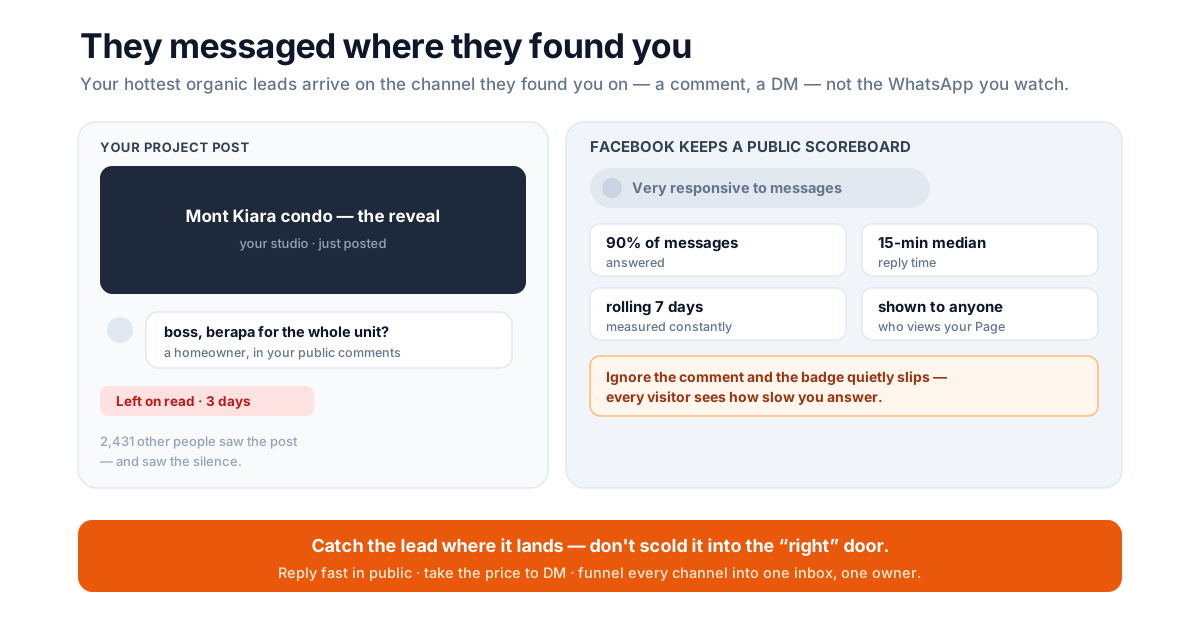
A Klang Valley interior-design studio posts a reveal on Instagram on a Thursday night — a Mont Kiara condo, warm oak, a kitchen island people stop scrolling for. By morning it has a few hundred likes and a comment sitting right underneath: "😍 boss, berapa for the whole unit?"
Nobody replies. Not because the studio is lazy — because "we handle enquiries on WhatsApp," and this didn't come in on WhatsApp. It came in as a comment, so it falls into the gap between "a like" and "a real lead," and everyone assumes it isn't really their job. Three days later it's still sitting there, on read, under a post that a couple of thousand other people have now scrolled past — including the ones also thinking about doing up their condo, who saw a buyer ask a question and saw the studio say nothing.
Meanwhile a competitor who replied to a near-identical comment within ten minutes — "Hi! So happy you love this one 🙂 just PM-ed you!" — booked the consultation.
This is the lead that lands on the wrong channel. It's often your highest-intent organic enquiry, and it leaks at the very first step — capture — before any of your clever follow-up system ever gets a shot at it. Let's fix the capture step.
Why do my best leads keep landing on the wrong channel?
Because renovation and interior-design buyers in Malaysia increasingly discover you on social before they ever decide to contact you — and people message where they already are. They see your work on Instagram, Facebook or a Qanvast project page, get excited about one specific photo, and tap whatever "message" button is closest. That's a comment under the post, or a DM to the account they found you on. It is almost never the tidy business WhatsApp number you'd prefer.
That's not a buyer being awkward. It's just how discovery works now. Malaysia had around 25.1 million social media identities at the start of 2025 — about 70% of the population — per DataReportal's Digital 2025 report, and the home-reno audience is squarely on Facebook and Instagram. Marketing guides for Malaysian ID firms describe the pattern plainly: even when a friend recommends a designer, prospects inspect your Instagram, tagged photos and reviews before messaging, and most start with inspiration on Instagram or TikTok before they shortlist. (Those are agency observations, not a hard survey, so treat them as directional — but they match what any reno firm with a decent Instagram sees in its own inbox.)
So the enquiry arrives through whichever door the buyer was standing at. There are four of them, and most firms only guard one:
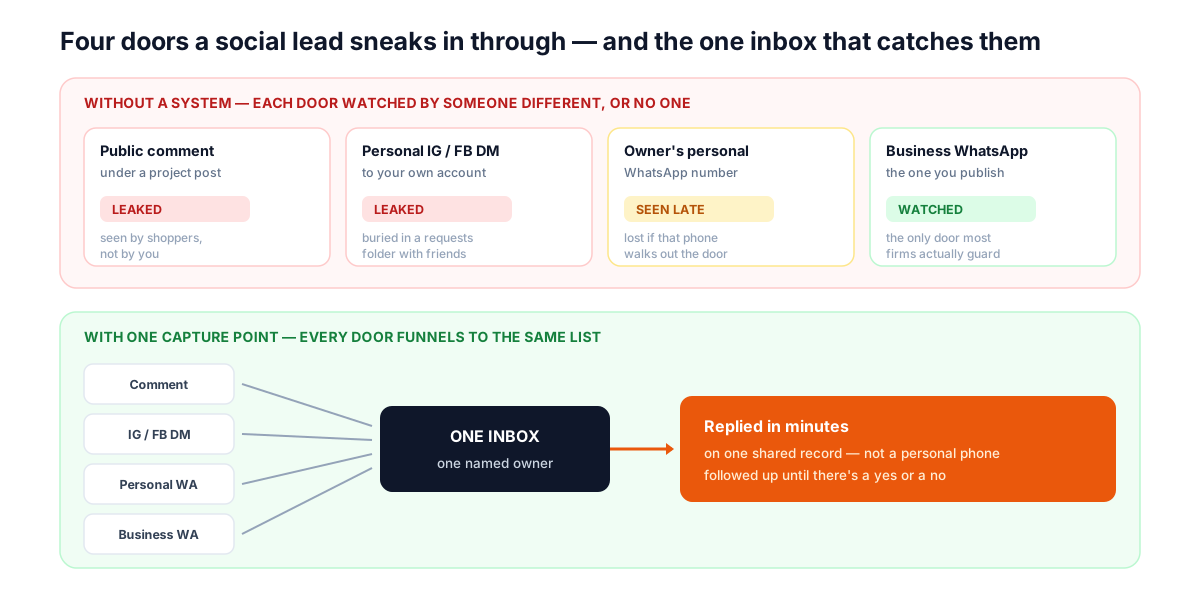
- The public comment — "berapa?", "PM me", "interested!", "boss can quote my place?" — left under a project post for everyone to see.
- The personal-account DM — a message to your own Instagram or Facebook, which, if your account is still a personal profile, lands in a message requests folder you open roughly never.
- The owner's personal WhatsApp — the number on your name card and your personal story, mixed in with family, suppliers and the kids' school group (the same owner-operator bottleneck where the boss's phone is the business).
- The business WhatsApp — the one you publish and actually watch.
This is a different leak from the one in how to never miss a WhatsApp enquiry, which is about enquiries getting forgotten once they're in front of you. This one is about leads that never reach a watched channel at all — and it's a different animal from paid Facebook and Instagram ad leads, which at least route cleanly into WhatsApp by design. These are your organic enquiries — the free, warm, socially-discovered ones — leaking through the side doors.
Why is an ignored public comment worse than a missed WhatsApp?
Because a missed WhatsApp is a private loss, but an ignored public comment is a public one — every other shopper on that post watches you not reply, and on a renovation decision where buyers are comparing three to five firms, that silence is a data point about you.
A missed WhatsApp message costs you one lead, quietly. Nobody else knows it happened. An ignored "boss, berapa?" under your reveal costs you that lead and broadcasts to everyone else considering you that this is a firm that leaves buyers on read. Here's the difference laid out:
| A missed WhatsApp message | An ignored public comment | |
|---|---|---|
| Who else sees it | Nobody — it's private | Every person who scrolls the post |
| What the silence signals | Nothing (invisible) | "This firm doesn't reply to buyers" |
| Is it scored | No | Yes — Facebook tracks your response rate publicly |
| How fast the buyer expects a reply | Fast | Faster — they asked in public, in the moment |
| Cost of silence | One lost lead | One lost lead + reputational drag on the next ones |
And that "scored" row is not a figure of speech. Facebook runs a public responsiveness meter on business Pages: the "Very responsive to messages" badge is awarded when a Page answers at least 90% of first messages with a median reply time of about 15 minutes, measured on a rolling 7-day basis — and it's shown to anyone who views the Page. In other words, the very channel most reno firms ignore keeps a running, visible scoreboard of exactly how fast they answer. A page full of unanswered "berapa?" comments and a greyed-out responsiveness badge is a quiet advertisement for your slowest habit.
This is the same speed-to-lead maths from how fast you should reply to a renovation lead — replying within five minutes makes you roughly 100× more likely to connect, and about 78% of buyers go with the firm that responds first — except here the clock is running in public, on a buyer who's standing in front of your best work with their wallet half out.
Why doesn't "just tell everyone to WhatsApp us" work?
Because a buyer messages where they already are, not where you wish they'd go — and asking them to stop, switch apps and start again adds friction at the exact moment they're hottest. The reflex fix ("put the business number everywhere and ignore the rest") treats your preferred channel as a gate. It isn't one. It's a sign on one door while buyers keep walking in through the other three.
Think about the actual moment. Someone is lying on the sofa at 11pm, scrolling, and your kitchen reveal stops them. They're excited now. If they have to leave Instagram, find your WhatsApp, open a fresh chat with a firm they can't see the work of anymore, and re-explain what they were looking at — a chunk of them simply won't. The heat is in the scroll. You either catch it there or you lose it.
Meta's own numbers show how normal in-app business messaging has become: the company has said around a billion people a week message a business across WhatsApp, Messenger and Instagram, and that roughly 40% of its advertisers use click-to-message formats (2022 figures, but the direction hasn't reversed). Buyers are comfortable messaging a business inside whatever app they're in. Fighting that is fighting the current.
So publish your preferred door — a clear "message us on WhatsApp here" in every bio and caption — but treat it as a preference, not a filter. The job isn't to herd buyers to the right channel. It's to catch the lead wherever it lands.
Reply in public, close in private — the move that wins the comment lead
The winning move on a public comment is a two-step: answer fast and warm in public, then take the scope and price into a DM. It's not "ignore it because we prefer WhatsApp," and it's not "dump the price in the comments." Both of those lose.
Here's why each step earns its place:
- The public reply does double duty. It tells that one buyer you're responsive, and it tells every other shopper reading the post the same thing — a free, visible endorsement of your speed, posted by you, under your best work. "Hi Aina! So glad you love this one 🙂 I've just PM-ed you the details" takes ten seconds and works on an audience of thousands.
- The move to DM keeps the actual conversation where it belongs. A renovation price depends entirely on scope, and a number without scope is a trap — quote "RM120k" in a public comment and you've either scared off a buyer whose job was simpler, anchored one whose job was bigger, or handed your pricing to every competitor reading your page. Scope and price are a private conversation.
Dumping the price in public fails for the same reason a vague one-line enquiry can't be quoted off a photo: you don't know enough yet, and committing to a number before you do costs you either the job or the margin. Answer the feeling in public ("yes, we'd love to"), move the figures to private.
How do you catch a lead no matter where it lands?
Build one capture habit and one capture point. The habit sweeps every door; the point is the single list every real enquiry lands on, whichever door it came through. Five moves:
- Publish one clear front door. A "message us on WhatsApp here" link in every bio, pinned post and caption. This is your preference, stated — not your filter.
- Switch personal accounts to professional ones. If enquiries arrive on your own Instagram or Facebook, a personal profile silently buries stranger-messages in a requests folder. A professional or business account surfaces them and unlocks the responsiveness tools (and the badge) in the first place.
- Sweep comments and DMs daily — and right after you post. A reveal going up is exactly when comments land, so that's when to be watching. Make it a named person's job to check every channel you post to, every day, the way you'd check the business WhatsApp.
- Reply in public, move to DM — the two-step above, fast.
- Funnel everything into one list with one owner. The enquiry that came through an Instagram comment and the one that came through your business number should end up on the same open-leads list, owned by one person, followed up the same way. One tracked list beats four half-watched inboxes every time.
What about the buyer who messages three of your channels at once?
Some of your keenest buyers will comment on the post and DM you and WhatsApp the number in your bio — all within a few minutes, because they're eager and they're covering their bases. Handle this badly and you look disorganised at the worst moment: a salesperson replies on WhatsApp while the owner, two days later, sends a cold "Hi, how can I help?" in the DM, and the buyer realises the left hand doesn't know what the right is doing.
That's the human-side version of the duplicate-lead problem across channels — and the cure is the same as everything above: one list, one owner. If every channel funnels into the same place, you see that the Bangsar lady who just commented is the same person who just DM'd, and one owner replies once, warmly, instead of three people replying three different ways. And it's worth catching, because an eager organic buyer who came to you through your own work — not a paid ad — is one of your warmest, cheapest leads, the kind that too often gets the slowest treatment precisely because it feels safe.
How HotLead helps — honestly
HotLead does not run your social media, and it will not reply to public comments for you. That part is yours, and it should be — the warm human line under your reveal is part of how you win the job, and no tool should fake it. What HotLead fixes is the leak after the comment becomes a message.
- Capture across channels into one inbox. Messages from your WhatsApp, Facebook and Instagram land in one sorted pipeline — so the DM and the WhatsApp enquiry sit on the same list, not in four apps.
- One owner, by rule. Every captured lead is auto-assigned to a single person (round-robin, manual, or a custom rule), so a social enquiry can't fall into the "someone else will get it" gap.
- Auto-greeting and a next-action list. An instant acknowledgement holds the lead while a human gets to it, and an open-leads list with overdue flags means the "PM-ed you" lead gets a real follow-up, not a one-and-done.
- Per-channel view. You see which organic channel actually sends buyers who book — so you know where your posting effort pays off, and where it's just likes.
It won't do your sweeping or write your public reply. It makes sure that once a side-door lead becomes a message, it never quietly slips away again.
For the whole picture of where reno leads come from and leak, start with the complete guide to managing renovation leads in Malaysia, and see the full channel-by-channel breakdown of where Malaysian reno leads come from. If most of your work comes in through Instagram and Facebook, the interior-design lead playbook and the renovation lead playbook go deeper on your specific funnel.
The enquiries you're most proud of — the ones your own work earned, free, on social — deserve better than a side door nobody's watching. Catch them where they land.
Frequently asked questions
Someone commented "PM me the price" under my Instagram post. Should I just reply with the price in the comments?
No, but don't leave it either. Reply in public, fast and warm — something like "Hi! So glad you love this one, I've just dropped you a PM" — then take the scope and the price into the DM. The public reply does two jobs at once; it shows that one buyer you're responsive, and it shows every other shopper reading the post the same thing. Dumping an actual price in a public comment is the other mistake — it strips the context out of a number that depends on scope, and it hands your pricing to every competitor watching your page. Answer in public, quote in private.
Enquiries keep landing in my personal Facebook and Instagram DMs, mixed in with friends and family. How do I stop missing them?
Two moves. First, if your account is still a personal profile, switch it to a professional or business account so messages from strangers don't get silently dumped in a "message requests" folder you never open. Second, stop relying on memory — set a daily habit of sweeping comments and DMs on every channel you post to, and log each real enquiry into the same list your WhatsApp leads go to. The goal is one tracked list of open enquiries, not one lead in a DM, one in your comments, and one on your personal phone.
Can't I just put "WhatsApp us only" in my bio and ignore everything else?
You can put it in your bio, and you should — a single clear "message us here" path is good. But you can't ignore the rest, because buyers don't read your bio before they get excited about a photo. They comment under the post they're looking at, or they DM the account they found you on, because that's where they already are. Treating your preferred channel as a gate just means the buyers who message anywhere else leak. Publish the preferred door, but catch the lead wherever it actually lands.
What is the "Very responsive to messages" badge, and does it actually matter for a renovation firm?
It's a badge Facebook shows on a Page when it answers at least 90% of first messages with a median reply time of about 15 minutes, measured on a rolling 7-day basis, and it's visible to anyone who views the Page. For a reno or ID firm being compared against three or four others, it matters because it's a public, platform-verified signal of how fast you respond — the opposite of a post full of unanswered "berapa?" comments. You don't have to chase the badge religiously, but it's a useful reminder that on a public channel, your responsiveness is on display whether you like it or not.
Does HotLead reply to my Instagram comments for me?
No. HotLead doesn't run your social media or auto-reply to public comments — that reply is yours, and it should be, because a warm human line under a project post is part of how you win the job. What HotLead does is make sure the enquiry doesn't leak once it becomes a message. It captures messages from your WhatsApp and your Facebook and Instagram into one sorted inbox, assigns each one to a single owner, and shows you per channel which source actually sends buyers — so the lead that came in through a DM sits on the same list, with the same follow-up, as the one that came through your business number.
Keep reading
- "We Went With Another Contractor" — I Built an AI to Win Back a Lost Renovation Lead Instead of Slamming the DoorA Shah Alam firm quotes a RM70k job, chases it for three weeks, and finally gets the message every owner dreads — "thanks, we've decided to go with another contractor." The reflex is a terse "ok, all the best 🙏" and a closed chat. The 2026 reflex is to ask AI to detect the rejection and auto-fire a win-back discount. I built it, and it begged. Here's the version that keeps a near-free option on a re-win without ever chasing a no.
- The Only Three Ways to Grow a Renovation Firm — and Which Lever to Pull FirstEvery renovation firm's revenue comes down to three levers — how many leads you get, how many you close, and how big each job is. They multiply, so a modest lift on each compounds. But they cost wildly different amounts to pull, and most owners reach first for the one they should reach for last. Here's the ranking, with Malaysian numbers.
- Sight Unseen: Winning the Overseas Malaysian Who Renovates a Unit They Can't VisitA Malaysian working in Singapore collects the keys to a KL condo and messages you to fit it out — but they can't come to a site visit, can't walk your showroom, and will wire a deposit to a firm they've never met. Most firms treat this lead like a walk-in, go quiet when the buyer can't pop by, and lose the highest-budget job in the inbox. Here's why the remote buyer is your hardest-trust but best-paying lead, and how to build a remote lane that actually closes it.