

Ask a renovation-firm owner how they plan to grow and you'll almost always hear the same answer: "get more leads." More Facebook spend, a new agency, boost a few posts. It's the most visible lever, the easiest one to buy — and for a small firm it's usually the most expensive and the slowest of the three you actually have.
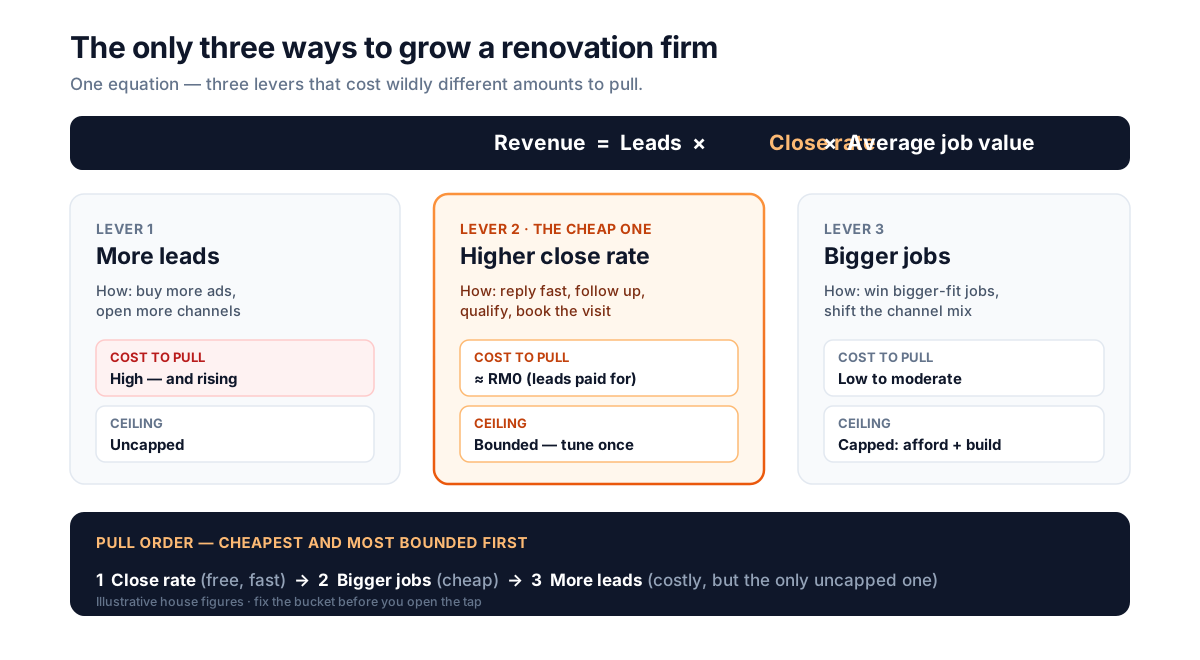
Every renovation firm's revenue reduces to exactly three levers: how many leads you get, what share of them you close, and how big the average job is. Revenue = leads × close rate × average job value. Because they multiply, a modest lift on each compounds into real growth. But they cost wildly different amounts to pull, and the ranking is the opposite of most owners' instinct. Let's lay out all three with Malaysian numbers, then rank them.
What are the only three ways to grow a renovation firm?
There are three, and only three, levers on your top-line revenue — because revenue is a product of exactly three things:
Revenue = Leads × Close rate × Average job value
Win more enquiries, close a bigger share of them, or make each job worth more. Every growth idea you've ever had — more ads, faster replies, better qualification, upselling a bigger scope, a referral push — works by moving one of these three numbers. Nothing else can.
This isn't a renovation idea; it's the oldest framework in business growth. Marketing strategist Jay Abraham built a career on the observation that there are only three ways to grow any business: increase the number of clients, increase the average transaction value, and increase how often they buy. His own arithmetic — 1,000 customers spending $100 twice a year, then lift each lever 10% — lands on a ~33% revenue jump from three small changes, because 1.1 × 1.1 × 1.1 ≈ 1.33.
Renovation bends the framework slightly. Buying a reno is a once-every-several-years decision, so Abraham's third lever — frequency — mostly shows up for us as repeat work and referrals, which quietly multiply your lead count for free. And for a firm that leaks enquiries on the way to a sale, Abraham's first lever ("more clients") hides the single most useful split there is: the difference between the leads you buy and the ones you close. Those two behave nothing alike in cost or ceiling, so we treat them as separate levers. That gives us the three that matter day to day — leads, close rate, job value — with margin as a quiet fourth on profit (covered in markup vs margin).
Why do the three levers multiply, not add?
Because revenue is their product, three small lifts compound into a gain much bigger than they look. Say a firm gets 40 enquiries a month, closes 7.5% of them into jobs, and averages RM80,000 a job — that's 3 jobs and RM240,000 a month. Now lift each lever by a modest 20%:
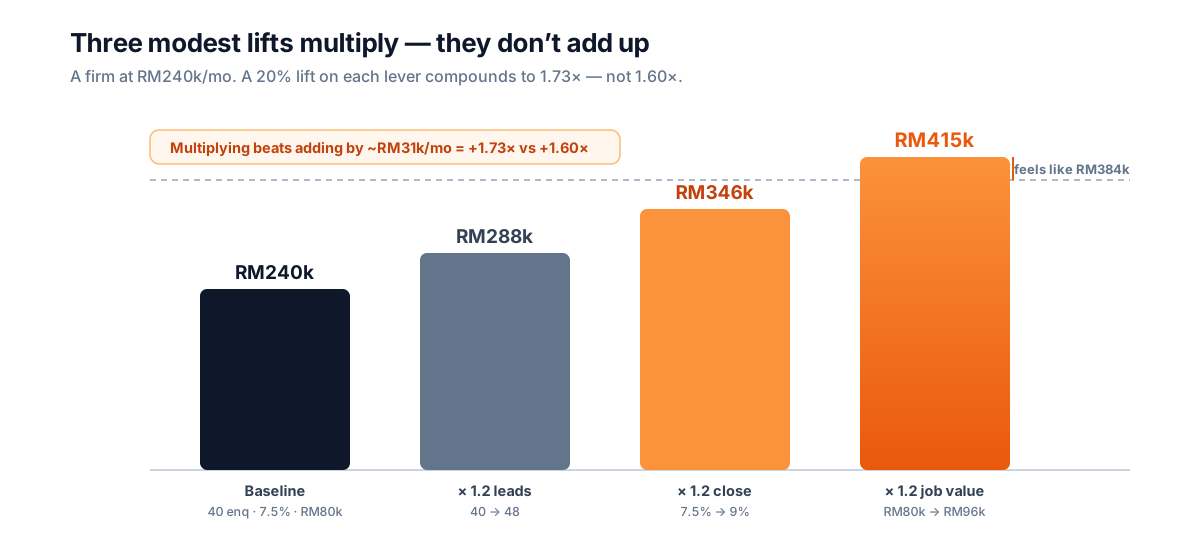
- 40 → 48 leads, still 7.5% close, RM80k → RM288,000
- 48 leads, close 7.5% → 9%, RM80k → RM345,600
- 48 leads, 9% close, RM80k → RM96k job → RM414,720
That's 1.73× the revenue — a 73% gain — from three lifts that each feel like 20%. The instinct is to add them up to +60%, which would be RM384k. The extra ~RM31,000 a month is the compounding you get for free when you move more than one lever at once. It's also the reason a firm that quietly tightens all three out-grows one that only ever shouts "more leads."
Which lever is the cheapest to pull?
Your close rate, by a wide margin — because you've already paid to get the leads. When 48 enquiries are sitting in your WhatsApp and you win 9% instead of 7.5%, the extra jobs cost you no ad budget at all. The money was spent the moment those leads arrived; closing a bigger share of them is almost pure upside.
On the worked figures, lifting the close rate alone from 7.5% to 9% takes a RM240k month to RM288k — +RM48,000 a month at zero extra spend. Buying your way to the same +RM48k by adding leads instead means paying for eight more enquiries every month, forever, and the new ones tend to close below your average because they come from colder sources.
And on a renovation funnel, a few points of close rate is rarely exotic. The overall 7–8% is really six stage rates multiplied together — reply, qualify, book, attend, quote, close — so the lift usually comes from fixing the weakest stage, not from becoming a better salesperson overnight. The usual culprits are the cheapest things in the business to fix:
- Reply speed. The response-time-to-close-rate curve is brutal in the first hour — an enquiry acknowledged in minutes converts far better than one answered the next morning.
- Follow-up. Most won deals need five or more follow-ups, yet 44% of firms quit after one. The leads you already gave up on are close rate lying on the floor.
- Ownership and qualification. A lead with one clear owner and a sharp first-reply qualification books the consultation; a lead nobody owns goes cold in a group chat.
The catch with close rate is its ceiling, which brings us to the ranking.
How far can each lever actually go?
This is where the three levers separate. They lift revenue identically on paper — each 20% move is worth the same +RM48k in isolation — but they cost different amounts to pull and they hit their ceilings at completely different points:
| Lever | How you pull it | Cost to pull | Ceiling | How fast it pays | The catch |
|---|---|---|---|---|---|
| Close rate | Reply fast, follow up, qualify, one owner per lead | ≈ RM0 — leads already paid for | Bounded — you can't close more than the market gives (~33% at quote stage); tune once, it's done | Fast — works on this month's existing leads | Finite headroom; once your funnel is tight, this lever is spent |
| Bigger jobs | Win better-fit work, scope honestly, shift channel mix upward | Low to moderate | Capped — by what buyers can afford and what you can build/fund | Medium | Bigger jobs strain cash and crew capacity |
| More leads | More ad spend, more channels, referral engine | High — and rising as you scale | Uncapped — always more audience to reach | Slow, and costs money upfront every month | Extra leads are colder; CAC climbs; you can pour them into a leaky funnel |
Two of the three levers are bounded: you tune your close rate and your job mix, and then they're largely done — there's a wall you approach and can't pass. Only one lever, more leads, has no ceiling at all. That single fact decides the order you should pull them in.
Why is "more leads" the lever to pull last?
Because it's the most expensive, the slowest, and the only one that actively fights another lever. Three reasons it belongs last, not first:
1. It costs real, rising ringgit. Unlike close rate, every extra lead is a cash outlay — and the cost climbs as you scale. The cheapest, highest-intent audience converts first; once you've captured them, growing spend means paying to reach colder people, so your marginal cost per lead rises above your blended average even while the average still looks healthy. Media buyers call this diminishing returns, or channel saturation, and it's usually invisible until late because the blended number hides it. Platform inflation stacks on top: Facebook's average cost per lead rose about 21% year-on-year in 2025. In Malaysia, property and home-services leads already run anywhere from roughly RM25 to RM150 each depending on channel and targeting — and that's before the colder, pricier tail.
2. The extra leads are colder. The leads you add at the margin rarely close at your current rate. So Lever 1 quietly drags on Lever 2 — buy more volume and your blended close rate usually falls, which is the opposite of what you want.
3. You can pour it into a leaky bucket. This is the real trap. A firm that reaches for more leads while winnable ones die on slow replies is paying full price to refill a bucket with holes in it. Even the framework this all comes from agrees: Abraham's own teaching calls winning new buyers "the slowest and most expensive" of the three levers, the one most companies over-rely on precisely because it's the most obvious.
None of this means leads don't matter — they're the only lever with no ceiling, so sustained growth eventually has to come from the top of the funnel. It means you earn the right to buy them by fixing the other two first.
So in what order should you pull them?
Cheapest and most bounded first. Fix the close rate, then raise job value, then open the tap — because the bounded levers are free money with an expiry, and tuning them makes every future lead worth more.
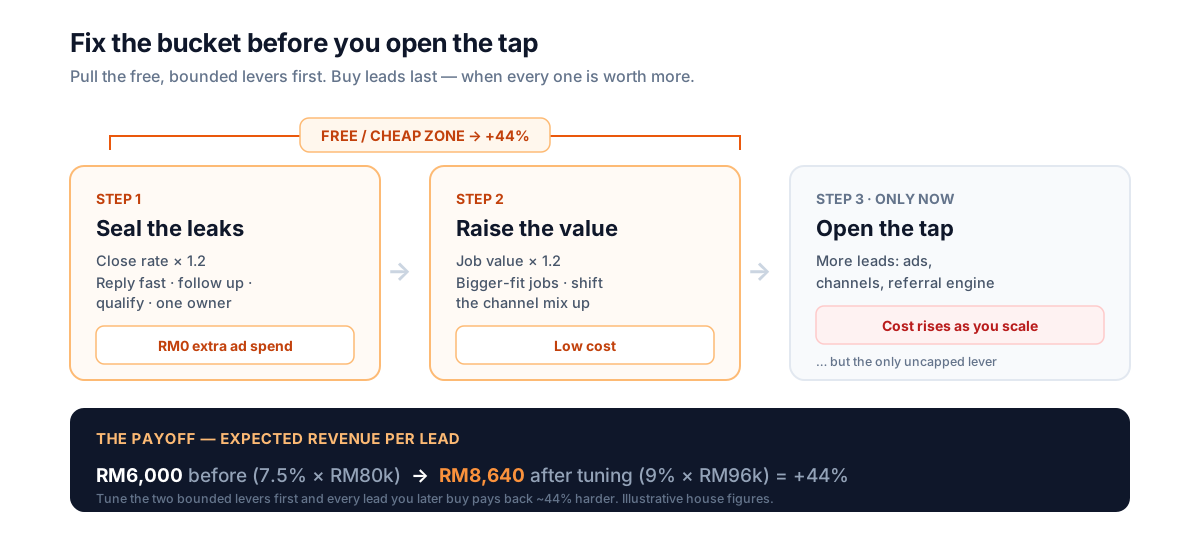
- Seal the leaks (close rate). Free, fast, works on the leads you already have. Do this first, always.
- Raise the value (bigger jobs). Win better-fit work and shift your channel mix toward sources that send larger jobs — referral and landed-property enquiries tend to be bigger than cold boosted-post leads, so the mix lever moves your average with no extra selling. Watch the catch: bigger jobs tie up more of your working-capital buffer and more crew-weeks, so grow size within what you can fund and build well.
- Open the tap (more leads). Now — and only now — widen the funnel.
Here's why the order pays twice. Tuning the two bounded levers by 20% each lifts a RM240k month to about RM346k — +44% at zero ad spend. But it also raises the expected value of every lead: at baseline a lead is worth 7.5% × RM80k = RM6,000 of revenue; after tuning it's 9% × RM96k = RM8,640 — about 44% more. So when you finally open the tap, each lead you buy pays back ~44% harder than it would have before. Buy leads last and you buy them when they're worth the most.
How HotLead fits in
HotLead doesn't set your growth strategy or buy your ads — the leads lever is your marketing budget's job, and job value is your sales craft. What it does is move and measure the lever that matters most and costs least: your close rate. It captures every enquiry so none leak, sends an instant auto-greeting so the first reply is fast, routes each lead to one owner by round-robin, manual or custom rule, and keeps every lead on a clear next action with overdue nudges so the five-plus follow-ups actually happen. That's the close-rate lever, pulled.
Just as important, its funnel and per-channel view tells you which lever is actually leaking — whether you're short on leads, short on close rate, or short on job value — and which sources send your bigger jobs, so you pull the right lever instead of the loudest one. That's the difference between the Klang owner doubling an ad budget he didn't need and fixing the stage that was quietly costing him the year.
Start with the complete guide to managing renovation leads in Malaysia, see the renovation lead playbook, or go deeper on the sibling to this piece — how many leads your firm actually needs a month, which sizes the top-of-funnel target once you've decided which lever to pull.
Sources: The "only three ways to grow a business" framework (more clients, bigger average transaction, more frequency) and the multiplicative 10%-each ≈ +33% math — Jay Abraham, summarised by ClickZ and the Atlanta Small Business Network, which also notes winning new buyers is "often the slowest and most expensive" growth lever. Diminishing returns / channel saturation as ad spend scales (the cheapest audience converts first; marginal CAC rises above blended CAC) — Recast, "Diminishing Returns: Accounting for Channel Saturation". Facebook average cost-per-lead up 21% year-on-year in 2025 — Search Engine Land, on WordStream 2025 benchmark data. Malaysian property / home-services cost-per-lead and CPC ranges (illustrative planning figures, not a renovation-specific benchmark) — 2Stallions Google Ads cost guide for Malaysia. Healthy home-improvement close rate (7–8% overall, six funnel stages multiplied; ~33% close at the quote stage; referral ~15–25% vs cold ~1%), average job value (condo RM40–150k, landed RM60–250k; RM80k worked figure), ~20% gross margin and the "five-plus follow-ups / 44% quit after one" rule are the illustrative house figures used across this series — see our funnel-stage benchmarks, response-time vs close-rate and follow-up system pieces. The worked revenue, per-lead-value and compounding figures are illustrative — plug in your own leads, close rate and average job value to find which lever is cheapest for you to pull next.
Frequently asked questions
What are the three ways to grow a renovation business?
Mathematically there are only three levers on your revenue — the number of leads you get, the share of them you close, and the average value of each job you win. Revenue = leads × close rate × average job value. (Profit adds a fourth lever, your margin, and repeat-and-referral work adds a fifth by multiplying your leads for free.) Everything you could do to grow — more ads, faster replies, better qualification, upselling, a referral push — works by moving one of these levers. Naming them turns 'we need to grow' into a decision about which lever is cheapest to pull next.
Is it better to get more leads or improve my close rate?
For almost every small Malaysian renovation firm, improve the close rate first. It's the cheapest lever by a mile — you already spent the ad money to get the leads sitting in your inbox, so winning a bigger share of them adds revenue at close to zero extra cost. Buying more leads costs real ringgit every month, that cost rises as you scale (the cheapest audiences get used up first), and the extra leads are usually colder and close at a lower rate. Fix the close rate, then widen the funnel.
Why do the three growth levers multiply instead of add?
Because revenue is their product, not their sum. If you lift leads, close rate and job value by 20% each, the result isn't 1 + 0.2 + 0.2 + 0.2 = 1.6× — it's 1.2 × 1.2 × 1.2 = 1.73×, a 73% gain. That's why three small, realistic improvements beat one heroic push on a single lever, and why a firm that quietly tightens all three out-grows one that only ever buys more leads.
What's the catch with just winning bigger renovation jobs?
Bigger jobs strain two things a small firm can run out of — crew capacity and cash. A larger job ties up more of your own money between payment milestones and occupies your crews longer, so chasing size without watching your working-capital buffer and crew-weeks is how a firm ends up profitable on paper but short on payroll. Raise job value by winning better-fit work and shifting your channel mix upward, not by taking on jobs you can't fund or build well.
Why does buying more leads get more expensive as I scale?
Because the cheapest, highest-intent audience converts first. Once you've captured them, growing spend means paying to reach colder, less relevant people, so each additional lead costs more than the last — your marginal cost per lead climbs above your blended average, even though the average still looks fine. Platform costs are rising on top of that (Facebook's average cost per lead jumped about 21% year-on-year in 2025). More leads is still the only lever with no ceiling, but it's the most expensive way to grow, which is why you pull it last.
Keep reading
- Sight Unseen: Winning the Overseas Malaysian Who Renovates a Unit They Can't VisitA Malaysian working in Singapore collects the keys to a KL condo and messages you to fit it out — but they can't come to a site visit, can't walk your showroom, and will wire a deposit to a firm they've never met. Most firms treat this lead like a walk-in, go quiet when the buyer can't pop by, and lose the highest-budget job in the inbox. Here's why the remote buyer is your hardest-trust but best-paying lead, and how to build a remote lane that actually closes it.
- "Ok, Proceed" Isn't Money in the Bank — I Built an AI to Ask for the Deposit the Moment a Renovation Buyer Says YesA Cheras contractor closes a RM62k job on WhatsApp, the buyer says "ok proceed lah", and then the owner — mid-site, phone in a dusty hand — has to stop, pull the bank details, the agreed deposit and the scope, and type a careful money message. In that gap a hot yes quietly cools back to "let me think." The 2026 reflex is to ask AI to detect the yes and auto-fire the invoice. I built it, and it asked a half-committed buyer for 40% to a personal account two seconds after a soft "ok ok". Here's the version that kills the typing delay without asking for money off a misread.
- Still Remember Me? The Renovation Lead That Comes Back Months LaterAn enquiry you'd written off three months ago suddenly pings — "hi, still remember me? the Mont Kiara condo, ok to start now ah?" It's one of the hottest leads in your inbox, and most firms handle it worst — because the context is gone, the quote is stale, and nobody owns it. Here's why a come-back lead is high-intent, why re-using the old price quietly bleeds margin, and how to catch it without looking like you forgot them.