

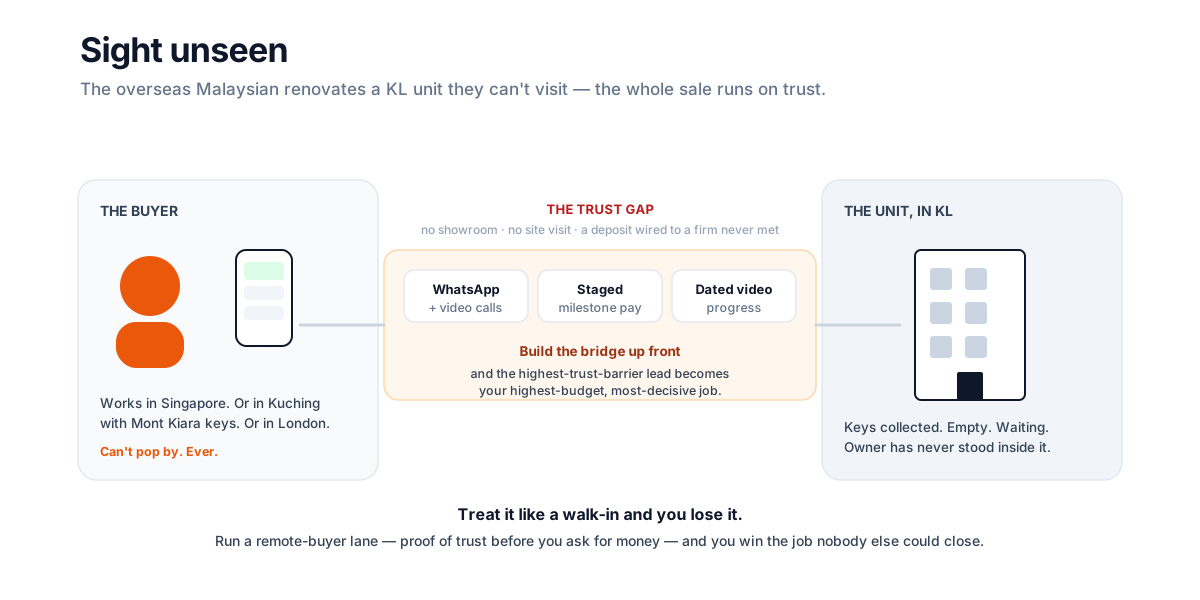
The message comes in on a Tuesday night, and it's one of the best-looking enquiries you've had all month.
"Hi, I just collected keys for my condo in Mont Kiara. Looking to do a full fit-out — three bedrooms, kitchen, built-ins, the works. I'm based in Singapore so can't really come back often, but I'd like to get started soon. Can you help?"
Fast, specific, serious money, a turnkey scope. You reply the way you reply to everyone: "Great! Let's arrange a site visit so we can measure up and quote you properly — when are you free to meet at the unit?"
And then it dies. Not because she lost interest. Because she literally cannot come. She's in Jurong, she flies back maybe twice a year, and the one thing your whole sales process is built around — getting the customer to stand in the space with you — is the one thing she can't do. You follow up once, she says "let me sort out my schedule", and three weeks later the unit is being fitted out by a firm that never once asked her to pop by.
I've watched this happen more times than I can count, and it's one of the most expensive leaks in a Malaysian reno or ID firm's inbox — because the lead you just fumbled is quietly one of the best jobs you'll see all year.
Who is the remote renovation buyer in Malaysia, and why are there so many?
The remote buyer is a Malaysian who owns a unit here but lives somewhere they can't easily get to it — and in our market there are a lot of them. The three you'll meet most are the Singapore-based Malaysian doing up a Klang Valley condo, the East Malaysian or outstation owner who bought a KL unit and can't fly over for every visit, and the investor furnishing a unit they may never personally live in. All of them run the entire sale on WhatsApp and video, make decisions from a distance, and will eventually wire you a deposit sight-unseen.
This isn't a niche. The Malaysian High Commission estimates 450,000 to 500,000 Malaysians work in Singapore, a huge pool of people on Singapore salaries who own or are buying property back home and manage it from across the Causeway. Layer on the investor-and-outstation condo stock — a 2022 NAPIC dataset analysed in a Planning Malaysia study counted about 51,700 unsold residential and serviced-apartment units nationwide, 9,441 of them in Kuala Lumpur, with condominiums and serviced apartments the single biggest overhang category. Those aren't owner-occupier terrace houses; they're exactly the kind of units bought by people who aren't standing in them.
So the remote enquiry isn't a weird edge case you can ignore. For a firm doing condo and serviced-apartment fit-outs in the Klang Valley, it's a steady, predictable slice of the pipeline — and most firms have no lane for it.
Why do firms lose the remote buyer they should easily win?
Because they treat a remote buyer like a walk-in, and the remote buyer fails the walk-in's first test — showing up. The whole default sales process quietly assumes the customer can stand in the space with you: book the site visit, measure up, walk the showroom, feel the quartz sample, meet face to face before any money moves. Take that assumption to someone in Jurong or Kuching and every step jams.
Two leaks do the real damage:
- You go quiet when they can't come. Your process has no next step after "let's book a visit" fails, so the lead just stalls. No visit means no measurement, no measurement means no quote, no quote means no follow-up — and the warmest, highest-intent buyer in your inbox is sitting in silence while a firm that did have a remote process sends them a video walkthrough.
- You over-promise on a finish they only ever saw in a photo. When you do push forward, you quote off one WhatsApp picture and a vague brief, describing finishes the buyer pictures one way and you build another. From 300km away they can't catch the drift early — so the gap only surfaces at handover, as a dispute you can't resolve by walking them to the actual tile. A disappointed remote handover is the worst kind: no warm face-to-face to smooth it over, just a bad video call and a bad review written from abroad.
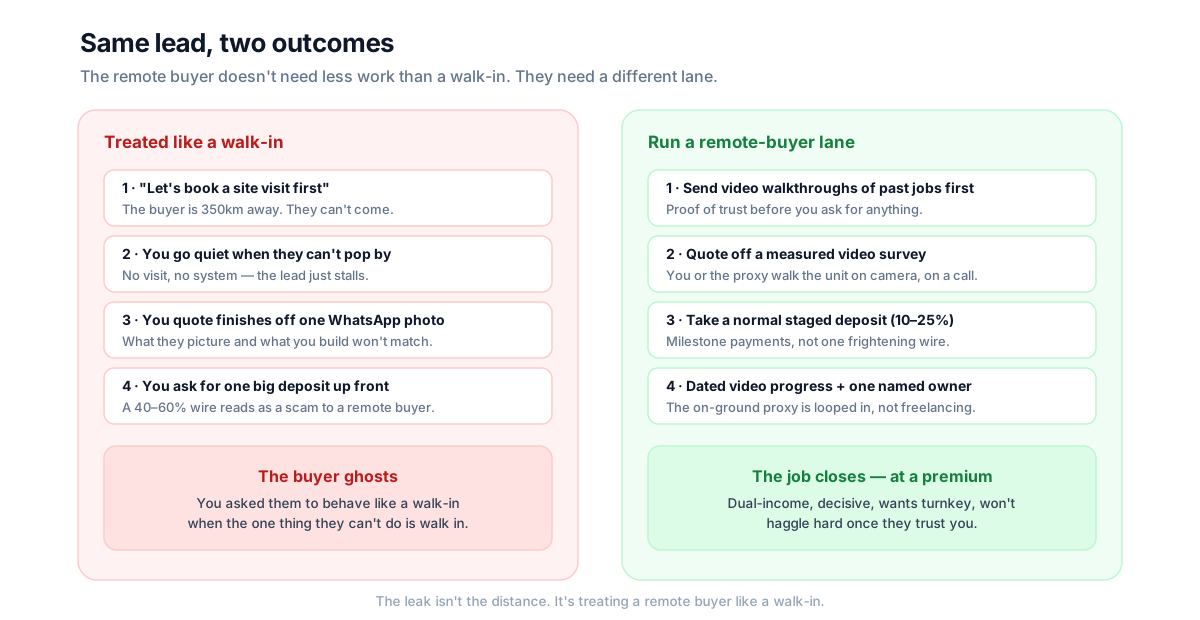
The painful part is that none of this is a hard customer. She wants to give you the job. She's just waiting for one firm to make it possible to buy without flying home — and the first one that does usually wins before the others have replied.
Isn't a buyer who can't even visit too risky and too much hassle to chase?
No — and this is the mindset flip that makes the money. The remote buyer looks like your hardest, highest-friction lead, so firms deprioritise them. But flip it around: once you've cleared the trust barrier, the remote buyer is frequently your highest-budget, most decisive, least price-sensitive job. The difficulty isn't a reason to avoid them; it's the moat that protects the firm willing to do the work.
Look at who they actually are. A Malaysian couple earning Singapore-dollar salaries, renovating a KL condo they'll use on visits or rent out, with no time or appetite to micromanage from abroad. They don't want three quotes and a haggle — they want one firm they can trust to handle everything so they don't have to keep flying back. That's a turnkey brief, a healthy budget, and a buyer who makes decisions fast once the trust is there. Compare that to the walk-in who visits five showrooms, asks for a 15% discount and disappears to think about it.
The reason most firms never see this upside is that they quit at the trust barrier. And the barrier is real: with Malaysians having lost RM3.1 billion to commercial crime across 41,701 cases in 2024, a remote buyer being asked to wire money to a firm they've never met is right to be cautious. That caution isn't an obstacle to argue past — it's the thing you solve, and solving it is exactly what your competitors won't bother to do.
How do you build trust with a buyer who wires money to a firm they've never met?
You prove it before you ask for anything, and you let your process — not your promises — do the reassuring. A remote buyer can't shake your hand or watch your team work, so every trust signal a walk-in gets for free, you have to deliver deliberately, up front, and in a form they can see from their phone. Build a remote-buyer lane with these five moves and you convert the leads everyone else lets die.
| Trust move | What it replaces | Why it works for a remote buyer |
|---|---|---|
| Video walkthroughs of real finished jobs, sent early | The showroom walk and seeing your crew in person | They judge your quality on actual work, not a glossy render — before you've asked for a cent |
| A measured video survey (you or the proxy walk the unit on a call) | The physical site-visit measure-up | You quote off real dimensions, not one photo, so the price holds and finishes match |
| A staged deposit in the normal 10–25% band | A single large upfront wire | A modest, structured first payment reads as legitimate; a big upfront demand reads as a scam |
| Dated video progress at each milestone | Dropping by to check on the work | The owner feels present the whole way, so there are no 300km surprises at handover |
| One named owner + a clear contract | The reassurance of a face across the table | A real registered business, a written scope and a single person who answers every time |
The deposit structure deserves its own emphasis, because it's where remote deals most often break. Years of local scam-warning content have trained Malaysian buyers that a demand for 40 to 60% upfront is a red flag — and that instinct is sharpest in someone wiring money from abroad. It helps to remember the mechanics too: an instant PayNow–DuitNow cross-border transfer is capped at RM3,000 a day, so a renovation deposit isn't a casual tap — it's a deliberate telegraphic or bank transfer the buyer has to consciously decide to make. Make that decision easy by keeping the first payment small, staged and tied to something they can see.
What about the cousin, the agent, the sibling — the person on the ground?
Treat the on-ground proxy as a real role in the deal, not a random middleman — because handled well, they're the single thing that makes a remote renovation actually buildable. The proxy is whoever the overseas owner trusts to be physically present: a sibling in KL, a cousin, a close friend, a property agent. They open the door for your survey, receive deliveries, do a physical check when a photo won't settle it, and sometimes hold the keys.
The leak here is a blurred chain of command. When you're sometimes talking to the owner in Singapore and sometimes to the brother in Cheras, it gets murky fast: who approved the extra socket, who agreed to the darker laminate, who's actually paying for the change. That confusion is how a remote job slides into a dispute — the owner says "I never agreed to that," the brother says "but I told them it was fine," and you're caught in the middle from a distance.
So set the roles out loud, early:
- The overseas owner is the decision-maker and the payer. Changes and money go through them, even when the proxy relays them. This is the same discipline as any multi-person household deal where the person messaging isn't the one who signs off — just stretched across a border.
- The proxy is the eyes and hands, not the approver. Lean on them for access, deliveries and physical checks; don't let an off-hand "ya can lah" from the cousin become an unbilled, unapproved change.
- Everyone sits on one record. A decision made with the proxy has to reach the owner before it's final, and both need to see the same scope, the same quote, the same progress — or things get lost in the gaps between people and time zones.
Get this right and the proxy becomes your biggest asset: the trusted local face who reassures the nervous overseas owner that you're real and the work is happening. Get it wrong and they become the fog the whole job gets lost in.
Remote-buyer lane vs. treating them like a walk-in — what each one costs
| Treat them like a walk-in | Run a remote-buyer lane | |
|---|---|---|
| First move | "Let's book a site visit" (they can't) | Video walkthroughs + a measured video survey |
| When they can't come | You go quiet; the lead stalls | The distance is the plan, not a blocker |
| The quote | Guessed off one photo | Built off real measurements |
| The deposit | One big wire that reads as a scam | Staged 10–25%, tied to visible progress |
| The handover | A surprise over a bad video call | A milestone they already watched happen |
| Who wins the job | Whoever made it buyable from abroad | You |
| The buyer you get | Nobody — it ghosts | High-budget, decisive, turnkey, loyal |
A walk-in you lose costs you around RM1,280 in expected gross profit on an average enquiry — and a remote buyer with a turnkey KL condo brief sits well above that average, because the job is bigger, the margin holds, and you've often spent less chasing it. Letting it die at "let me sort out my schedule" isn't bad luck. It's not having a lane for the most valuable lead type most Klang Valley fit-out firms never built a process for.
The bottom line
The next time an enquiry opens with "I'm based in Singapore so can't really come back often" — or Kuching, or London, or just outstation — don't hear a problem. Hear your best job of the quarter, waiting for one firm to make it buyable from a distance. The remote buyer runs the whole sale on WhatsApp and video, makes decisions from 300km away, and will wire real money to a firm they've never met once — and only once — they trust it. Treat them like a walk-in and you'll lose them at the site visit they can't attend. Build a remote lane — proof of trust up front, a measured survey, staged payments, dated video progress, one named owner and a cleanly-looped proxy — and you'll win the high-budget, turnkey, low-haggle jobs your competitors quietly let ghost.
For the whole system this sits inside — capture, qualify, quote, follow up and close — start with the complete guide to managing renovation leads in Malaysia. Read this alongside the multi-decision-maker lead where the person messaging can't say yes, why interior-design quotes stall between quote and deposit, the Malaysian deposit and progressive-payment norms that decide whether a remote buyer trusts you, and confirming a deposit payment slip without chasing.
How HotLead helps you run a job across a border
HotLead can't tell a lead is overseas or do the trust-building for you — the video walkthroughs, the staged terms, the judgement about the proxy are all yours. What it does is hold a remote job together so it doesn't leak across weeks and time zones:
- Capture and tag the remote buyer the moment they message on WhatsApp, Instagram or Facebook, so a high-value overseas enquiry never sits unseen in a busy inbox.
- One named owner per lead, so the buyer in Jurong deals with a single familiar face across months of back-and-forth — not a different person every time the group chat pings.
- Next actions with wake-dates for the longer remote cadence — the milestone video update, the staged invoice, the proxy check-in — so nothing gets forgotten across the distance and the job keeps moving without you holding it all in your head.
- One record for the owner and the proxy together, so a decision made with the cousin in KL reaches the owner in Singapore before it's final, and everyone sees the same scope and progress.
- A funnel and per-source view, so you can see which channels actually send you remote buyers and how that lane converts — because once you know it's real money, you build for it.
If your best condo enquiries keep dying at "I can't come for a site visit," the leak isn't the distance — it's not having a lane for it. See how HotLead works, or how it fits a renovation firm or an interior-design studio.
Sources: HumanResourcesOnline — Malaysian High Commission estimate of 450,000–500,000 Malaysians working in Singapore (including ~120,000 daily commuters); Planning Malaysia Journal — "Secular Trends in Property Overhang in Malaysian Residential and Serviced Apartments" (NAPIC data: ~51,700 unsold residential and serviced-apartment units nationwide in 2022, 9,441 in Kuala Lumpur; condominiums and serviced apartments the largest overhang category); Malay Mail — real-time PayNow–DuitNow cross-border payment linkage launched 17 November 2023 by Bank Negara Malaysia and MAS, person-to-person transfers capped at RM3,000 / S$1,000 a day; The Vibes — Bukit Aman: commercial-crime losses in Malaysia reached RM3.1 billion across 41,701 cases in 2024. Deposit-band norms (10–25% safe, 40–60% a scam red flag), expected gross profit per lost enquiry, and the up-to-five-firms shortlisting behaviour as cited in the renovation-deposit guide and the real cost of a lost renovation lead.
Frequently asked questions
How should I handle a renovation enquiry from a Malaysian working in Singapore who can't come for a site visit?
Stop making the site visit the gate. For a remote buyer the first move isn't "let's book a visit" — it's proving you're real and good without one. Send two or three video walkthroughs of finished jobs like theirs, do the measurement survey yourself or through their on-ground proxy on a video call so you quote off real numbers not one photo, and set up a longer back-and-forth on WhatsApp and video as the normal way you'll run the whole job. Treat the inability to visit as the brief, not a problem to solve, and you'll be the one firm that didn't go quiet on them.
Is it safe to take a deposit from an overseas buyer I've never met in person?
It's safe for you and it's the buyer who's taking the real risk, so the job is to lower their risk, not yours. A remote buyer is wiring money to a firm they've only seen on WhatsApp, in a country where scam warnings are everywhere, so a demand for one big upfront payment reads as a red flag and kills the deal. Ask for a normal staged deposit in the 10 to 25% band, structure the rest as milestone payments tied to visible progress, give them a registered business, a contract and a named person, and let the staged structure itself be the trust signal. You get paid; they feel protected. Both things are true at once.
How do I do a renovation handover when the owner is overseas and can't inspect the unit?
You build the handover across the whole job, not at the end. If the only time the remote owner "sees" the work is a final video call, every gap between what they pictured and what you built becomes a dispute from 300km away. Instead send dated video progress at each milestone — demolition, wiring, carpentry, tiling, final — so there are no surprises, get the on-ground proxy to do a physical walk-through on your behalf, and do a proper live video defects inspection room by room before the final payment. The owner should feel they watched the whole thing happen, because they did.
The buyer wants me to deal with their cousin or agent on the ground instead of them — how does that work?
Welcome it, but keep the lines clear. The on-ground proxy — a cousin, a sibling, a property agent, a friend — is genuinely useful. They open the door for the survey, receive deliveries, do physical checks and sometimes hold the keys. The danger is a blurred chain where you're not sure who approves a change or who's actually paying. Fix it up front — the overseas owner is the decision-maker and payer, the proxy is the eyes and hands, and both sit on one record so a decision made with the proxy doesn't get lost before it reaches the owner. It's the same discipline as any multi-person household deal, just stretched across a border.
Does HotLead handle overseas or remote renovation leads?
HotLead doesn't know a lead is overseas or run the trust-building for you — the video walkthroughs, the staged terms and the judgement are yours. What it does is hold the remote job together so it doesn't leak over weeks and time zones. You capture and tag the remote buyer the moment they message, route them to one named owner so they deal with a single familiar face, set next actions with wake-dates for the longer remote cadence (the video update, the milestone invoice, the proxy check-in) so nothing is forgotten across the distance, and keep the owner and the on-ground proxy on one record. The trust work is human; the follow-through is the plumbing.
Keep reading
- "Ok, Proceed" Isn't Money in the Bank — I Built an AI to Ask for the Deposit the Moment a Renovation Buyer Says YesA Cheras contractor closes a RM62k job on WhatsApp, the buyer says "ok proceed lah", and then the owner — mid-site, phone in a dusty hand — has to stop, pull the bank details, the agreed deposit and the scope, and type a careful money message. In that gap a hot yes quietly cools back to "let me think." The 2026 reflex is to ask AI to detect the yes and auto-fire the invoice. I built it, and it asked a half-committed buyer for 40% to a personal account two seconds after a soft "ok ok". Here's the version that kills the typing delay without asking for money off a misread.
- Still Remember Me? The Renovation Lead That Comes Back Months LaterAn enquiry you'd written off three months ago suddenly pings — "hi, still remember me? the Mont Kiara condo, ok to start now ah?" It's one of the hottest leads in your inbox, and most firms handle it worst — because the context is gone, the quote is stale, and nobody owns it. Here's why a come-back lead is high-intent, why re-using the old price quietly bleeds margin, and how to catch it without looking like you forgot them.
- "Did They Even See It?" I Built an AI to Read the Silence After a RM62k Renovation QuoteA Puchong reno firm sends a detailed RM62k kitchen quote on WhatsApp, then gets three days of silence. Did they read it? Comparing? Sticker shock? Nobody knows, so the follow-up is a blind "just checking in" fired into the dark. The 2026 reflex is to ask AI to score the buyer's intent and auto-chase. I built it — and it confidently invented a signal it couldn't actually see, then sent the one message that re-opens the price. Here's why the honest build, which admits what it can't know, is the one that earns its keep.