

A renovation firm in Puchong spends two hours pricing a Mont Kiara condo kitchen — hacking, cabinetry, a solid-surface top, the works — and sends it over WhatsApp at 6pm: a tidy PDF and a warm message. RM62,000. Then nothing.
Day one, nothing. Day two, nothing. Day three, the owner is staring at the chat with the two grey ticks and no idea what they mean. Did she even open the PDF? Is she comparing it against two other firms? Did the number scare her? Is she waiting on her husband, or on the bank? He has no signal — so he does what almost everyone does. He fires off "Hi, just checking in on the quote 😊" — and that one message, sent blind, is quietly one of the worst things he can do.
That moment — the quote went quiet, now what? — is where real money dies in this trade. The lead is the furthest down the funnel it will ever be; you've already spent the two hours quoting it. So the 2026 reflex is obvious and sounds smart: "Can't AI read the thread, tell me if they're hot, and chase them for me?"
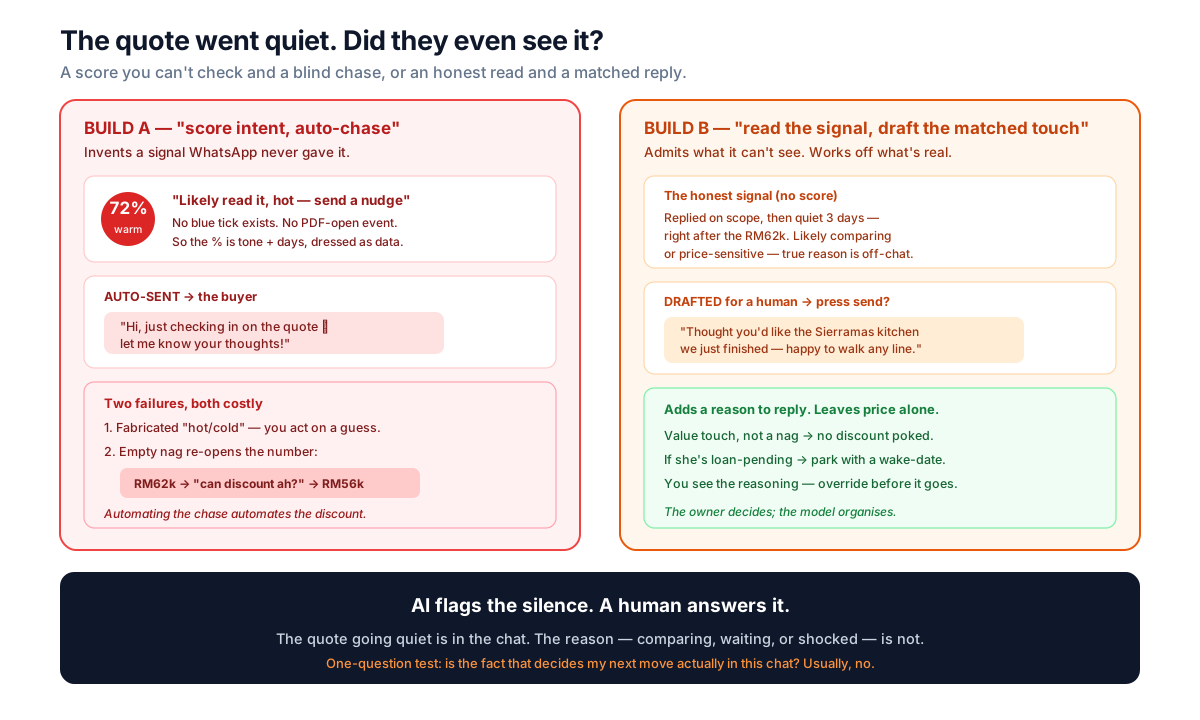
I built it. I pointed a model at a stalled-quote thread and asked it to score the buyer's intent and draft the follow-up. It produced a confident "72% — warm, likely comparing, send a nudge" and a perfectly polite chase. It looked like data. It was a guess wearing a percentage sign — and the chase it wrote re-opened the price. Here's what went wrong, and the version of the build that actually earns the quote back.
Can AI tell me if a buyer opened my renovation quote?
No — and any tool that claims to is inventing the signal. This is the whole crux, so let's be precise about it. On a normal WhatsApp Business chat you have exactly two honest signals: the ticks, and whether they replied. And the ticks betray you. Read receipts — the blue double-tick — are an account-wide toggle the recipient controls: if your buyer has switched read receipts off (a common privacy setting, and the switch is two-way, so plenty of people leave it off), you will never see a blue tick from her no matter how many times she reads your quote. On top of that, WhatsApp does not tell a sender whether an attached PDF was ever opened. There is no "document viewed" event. So the single question the owner most wants answered — did she even look at it? — is one the platform structurally does not answer.
That matters enormously for what you let AI do. If you ask a model "is this lead hot, did they read it, score their intent," it cannot read a receipt that doesn't exist — so it does the only thing it can: it pattern-matches on how the thread looks (how long the messages were, how enthusiastic the earlier replies sounded, how many days of silence) and returns a confident number. That number feels like it's measuring engagement. It's measuring vibes. And a confident wrong signal is more dangerous than an honest blank, because you act on it.
So what did the flashy build do? (Build A)
It invented a readiness score it couldn't see, then auto-fired a "just checking in" chase — the two worst moves stacked. Build A was the one everyone pictures: "AI, watch my quotes, score each buyer's intent, and when one goes quiet, send a follow-up automatically." It fails twice, and both failures cost money.
Failure one: the fabricated signal. As above — it scored the Mont Kiara buyer "72% warm" off nothing but the thread's tone and the three-day gap. That's not a reading, it's a projection. Act on a made-up "warm" and you nag a buyer who was quietly offended by the price; act on a made-up "cold" and you drop a buyer who was simply waiting on her loan approval. Either way the score didn't add information — it laundered a guess into something that looks like a dashboard.
Failure two: the move it automates is the one you should never make. The auto-chase it drafted was the classic "Hi, just following up on the quote — let me know your thoughts!" Two problems with that on a stalled renovation quote, both well documented. First, it adds no new reason to reply — Gong's analysis of real sales conversations found reminder-only follow-ups underperform ones that add something fresh, precisely because an empty nudge gives the buyer nothing to respond to and reads as automated. Second, and this is the expensive one: a bare chase re-opens the price. Poke a stalled RM62k number and the buyer's reflex reply in this market is "can discount ah? what's your best price?" — and here the behavioural research is unkind. The anchoring effect (Tversky and Kahneman, 1974; the Harvard Program on Negotiation has a library on it) means once a number is back on the table, the conversation adjusts away from it, and on a quote you're defending it only adjusts one direction: down. Automating the chase automates the discount.
Why is the silence after a quote the most misread signal in the funnel?
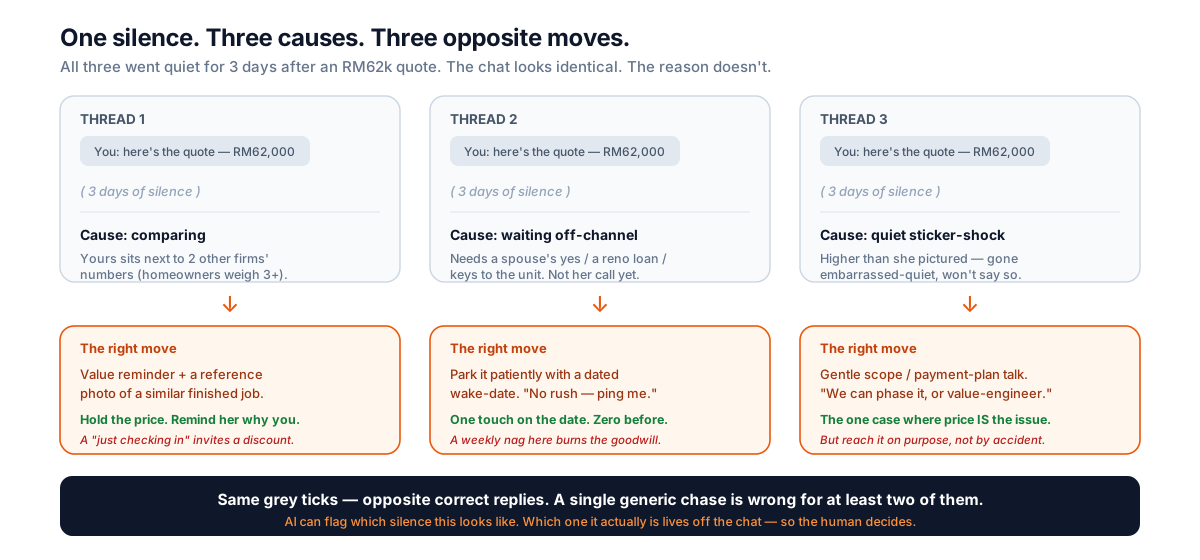
Because one silence has at least three completely different causes that look identical in the chat — and each needs the opposite next move. This is the un-Googleable heart of it. When a quote goes quiet, the three-day gap in your WhatsApp looks exactly the same whether the buyer is:
- Comparing — she's got your RM62k next to two other firms' numbers and is weighing them. A Malaysian homeowner routinely gathers three or more quotes before committing (Recommend.my's renovation guidance treats comparing several contractors as the norm). The right move: remind her why you, with a reference photo of a similar finished job — add value, don't touch the price.
- Waiting off-channel — the yes she needs isn't hers. It's her husband's, or the bank's renovation-loan approval, or the keys to the unit, or the year-end bonus. The right move: park it patiently with a dated wake-date and a light "no rush — ping me when the loan's through," not a weekly nag that burns goodwill.
- Quiet sticker-shock — the number was higher than she'd pictured, and rather than say so she's gone embarrassed-quiet. The right move: a gentle scope or payment-plan conversation ("we can phase it, or value-engineer the island") — carefully, because this is the one case where the price genuinely is the issue.
Same grey ticks. Opposite correct responses. And critically, which one it is lives off the chat — in her marriage, her bank, her head. The chat can tell you the silence happened; it cannot tell you why. That's the exact division of labour I keep hitting across this whole series: AI can flag the silence, but the judgement of what it means stays human, because the deciding fact was never written down.
What signal does the chat honestly give you?
Not intent — but three real, visible facts that narrow the guess a lot. This is where AI genuinely helps, because reading these fast across a pile of stalled quotes is exactly the boring work software is good at. The honest signals are:
- Did they reply, then go quiet — or never reply at all? A buyer who engaged with the scope and then went silent after the number is a different animal from one who never acknowledged the quote landed. The first is weighing; the second may not have opened it.
- Where did the silence fall — right after the number, or mid-scope? Going quiet the instant the RM62k appeared leans toward price (comparing or shock). Going quiet mid-scope discussion — before the final figure — leans toward a stall in their own process. The position of the silence is a real clue the chat actually contains.
- How many days since the number went out? Three days is "still deciding." Three weeks with no wake-date is a different conversation. Time is a fact, not a guess.
None of those is a hotness score. Each is a visible fact you can point at. Mapped together, they narrow the likely reason — and, crucially, they let AI draft a reason-matched next touch instead of one generic nag:
| What the chat honestly shows | Most likely reason | The next touch that fits |
|---|---|---|
| Replied on scope, went quiet right after the number | Comparing, or quiet sticker-shock | A value reminder + reference photo; hold price. Offer to walk the scope, not cut it |
| Went quiet mid-scope, before the final number | Stalled in their own process (loan, spouse, keys) | A light scope question + "no rush" — keep it warm, don't chase price |
| Never replied after the quote landed | May not have opened it; or very early | Confirm receipt plainly: "want me to resend the PDF / walk you through it?" |
| Quiet 2+ weeks, said "after I collect keys" earlier | Genuine dated "not yet" | Park with a wake-date; one touch on the date, zero before |
What did the build that actually paid look like? (Build B)
The one that reads the honest signal, names the plausible reason out loud, and drafts a reason-matched next touch for a human to send — never a score, never a blind chase, never an auto-send. Same shape as every build in this series that's earned its keep: let AI read and arrange; keep the decision with the person who knows the job.
Build B, pointed at the Mont Kiara thread, doesn't say "72% warm — send nudge." It says: "Replied on scope, went quiet 3 days ago right after the RM62k. Most likely comparing or price-sensitive — can't tell which from the chat (the reason's off-channel). Suggested touch: send the Sierramas kitchen reference photo + 'happy to walk you through any line item' — no price mention. Or, if you know she's loan-pending, park with a wake-date instead.'" Then it waits for the owner to pick and press send. The difference reads small and is everything:
| Build A — "score intent, auto-chase" | Build B — "read the signal, draft the matched touch" | |
|---|---|---|
| The "did they open it" signal | Fabricated into a confidence % | Admitted as unknown — works off reply/no-reply only |
| Output | A hidden score + an auto-sent nudge | A visible signal read + a drafted touch, human sends |
| The follow-up it favours | Generic "just checking in" | Reason-matched: value reminder / scope Q / park |
| Effect on price | Re-opens the number → invites a discount | Leaves price alone unless the owner chooses to raise it |
| When it's wrong | Auto-sent before you can stop it | You see the reasoning and override before it goes |
| What the owner trusts | A percentage | Their own read, better organised |
What should an owner actually do when a quote goes quiet?
Pre-empt the silence at send, then match every follow-up to a reason — and never let the price be the thing you poke. Most of the win here is habit and a little plumbing; the AI is a thin, honest layer on top.
- Kill the "did they see it" question at send. End the quote message with a plain receipt-ask: "Got the PDF okay? Happy to walk you through any line." Now a reply (or none) tells you more than any tracker would — and you've invited the easy first response.
- Give every follow-up a new reason to exist. A reference photo, a material lead-time, a slot about to fill, a scope clarification. Never "just checking in." If the only thing a touch says is "respond to me," it's noise — and it re-opens the price.
- Match the touch to where the silence fell. Quiet right after the number → value, not price. Quiet mid-scope → a light question, keep it warm. Never replied → confirm receipt. This is the whole game.
- Park the real "not yet" with a wake-date, don't nag it. A buyer waiting on keys in December is a held warm lead on a timer, not a cold one. One touch on the date; zero before. Nagging a patient buyer loses a job you'd otherwise have won.
- Keep showing up — with a reason — past where most firms quit. If ~80% of sales need five-plus follow-ups and nearly half of firms stop after one, persistence with value is free market share. Set a stop point so it stays persistence, not pestering.
How HotLead fits — honestly
I'll be straight, the way I try to be in all of these, because over-claiming is the exact hype I keep arguing against. HotLead does not ship a quote-open tracker or an AI intent-scorer — those are the experiment in this piece, and the piece is the argument for why both are signals you can't honestly get on WhatsApp. What it ships is the transparent, auditable version of the same job:
- The whole thread on one lead record. So you can see for yourself exactly where the silence fell — right after the number, or mid-scope — instead of asking a model to guess. The position of the silence is a real signal, and keeping one consistent record of the quote and the conversation is what makes it readable.
- A next action and an overdue flag on every lead. A quiet quote surfaces on its own as a due or overdue follow-up — in plain sight, with a reason — so it never slips your mind in a pile of fifteen other threads. That's the honest version of "chase it," and it's the same engine behind replying before a lead goes cold.
- One owner per lead, by rule. So a stalled quote never sits in the gap between two people both assuming the other is on it — the gap where quotes really die.
- A funnel and per-channel view. So you can see how many quotes are stalled at the quote stage, and from which sources, instead of staring at grey ticks one thread at a time.
The judgement of why a quote went quiet — and therefore what to send next — stays with you, because you're the one who might know she's loan-pending and the model only knows the thread. If the real problem underneath this is quotes that stall and never close, start with the complete guide to managing renovation leads in Malaysia, see how it fits a renovation firm or an interior design studio, and read the companion builds on writing the quote follow-up so it nudges instead of nags, reading a live "they're comparing us" signal before you spend margin, and the human side of the same moment — when a quote gets ghosted, do you chase or wait?
Sources: That WhatsApp read receipts are an account-wide, recipient-controlled toggle (so a buyer can read your quote with no blue tick ever showing, and turning it off hides it both ways) is documented in WhatsApp how-to guides including Rasayel and Timelines.ai; WhatsApp exposes no "document opened" event to a sender, so PDF-open tracking is not available on the app. Follow-up persistence and drop-off figures (~80% of sales after 5+ follow-ups; ~44% give up after one) are from Invesp — The Importance of Sales Follow-Ups (a widely cited compilation; the "five touches" origin is debated and used here for shape, not precision). That value-add follow-ups outperform reminder-only "just checking in" messages is from Gong — writing the perfect follow-up sales email, according to science. The anchoring effect — once a number is re-opened, adjustment is insufficient and it tends to move in the counterpart's favour — traces to Tversky and Kahneman's 1974 Science paper "Judgment under Uncertainty: Heuristics and Biases" and is applied to price in the Harvard Program on Negotiation. The "compare at least three quotes" homeowner norm is from Recommend.my — renovation contractors in Malaysia. The size of Malaysia's home-improvement and renovation market (RM47.7 billion in 2024) is the figure reported by the New Straits Times (citing Topmix). Renovation lead-volume and job-value figures (a ~RM60–62k condo-kitchen job, ~3+ quotes compared, homeowners weighing firms on Qanvast-style shortlists) are typical operating numbers reused from earlier pieces in this series and labelled typical rather than a single quoted study; the AI experiment and the Puchong / Mont Kiara scenario are described from practice and labelled illustrative, not a controlled trial. No open-rate, intent-accuracy or win-rate percentage is invented here — the scorer's failure is described qualitatively, because fabricating a number for it would be the exact mistake this article warns against.
Frequently asked questions
Can AI tell me if a customer opened or read my renovation quote?
Honestly, no — and be wary of any tool that says it can. On a normal WhatsApp Business chat, read receipts (the blue ticks) are an account-wide setting the buyer can turn off, and if they do, you see no read status at all. WhatsApp also doesn't tell a sender whether an attached PDF was actually opened. So "did they read my quote" is a signal you mostly don't have. An AI that hands you a confident "85% likely read, hot lead" isn't reading a receipt you can't see — it's guessing from how the thread looks and dressing the guess up as data. The useful thing AI can do is read the signals that ARE real (did they reply then go quiet, how far into the scope talk, how many days) and help you match your next message to the likely reason.
Why do renovation buyers go silent after getting a quote?
Usually one of three reasons, and they look identical from your side. First, they're comparing — a Malaysian homeowner typically gathers three or more quotes before deciding, so yours is sitting in a shortlist being weighed. Second, they're waiting on something off-channel — a spouse's yes, a renovation loan, keys to the unit, the year-end bonus. Third, it's quiet sticker-shock: the number was higher than they pictured and they've gone embarrassed-quiet rather than say so. Each needs an opposite move — a value reminder, a patient park-with-a-wake-date, or a gentle scope or payment-plan conversation — which is exactly why a single generic "just checking in" is the wrong answer to all three.
Should I just send a \"just checking in\" follow-up when a quote goes quiet?
It's the most common move and close to the worst one. Research on sales follow-ups (Gong's analysis of real sales conversations is the clearest) finds that reminder-only messages — "just following up", "did you see my quote" — underperform follow-ups that add something new, because they give the buyer no fresh reason to reply and read as automated. Worse, on a renovation quote a bare chase re-opens the price: the moment you poke a stalled number, the buyer's next line is often "can discount ah?", and a re-opened figure only moves down. A better touch adds a reason to reply — a reference photo of a similar finished job, a clarifying scope question, a reminder of a slot or a material lead-time — and leaves the price alone.
How many times should I follow up on a renovation quote before giving up?
More than once, and more than most firms do. The widely cited compilation from Invesp reports that around 80% of sales happen after five or more follow-ups, yet about 44% of salespeople give up after a single one — so the firm that simply keeps showing up, with a reason each time, wins quotes the faster-quitting firm leaves on the table. For a renovation quote the practical shape is: confirm receipt on the day you send it, add a value touch or a scope question a few days later, and if it's a real "not yet" (waiting on keys or a loan), park it with a dated wake-date rather than nagging weekly. Persistence wins; pestering with the same empty line does not.
Does HotLead track whether my quote was opened or score the buyer's intent?
No, and I won't pretend it does, because the whole point of this experiment is that a quote-open tracker and an intent score are signals you can't honestly get on WhatsApp. What HotLead ships is the honest version of the same job: the entire thread sits on one lead record so you can see exactly where the silence fell (right after the number, or mid-scope), every lead carries a next action and an overdue flag so a quiet quote surfaces on its own instead of slipping your mind, one owner holds the lead by rule so it never sits in the gap between two people, and the funnel view shows how many quotes are stalled at the quote stage. That turns "did they see it?" from a number you're asked to trust into a tracked step you actually work.
Keep reading
- The Three Numbers That Predict Your Next Quarter of Renovation LeadsYour paid-lead numbers tell you about this month. Reviews earned per won job, your referral rate and your repeat rate tell you about next quarter — they're leading indicators of the free pipeline most reno firms only notice once it dries up. Here's how to read the three trust numbers, why you should measure behaviour instead of a loyalty survey, and how to spot a dry quarter while there's still time to prevent it.
- A Main Contractor Just Asked You to Quote a Package. Qualify the Payer First.When another contractor WhatsApps you to price a trade package, it looks like the cleanest lead of the month — a pro who knows what he wants. It's actually your riskiest, because the risk isn't the project, it's the payer. Here's how to handle it.
- 15 Live Leads, One Free Hour: Which Renovation Lead Do I Call First? I Let AI Rank My MorningA Kajang contractor opens WhatsApp at 8:40am with 15 live leads and one free hour before he's on-site in Semenyih. Who does he call first? The 2026 reflex is to ask AI to score the pipeline and rank the hot ones. I built it. The score read like data, so he worked the list it gave him for a week — and it quietly buried his best lead at the bottom. Here's why a confident 0-to-100 score is worse than no score, and the honest way to order a morning that actually earns its keep.