

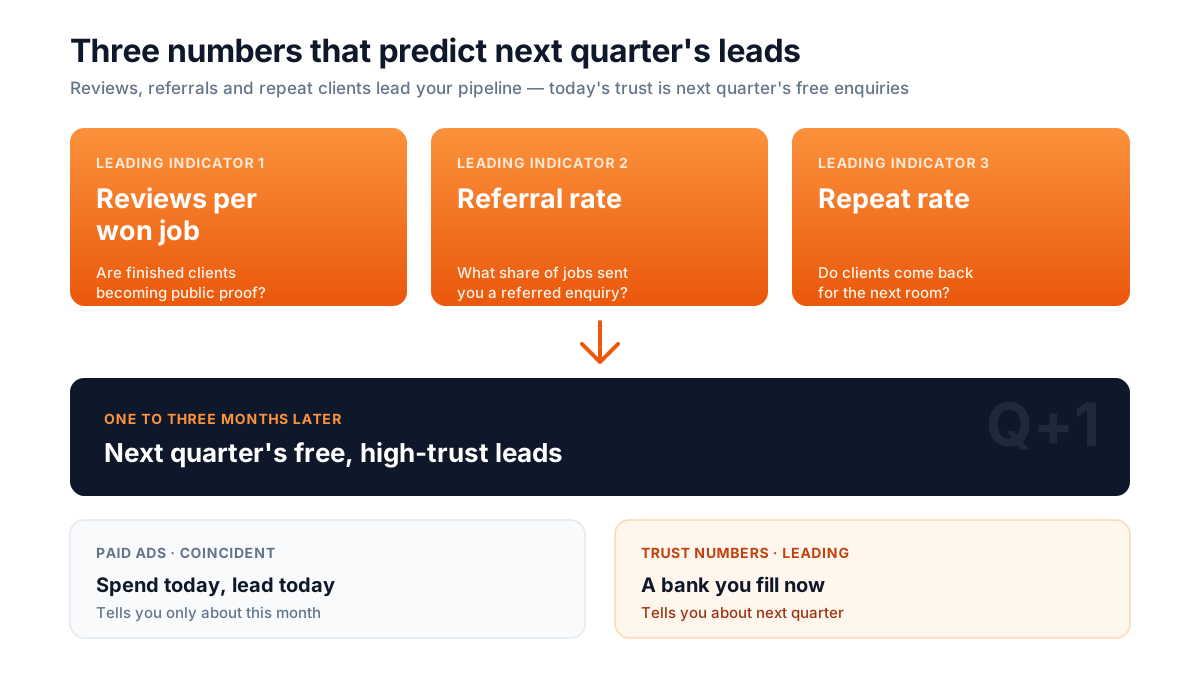
Ask a renovation-firm owner how business is and they'll tell you about this month — enquiries in the WhatsApp, quotes out, deposits in. Ask them what next quarter looks like and you'll usually get a shrug and a feeling. That gap is the whole problem. The leads you'll get in three months are already being decided right now, by numbers almost nobody tracks.
Your paid-lead numbers are coincident — you spend today and a lead arrives today. But reviews, referrals and repeat clients are leading numbers: today's happy client becomes a stranger's shortlist decision one to three months from now. Most firms only discover their free pipeline has dried up the month the calendar goes quiet — a lagging surprise. It was measurable a quarter earlier, in three trust numbers you can count without a survey.
Why are reviews, referrals and repeat clients "leading" indicators?
Because they move before your enquiry count does, and they forecast it. A lead number you can act on today — an unanswered WhatsApp, an overdue follow-up — tells you about this week. A trust number tells you about next quarter, because of a lag built into how strangers find you.
Picture the chain. You finish a kitchen in Bangsar this month. The client is happy, leaves a Google review, and tells a colleague. That review then sits on your profile, and the colleague's recommendation sits in someone's memory — until, one to three months later, a stranger Googling "interior designer KL" reads your eleven reviews, or the colleague finally gets their condo keys and messages you. The enquiry lands next quarter. The thing that caused it happened now.
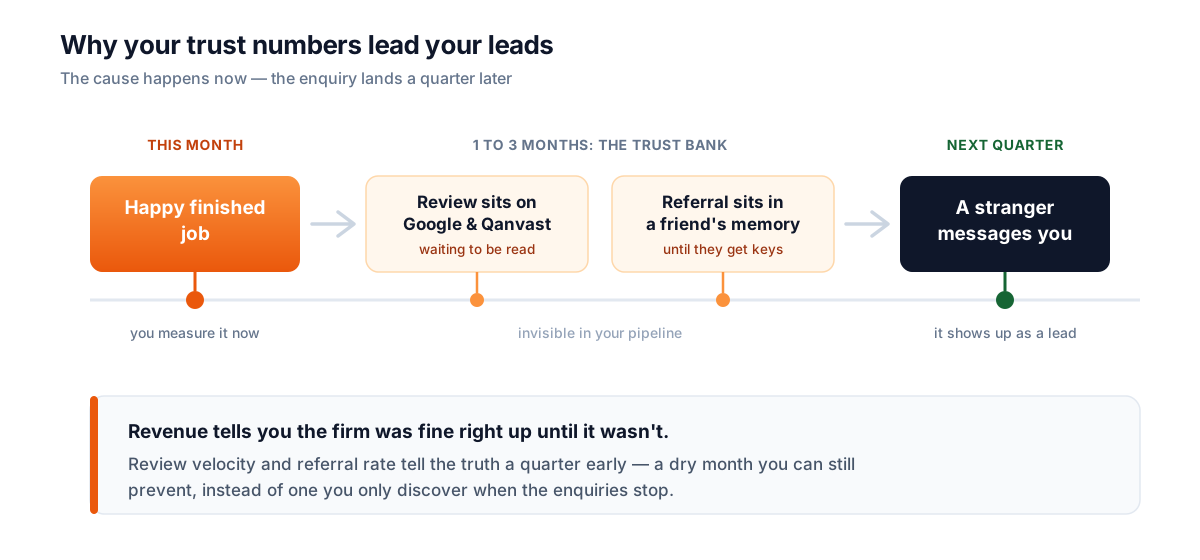
That lag is why reviews are the real top of your funnel, not an afterthought. Three in four consumers read reviews before choosing a local business, and 88% say they'd use a business that replies to all its reviews versus just 47% for one that never responds (BrightLocal, 2024). A thin profile doesn't show up as a lost enquiry in your pipeline — it shows up as an enquiry that never arrives. You can't see it leak, which is exactly why you have to measure the input.
The idea that loyalty predicts growth isn't new. It's the backbone of Fred Reichheld's famous 2003 Harvard Business Review argument, "The One Number You Need to Grow" — the origin of Net Promoter Score — which proposed that a single question, how likely are you to recommend us, forecasts a company's growth better than anything else. The instinct is right: willingness to recommend really does sit upstream of future demand. The measurement, though, is where a small firm should part ways with the big-company playbook.
Why measure behaviour, not willingness?
Because stated intent flatters you, and you don't need it anyway. The weak point in the survey approach isn't the concept — it's that asking people how loyal they feel is a soft signal. Independent replication of Reichheld's data (Jeff Sauro's work on the claim) found the original evidence was concurrent, not predictive — it correlated past growth with past scores, which isn't the same as forecasting. And people say one thing and do another: a widely cited Texas Tech study found 83% of satisfied customers say they're willing to refer, but only about 29% actually do.
That's the pragmatic edge of being small. A multinational runs NPS surveys because it can't observe ten million customers individually. You can. You know whether the Bangsar client actually left the review, whether the Puchong job actually sent you a neighbour, whether the Setapak client actually came back for the bathroom. Revealed behaviour is a harder, truer leading signal than a stated score — and it's already sitting in your WhatsApp and your won-job list. So don't survey loyalty. Count it.
The three numbers, and what each one forecasts
There are three behaviours worth counting, each a different slice of the free pipeline. For a typical Malaysian firm doing 40 to 60 enquiries a month and closing around 7 to 8% — roughly three to five won jobs a month — these are small, countable numbers, not statistics.
| Trust number | How to count it (per month or quarter) | Healthy direction | What it forecasts | The leak it warns of |
|---|---|---|---|---|
| Reviews per won job | New public reviews (Google, Qanvast) ÷ jobs finished | Rising, or steady near 1 | Strangers' shortlists next quarter | You've stopped asking at handover |
| Referral rate | Won jobs that produced ≥1 referred enquiry ÷ won jobs | Steady or rising | Warm, high-close enquiries next quarter | Quality slipped, or the ask never happens |
| Repeat rate | Clients who came back or expanded ÷ past clients | Steady | Near-zero-cost jobs with no sales effort | A handover that didn't leave the door open |
Read them together, not in isolation:
- Reviews per won job is your review velocity. Fewer than one in ten happy clients review you unprompted, but around 70% will when you ask — so this number is almost entirely a measure of whether the ask is happening, not whether clients are happy. A velocity drifting toward zero means the handover ask got dropped while you were fighting the next fire, and three months later your profile looks thinner next to a competitor's.
- Referral rate is the single best read on delivered quality, because a referred lead is worth far more than a paid one — it closes at roughly 15–25% versus about 1% for a cold boosted post. If this rate falls, something in the actual work or the experience slipped, and it will quietly starve your cheapest, highest-close channel a quarter from now.
- Repeat rate is the slowest and most undervalued. Renovation isn't a subscription, but clients do come back — the bathroom after the kitchen, the second property, the office fit-out — and a returning client carries the whole lifetime value of the relationship at almost no acquisition cost.
What's a healthy level — and can a number be too high?
There's no universal target, and chasing one misses the point — but the trust numbers can warn you in both directions, which is what makes them so useful.
On the low side, trade data gives a working range: for many remodelers, repeat and referrals together supply roughly two-thirds to 80% of leads (ProRemodeler put it near 35% referral plus 32% repeat, with smaller firms leaning on them even more). If your free channels are well below that and falling, you're increasingly renting your pipeline from ad platforms — more exposed, more expensive, and closing at a fraction of the rate.
On the high side — and this is the counter-intuitive part — a trust number can signal a problem by being too strong. Remodeling's RAR benchmarking notes that when repeat and referral climb toward 90% of leads, it can indicate a lack of growth, while around 50% suggests a firm growing quickly. A firm living almost entirely on word-of-mouth has stopped reaching new buyers, so it can only grow as fast as its existing clients renovate again — and it's dangerously exposed, because one bad job can poison a whole cluster of a client's friends at once.
The Malaysian context sharpens this. Word-of-mouth here isn't just a nice-to-have — in a market where renovation-deposit scams are common enough to be their own news genre, a trusted recommendation clears the trust barrier faster than any ad. But the share erodes if you don't feed it: ZenWeb Malaysia's data shows interior-design word-of-mouth falling from about 28% of discovery in 2022 to roughly 18% in 2026, with construction holding higher near 36%. A declining free-channel share is the slow leak these numbers exist to catch.
The dry quarter you can see coming
The payoff for tracking all this is simple: you get a quarter of warning. The cost of not tracking it is a slow month that feels like it came from nowhere.
That's the difference between a leading number and a lagging one. Revenue told the owner the firm was fine right up until it wasn't. The trust numbers told the truth a quarter early — to anyone who was reading them.
How do you actually track these on a WhatsApp-run firm?
Three habits, none of which needs a data analyst:
- Tag the source of every enquiry as it lands. Referral, repeat client, Qanvast, Atap, boosted post. This is the one input that turns "referred" from a guess into a count, and it's the same source tag that powers your per-channel economics.
- Make the review ask a tracked step at handover, not a good intention. The whole review-velocity number is really a measure of whether the ask happens — so put it where it can't be forgotten, after the snags are cleared and the client is happy.
- Read them monthly, and watch the trend. These are slow numbers — checking them weekly just adds noise, the same cadence trap that catches owners who watch revenue daily. A quarterly comparison is where the signal lives.
The honest obstacle is the same one that defeats every measurement habit in a small Malaysian firm: the raw data lives scattered across dozens of WhatsApp threads and the owner's memory. A referral only counts if someone noted that the Puchong enquiry "came from the Bangsar client." A repeat job only counts if the returning client is recognised instead of re-typed as a cold stranger. Running on feel isn't a discipline failure — it's a data-access failure, and it's why the trust numbers are the ones owners most want and least have.
How HotLead fits in
HotLead doesn't collect reviews or manufacture referrals — those come from the work you do and the ask you make at the right moment. What it does is give you the source-tagged data to read these three numbers, for Malaysian renovation, interior-design and construction firms, on the WhatsApp you already use. It:
- Captures and tags every enquiry by source, so "referral" and "repeat client" become channels you can count and compare — the raw input your referral rate and repeat rate are built from.
- Keeps every won job on one record with one owner, so a returning client is recognised with their full history instead of handled like a cold lead — and so the review ask at handover becomes a tracked next action, not a forgotten intention.
- Shows the funnel and per-channel ROI over months, so the free channels' share — and its trend — is read off a screen rather than reconstructed from chat history, with team performance alongside it.
It deliberately doesn't run loyalty surveys or score your clients — the point of this piece is that you don't need to. Start with the complete guide to managing renovation leads in Malaysia, see what a referred lead is actually worth, or read the renovation lead playbook and the interior-design playbook.
Sources: Fred Reichheld, "The One Number You Need to Grow," Harvard Business Review (2003) — the Net Promoter Score growth claim; Jeff Sauro / MeasuringU, replication of "The One Number You Need to Grow" (the original evidence is concurrent, not predictive); Texas Tech University referral study, cited in Entrepreneur (83% of satisfied customers willing to refer, 29% actually do); BrightLocal, Local Consumer Review Survey 2024 (75% read reviews before choosing a local business; 88% vs 47% on review responses); ProRemodeler, "Business Results Survey: Repeats and Referrals" (35% referral + 32% repeat of lead activity; smaller firms higher); Remodelers Advantage / RAR benchmarks (repeat-and-referral share ~50% growing fast vs ~90% signalling a growth problem); ZenWeb Malaysia industry discovery data (word-of-mouth ~36% construction, ~18% interior design in 2026, down from ~28% in 2022). House figures — 40–60 enquiries a month, ~7–8% close rate, under-10%-unprompted-to-70%-when-asked review rates, referral close 15–25% vs ~1% cold — are used for consistency across this series and labelled as typical, not firm-specific. Statistics drawn from widely cited secondary reports (the Texas Tech figures) are flagged as such.
Frequently asked questions
What are leading indicators for a renovation business's leads?
Leading indicators are numbers that move before your lead count does and that forecast it. For a renovation or interior-design firm the clearest three are how many reviews each finished job earns you, the share of won jobs that produce at least one referred enquiry, and the share of clients who come back for more work. They lead because a review or a referral today becomes a stranger's shortlist decision one to three months later. Your enquiry count and revenue are lagging indicators — by the time they fall, the cause happened a quarter ago.
Should I run an NPS survey to measure customer loyalty?
For a small reno firm, usually no. Net Promoter Score asks customers how likely they are to recommend you, and the famous claim is that the answer predicts growth. But independent replications have shown the original evidence was concurrent, not predictive, and stated intent is unreliable anyway — about 83% of happy customers say they will refer and only around 29% do. You don't need a survey panel to read loyalty; you can count the real thing. Track who actually reviewed you, actually referred someone, and actually came back. Revealed behaviour beats a stated score.
What's a good referral rate for a renovation or interior-design firm?
There's no single benchmark, but trade data gives a working range. For many remodelers, repeat business and referrals together supply roughly two-thirds to 80% of leads — ProRemodeler's survey put it near 35% referrals plus 32% repeat — and smaller firms lean on them more. The more useful number is your own trend. A referral rate drifting down over two or three quarters is an early warning regardless of the absolute level, and in Malaysia the word-of-mouth share erodes on its own if you don't feed it (ZenWeb shows interior-design word-of-mouth falling from about 28% to 18% of discovery, 2022 to 2026).
Can a renovation firm get too many leads from referrals?
Yes, and it's a real signal. Industry benchmarking (RAR) suggests that when repeat and referral climb toward 90% of your leads it can indicate a growth problem — you've stopped reaching new buyers, so the firm can only grow as fast as your existing clients renovate again. Around 50% often means a firm growing quickly on new demand with a healthy loyal base underneath. So read the trust numbers two ways — too low warns of a dry quarter coming, and too high warns of a ceiling and the fragility of depending on a channel you can't scale on demand.
How do I track reviews and referrals if everything runs on WhatsApp?
Tag the source of every enquiry as it lands — referral, repeat client, Qanvast, boosted post — so "referred" becomes something you count, not guess. Keep each won job on one record so a returning client is recognised instead of treated as a cold stranger. Make the review ask a tracked step at handover rather than a good intention you forget. Then read the three numbers monthly, not daily, because they move slowly. The honest catch in most Malaysian firms is that this data is scattered across chat threads and the owner's memory, which is exactly why a lightweight system that captures the source automatically is what makes the measurement survive a busy month.
Keep reading
- A Main Contractor Just Asked You to Quote a Package. Qualify the Payer First.When another contractor WhatsApps you to price a trade package, it looks like the cleanest lead of the month — a pro who knows what he wants. It's actually your riskiest, because the risk isn't the project, it's the payer. Here's how to handle it.
- 15 Live Leads, One Free Hour: Which Renovation Lead Do I Call First? I Let AI Rank My MorningA Kajang contractor opens WhatsApp at 8:40am with 15 live leads and one free hour before he's on-site in Semenyih. Who does he call first? The 2026 reflex is to ask AI to score the pipeline and rank the hot ones. I built it. The score read like data, so he worked the list it gave him for a week — and it quietly buried his best lead at the bottom. Here's why a confident 0-to-100 score is worse than no score, and the honest way to order a morning that actually earns its keep.
- How Often Should a Renovation Firm Check Each Number? The Review Rhythm That Fits a Malaysian FirmMost reno owners refresh revenue and the bank balance daily — the two numbers they can do least about — and never review the ones they could still fix this week. Here's how to set each number's review frequency by how fast it moves and whether you can act on it, with a daily, weekly and monthly rhythm built for a WhatsApp-run Malaysian firm.