

A renovation contractor in Kajang opens WhatsApp at 8:40 on a Monday morning with fifteen live leads blinking at him and exactly one hour before he has to be on a site in Semenyih. Two crews, both already out. Somewhere in that list is a real kitchen job worth RM60,000 — and somewhere in it are five people who'll never book anything. He can seriously work maybe six of them before he's in the car. Which six?
That question — who do I call first? — is the one every owner in this trade answers badly, every single morning, because they answer it by scrolling. Top of the list is whoever messaged most recently, which has nothing to do with who's worth calling. So the 2026 reflex is obvious and, on the face of it, smart: "Can't AI just read all my chats and tell me who's hot, so I work the right list?"
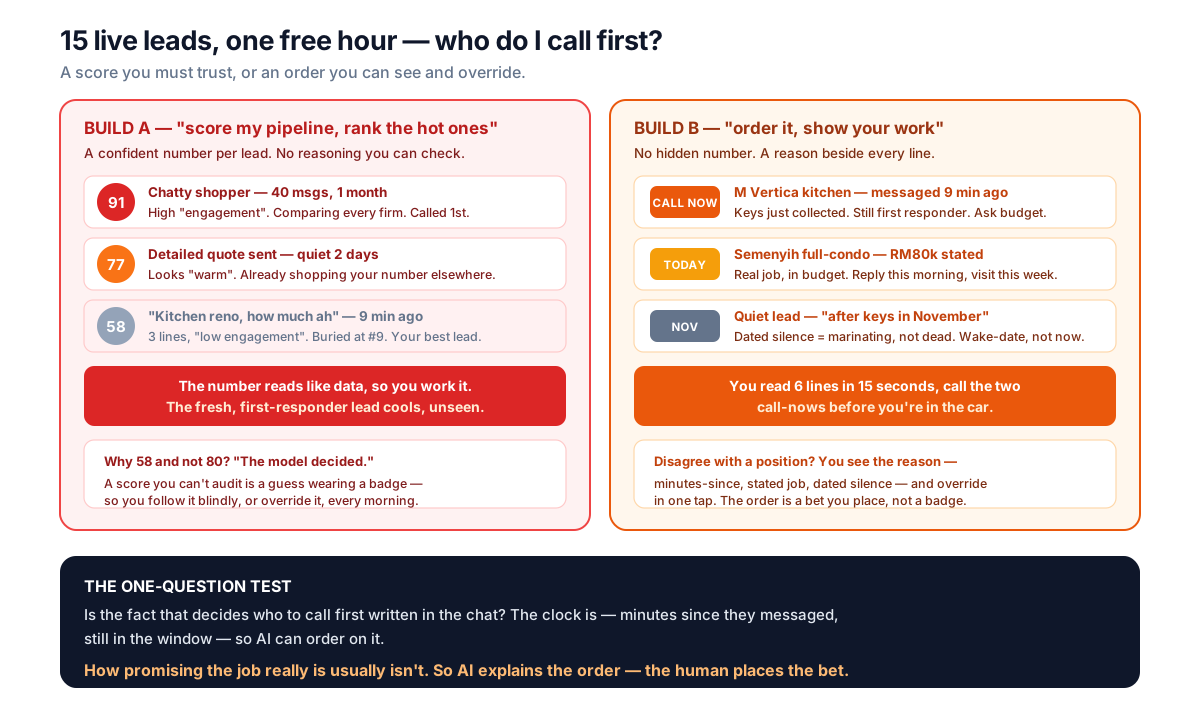
I built it. I pointed a model at a pipeline, told it to score every live lead out of 100 and rank them. It produced a beautiful ordered list with little red and green numbers. The owner worked that list for a week. And the score — because it looked like data — quietly sent him at the chatty time-wasters first and left his single best lead sitting near the bottom, unopened, cooling. Here's what went wrong, and the version of the build that actually earns its hour back.
Which lead should a renovation owner call first?
The one still inside its first-response window — not the one a model calls "hottest." The single most decisive fact about who to call first is a clock, not a quality. A renovation buyer who messages you is almost always messaging two or three firms in the same hour, and the research on response time is brutal and consistent: the MIT and InsideSales Lead Response Management study, analysed in Harvard Business Review, found you're about 100 times more likely to connect with a lead if you reach them within five minutes rather than thirty, and roughly 21 times more likely to qualify them. Separately, about 78% of buyers go with the first firm to respond.
So the top of your morning list writes itself from timing. A lead that came in eight minutes ago is a different animal from one that's sat two days — not because it's a better job, but because the window where you can still win it by being first is open right now and closing fast. Everything else is secondary to that. A hotness score that ranks on how promising the job looks, and ignores how long the buyer has been waiting, is optimising the wrong variable — it'll send you to a "90" that's been sitting since Friday while a fresh "60" that you could still be first to quietly goes cold.
So what happened when I asked AI to score my pipeline?
It handed back a confident 0-to-100 number for each lead, the owner couldn't see where any number came from, and so he worked a ranking he had no way to check — for a week, in the wrong order. The failure wasn't that the model was stupid. It's that a score is the wrong shape of answer for this problem.
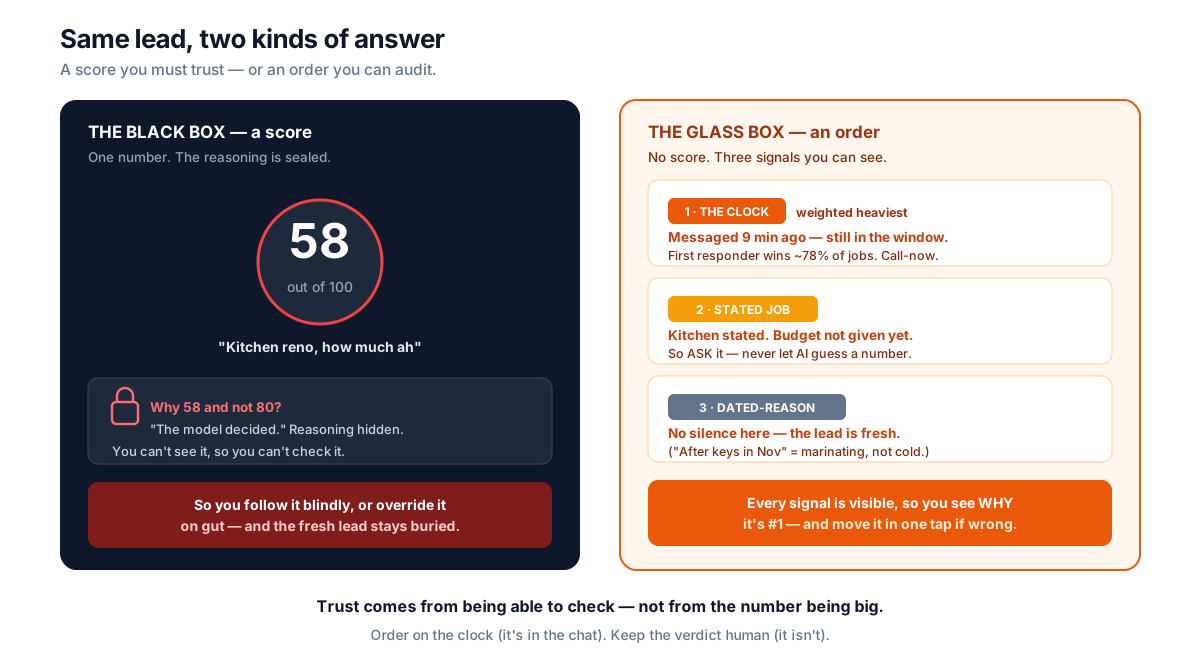
Here's the mechanism, and it's well documented in the world of lead scoring. When a lead shows up marked 91 and you ask why 91, the honest answer from a black-box model is "the model decided." Research into why B2B lead-scoring models fail — summarised well in HG Insights' work on the "glass box" shift — keeps landing on the same point: teams stop trusting a score whose reasoning they can't see, so they either follow it blindly or override it with their gut, and near-threshold leads get skipped. A score nobody can audit isn't really a priority list; it's a guess wearing a badge.
For a big sales team that's a productivity tax. For a solo renovation owner it's worse, because there's no team to catch the miss. If the score buries a real RM60k job at position 12, nobody else is working position 12. You simply never call it, and you never find out you didn't. The error is invisible — the same quiet, un-auditable kind of wrong I keep running into every time AI is asked to decide instead of draft.
Why does a confident "hotness" score bury your best lead?
Because the things a model can easily measure — how much the buyer typed, how many times they replied, how "engaged" the thread looks — reward the talkers, and your best lead is often the quietest, newest one. Low information is not low value. It's a signal of where the buyer is in their journey, not how good the job is.
A buyer who sends a single line — "renovate my kitchen, how much ah" — and nothing else usually isn't a tyre-kicker. They're early. They've just started looking, they probably haven't messaged three other firms yet, and that is precisely what makes them the first responder's dream: you can still be the first voice they hear. A scoring model trained on engagement does the exact opposite of what you want — it ranks the person who's sent forty messages comparing quotes for a month (high engagement, low intent to buy from you) above the person who sent one message nine minutes ago (low engagement, wide open). This is the same trap as reading a thin or vague enquiry as a weak one, and it's the same reason a spam-and-triage filter tuned too tight throws away real buyers: the leads that look the least impressive at the door are frequently the ones where your advantage is biggest.
What's the honest way to order a morning list?
Not with a score — with a transparent sort on a few explicit signals you can see, argue with, and override in a glance. Priority is a bet you're placing on where your hour pays back best, and you can only place a bet well if you can see the reasoning. Three signals do almost all the work, and crucially each one is visible:
- The clock — minutes since they messaged, and are they still in the window. This is the heaviest signal, because of the response-time research above. A lead that landed minutes ago and hasn't been answered is a call-now, full stop. This is just the response-time-versus-close-rate relationship applied to a to-do list.
- A stated scope or budget signal — in their words, not inferred. "Full condo, about RM80k, keys next month" is a different priority from "how much to paint one room." Note the discipline: a stated number the buyer actually typed, not a budget the AI guessed — guessing it is the invent-a-field mistake that poisons everything downstream.
- A dated-reason check — is this silence marinating or dead? A lead that's quiet because they said "after I collect keys in November" is a held, warm lead on a wake-date, not a cold one — the same distinction that separates a stalling deal from a marinating one. Ordering a dated-silence lead as "cold" is a mistake; ordering it by its wake-date is right.
The point isn't that these three are the perfect formula. It's that you can see all three, so when the sort puts a lead where you disagree, you know exactly why and you can move it. That's a priority list you can trust, because trust comes from being able to check — not from the number being big.
What did the build that actually paid look like?
The one that orders the list instead of scoring it: AI reads every live thread, sorts them by those explicit signals, writes one line next to each lead saying why it's there, flags the in-window ones as call-now, and never collapses it into a hidden number or drops a lead off the bottom. Same division of labour that's earned its keep at every step of this series — let AI read and arrange; keep the judgement human.
The difference sounds small and is everything:
| Build A — "score my pipeline" | Build B — "order it, show your work" | |
|---|---|---|
| Output | A number, 0–100, per lead | A ranked list with a reason beside each line |
| Can the owner check it? | No — the reasoning is hidden | Yes — every position shows its signal |
| Thin, fresh lead | Scored low, buried | Flagged call-now (in-window) near the top |
| Chatty month-old shopper | Scored high, called first | Ranked on stated job + window, not chattiness |
| When it's wrong | You never find out | You see the reason and override in one tap |
| What the owner ends up trusting | A badge | Their own bet, better informed |
So Build B, on that Kajang morning, doesn't say "Lead #7: 91." It says: "Call now — M Vertica kitchen, messaged 9 min ago, keys just collected, no budget stated yet (ask it). Still first responder." And lower down: "Later — 2 days quiet after you sent RM72k quote; comparing firms; draft a scope-question nudge, not a call." The owner reads six of those lines in fifteen seconds, calls the two call-nows before he's in the car, and schedules the rest. The order is the product. The reason beside each line is what makes the order worth following.
What should an owner actually do before the morning rush?
Make the order transparent, work the window first, and keep the bet yours. Most of the win here is a habit and a bit of plumbing — the AI is a thin, honest layer on top, not the thing doing the work.
- Auto-acknowledge everything first, before you rank anything. An instant auto-greeting on every inbound means no lead is ever fully unanswered while you're deciding the order — it buys you the window back on all of them at once. This is the boring plumbing that quietly solves half the problem.
- Work the in-window leads before the impressive ones. Fresh and unanswered beats big-but-stale. You can always quote a well-documented job this afternoon; you cannot un-cool a buyer who messaged someone else back first.
- Sort on signals you can see — not a score. Minutes-since-messaged, a stated scope or budget, a dated reason for any silence. If a tool can't show you why a lead is where it is, don't let it decide your morning.
- Override freely, and notice when you do. The sort is a starting bet, not an order. If you move a lead up because you know the buyer from a referral, that's the system working — your knowledge is a signal no model has.
- One owner per lead, so nothing sits unclaimed. The worst position on any list is the lead nobody decided was theirs. One owner by rule means every lead has someone whose morning it's in.
How HotLead fits — honestly
I'll be straight, the way I try to be in all of these, because over-claiming is the exact hype I keep arguing against. HotLead does not ship an AI that scores your leads or paints them red and green — the pipeline-scorer is the experiment in this piece, and the piece is the argument for why a black-box score is the wrong tool for a one-person morning. What it ships is the transparent, auditable version of "who first":
- A next action and an overdue flag on every lead. The leads that are due, or ageing past their response window, surface on their own — in plain sight, with a reason (overdue, follow-up due, visit to confirm), not a hidden number. That's the honest "call-now" flag the first-responder research says actually matters.
- One owner per lead, by rule. Round-robin, manual, or a custom rule by area or source — so no lead sits in the gap between two people both assuming the other has it, which is where morning leads really die.
- A funnel and per-channel view. So you can see where leads stall by stage and by source — the pattern behind the pile — instead of staring at fifteen threads and guessing.
The judgement of which bet to place with your one free hour stays with you, because you're the one who knows the jobs and the model only knows the thread. If the real problem underneath this is a pile of leads you can't get through in the time you have, start with the complete guide to managing renovation leads in Malaysia, see how it fits a renovation firm or an interior design studio, or read the companion builds on replying fast enough to be first, catching a stalling deal before it goes cold, and the four numbers a reno firm should actually track.
Sources: The response-time findings — that reaching a web lead within five minutes rather than thirty raises the odds of connecting roughly 100-fold and of qualifying it about 21-fold, that around 27% of inbound leads never receive follow-up, and the first-responder advantage — are from the MIT / InsideSales (now XANT) Lead Response Management study, analysed by James Oldroyd and colleagues and summarised in Harvard Business Review's The Short Life of Online Sales Leads; the widely cited figure that ~78% of buyers purchase from the first company to respond is drawn from the same speed-to-lead literature. The point that black-box lead-scoring models lose trust because users can't see the reasoning, and that experienced people override scores they can't explain, is from industry research on lead scoring including HG Insights ("the glass box shift"). The size of Malaysia's home-improvement and renovation market (RM47.7 billion in 2024, projected to rise toward RM59.2 billion by 2029) is from Ken Research. Renovation lead-volume, close-rate and job-value figures (40–60 enquiries a month on one WhatsApp number, ~90.7% WhatsApp reach, a ~RM60–80k condo-kitchen job, ~RM1,280 expected gross profit per enquiry) are typical operating numbers reused from earlier pieces in this series and labelled typical rather than a single quoted study; the AI experiment and the Kajang / Semenyih and M Vertica scenarios are described from practice and labelled illustrative, not a controlled trial. No score accuracy, conversion or win-rate percentage is invented here — the scorer's failure is described qualitatively, because fabricating a number for it would be the exact mistake this article warns against.
Frequently asked questions
Can AI tell me which renovation lead to call first?
It can help you ORDER the list, but it should not hand you a verdict. The useful thing AI does here is read every live thread fast and sort it by signals you can see — how long since the buyer last messaged, whether they stated a scope or a budget, whether a silence has a dated reason behind it. What it should not do is collapse all that into a single confident "hotness" score, because the one fact that most decides who to call first — whether a lead is still inside its first-response window — is about the clock, and the facts that decide how promising a lead really is usually aren't in the chat at all. Let AI order and explain; you place the bet.
Should I trust an AI lead score?
Not blindly, and the research on lead scoring is clear about why. Scoring models get ignored when the people using them can't see the reasoning — a rep looks at a lead marked 91, asks why, and the honest answer is "the model decided," so they either trust a number they can't check or override it with their own judgement. For a small renovation firm the stakes are sharper, because you don't have a sales team to absorb a bad ranking — if the score buries a real job, you simply never call it. A score you can see through and argue with is worth having. A black box that tells you a number and not a reason is worse than your own gut, because your gut at least knows it's guessing.
Isn't a thin, one-line enquiry a low-priority lead?
Far less often than it looks, and this is exactly where a hotness score fails you. A buyer who sends "kitchen reno, how much ah" with nothing else usually isn't a time-waster — they're EARLY. They've just started looking, they haven't messaged three other firms yet, and that makes you the first responder, the position most likely to win the job. A model that ranks on how much the buyer has typed, or how engaged the thread looks, scores that lead low and pushes it down the list — so you call the chatty buyer who's been comparing quotes for a month and let the fresh one cool. Low information at the door is a signal of where the buyer is in their journey, not how good the lead is.
How many leads can I realistically work in a morning?
Fewer than you think, which is the whole reason order matters. A small Klang Valley reno firm takes somewhere around 40 to 60 enquiries a month across WhatsApp, Facebook and the platforms, and on a busy Monday a dozen or more of those are live at once. If you've got an hour before you're on-site, you're making maybe six to ten real contacts — calls, proper replies, a booked visit. The question isn't "how do I work all 15," it's "which 6 do I work first," and the answer that pays is the ones still inside their response window and the ones with a stated, fundable job — not whichever one a model painted red.
Does HotLead rank or score my leads with AI?
No, and I won't pretend it does, because the whole point of this experiment was that a black-box AI score is the wrong tool for this job. What HotLead ships is the honest, transparent version — every lead carries a next action and an overdue flag, so the ones that are due or ageing past their window surface on their own; one owner per lead by rule, so nothing sits unclaimed while you decide; and a funnel and per-channel view so you can see where leads actually stall. That's a morning list you can read, question and reorder in a glance — not a number you're asked to trust. The judgement of which bet to place that hour stays with the person who knows the jobs.
Keep reading
- How Often Should a Renovation Firm Check Each Number? The Review Rhythm That Fits a Malaysian FirmMost reno owners refresh revenue and the bank balance daily — the two numbers they can do least about — and never review the ones they could still fix this week. Here's how to set each number's review frequency by how fast it moves and whether you can act on it, with a daily, weekly and monthly rhythm built for a WhatsApp-run Malaysian firm.
- The Lead Who Can't Say Yes: Selling a Renovation When the Decider Isn't in the ChatThe person messaging you about the renovation often isn't the one who signs off the job — it's a wife gathering quotes while the husband holds the budget veto, an adult child sourcing for aging parents, one sibling of a jointly-owned unit. So you pour your whole pitch, quote and follow-up into someone who can't actually say yes, and the deal dies in a family discussion you were never invited to. Here's how to spot the messenger early and get the real decider into the room — without insulting the one who chose you.
- "Can Discount Ah?" Can AI Spot a Price-Shopping Renovation Lead — and Should It Decide the Next Move?A Puchong contractor gets "another firm quoted me RM55k, can match or not?" at 10pm and does what a tired owner does — he knocks RM6k off to not lose it. He's trained that buyer, and the ten after her, to push. So the 2026 reflex is to ask AI to read the thread, flag the price-shoppers, and either auto-discount to win them or bin them as tyre-kickers. I built it. It mislabels your best buyer as a time-waster and your margin as negotiable — because the signal is in the chat but the right move never is. Here's the build that earns its keep, and why "can discount ah?" is the start of a conversation, not a verdict.