

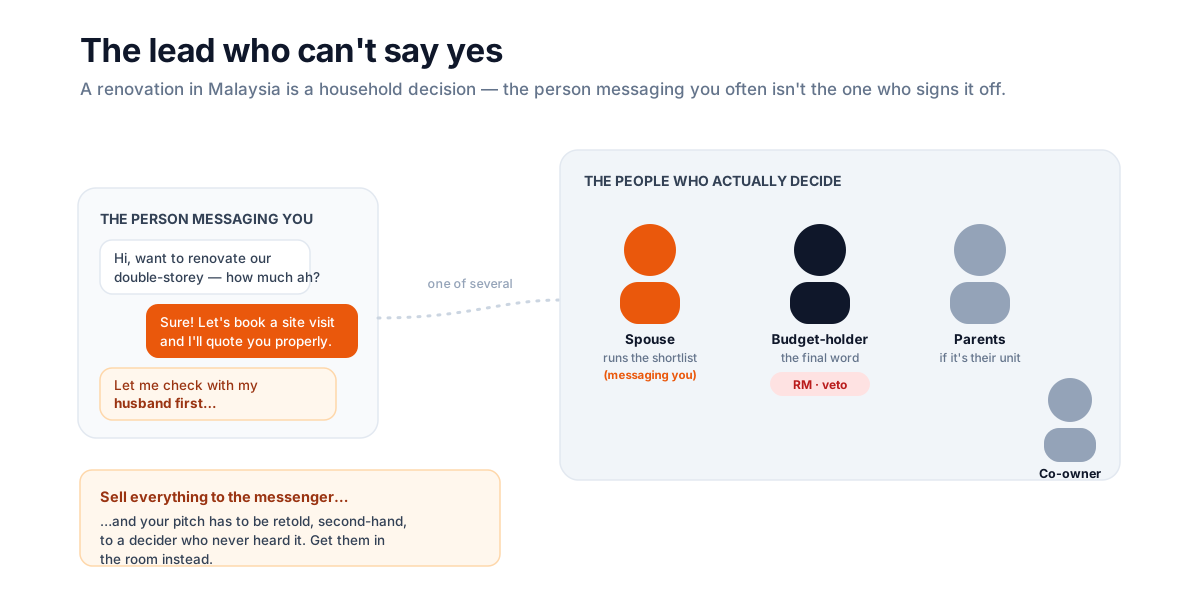
There's a lead that stings more than the one who ghosts you, because this one talked to you for three weeks.
A woman in Setia Alam messages your firm about doing up her family's double-storey — warm, organised, clearly keen. She replies fast, sends photos, asks good questions about the kitchen and the wet area. You drive out, spend an hour walking the house, send a clean RM120k quote. She says it looks great. You follow up gently; she's still lovely, still engaged. Then, on day nineteen: "Thanks so much for everything, really appreciate it — but my husband prefers to go with another contractor he found. All the best!"
Her husband. The man you never met, never pitched to, never got to answer a single question for. He compared your quote against someone else's on a WhatsApp forward and a dinner-table chat you weren't part of, and you lost a job you thought you'd basically won — to a firm that, somewhere along the way, got him in the room.
Here's the uncomfortable truth underneath that loss, and it's one almost every reno and ID firm in Malaysia keeps relearning the expensive way: the person messaging you is very often not the person who can say yes. And if you spend your whole pitch, quote and follow-up on the messenger, you're selling to someone who can't buy.
Why does a renovation in Malaysia almost never have just one decision-maker?
Because a renovation is a big, shared, household decision — and Malaysian households are shared in a way that puts the money, the taste and the final word in more than one pair of hands. The average household here is 3.7 people, and a large share are extended families living under one roof, so the "customer" is usually a small committee, not an individual.
Two patterns make this concrete, and both are specific to the kind of spend a renovation is:
- The big number has a different owner than the day-to-day. A renovation isn't groceries — it's one of the largest discretionary spends a household makes. A study of 1,778 married Malaysians in the Journal of Family and Economic Issues found that women are usually the final decision-makers on everyday household expenditure, while men more often make the final call on large household expenditure. Translate that to your inbox: the wife very often runs the search, the shortlist and the daily conversation with you — and then the husband weighs in heavily on the five- or six-figure number. She's not wasting your time. She genuinely can't close it alone.
- Plenty of households still hand the final word to one person who isn't messaging you. A 2026 Ipsos survey with King's College London's Global Institute for Women's Leadership found that 58% of Malaysians agree the husband should have the final word on key decisions at home — against a global average of just 21%. You don't have to agree with the attitude to plan around the reality: in a majority of homes, the person who texts you and the person who holds the veto are different people.
And it isn't only couples. We're an ageing society — Malaysians aged 60 and over are now around 11.6% of the population and rising, and roughly 70% of older Malaysians live with an adult child. So "doing up my parents' place" or "my mum's condo needs a refresh" lands in your WhatsApp as a message from the adult kid — the gatekeeper and translator — while the parents hold the money, the taste and the final no. Add the jointly-owned inherited house where three siblings all have to agree, and the pattern is everywhere.
Why does selling everything to the messenger lose the job?
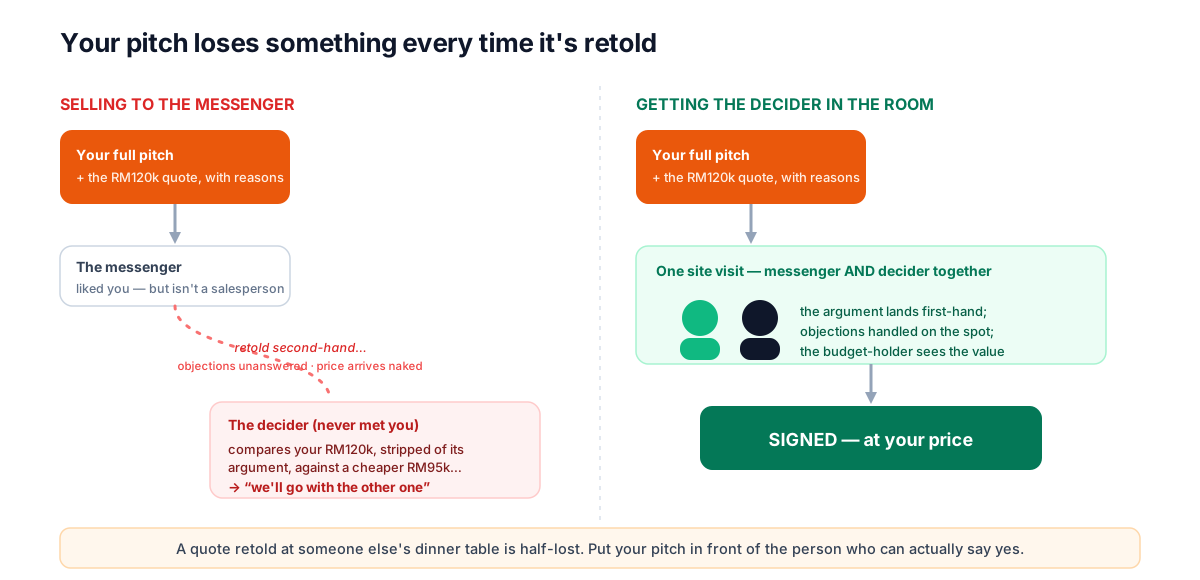
Because a pitch delivered second-hand almost never survives the trip. When the only person who ever hears your reasoning is a messenger, everything that wins a renovation job — why your quote is RM10k more than the cheap one, how you'll handle the wet-kitchen waterproofing, why your timeline is realistic and the other firm's isn't — has to be re-told by someone who isn't a salesperson, to a decider who wasn't in the room.
Three things break, every time:
- Objections go unanswered. The husband says "why so expensive?" at dinner. The wife, who liked you but can't recite your scope breakdown, shrugs. The objection you'd have closed in thirty seconds just killed the deal, and you never even heard it.
- Your price arrives naked. The number travels, the argument doesn't. Stripped of everything that justified it, your RM120k sits next to a competitor's RM95k with no context — and you look like the expensive one, not the thorough one.
- You can't read the room, because you've never seen it. You don't know if the parents hated the layout or loved it, whether the real blocker is budget or trust or a brother in Penang. You're flying blind on a deal you can't see.
This is the quiet reason so many warm leads go silent after a good quote. It often isn't price and it often isn't you — it's that the deal moved into a family discussion you had no way to influence, and your carefully-built pitch didn't make it through the door. You weren't rejected. You were just never actually in the race.
Who exactly is the messenger? Four kinds, and none of them is a weak lead
The mistake isn't talking to a messenger — it's giving every messenger the same casual "just quote and wait" when each one needs a different move. In a Malaysian inbox they come in four recognisable shapes:
| The messenger | What they actually control | The move |
|---|---|---|
| The spouse running the shortlist (wife gathering quotes, husband holds the budget veto) | Which firms even get to quote — she's the gate | Win her completely, then get both of them to the visit before you reveal the full number |
| The adult child sourcing for parents (filial piety; growing with our ageing population) | Access and trust — they'll bring the deciding parent, or not | Make the child your champion and propose a joint visit so the parents meet you, not just your quote |
| The co-owner / sibling of a jointly-owned unit (inherited house, joint-name condo) | Half a decision — nobody can sign alone | Surface early that all owners must agree; get them aligned before you invest a full quote |
| The helper, PA, agent or relative messaging on the owner's behalf | Nothing but relay — no stake, no authority | Be warm and efficient, but get to the principal fast; don't pour your pitch into a pure pipe |
The through-line: the messenger is almost always your route in, not an obstacle in front of the "real" lead. The wife who shortlists is the reason you're even being considered. The adult child is the serious filter who'll physically bring the parent to the site. Push these down your list as "not the decision-maker," and you're binning the best-connected jobs in your inbox — the exact thing that makes authority-scoring a lead so dangerous. Respect the messenger; just don't mistake them for the whole deal.
But shouldn't I just quote and let the family decide in their own time?
Send the quote — but don't make it your exit, because "quote and wait" hands the whole decision to a room you're locked out of. The moment your number disappears into a private family discussion, you've given up the three things that actually win renovation jobs: the ability to answer an objection, the context that justifies your price, and the read on what the decider is really worried about.
Think about what the competitor who beats you is usually doing differently. It's rarely that they're cheaper or more talented. It's that they got the budget-holder to walk into their showroom, or onto a video call, or out to the site — so their pitch was delivered first-hand to the person who could say yes, while yours was being paraphrased over dinner. Same job, same quality of work, opposite outcome, decided entirely by who was in the room.
This is also why you shouldn't misread the stall. When the wife who was so warm goes quiet, the instinct is "lost interest" or "too expensive" — so firms either give up or, worse, slash the price to revive it. But the real blocker is often just that the decision has moved to someone you haven't met. Cutting your margin doesn't fix that. Getting in front of the decider does.
How do I get the real decision-maker in without insulting the one who messaged me?
Make it normal and inclusive, not a demotion of the person you've been talking to. For a spend this size, asking who else is involved isn't rude — it's what a professional does, and buyers expect it. The whole skill is doing it early (before you reveal your full price) and framing it as making the messenger's life easier, not going over their head.
Four moves, in order:
- Spot the messenger early. The tells are reliable: every commitment is deferred a round ("let me check with my husband", "I'll ask my parents", "my brother also must agree"), and they can't firmly confirm the budget or the start date because neither is theirs to confirm. That's your cue to shift from pitching to organising.
- Ask the one question — gently, and before the big number. Something like: "Since this is a big decision for the family, it's worth having everyone who's deciding see the space and the material samples together — would your husband/your parents be able to join the site visit?" It's completely normal for a renovation, nobody takes offence, and it does the one thing that matters: it gets the decider in front of your pitch instead of a forwarded PDF. Ask it before you reveal your full price, too, so your number isn't carried off to be shopped against two other quotes by someone who can't defend it.
- Arm the messenger — don't bypass them. They are going to sell you internally whether you help or not, so help. Thank them, keep them as your main contact throughout, and give them something easy to carry back: a short, plain-language summary of the scope and what makes you different, plus two or three photos of a similar finished job. You're not demoting them; you're making them look good to the people they answer to. That's how an ally stays an ally.
- Engineer one decision-moment with the decider present. A joint site visit. A twenty-minute call. "Bring your husband down on Saturday to see the samples — it's much easier to decide when you're both looking at the same thing." One real moment with the budget-holder in the room is worth more than ten follow-ups aimed at a messenger who can't say yes.
Sell to the messenger, or recruit the decider — what each one costs
| Sell everything to the messenger | Recruit the decider into the room | |
|---|---|---|
| Where your pitch lands | Second-hand, retold by a non-salesperson | First-hand, in front of the person who can say yes |
| Your price | Arrives naked, next to a cheaper quote | Arrives with the argument that justifies it |
| Objections | Unheard and unanswered, killed at dinner | Raised and handled on the spot |
| Who wins | Whoever got the decider in front of them | You |
| Cost of getting it wrong | A warm, winnable job lost in a room you couldn't enter | A few polite questions and one joint visit |
Every enquiry a small reno firm loses is worth around RM1,280 in expected gross profit once you weigh job value, margin and conversion — and a lead where a messenger has already shortlisted you is worth more than a cold one, because you've already spent the reply, the qualifying and often the site visit on it. Losing that to "my husband preferred someone else" isn't bad luck. It's a pitch that was never delivered to the person who decided.
The bottom line
The next time a renovation enquiry is warm, fast and lovely but every yes keeps getting deferred a round, stop selling harder to the person in front of you and start asking who else is behind them. In Malaysia a reno is a shared household decision far more often than not — the wife runs the shortlist, the husband signs off the big number, the adult child sources for the parents, the siblings co-own the house. The messenger isn't your problem; they're your way in. Your job is to arm them, respect them, and get the person who can actually say yes into the same room as your pitch — because a quote that has to be retold at someone else's dinner table is a quote you've already half-lost.
For the whole system this sits inside — capture, qualify, visit, quote and follow up — start with the complete guide to managing renovation leads in Malaysia. This piece is about the human judgement of who you're really selling to; read it with whether AI can spot the decision-maker for you (short version: not reliably — it's an off-chat fact), the chase-or-wait call when a warm lead goes quiet, qualifying on the first reply, and the silent site visit where the signals are fine but nobody commits.
How HotLead helps you sell to a household, not just a phone number
HotLead can't read a family for you or tell you who really holds the money — that's your judgement, and it lives off the chat. What it does is make selling to a multi-person household manageable instead of leaky:
- One record for the whole thread, so every "let me check with my husband" and "my parents' unit" tell is visible in one place — and nothing about who's really deciding gets lost between replies or handoffs.
- One named owner per lead, so the family deals with a single familiar face across weeks of back-and-forth, instead of re-explaining themselves to whoever happens to pick up the group chat.
- A next action with a wake-date, so "get both of them to Saturday's site visit" or "follow up once she's spoken to her brother" becomes a tracked step with an owner — not a thing you meant to arrange and forgot.
- A funnel and per-source view, so you can see which leads are stuck waiting on a decider you haven't met yet, and which channels send you clean single-decider jobs versus whole-family committees.
If your warm leads keep dying in conversations you were never part of, the leak usually isn't your price or your work — it's that your pitch never reached the person who could say yes. See how HotLead works, or how it fits a renovation firm or an interior-design studio.
Sources: Department of Statistics Malaysia — Household Income Survey Report 2024 (average household 3.7 persons); Abdullah Yusof, S. and Duasa, J. (2010), "Household Decision-Making and Expenditure Patterns of Married Men and Women in Malaysia," Journal of Family and Economic Issues, 31:371–381 (women final on everyday spend, men more often final on large household expenditure; 1,778 married Malaysians); Malay Mail / Ipsos and the Global Institute for Women's Leadership, King's College London (March 2026) (58% of Malaysians agree the husband should have the final word on key home decisions, vs a 21% global average; 500 Malaysians surveyed); UNDP Malaysia — Navigating the future of care for older persons in Malaysia by 2040 (older Malaysians aged 60+ around 11.6% of the population; roughly 70% live with an adult child). Job-value bands, expected gross profit, and the up-to-five-firms shortlisting norm as cited in the complete guide to managing renovation leads in Malaysia and the real cost of a lost renovation lead.
Frequently asked questions
The person messaging me about a renovation might not be the decision-maker — how do I tell?
Watch for the tells, because they show up fast. A messenger defers every real commitment a round — "let me check with my husband", "I need to ask my parents", "my brother and I own it together" — and struggles to confirm the budget or the timeline because neither is theirs to confirm. They're often great on taste and logistics but go vague the moment a yes is required. None of that makes them a weak lead. It just tells you the person who can approve the job isn't in the chat yet, so your job shifts from pitching harder to getting the real decider into the conversation.
Should I just send the quote and let the family discuss it among themselves?
That's the most common way to lose a warm lead slowly. Once your quote goes into a private family discussion you can't join, your price travels second-hand through someone who isn't a salesperson, every objection you could have answered in thirty seconds goes unanswered, and the firm that got the decider to actually meet them wins on far less. Send the quote, yes — but not as your exit. Pair it with a reason to get the budget-holder in front of you before the decision happens, not after, so your pitch is in the room instead of being retold.
How do I ask to speak to the real decision-maker without offending the person who contacted me?
Frame it as normal and inclusive, not as a demotion. For a spend this size you simply say something like "since this is a big decision for the whole family, it's worth having everyone who's deciding see the space and the samples together — are they free to join the site visit?" You're not pushing the messenger aside; you're making their job easier, because they were going to have to sell you internally anyway. Thank them, treat them as your main contact throughout, and give them something easy to carry back — a short summary and a couple of photos — so they look good to the people they answer to.
Why is a spouse or adult child gathering quotes actually a good lead, not a time-waster?
Because they're usually your route in, not a dead end. The wife running the shortlist is the one who decides which three firms even get to quote — win her and you're on the list the husband chooses from. The adult child sourcing for aging parents is the serious filter who will bring the deciding parent to the visit. Pushing these leads down your list as "not the decision-maker" throws away exactly the well-connected jobs you most want. The messenger isn't the obstacle; treating them like one is.
Does HotLead figure out who the decision-maker is?
No — reading a family and knowing who really holds the money is human judgement, and it lives off the chat, not inside it. What HotLead does is the plumbing that makes selling to a multi-person household manageable. The whole thread sits on one record so every "check with my husband" tell is visible and nothing is lost between replies, one named owner holds the relationship so the family deals with a single familiar face, and a next action with a wake-date turns "get both of them to the Saturday visit" into a tracked step instead of a hope. The judgement stays yours; the follow-through stops leaking.
Keep reading
- "Can Discount Ah?" Can AI Spot a Price-Shopping Renovation Lead — and Should It Decide the Next Move?A Puchong contractor gets "another firm quoted me RM55k, can match or not?" at 10pm and does what a tired owner does — he knocks RM6k off to not lose it. He's trained that buyer, and the ten after her, to push. So the 2026 reflex is to ask AI to read the thread, flag the price-shoppers, and either auto-discount to win them or bin them as tyre-kickers. I built it. It mislabels your best buyer as a time-waster and your margin as negotiable — because the signal is in the chat but the right move never is. Here's the build that earns its keep, and why "can discount ah?" is the start of a conversation, not a verdict.
- What a Referred Lead Is Actually Worth — and Why Your Best Ringgit Protects ItA referral isn't just a "free" lead — it wins on cost, close rate and lifetime value at the same time, and those three advantages multiply. Here's what a referred renovation lead is really worth against a paid one, why owners under-fund their single best channel, and why the highest-return marketing ringgit protects the referral engine instead of buying more cold strangers.
- "Boleh Buat Macam Ni Tak?" — The Expensive-Look, Small-Budget ID Lead in MalaysiaA homeowner sends a saved Instagram image of a RM250k penthouse look and asks for it on a RM90k budget. Most Malaysian ID studios either quote the dream and scare them off, or say "can can" and disappoint them later. Here's why this lead is actually one of your most winnable — and the "same look, three budgets" way to convert it without touching your margin.