

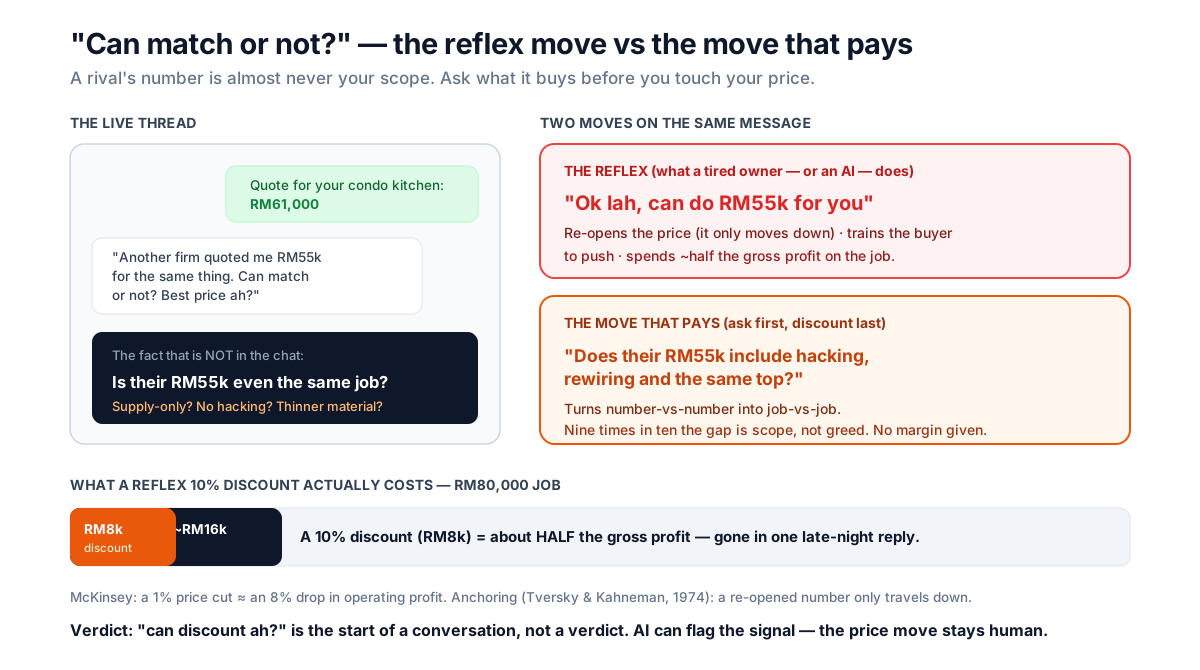
A contractor in Puchong gave away RM6,000 of gross profit at 10 o'clock on a Tuesday night, and trained a customer to ask for it again.
The message that did it was ordinary: "Bro, another firm quoted me RM55k for the same thing. Can match or not?" He'd quoted RM61,000 for a condo kitchen — a fair number for his scope. He was tired, it was late, the job was real, and the thought of losing it to someone RM6k cheaper stung. So he typed back "ok lah, can do RM55k for you" and went to bed. He felt like he'd saved the deal. What he'd actually done was tell that buyer — and, through the way these things travel in a condo WhatsApp group, the next few buyers from the same block — that his first price was never his real price.
I keep getting asked the 2026 version of this problem: "Can't AI just read my chats, spot the price-shoppers, and either win them with the right discount or stop wasting my time on them?" It's a fair question, because the live "they're comparing us" moment is where real margin leaks, fast and quietly.
So I built it. Short answer: AI can spot the signal — the "best price ah," the rival quote, the long silence after you send the number — and it genuinely helps to surface it. But the moment you let it decide what to do about that signal, it does the two most expensive things possible: it mislabels your best buyer as a tyre-kicker, and it reaches for a discount. Here's why, and here's the build that actually paid.
Why is "can discount ah?" so easy to read wrong?
Because in Malaysia, asking for a discount is a cultural reflex, not a verdict on your price — and both a tired human and a literal-minded AI mistake the reflex for a rejection. Haggling is normal here. The customary move at the pasar, at smaller shops, and on big-ticket work is to ask, and the guidance for buyers is to aim for something like 10–30% off the asking number. "Boleh discount tak?" or "what's your best price?" is, more often than not, the opening line of an interested buyer — someone engaged enough to start negotiating — not a brush-off from a time-waster.
That matters because of which leads it fools you on. A buyer who opens with "best price ah" before you've even sent a number looks, to a cold reading, like low intent. It's frequently the opposite: they're pre-sold enough on the work to jump straight to the dance. If you — or your AI — treat that as a tyre-kicker tell and go cold, you hand a ready buyer to the firm that answered warmly. This is the same trap as reading a thin or vague enquiry as a weak one: low information at the door signals an early buyer, not a low-value one.
So what happened when I let AI classify the price-shoppers?
It confidently sorted serious buyers into the bin, because it read the words and not the culture. I gave a model the obvious instruction: read each live thread, flag the price-shoppers and low-intent leads so I can focus elsewhere. On explicit lines — "sorry, really out of budget this year" — it did fine. But on the ritual openers, the ones that actually decide money, it failed in a specific, documented way.
AI reads "what's your best price ah" the way a sentiment model reads any blunt price-and-objection phrase: literally, as negative, as an obstacle. That's not a prompt I wrote badly — it's a known limit. Sentiment and intent models default to a literal reading when they lack tone, history and cultural cues, and they degrade hard on exactly the things a Malaysian WhatsApp thread is full of — code-switching, Manglish, and pragmatic nuance where the same three words mean "I'm interested, let's negotiate" from one buyer and "I'm fishing" from another. The model can't tell those apart, because the difference isn't in the words. So it labels both "price-shopper, low intent," and you quietly stop working the half of them who were ready to sign.
Why is auto-discounting the most expensive thing to automate?
Because a discount is the one move that spends real margin, and told to "win the deal," an AI reaches for it first — it's the simplest lever in the box. Three things compound the damage, and all three are well-documented.
Anchoring. The price you re-open only travels one way. Tversky and Kahneman's 1974 anchoring work — the one where a spun wheel of random numbers moved people's later estimates — is one of the most robust findings in decision-making. Once you say "ok, RM55k," that becomes the new ceiling, and the next ask ("can throw in the TV console?") pushes down from there. You never adjust back up.
Training. Discount the moment someone pushes, and you teach them to push. Negotiation practitioners are blunt that a reflexive discount is a symptom, not a strategy: a price that drops the instant it's questioned tells the buyer the first number was padded, so another nudge will produce another cut. On a renovation, where buyers compare three to five firms and talk to each other in the same condo group, that lesson spreads.
Margin. The arithmetic is brutal on a thin-margin trade. On an RM80k job at a typical ~20% gross margin, that's about RM16k of gross profit — and a reflexive 10% discount is RM8k, half the profit on the job, gone in one late-night reply. McKinsey's Power of Pricing research found a 1% cut in average price drops operating profit by around 8% when volume holds — price is the most sensitive lever you own, and a discount yanks it the wrong way. (The deeper arithmetic of when a discount is actually worth it lives in the discount-to-close and discount margin-math pieces — the short version is that it's a deliberate, bounded decision, never a reflex.)
What's the one fact AI never has in a "they quoted me less" message?
Whether the other firm's number is even for the same job. This is the whole game, and it's the fact that is structurally not in the chat. When a buyer says "another firm quoted RM55k," the useful question isn't "can I match RM55k" — it's "what does RM55k buy?" On a renovation, the honest answer is almost always a different job: supply-only where yours is supplied-and-installed, hacking or rewiring excluded, a thinner cabinet carcass, laminate where you specced solid surface, no warranty. The number looks like your number. The scope behind it rarely is.
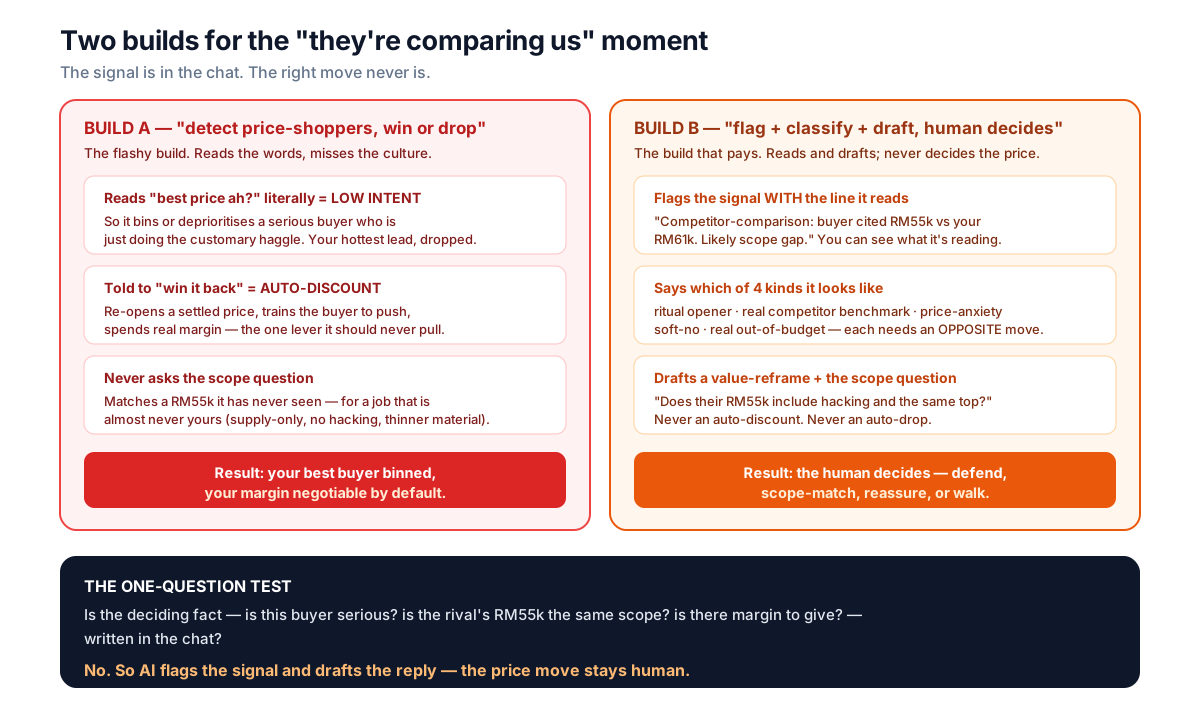
This is the one-question test that decides every build in this series: does the right move depend on a fact that's written in the chat? Here the answer is no — the deciding fact (the rival's actual scope, the buyer's real seriousness, whether you have margin to give) lives off-channel, in a quote you've never seen and a head you can't read. So AI can flag that the comparison is happening, and it can draft the scope question for you. It cannot answer the scope question, because it doesn't have the scope. The move stays human.
What did the build that actually paid look like?
The one that flips the job: AI reads the live thread, flags the shopping signal with the line it's reading, says which of four kinds it looks like, and drafts a value-reframe plus the one scope question — and a human decides what to do. Same division of labour that's earned its keep at every step of this chain: let AI read and draft, keep the judgment human.
The useful part turned out to be naming which kind of signal it is, because the four kinds need opposite moves — and giving all four the same reflexive discount is the mistake.
| What they typed | What Build A heard | What it usually is | The move that protects the deal AND the margin |
|---|---|---|---|
| "Best price ah?" / "boleh discount?" before you've quoted | Low intent, deprioritise | The bargaining reflex — often a serious buyer opening the dance | Answer warm, hold your number, qualify. Don't pre-discount a price you haven't even sent. |
| "Another firm quoted RM55k" | Match it or lose it | A real comparison — of a scope that's almost never yours | Ask the scope question. Make the two quotes comparable before you touch your number. |
| "Let me discuss with my wife" / "a bit high ah" then silence | Lost on price | Often indecision, not a rival (JOLT Effect) | De-risk and reassure — a reference job, a past client's number. A discount answers a question they didn't ask. |
| "Really can't afford, max RM40k" | Drop as unqualified | A genuine budget ceiling | Value-engineer the scope to the budget, or refer out. Don't chase it with margin you can't spare. |
So Build B, on that Puchong "can match or not?" message, doesn't fire a discount and doesn't bin the lead. It flags: "Competitor-comparison signal — buyer cited RM55k vs your RM61k. Likely scope gap. Suggested reply drafted — ask what the RM55k covers before any price move." And it drafts the words: "Happy to look at it with you — quick one so I'm comparing fairly: does their RM55k include hacking the old cabinets, the rewiring, and a solid-surface top like we specced? Some quotes are supply-only. Once I know, I'll tell you honestly where we're the same and where we're not." The owner reads it, tweaks a word, sends it in one tap. No margin spent. The conversation moves from number vs number to job vs job — which is the only comparison you can win without discounting.
What should an owner actually do when a lead starts shopping?
Treat the price question as the start of a conversation, not a verdict on the deal — and make the discount the last lever you touch, never the first. Most of the win here is a habit, not an AI.
- Don't flinch at "best price." It's a reflex, and usually a sign of interest. Answer warmly, hold your number, and keep qualifying. A calm "let me show you what's in it" beats a nervous "ok can discount."
- Ask the scope question before any price move. "Is that RM55k including hacking and the same material?" Nine times in ten the gap is scope, not greed — and once the buyer sees it, your number stops looking high.
- Defend on value, discount on purpose. Lead with what they get — your finish, your warranty, your not disappearing after the deposit. If you do give ground, do it as a deliberate, bounded decision tied to something you get back (a faster deposit, a dropped line item), not as a reflex.
- Never let AI set the price. Use it to spot the wobble and draft the reframe. The number is yours, because the facts behind it aren't in the chat.
- Make "they're comparing us" a tracked step. The live shopping moment is where deals quietly go cold while you're on-site. One owner, one record, a next action — so the reframe actually gets sent instead of forgotten.
How HotLead fits — honestly
I'll be straight, the way I try to be in all of these, because over-claiming is exactly the hype I keep arguing against. HotLead does not ship an AI that detects price-shoppers or decides your discount — the shopper-classifier and the auto-discounter are the experiment in this piece, and the piece is the argument for why neither should run unattended. What HotLead gives you is the groundwork that makes the live moment handleable:
- The whole thread on one record. You see the comparison dance as it happens — the "best price," the "another firm quoted," the silence — in one place, not scattered across three reps' phones, so you can read the real signal instead of a fragment.
- One owner per lead, by rule. The person who knows the relationship handles the wobble, because whether a "discuss with my wife" is indecision or a real rival is a read only the human in the conversation can make. Round-robin, manual, or a custom rule by area or source.
- A next action and overdue nudge. So "they're comparing us — send the scope question" becomes a tracked step that actually happens, instead of a thread that goes quiet while you're up a ladder.
- A funnel and per-channel view. So you can see which channels send price-led leads versus value-led ones — because if every "can match or not?" comes from one boosted-post source, that's a channel problem, not a pricing one.
The price move itself — defend, scope-match, reassure, or walk — stays with you, because it's the decision that isn't in the chat. If leaking margin and mishandled price moments are the problem underneath all this, start with the complete guide to managing renovation leads in Malaysia, see how it fits a renovation firm or an interior design studio, or read the companion builds on why deals really die, keeping your quote consistent across a long thread, and what AI still can't do in a contractor's lead process.
Sources: The finding that a 1% change in average price moves operating profit by roughly 8% (and that price is a more powerful profit lever than volume or variable cost) is from McKinsey & Company's The Power of Pricing, based on its analysis of S&P 1500 companies. The anchoring effect — that an initial number heavily shapes the final figure, even when arbitrary — is Amos Tversky and Daniel Kahneman's (1974), summarised for negotiation by the Program on Negotiation at Harvard Law School. That a reflexive discount signals a padded price and trains buyers to push is drawn from negotiation practice, including Karrass. The customary 10–30% haggle range and the normality of asking for a discount in Malaysian buying is from local bargaining guides including malaysiasite.nl. The point that pricing discussed with confidence (rather than dodged) correlates with higher win rates is from Gong's analysis of sales conversations. That sentiment and intent models default to literal readings without tone and cultural context, and degrade on code-switched, low-resource, pragmatically complex text like Manglish, is from NLP research including Label Your Data and a systematic review of code-mixed sentiment analysis. The "no decision / indecision" framing of stalled deals is from The JOLT Effect (Dixon & McKenna), discussed in the companion loss-reason piece. Renovation lead-volume, close-rate and job-value figures (40–60 enquiries a month, ~7–8% close, ~RM80k job at ~20% gross margin, ~RM1,280 expected gross profit per enquiry, buyers comparing up to five firms) are typical operating numbers reused from earlier pieces in this series and labelled typical rather than a single quoted study; the AI experiment and the Puchong and JB scenarios are described from practice and labelled illustrative, not a controlled trial. No win-rate, conversion or discount-response percentage is invented here — the classifier's failure is described qualitatively, because fabricating a number for it would be the exact mistake this article warns against.
Frequently asked questions
Can AI tell me which of my renovation leads are just price-shopping?
It can flag the signal — "best price ah?", "another firm quoted RM55k", a long silence after the quote — and show you the exact line it's reading. What it can't do reliably is judge what that signal means, and that's the part that matters. In Malaysia, asking for a discount is a cultural reflex that comes from serious buyers as often as from tyre-kickers, so an AI that classifies "can discount?" as low intent will quietly deprioritise some of your best leads. Let it surface the signal and draft a reply; keep the verdict — serious or not, defend or walk — with the human who can read the whole relationship.
Should AI just auto-discount to win a price-shopping lead?
No, and this is the most expensive thing you can automate. A discount is the one move that spends real margin, and told to "win the deal back" an AI reaches for it by default because it's the simplest lever. Three problems compound. Anchoring — the number you re-open only moves one way, down. Training — give a discount the moment someone pushes and you teach that buyer, and every buyer after who hears about it, that your price isn't real. Margin — on an RM80k job at a ~20% gross margin, a 10% discount is about half your gross profit on that job. Whether to discount at all is a deliberate, bounded decision a human makes with the numbers in front of them, not a reflex a model fires.
A competitor quoted my customer less. Should I match it?
Not before you know what "it" is. The single most useful fact in a "another firm quoted RM55k" message is the one that isn't in the message — whether that RM55k covers the same scope. It almost never does on a renovation. It might be supply-only where yours is supplied-and-installed, it might exclude hacking, wiring, or the cabinet material you specced, it might be a different grade of finish. Your move is to make the two scopes comparable — "is that RM55k including hacking and the same solid-surface top?" — not to knock your own number down to meet a figure for a different job. Nine times in ten the gap is scope, not greed.
Isn't "best price" a sign the lead isn't serious?
Far less often than it feels, and treating it that way is a real leak. Haggling is customary across a lot of Malaysian buying — at the pasar, at smaller shops, on big-ticket work — and "boleh discount tak?" is frequently the opening line of a genuinely interested buyer, not a brush-off. If you read it as a tyre-kicker tell and go cold, you hand a ready buyer to the firm that answered warmly. The better read is that they're interested enough to negotiate; your job is to hold your number, add value, and find out what they actually need — not to flinch or to write them off.
Does HotLead detect price-shoppers or decide the discount for me?
No, and I won't pretend it does — the shopper-detector and the auto-discounter are the experiment in this piece, and the piece is the argument for why neither should run unattended. What HotLead ships is the groundwork that makes the live moment handleable — the whole thread on one record so you can see the comparison dance as it happens, one owner per lead so the person who knows the relationship handles the wobble, a next action and overdue nudge so "they're comparing us" becomes a tracked step instead of a dropped one, and a funnel plus per-channel view so you can see which channels send price-led leads versus value-led ones. The price move stays yours, because the deciding fact lives off the chat.
Keep reading
- What a Referred Lead Is Actually Worth — and Why Your Best Ringgit Protects ItA referral isn't just a "free" lead — it wins on cost, close rate and lifetime value at the same time, and those three advantages multiply. Here's what a referred renovation lead is really worth against a paid one, why owners under-fund their single best channel, and why the highest-return marketing ringgit protects the referral engine instead of buying more cold strangers.
- "Boleh Buat Macam Ni Tak?" — The Expensive-Look, Small-Budget ID Lead in MalaysiaA homeowner sends a saved Instagram image of a RM250k penthouse look and asks for it on a RM90k budget. Most Malaysian ID studios either quote the dream and scare them off, or say "can can" and disappoint them later. Here's why this lead is actually one of your most winnable — and the "same look, three budgets" way to convert it without touching your margin.
- Can AI Route a Fresh Renovation Enquiry to the Right Next Step? We Tried ItMost solo reno owners fire one dead line at every lead — can share more details ah? That single generic reply stalls the buyers who were ready to book. So I asked whether AI can pick the right next step for each enquiry, and draft the reply that gets it there — without committing a slot or a price it cannot know.