

Here is a Wednesday scene from a small Klang Valley interior-design studio. The owner is on a Bukit Jalil site with dust in his hair when three WhatsApp enquiries land in an hour. He does what every busy solo operator does: he copies the same line into all three — "Hi, thanks for your enquiry! Can share more details ah?" — and gets back on the ladder. Two of them never reply. One of the two had already written "kitchen + 2 baths, Setapak condo, budget around 30k, keys in December" in the very first message. She did not need to share more details. She needed him to move.
That is the problem I want to point AI at today. Not "can AI write a reply" — we already answered that one, and the answer was: automate the instant acknowledgement, keep the sending human. This is the next message along, the first real human reply, and the honest 2026 question an owner actually cares about: can AI decide what each fresh enquiry needs next — and draft the reply that gets it there — profitably, without committing a slot or a price it has no business promising? I built it and measured it. Here is the problem, what the generic reply costs, what the two builds did, and what you should do on Monday.
What does the generic first reply actually cost?
The generic reply costs you the leads that were ready to buy — the most valuable ones you get. The damage is not that it is impolite. It is that a single one-size line cannot do the one thing a first reply exists to do: send the buyer to the correct next step. So it sends everyone to the same dead end — "share more details" — and the buyers who were already past that step quietly leave.
Start with why speed matters, because that is the window the generic reply wastes. Dr James Oldroyd's 2007 Lead Response Management study with MIT and InsideSales — over 15,000 leads and 100,000+ call attempts — found that contacting a lead within 5 minutes makes you about 100× likelier to connect and 21× likelier to qualify than waiting 30 minutes, and the firm that replies first tends to win roughly 78% of the deal. In a WhatsApp-first market where a Qanvast or Atap enquirer is comparing you against up to five firms in parallel, the first useful reply is most of the game.
Now put a ringgit figure on getting the reply out but making it useless. A mid-range condo renovation in Malaysia runs roughly RM45k–RM120k. A firm doing 40–60 enquiries a month is holding real expected gross profit in that inbox — on the order of RM1,280 of expected gross profit per genuine lead in the house maths this series uses. Fire the generic line at a ready buyer and you have technically replied fast while still losing her, because you answered a question she did not ask and skipped the one she did. That is the worst of both worlds: the speed with none of the routing.
So can AI route it? Build A: read, reply, and commit
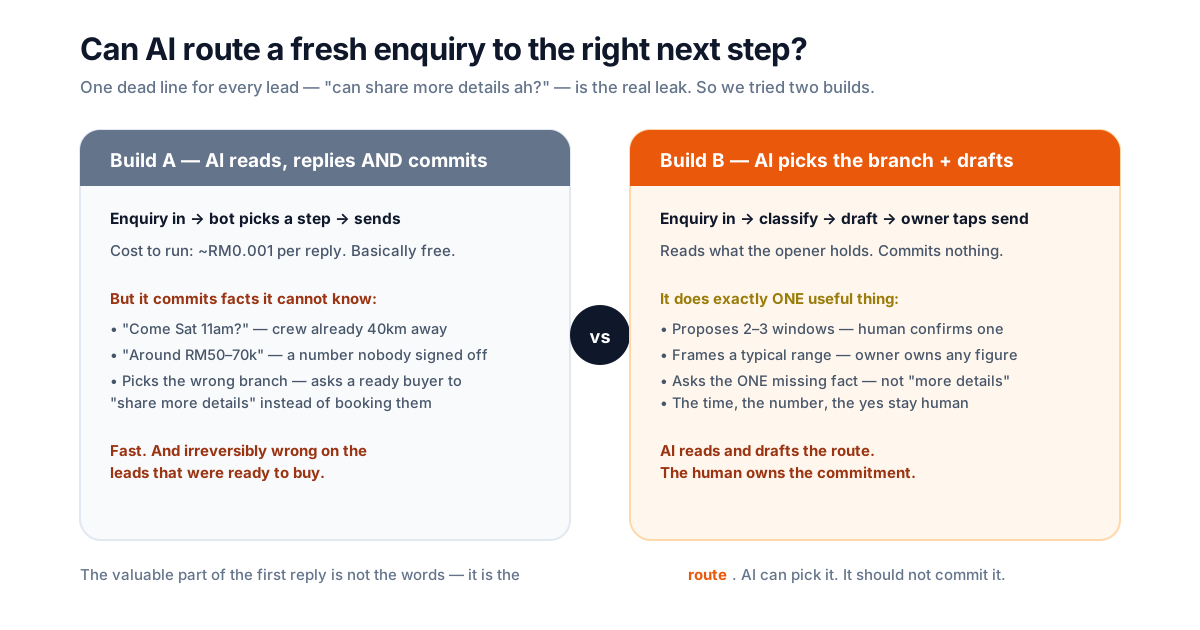
Build A is the flashy, dangerous one — and the failure is not that it writes badly. It writes fine. It is that it commits things it cannot know. I wired a bot to read each enquiry and send a complete, helpful, forward-moving reply on its own: pick the next step, and take it. On easy enquiries it looked great. On the enquiries that matter — the ones with a job attached — three failures showed up fast. These are the illustrative patterns I saw stress-testing it, not a published trial:
- It auto-booked a slot the crew could not make. Given "can someone come see my place this Saturday?", the bot cheerfully confirmed "Sure, Saturday 11am works!" — with no idea the only estimator was already committed to a job 40km away that morning. A missed proposal is recoverable; a confirmed double-booking is not. You either no-show the buyer and burn the first-responder trust you just earned, or bump a paying job. (This is the same wall the auto-scheduling experiment hit: the crew's real week lives off-channel.)
- It threw out a price band nobody approved. Asked "roughly how much for a condo kitchen?", it produced a confident "around RM50–70k" — a number in writing, on WhatsApp, from "your firm". That is now a figure you have to walk back, and re-opening a price only ever moves it down. (Same reason you never let AI put a number on a photo.)
- It picked the wrong branch. Handed our ready Setapak buyer — scope, budget, unit and timeline all stated — it still opened with "could you share a bit more about what you're looking for?" because that was the safe generic move baked into its prompt. It had every fact it needed to offer a visit and asked for details anyway.
That last one is the quiet killer, and it is exactly the mistake the human owner makes too under load. Which is the real lesson: automating a bad default just serves the bad default faster.
Why the generic reply fails worst on your best leads
Because a detailed opener is not a demanding customer — it is a high-intent buyer who already did the work, and the generic reply insults exactly that effort. This is the contrarian bit worth sitting with. Everyone optimises the first reply for the vague enquiry ("renovate this how much ah"). But the enquiry that arrives with "kitchen + 2 baths, Setapak condo, ~30k, keys Dec" is the one you can least afford to fumble — they told you scope, budget, unit and timeline in one breath, which means they are far down their own journey and probably messaging you precisely because they are ready to act.
Meet that with "can share more details ah?" and you do two harmful things at once. You signal you did not read her message, and you push the work back onto the person who was ready to give you money. Contrast the friction research from form design: completion runs about 36% higher when you ask one question at a time rather than a wall of them (Jotform, Typeform), and removing even a single field from a form can lift conversions sharply while conversion falls off a cliff past six fields (form-optimisation studies via VentureHarbour and Formstack). A vague "share more details" is the conversational version of a six-field form dumped on someone who was one tap from booking.
What actually paid: Build B — AI picks the branch, a human commits
Build B splits the reply into the two things it really is: a routing decision AI can make, and a commitment only a human should. AI reads the fresh enquiry, classifies it into one of a small set of branches from what the opener actually contains, and drafts a warm reply that does exactly one useful thing for that branch. Then it stops. The time, the number, the yes — every promise — waits for a person to read, adjust and tap send.
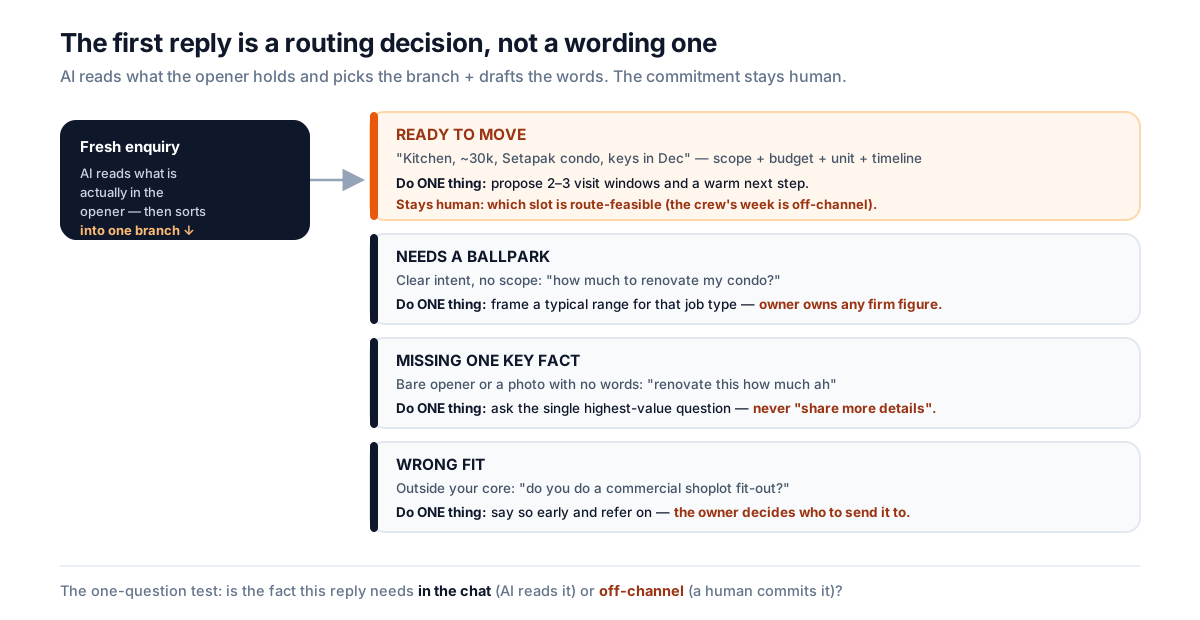
Here is the routing table it runs on — nothing exotic, just the branches a good salesperson already uses, made explicit so they happen every time:
| Enquiry pattern | The branch | The ONE thing the reply does | What stays human |
|---|---|---|---|
| Scope + budget + unit + timeline ("kitchen, 30k, Setapak condo, keys Dec") | Ready to move | Propose 2–3 visit windows and a warm next step | Which slot is route-feasible for the crew |
| Clear intent, no scope ("how much to reno my condo?") | Needs a ballpark | Frame a typical range for that job type, note it firms up after a visit | Any firm figure or discount |
| Bare opener or a photo, no words ("renovate this how much ah") | Missing one fact | Ask the single highest-value question (which rooms / rough budget) | Which question matters most this time |
| Outside your core ("commercial shoplot fit-out?") | Wrong fit | Say so early and refer on, warmly | Who to refer to, whether to take it anyway |
The reason this split works is not a HotLead opinion — it is the same test that runs through everything AI can and cannot do in a lead process: is the fact this reply needs written in the chat, or is it off-channel? Reading whether an enquiry is ready-to-book versus missing-scope is in the chat — that is text classification, which is what language models are genuinely reliable at. Deciding whether Saturday 11am is actually free, or what number to promise, is off-channel — and that is where the model has nothing to draw on, so it invents. Build B lets AI do the first and forbids it the second.
Where does AI stop, honestly?
Even the routing half is not free of error, so a human still reads the branch pick — but the review is a two-second glance, not a rewrite. Research on "intent hallucination" shows that even state-of-the-art models sometimes misread or omit what a query is really asking, so the classifier will occasionally file a ready buyer under "needs a ballpark" or miss a wrong-fit. That is fine, because Build B is a draft in front of a human, not an autonomous send. The owner glances: right branch? send. Wrong branch? one tap to the correct draft.
And there is a whole category the router should hand straight back: the enquiry where the deciding fact is a person, not a pattern. A message that reads like a competitor benchmarking your price, a nervous first-time renovator who needs reassurance before anything else, a referral from a past client who should get a personal note — these are not branches, they are judgement calls, and the owner takes them. The point of automating the routine 80% is to free attention for exactly these.
It is also worth naming the trust dimension, because the numbers are one-sided. Surveys keep finding people want a human in high-stakes conversations — Kinsta's 2025 work put it at 93.4% preferring a human over AI handling the conversation, SurveyMonkey's 2025 study found a similar strong majority, and Pega research found 48% distrust companies that let AI handle queries completely. A first-time renovator about to spend RM80k is that nervous buyer. The human tap on send is not just a quality control — it is the trust signal.
What should an owner actually do on Monday?
You do not need to build a bot to get 90% of this. The routing discipline is worth more than the automation:
- Auto-greet instantly, commit nothing. An instant "Hi, thanks for reaching out — a designer will reply shortly" buys the five-minute window and promises nothing. This is the one part safe to fully automate. Nothing sits unanswered while you decide the route.
- Write your branches down. You already reply four ways — book, ballpark, one-question, no. Make them explicit so they happen under load instead of collapsing into "share more details".
- Read before you route. Before you type, ask what this opener already contains. If it is a full brief, do not ask for a brief — offer the visit.
- Do exactly one useful thing per reply. One question, or one range, or one proposed time. Not all three, and never zero.
- If you use AI, let it draft the route — never the commitment. Two or three windows, not a confirmed slot. A typical range, not a signed price. Your thumb stays on send.
- One owner per lead. A perfectly routed reply is worthless if it is nobody's job to send it.
Where HotLead fits (and where it does not)
I want to be straight, the way this series always is: HotLead does not ship an AI that reads your enquiries, classifies them and drafts routed replies. That classify-and-draft build is an experiment about where AI earns its keep next — labelled an experiment, not a feature.
What HotLead ships is the plumbing that makes routing reliable in the first place, and honestly that is where most of the leak closes. Every enquiry is captured instantly with an auto-greeting, so nothing goes cold while you think. Round-robin, manual or custom-rule routing sends the lead to the right owner — routing the lead to a person is the routing HotLead really does. A next action with an overdue flag on every lead means the correct next step is a tracked task, not a good intention that dies on a ladder. And a lead owned by one person is a lead that actually gets its reply.
Put differently: HotLead routes the lead to the right human fast, and gives that human the next step in front of them. The experiment in this piece — AI routing the enquiry to the right next step and drafting the words — is a thin, promising layer that sits on top of that plumbing. Get the plumbing right first. The AI is the assist, never the mechanism.
Part of Managing Renovation Leads in Malaysia: The Practical Playbook. Related: Can AI write the first WhatsApp reply? · Turning a messy enquiry into a sales-ready lead · How to qualify a renovation lead in the first reply · How fast should you reply? · For the industries this serves, see the renovation and interior design hubs.
Frequently asked questions
Can AI reply to my WhatsApp renovation leads for me?
It can draft a genuinely good first reply in seconds for a fraction of a sen, and it is reliable at the routing part — reading whether an enquiry is ready to book, needs a ballpark, or is missing one key fact. What it should not do unsupervised is commit anything inside that reply — a specific visit slot depends on your crew's week, and a price depends on a scope only a person can judge. The build that pays has AI pick the branch and draft the words while a human owns the commitment and taps send.
What is wrong with sending the same first reply to every enquiry?
It treats a buyer who told you scope, budget, unit and timeline exactly like a three-word how much ah. The ready buyer wanted you to move — offer a visit or a range — and instead gets asked to do more work, so they cool off or message the next firm. A generic reply is a routing failure disguised as politeness, and it leaks the leads you most wanted to keep.
Is it safe to let AI auto-book a site visit or auto-send a price?
No. Both commit a fact that does not live in the chat. Crew availability and route feasibility sit in someone's head or van route, so an auto-booked slot can collide with a job 40km away, and a confirmed double-booking is not reversible. A price depends on strata rules, scope and margin the AI cannot see. Have AI propose two or three windows or frame a typical range, then let a human confirm the one that is real.
How much does it cost to have AI draft these replies?
Almost nothing in compute. At published GPT-4o mini token pricing, a short qualifying reply works out to roughly a tenth of a sen — well under RM1 a month even at forty to sixty enquiries. The cost that matters is never the tokens; it is a wrong auto-sent slot or number on a job worth tens of thousands of ringgit.
Does HotLead use AI to route and reply to my leads?
No, and it is worth being straight about that. HotLead does the plumbing that makes routing work — instant capture and an auto-greeting on every enquiry, round-robin, manual or custom-rule routing that sends the lead to the right owner, and a next action with an overdue flag so nothing is forgotten. The AI classify-and-draft in this piece is an experiment about where AI could help next, labelled as such, not a shipped feature.
Keep reading
- How Much Deposit Should a Renovation Firm Ask For? The Profit-Aware Number, Not a Round OneMost reno firms set their deposit at a round social number — a comfortable 10 percent, or they copy a rival's aggressive 50 percent. Both are wrong. Your deposit is the conversion event of your entire funnel and, at the same time, the only thing standing between your working capital and an unvetted stranger. Here's how to price the deposit from your at-risk cost, why a low deposit is really an interest-free loan to a stranger, and why in Malaysia's scam-scarred, loan-dependent market a high one doesn't just cost margin — it loses the deal.
- The 'Quick Question Ah?' Lead: When a Buyer Uses You as a Free Second Opinion for Someone Else's RenoSome of your busiest WhatsApp threads are with buyers who already have a builder — a cousin, a part-time reno friend — and are messaging you only to sanity-check his price, his tile, his scope. Every question you answer in full is a free consult that de-risks the other guy's job. Here's how to spot the sanity-check lead, why answering everything loses you the work, and how to convert a real doubt without becoming the unpaid QA department.
- Did We Already Say RM68k? Using AI to Stop Quote Drift Across a Long Renovation ThreadOver a weeks-long WhatsApp thread with two or three quote revisions, a rep re-states a number that contradicts an earlier promise — and re-opening a settled price quietly invites a discount that eats a whole job's profit. So I pointed AI at the drift. It works beautifully as a flag, and dangerously as an auto-corrector.