

Two renovation firms send a quote on the same RM80,000 condo job. The first asks for a comfortable 10 percent deposit because that feels friendly and easy to say yes to. The second asks for 50 percent to "lock it in" and protect against a buyer who ghosts. One of them is quietly funding the buyer's renovation out of their own working capital; the other just tripped every scam alarm the buyer has and lost the job to a third firm. Both picked their deposit as a round social number — and both got it wrong.
Your deposit is not an accounting formality. It is the single most under-thought number in a reno firm's sales process, and it does two jobs at once that pull in opposite directions. It is the conversion event of your whole funnel — the moment a warm lead becomes a signed job or walks. And it is the only thing standing between your working capital and an unvetted stranger. Price it wrong in either direction and you either lend money to people you shouldn't or lose deals you should have won.
This piece is the decision underneath the norms. The companion piece on deposit and progressive-payment terms maps what the Malaysian market expects — the bands, the stage draws, the cashflow behind a won job. This one answers the harder question sitting on top of it: given those norms, how much should you ask on this job — and why the right answer is a number priced from your risk, not a round one.
How much deposit should a renovation firm actually ask for?
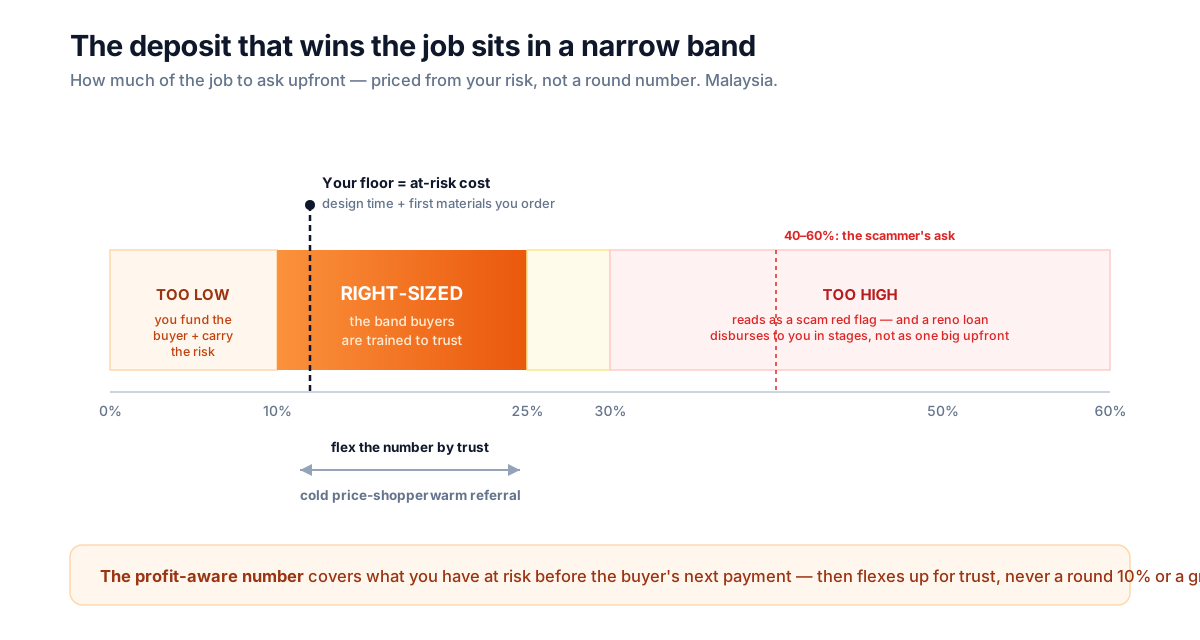
Enough to cover your at-risk cost, and no more than the band buyers trust. The floor is the cash you commit before the buyer's next payment — design time plus the first materials you order. The ceiling is the market's trust line, which in Malaysia sits around 10 to 20 percent on signing and reads anything above 30 percent as a warning. For most reno, ID and contracting jobs that puts your deposit in a 10 to 25 percent band, staged against milestones after that — and the exact number inside the band is a decision, not a default.
The mistake almost every owner makes is skipping straight to a round number. Ten percent because it sounds fair. Thirty percent because a bigger firm does it. Fifty because they got burned once. None of those numbers is anchored to anything real about your cost or this lead. The profit-aware way is to build the number from two hard constraints — a floor set by your own money at risk, and a ceiling set by what the Malaysian market will accept without smelling a scam — and then place the deposit inside the gap between them.
Get the floor and the ceiling right and the band is usually narrower than owners think. Let's price both.
Why is a low deposit really a loan to a stranger?
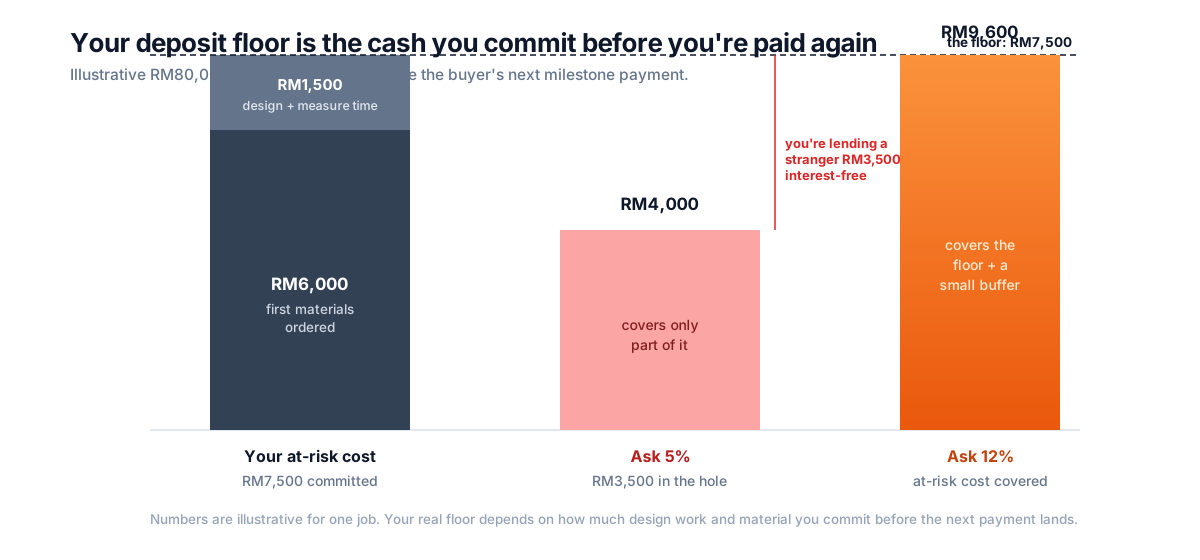
Because on a real renovation job you spend your own money before the buyer's second payment arrives — and if your deposit doesn't cover that spend, the difference is an interest-free loan you've made to someone you haven't vetted. A deposit below your at-risk cost isn't "buyer-friendly." It's you financing a stranger's renovation on a thin margin, and carrying the loss if they walk.
Walk through the cash on an RM80,000 job. Before the buyer owes you anything more, you've likely spent time on detailed design and site measurement, and you've ordered the first tranche of materials so the job can start on schedule. Say that's roughly RM1,500 of design and measure time and RM6,000 of first materials — about RM7,500 you've committed. Ask for a 5 percent deposit (RM4,000) and you are RM3,500 out of pocket the moment work begins, on a job for a buyer whose reliability you're still guessing at. That gap is not a discount or a goodwill gesture. It's an unsecured loan.
This is the same working-capital logic that decides how much cash a reno firm needs to run at all: every live job ties up your money between the deposit and the final payment, and a deposit set below your at-risk cost widens that gap on every single job. Win ten jobs on 5 percent deposits and you've quietly extended tens of thousands of ringgit in interest-free credit across your order book — which is exactly how a profitable, fully-booked firm still misses payroll.
So the floor is clear: never ask for less than your at-risk cost. But the obvious response — "then just ask for a lot" — is where firms lose deals in Malaysia specifically.
Why does a high deposit lose the deal, not just margin?
Because in the Malaysian market a large upfront demand is the single most recognisable signature of a renovation scam — and buyers have been trained, hard, to run from it. Ask for 40 to 60 percent and you don't look confident. You look exactly like the contractor who took a deposit and vanished, so the buyer walks.
This isn't a soft branding worry; it's a documented pattern. Consumer and industry guides across the market land on the same rule: PropertyGuru Malaysia advises a renovation deposit of around 15 to 20 percent and never more than 30 percent, while FindContractor.my flags a 40 to 60 percent upfront demand as a classic scam tactic and recommends capping the deposit at 10 to 25 percent, releasing later payments only against inspected milestones. The fear is grounded in real losses: reporting collected by The Makeover describes a buyer who paid RM200,000 upfront to a "contractor" who then disappeared with no work started, and in a widely-reported Rawang case five homeowners lost a combined RM127,000 the same way. CIDB has since pushed a standard renovation agreement template and a grievance helpline precisely to curb the big-deposit-then-vanish playbook.
There's a second, more concrete reason a big ask fails — and it's the most un-Googleable part of this whole decision.
How does a renovation loan cap the deposit you can ask?
It caps it structurally, because on a loan-funded job the bank controls most of the money and releases it to you in stages — so a loan-dependent buyer physically cannot hand you a big deposit on signing. A 50 percent upfront ask doesn't just scare a loan buyer; it collides with the mechanics of how their money actually reaches you.
Here's the mechanic. For renovation-purpose loans above RM50,000, banks require your itemised quotation and typically take one to three weeks to approve, per RinggitPlus and PropertyGuru. Then the money doesn't land in the buyer's account for them to pass on — it's disbursed directly to you, progressively, against completed works. Maybank's MyDeco renovation financing states plainly that 70 percent of the approved facility is disbursed progressively to the interior designer, contractor or supplier against works completed and documented. Read what that means for your deposit: your loan-funded buyer's cash is the staged progress payment. There is no lump they can use to fund a 50 percent deposit on day one, short of raiding the savings the loan existed to protect.
So the deposit that a loan-dependent buyer can realistically pay on signing is small — their own top-up cash — with the bulk arriving in exactly the staged, milestone-tied way the anti-scam guides recommend anyway. A big upfront ask asks for money that, by the loan's design, isn't there yet.
What's the right deposit — and why should it flex by lead?
The right deposit is the number inside the trusted band that covers your at-risk cost for this job — and where you sit in that band should move with how much you trust the lead. A warm referral tolerates a faster, larger deposit; a cold price-shopper reads the same ask as a warning. The floor stays fixed by your cost; your position above it flexes by trust.
This is the part a fixed policy gets wrong. "We always take 10%" under-charges on a job where you've committed heavy design work, and "we always take 30%" scares off the exact cold leads you're trying to convert. The trust dimension matters because your two risks — abandonment (they vanish after you've spent) and lost conversion (they walk at the ask) — trade off differently depending on where the lead came from:
| Lead type | Abandonment risk | The deposit that fits | Why |
|---|---|---|---|
| Warm referral (past client vouched) | Low | Toward the top of your band, quicker | Trust is pre-built; they expect to commit, and a confident ask reads as normal |
| Repeat client | Very low | Top of band, or streamlined terms | Track record removes the guesswork; friction is the only enemy |
| Cold platform lead (Qanvast, Atap, FB ad) | Unknown | Floor of your band — cover at-risk cost, no more | They have four other quotes open; a big ask is a reason to drop you |
| Price-shopper, vague scope | Unknown, higher | At-risk-cost floor, staged tightly | Protect your committed cash without giving them a scam-shaped reason to leave |
Notice what's happening: a cold Qanvast lead is comparing you against several firms in parallel, so your deposit ask is being benchmarked — and the buyer who's read the scam guides will treat the higher number as the disqualifier. The referral, meanwhile, would happily pay more and faster because someone they trust already told them you're safe. Same job, same at-risk cost, different right number — set by the lead's source and warmth.
Which is the whole reason this decision doesn't live in a policy document. It lives in whatever tells you where each lead came from and how warm it is.
Where a lead system fits
The at-risk-cost floor you can work out on a calculator once. The hard part is the other half of the decision — knowing, at the moment a warm lead is ready to sign, whether this is a vouched referral you can confidently ask more of or a cold price-shopper you should meet at the floor — and doing it across dozens of live enquiries without guessing.
That's a lead-management problem, not a spreadsheet one. A system like HotLead captures and tags every enquiry by source — referral, Qanvast, Atap, FB ad, walk-in — so when a lead reaches the deposit conversation you already know how much trust is behind it and where in the band to pitch the ask. Its funnel and per-channel views show you which sources actually convert at which deposit levels, so you set the number from your own data instead of a round guess — and you can see whether the leads you're losing are dropping at the deposit step, the tell that your ask is above the trust line for that channel. The next-action and overdue-follow-up prompts keep a loan-dependent buyer's deal warm through the one-to-three-week bank wait, aimed at their approval date rather than nudged with a nervous discount. The tool doesn't set your deposit. It makes sure you set it from the two things that actually decide the right number — your at-risk cost and this lead's trust — instead of a habit.
The firms that protect both their margin and their conversion aren't the ones with the friendliest deposit or the safest one. They're the ones who price the deposit from what they have at risk, keep it inside the band Malaysian buyers trust, and flex it by how well they know the lead in front of them.
Working through the economics of your pipeline? Start with the complete guide to managing renovation leads in Malaysia, then see the deposit and progressive-payment norms behind a won job, why a deposit is a liability and not profit, and when a discount to close a stalled deal is actually worth it.
Frequently asked questions
How much deposit should a renovation firm ask for in Malaysia?
Enough to cover your at-risk cost, and no more than the band buyers trust. The floor is the cash you commit before the buyer's next payment — design and measure time plus the first materials you order — because anything below that means you are funding a stranger's job from your own pocket. The ceiling is set by the market — Malaysian buyers are trained to accept roughly 10 to 20 percent on signing and to read anything above 30 percent, especially 40 to 60 percent, as a scam signal. For most reno, ID and contracting jobs that lands you in a 10 to 25 percent deposit, staged against milestones after that. Pick the number inside that band that covers your at-risk cost for this specific job, then flex it up for a trusted referral and down for a cold price-shopper.
Is a low deposit better for winning renovation leads?
Only up to the point where it stops covering your at-risk cost — below that it is not buyer-friendly, it is you lending an unvetted stranger money interest-free. A small deposit does reduce friction on signing, but on an RM80,000 job you may have already committed several thousand ringgit in design time and ordered materials before the buyer's next payment is due. If your deposit is smaller than that, you are financing their renovation on your own thin margin and carrying the abandonment risk if they walk. Set the deposit to cover what you have at risk, then reduce friction with a clear staged-payment schedule instead of by under-charging upfront.
Why do Malaysian buyers refuse a large renovation deposit?
Because a large upfront demand is the single most common signature of a renovation scam here, and buyers have been trained to fear it. Reported cases run to hundreds of thousands of ringgit lost to contractors who took a big deposit and vanished, and consumer guides across the market repeat the same rule — cap the deposit at 10 to 25 percent and treat a 40 to 60 percent demand as a red flag. On top of that, a buyer funding the job with a renovation loan physically cannot hand you 50 percent on signing, because the bank disburses to you in stages against completed works. So a high deposit ask does not read as confidence — it reads as danger, and it loses you deals.
How does a renovation loan affect the deposit I can ask for?
It caps it, because the bank — not the buyer — controls most of the money and releases it in stages. For renovation-purpose loans above RM50,000 the bank requires your itemised quotation and typically approves in one to three weeks, then disburses progressively to you against completed works rather than as a lump sum the buyer can pass on. Maybank's MyDeco, for example, pays 70 percent of the facility progressively to the contractor or designer against documented progress. So if your buyer is loan-dependent, a large upfront deposit is not just risky for them — it is structurally impossible, and asking for it either kills the deal or forces them to fund your deposit from savings they were trying to protect.
Should the deposit percentage be the same for every lead?
No — it should flex by how much you trust the lead, which is a lead-management decision, not a fixed policy. A warm referral who came through a past client has already been vouched for and will tolerate a faster, larger deposit; a cold price-shopper who found you on Qanvast with four other firms open will read the same ask as a warning and drop you. The at-risk-cost floor stays constant, but where you sit inside the trusted band should move with the lead's source and warmth. That is exactly why the deposit decision belongs in a system that tags every lead by source and warmth, not in a one-size policy in your head.
Keep reading
- The 'Quick Question Ah?' Lead: When a Buyer Uses You as a Free Second Opinion for Someone Else's RenoSome of your busiest WhatsApp threads are with buyers who already have a builder — a cousin, a part-time reno friend — and are messaging you only to sanity-check his price, his tile, his scope. Every question you answer in full is a free consult that de-risks the other guy's job. Here's how to spot the sanity-check lead, why answering everything loses you the work, and how to convert a real doubt without becoming the unpaid QA department.
- Did We Already Say RM68k? Using AI to Stop Quote Drift Across a Long Renovation ThreadOver a weeks-long WhatsApp thread with two or three quote revisions, a rep re-states a number that contradicts an earlier promise — and re-opening a settled price quietly invites a discount that eats a whole job's profit. So I pointed AI at the drift. It works beautifully as a flag, and dangerously as an auto-corrector.
- The Warranty as a Closing Lever: Why a Longer Guarantee Beats a Discount on a Renovation DealA quote is stalling and the buyer wants a reason to say yes. Before you drop the price, look at the other lever in your hand — a longer workmanship warranty. It is the same expected-value decision as a discount, but the math runs the opposite way — a price cut costs you thousands with certainty, while extending the defects cover costs you a couple of hundred ringgit in expectation, for arguably more trust with a scam-wary buyer. Here is the EV case for the non-price concession, the trap that turns it into a hidden liability, and which leads it actually moves.