

Every renovation and interior-design owner knows referrals are good. Almost none of them put a ringgit figure on how good — and that gap is why they quietly starve their best channel while pouring money into their worst.
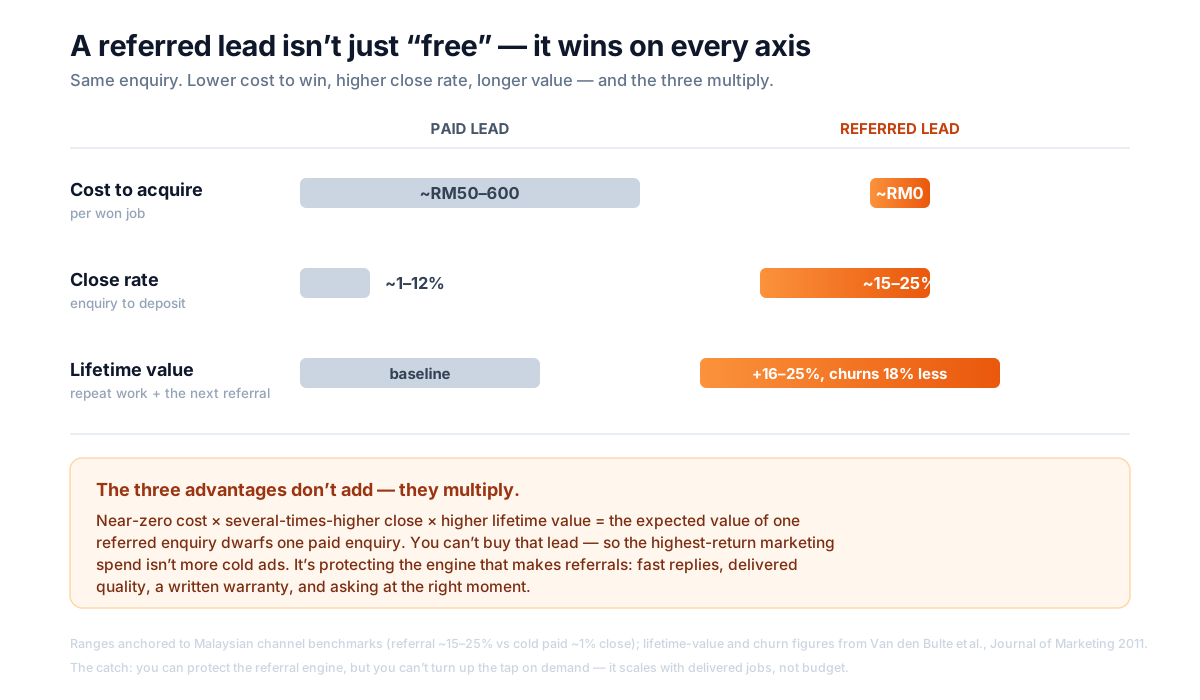
A referred lead isn't just a "free" lead. It beats a paid lead on three separate axes at the same time — it costs almost nothing to acquire, it closes several times better, and the customer it becomes is worth more over its lifetime — and those three advantages multiply, they don't add. That compounding is what makes one referred enquiry worth many paid ones. The practical consequence runs against instinct: because you can't buy a referral, the highest-return marketing spend is usually not another ad — it's protecting the engine that produces referrals in the first place.
How much more is a referred lead worth than a paid one?
Far more than "free" suggests, because the advantages stack on top of each other. Price out the same enquiry two ways — as a cold paid lead and as a referral — across the three things that decide a lead's real value, and the referral wins each one, then wins again on the multiplication.
| Axis | Paid lead (cold) | Referred lead | Why it compounds |
|---|---|---|---|
| Cost to acquire | ~RM50–600 per won job | ~RM0 | Nothing paid to the channel to make the enquiry land |
| Close rate | ~1–12% | ~15–25% | Trust is pre-transferred by the referrer |
| Lifetime value | baseline | +16–25%, churns ~18% less | Referred clients stay longer and refer onward |
Take the close rate alone. A warm introduction converts in the 15–25% band while cold paid social sits near 1% — people are roughly 4× more likely to buy when referred (Extole; cross-channel benchmarks we used in cost per lead vs cost per job). That gap alone makes a referral worth many paid leads. Now layer on a near-zero acquisition cost, and then layer on a higher lifetime value — and the three don't sum, they compound. A channel that is 20× better at closing and free to feed and produces longer-lived customers isn't a little better than paid. It's a different asset class.
The lifetime-value piece is the one owners miss most, and it's the best-evidenced. In the landmark Wharton study of nearly 10,000 accounts at a German bank, referred customers were about 25% more profitable, roughly 18% less likely to churn, and carried 16–25% higher customer lifetime value than customers won any other way (Schmitt, Skiera & Van den Bulte, Journal of Marketing, 2011). For a reno firm, that maps directly to what one happy client is really worth — the repeat kitchen two years later, the sister's condo, the office fit-out — and a referred client sits at the top of that distribution, not the middle.
Why do owners under-invest in their single best channel?
Because you can't buy it, and anything you can't buy doesn't get a budget line. A paid channel has a dashboard — spend goes in, leads come out, a number you can push. The referral channel has no slider, no invoice, no agency to call. So it gets filed under luck rather than strategy, and the marketing budget flows entirely to the channels that happen to have a "boost" button.
This is the quiet misallocation. An owner will spend RM6,000 a month on ads chasing cold strangers who close at 1–12%, while doing nothing deliberate to protect the channel that closes at 15–25% and costs nothing. Not because they've weighed it and decided — because the referral channel never appeared on the spreadsheet where decisions get made. It's invisible, so it's neglected, so it slowly shrinks.
There's a distinctly Malaysian reason the channel is worth even more here than the global averages suggest. Renovation-deposit scams are common enough to be their own news genre — victims routinely lose RM15,000 to RM80,000, and cases above RM100,000 (one woman lost RM200,000 to a contractor who took the money and vanished) appear regularly in the local press (EdgeProp; The Makeover). In a market that primed to distrust contractors, a recommendation from someone the buyer already trusts does something no ad can: it clears the trust barrier before the first message. That makes a Malaysian referral more valuable relative to a cold lead, not less.
So where should your next marketing ringgit go?
Into the engine that makes referrals — before another cold ad. You can't buy a referral, but referrals aren't random: they're the output of a system, and every part of that system is something you can fund and improve. The reframe is simple. Stop asking "how do I buy more leads?" and start asking "what makes my happiest clients send me their friends — and am I spending anything to protect it?"
There are four levers, and all four are cheaper than a month of ads:
- Reply fast — even to the warm ones. A referred lead arrives pre-sold, which is exactly why firms get complacent and let it sit. That's a leak. As we covered in the warm-lead complacency trap, "they already trust us, they'll wait" is how you lose the lead that was easiest to win. Speed protects the close rate that makes referrals valuable in the first place.
- Deliver the job cleanly. A referral is the referrer staking their own reputation on you. Deliver well and they refer again; botch it and you don't just lose one client, you lose their whole circle — one bad job poisons a cluster. Delivery isn't an ops concern separate from marketing; for this channel, delivery is the marketing.
- Stand behind it in writing. A written warranty / defects-liability period is what lets a happy client recommend you without personal risk — "don't worry, they guarantee the work." It converts a private good experience into a transferable one.
- Ask — at the right moment. The highest-yield ask is right after a happy handover, when the kitchen is new and the goodwill is peak. Most firms never ask at all. (Whether to also pay for referrals is a separate decision — see should a renovation firm pay for referrals — and you can run every lever here without paying a sen.)
What's the catch — why can't referrals be your whole plan?
Because the thing that makes referrals great also makes them unreliable as a growth engine. The same traits cut both ways:
- You can't turn up the tap. Referrals scale with delivered jobs, not with budget. Double your ad spend and you double your leads next week; you cannot double referrals next week at any price.
- They're fragile. One bad job doesn't cost you one client — it can poison a whole cluster of that client's friends who would have come. Concentrated upside, concentrated downside.
- The share can shrink. The ID numbers above (28% → 18%) show word-of-mouth can quietly decline even as the firm grows, especially as buyers shift to Qanvast, Google and Instagram for discovery.
So the honest strategy is a barbell, not an all-in bet. Protect and compound the referral engine as your floor — it's your cheapest, best-closing, longest-lived channel and it deserves deliberate spend. Then buy paid leads on top to grow beyond what word-of-mouth alone can carry, ranking those paid channels by cost per won job, not cost per lead. The mistake isn't running ads. The mistake is running ads while your best asset silently decays because nobody put it on the spreadsheet.
How HotLead fits in
You can't manage what you can't see, and the referral channel's whole problem is invisibility. HotLead is built so Malaysian renovation, interior-design and construction firms can finally see and protect this asset, on top of the WhatsApp they already use. It captures every enquiry with its source tagged — so referrals stop blurring into one anonymous inbox and you can actually measure your referral rate and close rate against paid. Its funnel and per-channel view proves what the referral channel is worth next to your ads, which is the evidence you need to justify funding the engine instead of another boosted post. Its one-owner routing with next-action and overdue follow-ups means a warm referral never gets the slow, complacent reply that leaks it. And its team-performance view shows whether referred leads are being dropped by whoever "knew them already."
HotLead doesn't manufacture referrals — no tool can; that comes from delivered work and a well-timed ask. What it does is make the channel visible, measurable and defensible, so the spend that protects it stops being invisible too.
Start with the complete guide to managing renovation leads in Malaysia, see the renovation lead playbook or the interior-design playbook, or go deeper on what one renovation client is really worth and the four numbers every reno firm should track.
Sources: Philipp Schmitt, Bernd Skiera & Christophe Van den Bulte, "Referral Programs and Customer Value," Journal of Marketing (2011) — study of nearly 10,000 bank accounts finding referred customers ~25% more profitable, ~18% less likely to churn, and carrying ~16–25% higher customer lifetime value (Wharton faculty PDF; Extole summary); Extole referral-marketing benchmarks (referred buyers ~4× more likely to purchase; warm intro/referral ~15–25% close vs cold paid social ~1%); ZenWeb Malaysia industry marketing guides (word-of-mouth/referral ~36% of construction discovery; ~18% for interior design in 2026, down from ~28% in 2022); EdgeProp Malaysia and The Makeover on Malaysian renovation-deposit scams (typical losses RM15,000–80,000, cases exceeding RM100,000). Ringgit acquisition-cost and close-rate ranges in the scorecard are illustrative, anchored to the Malaysian channel benchmarks above — replace them with your own source-tagged numbers for your real figures.
Frequently asked questions
Is a referred lead really worth more than a paid lead?
Yes, and by a wide margin, because it wins on three things at once. It costs almost nothing to acquire, it closes several times better than a cold paid lead (roughly 15–25% versus about 1% for cold paid social), and the customer it becomes is worth more over time — about 25% more profitable and roughly 18% less likely to churn, per a Wharton study of nearly 10,000 accounts. Those advantages multiply, not add, so the expected value of one referred enquiry dwarfs one paid enquiry. The mistake is calling it "free" and leaving it at that.
If I can't buy referrals, how do I actually invest in the channel?
You invest in the engine that produces them rather than the leads themselves. Four levers move it — replying fast even to warm intros, delivering the job cleanly so the referrer's reputation is safe, standing behind the work with a written warranty, and asking for the referral at the right moment (right after a happy handover). Spending on these is real marketing spend; it just doesn't show up on an ad platform. For many Malaysian reno firms it returns more per ringgit than another boosted post.
How much of a Malaysian renovation firm's leads come from word-of-mouth?
It varies by trade, but word-of-mouth is consistently one of the top channels. ZenWeb Malaysia's industry data puts word-of-mouth and referral at roughly 36% of discovery for construction firms, and around 18% for interior-design studios in 2026 — notably down from about 28% in 2022, a reminder that the referral share can shrink if you don't protect it. In a market where renovation-deposit scams are common enough to be a news genre, a trusted recommendation also clears the trust barrier faster than any ad can.
Can a renovation firm run on referrals alone?
No, and that's the honest limit of the channel. Referrals are unscalable — you can't turn up the tap on demand, they grow only as fast as you deliver jobs, and one bad job can poison a whole cluster of a client's friends at once. The ID data above shows the share can decline over time. So treat referrals as the floor you protect and compound, then buy paid leads on top to grow beyond what word-of-mouth can carry. Protect the asset; don't bet the firm on it.
What's the difference between this and paying for referrals?
Paying for referrals is about whether to add a cash or gift incentive on top of the word-of-mouth you already earn — a tactic covered separately. This piece is about the channel's value as an asset and where your marketing budget should go because of it. You can run the protection levers here without paying a sen in referral incentives; the two decisions are independent.
Keep reading
- "Boleh Buat Macam Ni Tak?" — The Expensive-Look, Small-Budget ID Lead in MalaysiaA homeowner sends a saved Instagram image of a RM250k penthouse look and asks for it on a RM90k budget. Most Malaysian ID studios either quote the dream and scare them off, or say "can can" and disappoint them later. Here's why this lead is actually one of your most winnable — and the "same look, three budgets" way to convert it without touching your margin.
- Can AI Route a Fresh Renovation Enquiry to the Right Next Step? We Tried ItMost solo reno owners fire one dead line at every lead — can share more details ah? That single generic reply stalls the buyers who were ready to book. So I asked whether AI can pick the right next step for each enquiry, and draft the reply that gets it there — without committing a slot or a price it cannot know.
- How Much Deposit Should a Renovation Firm Ask For? The Profit-Aware Number, Not a Round OneMost reno firms set their deposit at a round social number — a comfortable 10 percent, or they copy a rival's aggressive 50 percent. Both are wrong. Your deposit is the conversion event of your entire funnel and, at the same time, the only thing standing between your working capital and an unvetted stranger. Here's how to price the deposit from your at-risk cost, why a low deposit is really an interest-free loan to a stranger, and why in Malaysia's scam-scarred, loan-dependent market a high one doesn't just cost margin — it loses the deal.