

A waterproofing specialist in Shah Alam told me about the job he still calls "the cleanest lead I ever regretted." A main contractor he'd met once on a site messaged his WhatsApp: "Bro, got a condo job in Cyberjaya, three blocks, need waterproofing for the wet areas and roof. Can quote? Fast one."
No tyre-kicking. No "can you come measure for free today ah?" No haggling over a RM300 site visit. A professional who knew exactly what he wanted. It felt like the easiest RM180k of the year — so he priced it the way he prices a homeowner: fast, friendly, sharp number to win on rapport. He got it.
Eight months later he was RM42,000 out of pocket, chasing a progress claim the main con kept parking with "client haven't release yet, bro, you know how it is." The job was technically "won." The money was somewhere up a chain he couldn't see.
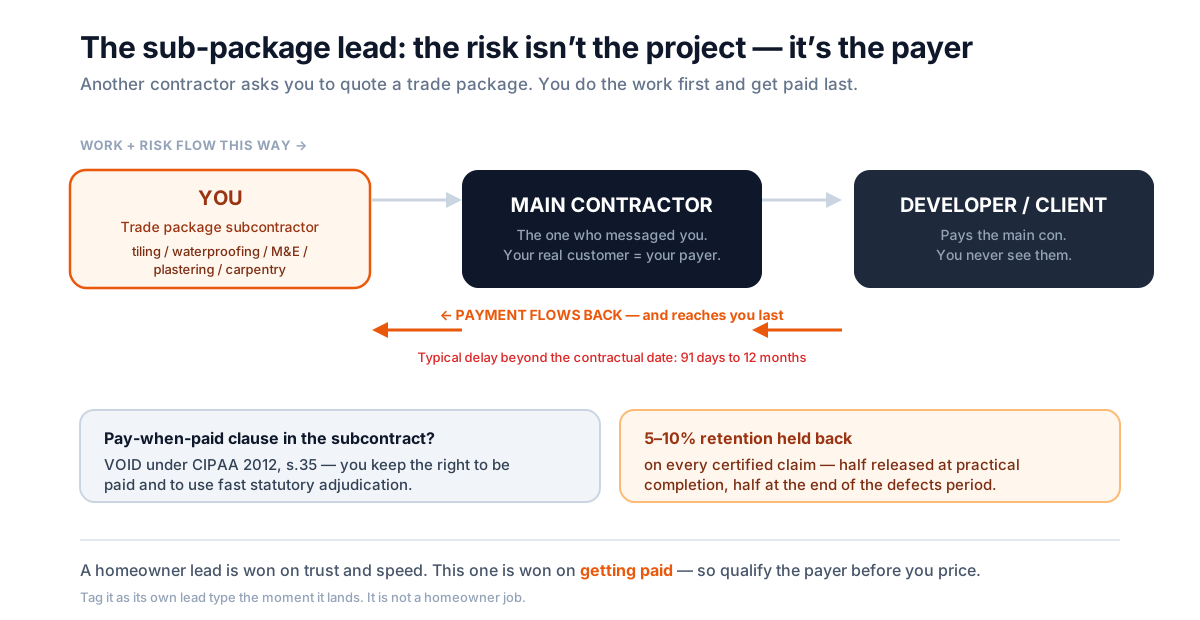
Here's what he'd missed, and what most specialist and trade firms miss: when another contractor sends you a lead, your customer is a business, not a homeowner — and the risk isn't the project. It's the payer.
A main contractor just messaged you for a quote — why is this a different lead?
Because the buyer is a business, so the entire sale flips. A homeowner buys on trust, design and a fast, friendly reply — that's the lead you're built for. A main contractor buys on price certainty, reliability to a programme, and whether you can carry the cash-flow until he pays you. Same WhatsApp, completely different game.
Most trade and specialist firms in Malaysia — tiling, plastering, waterproofing, M&E, carpentry, ceiling, aluminium — run these enquiries through the exact same inbox as their homeowner jobs. That's the first mistake. This isn't one of the lead types we've mapped before, and it doesn't behave like any of them:
- It's not a government tender (formal, deadline-driven, won on a submitted bid).
- It's not a strata / JMB committee job (an owner committee, many voices, a paper trail).
- It's not a takeover of an abandoned job (rescuing someone else's unfinished work).
- It's not an insurance-claim restoration (a disaster, an adjuster, a policy holder).
It's a contractor-to-contractor sub-package lead — a main con subbing out a trade to you — and the thing that makes it unique is simple: you don't get paid by the person benefiting from the work. You get paid by a middleman who gets paid by someone else.
Why does a sub-package lead look so clean — and bite so hard?
Because everything that normally signals a good lead is present, and the one thing that signals a dangerous one is invisible. The buyer is competent, decisive and specific — so your lead-quality instincts light up green. Meanwhile the real risk, the payment chain behind him, never shows up in the chat.
Think about what you screen a homeowner lead for: are they serious, do they have budget, are they just collecting quotes? A main con passes all of those on sight. He's a pro. He has a live project. He's not price-shopping five firms for fun. So your guard drops at the exact moment it should go up.
And the money is the whole story. The reason the Shah Alam job hurt wasn't bad work or a bad price — the work was fine and the price was fine. It was that he'd priced and planned as if "won" meant "paid," on a job where those are two events sometimes a year apart.
Who's actually paying you? Qualify the payer before you price
The single most valuable thing you can do with a sub-package lead is refuse to quote until you understand the payer. Not the project — the payer. Before a price goes out, you want five answers:
- Who is the main con, really? Name, company, track record. Have they paid subbies on time before? In this industry, that's a reputation you can actually ask around about — other trades on the ground know who stretches payment.
- Is the project funded or financed? A developer job stalled on a bridging loan is a different risk from a cash-rich private client. If the top of the chain is shaky, every ringgit below it is shaky.
- What are the payment terms? Progress claims — monthly? Certified by whom? Net how many days? "We'll settle after we claim from client" is a pay-when-paid answer, and you'll want to note it (more on why that clause can't bind you below).
- How much retention, and when is it released? 5%? 10%? One release or two? This is margin you won't see for a long time.
- What's the claim cycle and the programme? How long is the job, how many claims, and where does your trade sit in the sequence? Your cash-out happens before your cash-in — you need to know how big that gap gets.
None of that is rude to ask. A serious main con expects it; it marks you as a firm that's been burned before and runs tight, which is exactly who he wants waterproofing his three blocks. The firm that quotes blind is the one that goes bust mid-job and leaves him with a hole in his programme — his nightmare, not just yours.
Does CIPAA protect you? The homeowner line that flips with this lead
Yes — and this is the part most trade firms don't realise flips entirely in their favour. The law that doesn't cover a homeowner reno almost always does cover your subcontract, and it's built to get you paid.
Here's the line. The Construction Industry Payment and Adjudication Act 2012 (CIPAA) gives contractors a fast, statutory route to chase payment. But it has one headline exemption — section 3 — that carves out "a construction contract entered into by a natural person for any construction work in respect of any building which is less than four storeys high, and which is wholly intended for his occupation." In plain terms: a homeowner's own house, under four storeys. That's why, when you do a double-storey terrace reno for a homeowner, CIPAA doesn't apply and your protection is whatever your contract and deposit terms say.
Now flip it. Your subcontract is between you and a main contractor — two businesses. The "natural person" condition fails immediately, so the exemption doesn't apply, and you're inside CIPAA. Two things follow that matter at the lead stage:
- Any pay-when-paid clause is void. Section 35 makes a conditional-payment provision — one that ties your payment to the main con first being paid by his client, or to his funds being available — void. Malaysian courts have enforced this: a "back-to-back" clause was struck down as a conditional payment provision in Sinwira Bina, and a pay-when-paid clause was treated as null and void under s.35 in the 2024 JDI Builtech v Danga Jed decision. The clause can still be printed in the subcontract you're handed. It just doesn't bind you.
- You get a fast-track to claim. CIPAA's statutory adjudication is designed to resolve a payment dispute far quicker than the courts (commonly described as a roughly 100-day process), administered through the AIAC. It's a real lever — knowing you have it changes how you quote and how you chase.
Retention and progress claims: the money that leaves after you've "won"
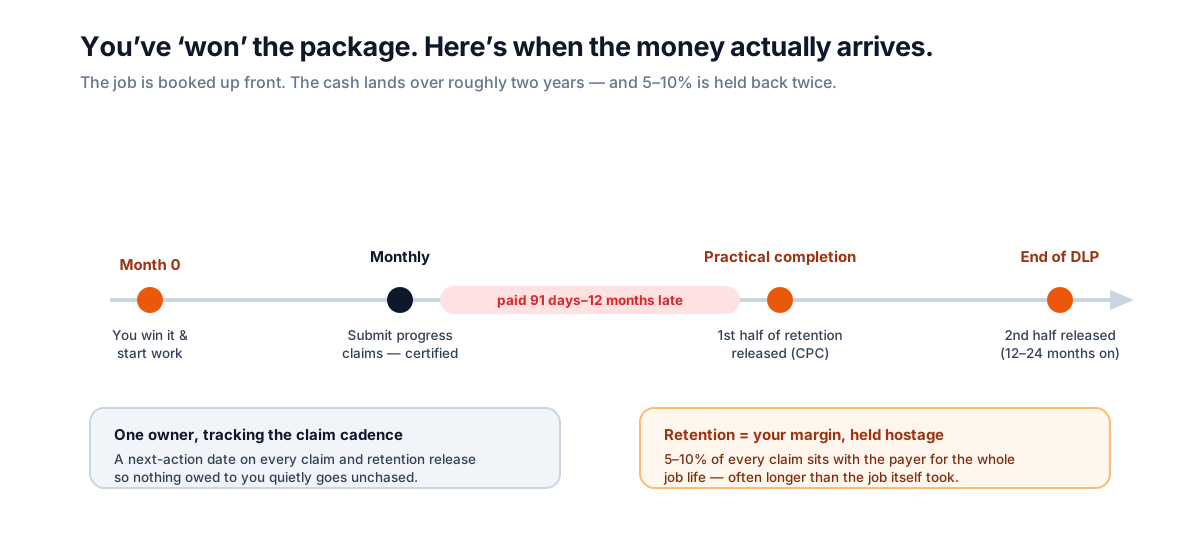
Even with CIPAA behind you, the structure of how you get paid is the thing that catches firms out. On a contractor package, you do the work first, claim monthly, and the money trickles back down the chain — late — with a slice held back twice. Winning the job is the start of the cash-flow problem, not the end.
Two numbers do the damage:
- The payment delay. A Master Builders Association of Malaysia survey found around 80% of contractors reported slow progress payment, and delays commonly run from 91 days to 12 months past the contractual date. You're funding labour and materials out of your own pocket across that gap.
- Retention. Commonly 5–10% of every certified claim is held back, released in two halves — the first at practical completion, the second at the end of the defects liability period, often 12 to 24 months later. That's your profit margin, parked in the payer's account for longer than the job itself ran.
Price a package as if the full amount arrives on handover and you've quietly given away your margin to the gap. The fix is to price the cash-flow cost in — treat the delay and the retention as a real cost of the job, the same way you'd cost material or labour. If you don't, every "won" contractor package makes your bank balance worse before it makes it better. (This is the same "where does the money actually leak" thinking we apply to the numbers every reno firm should track — except here the leak is time, not conversion.)
How do you handle a sub-package lead at the inbox?
You handle it as its own lead type, from the first message. Four moves turn the riskiest "easy" lead into a controlled one:
| Homeowner direct lead | Main-contractor sub-package lead | |
|---|---|---|
| Who's the buyer | The end client, spending their own money | Another business — a middleman in a payment chain |
| What wins it | Trust, a fast reply, a likeable quote | Price certainty, reliability, and you carrying the cash-flow |
| The real risk | They go cold or pick a faster firm | You do the work and get paid late — or fight for it |
| Legal regime | Outside CIPAA (if it's their own home, under 4 storeys) | Inside CIPAA — pay-when-paid void, adjudication available |
| Qualify for | Budget, scope, seriousness | The payer: funding, terms, retention, claim cycle |
| Who should own it | One salesperson, instantly | One owner tracking the claim cadence for the job's whole life |
- Tag it on arrival as a contractor lead, not a homeowner job. The first decision is what kind of lead it is, because it changes everything after. A contractor-to-contractor package goes into its own lane — never mixed in with the homeowner enquiries where the fast-friendly reflex lives.
- Qualify the payer before you price. Run the five questions above. The quote waits until you know how and when the money reaches you. A fast acknowledgement, then a real conversation — not a blind number.
- Price the cash-flow cost in. Build the payment delay and the retention into the quote as a cost line, not a surprise. You're not just pricing waterproofing; you're pricing waterproofing you'll fund for months before you see it back.
- Give it one owner for the whole job, not just the quote. Because the money lands over roughly two years — monthly claims, certifications, two retention releases — this lead needs an owner who doesn't lose it in a group chat and keeps a next-action date on every claim and release. The homeowner job ends at handover. This one ends when the last retention cheque clears.
How HotLead helps a trade firm run the contractor lane
HotLead sits as a light layer on top of the WhatsApp your enquiries already land in — nothing changes for the main con messaging you — and it's built so a contractor package can't be handled with the wrong reflex. Honestly, here's what it does and doesn't do:
- Captures and tags every enquiry on arrival, so a contractor-to-contractor package lands in its own lane, not mixed into the homeowner inbox where it gets the fast-quote treatment.
- Routes it to one owner instantly — round-robin, manual, or a custom rule we set up (say, all contractor-sourced packages to the person who handles commercial) — so one person carries it end to end.
- Keeps a next action and flags overdue follow-ups, so every progress claim, certification and retention release has a date and nothing you're owed quietly goes unchased across a two-year job life.
- Shows your funnel and per-channel ROI, so over time you can see which main cons send packages that actually pay — and quietly stop chasing the ones that don't.
What it won't do, and no software honestly can: vet the main con's balance sheet, tell you if the developer's loan is solid, or draft your subcontract. That's your job and your lawyer's. HotLead makes sure the lead is caught, tagged correctly, owned, and chased through the long payment tail — so the firm's attention is on the right risk.
If your trade firm keeps winning contractor packages and then bleeding on the cash-flow, the leak isn't your pricing or your work — it's handling a payer lead with a homeowner playbook. Start with the contractor lead-management hub, read the complete guide to managing renovation leads in Malaysia, or see how HotLead works.
Sources: CIPAA 2012 section 35 voiding conditional / pay-when-paid clauses, and the Sinwira Bina and JDI Builtech v Danga Jed decisions, from HHQ — Section 35 of CIPAA 2012: Overview of Authorities on Conditional Payment and NZSK Legal — The Power of Section 35 CIPAA. The section 3 exemption (natural person, under four storeys, wholly for own occupation) from Thomas Philip — 3 Basic Things You Need to Know About Your CIPAA Claims and MISHU — A Contractor's Guide to CIPAA Payment Claims & Adjudication. Retention practice (5–10%, two-moiety release at CPC and end of defects liability period) from Thomas Philip — Retention Sum in Construction Contracts. Late-payment prevalence (~80% slow progress payment; 91 days to 12 months) from the Master Builders Association of Malaysia figures reported in Late Payment Issues of Subcontractors in the Malaysian Construction Industry (ResearchGate). The Shah Alam, Klang and Cyberjaya firms are illustrative; the pattern is one we see repeatedly.
Frequently asked questions
A main contractor messaged me to quote a package — how is that different from a homeowner lead?
The buyer is a business, not an end client, so the whole sales motion flips. A homeowner buys on trust, design and a fast, friendly reply. A main contractor buys on price certainty, reliability to a programme, and whether you can carry the cash-flow. The homeowner reflex — quote fast, win on rapport — is the wrong one here, because the real risk isn't the project, it's the payer. You get paid by the main con, who gets paid by his client, so pay-when-paid exposure, retention and progress-claim timing decide whether a won job becomes a cash-flow hole.
Is a pay-when-paid clause legal in a Malaysian subcontract?
No. Section 35 of the Construction Industry Payment and Adjudication Act 2012 (CIPAA) makes a conditional-payment clause void — one that says you only get paid when or if the main contractor is paid by his client, or that ties your payment to the availability of his funds. Malaysian courts have struck such clauses down (for example in Sinwira Bina and, more recently, JDI Builtech v Danga Jed). It can still appear in the subcontract you're handed, but it doesn't bind you, and you keep the right to claim and to use statutory adjudication.
Does CIPAA apply to my subcontract work?
Almost always, when your customer is another contractor. CIPAA covers written construction contracts for work carried out in Malaysia. Its one big exemption (section 3) is a contract entered into by a natural person for a building under four storeys that is wholly intended for his own occupation — that's a homeowner's own house. A subcontract between you and a main con is between two businesses, so the natural-person condition fails and the exemption doesn't apply. Check your own contract, but the default is that you're inside CIPAA — which is good news for you.
What is retention and why does it matter at the lead stage?
Retention is a slice of every certified payment — commonly 5% to 10% — that the payer holds back as security against defects. It's usually released in two halves — the first at practical completion, the second at the end of the defects liability period, often 12 to 24 months later. It matters at the lead stage because it's your margin sitting in someone else's account for the whole life of the job. If you price a package as if you'll be paid in full on completion, you've mispriced it.
How should I reply to a sub-package enquiry from another contractor?
Don't fire back a price. Reply fast to acknowledge, then qualify the payer before you quote — who's the main con, is the project funded or financed, what are the payment terms, how much retention, and what's the progress-claim cycle. Tag it in your system as a contractor-to-contractor lead, not a homeowner job, give it one owner, and build the cash-flow cost into the number. The quote comes after you understand how and when you'll be paid, not before.
Keep reading
- 15 Live Leads, One Free Hour: Which Renovation Lead Do I Call First? I Let AI Rank My MorningA Kajang contractor opens WhatsApp at 8:40am with 15 live leads and one free hour before he's on-site in Semenyih. Who does he call first? The 2026 reflex is to ask AI to score the pipeline and rank the hot ones. I built it. The score read like data, so he worked the list it gave him for a week — and it quietly buried his best lead at the bottom. Here's why a confident 0-to-100 score is worse than no score, and the honest way to order a morning that actually earns its keep.
- How Often Should a Renovation Firm Check Each Number? The Review Rhythm That Fits a Malaysian FirmMost reno owners refresh revenue and the bank balance daily — the two numbers they can do least about — and never review the ones they could still fix this week. Here's how to set each number's review frequency by how fast it moves and whether you can act on it, with a daily, weekly and monthly rhythm built for a WhatsApp-run Malaysian firm.
- The Lead Who Can't Say Yes: Selling a Renovation When the Decider Isn't in the ChatThe person messaging you about the renovation often isn't the one who signs off the job — it's a wife gathering quotes while the husband holds the budget veto, an adult child sourcing for aging parents, one sibling of a jointly-owned unit. So you pour your whole pitch, quote and follow-up into someone who can't actually say yes, and the deal dies in a family discussion you were never invited to. Here's how to spot the messenger early and get the real decider into the room — without insulting the one who chose you.