

A main contractor in Johor Bahru told me about the week that finally made him fix his inbox. On the Monday, a tender notice for a school upgrade landed — the kind his G4 firm could actually bid for. The whole office swung onto it: site visit, Bill of Quantities, chasing the supplier prices, the SST line, the lot. Heads down for four days.
On the Wednesday, in the same WhatsApp, a homeowner messaged: "Hi, saw your signboard at the Taman job — can you quote a double-storey extension? Looking to start after Raya." It sat. Nobody replied — everyone was buried in the tender. By Friday the homeowner had signed with another contractor who'd answered within the hour. The extension was worth more, with better margin and no competing against fifteen other bidders, than the school tender they eventually lost anyway.
Here's the thing he'd missed, and most contractors miss: a tender and a direct enquiry are two completely different sales motions. Running them through one inbox doesn't just blur them — it makes you lose both.
What's the difference between a tender enquiry and a direct project lead?
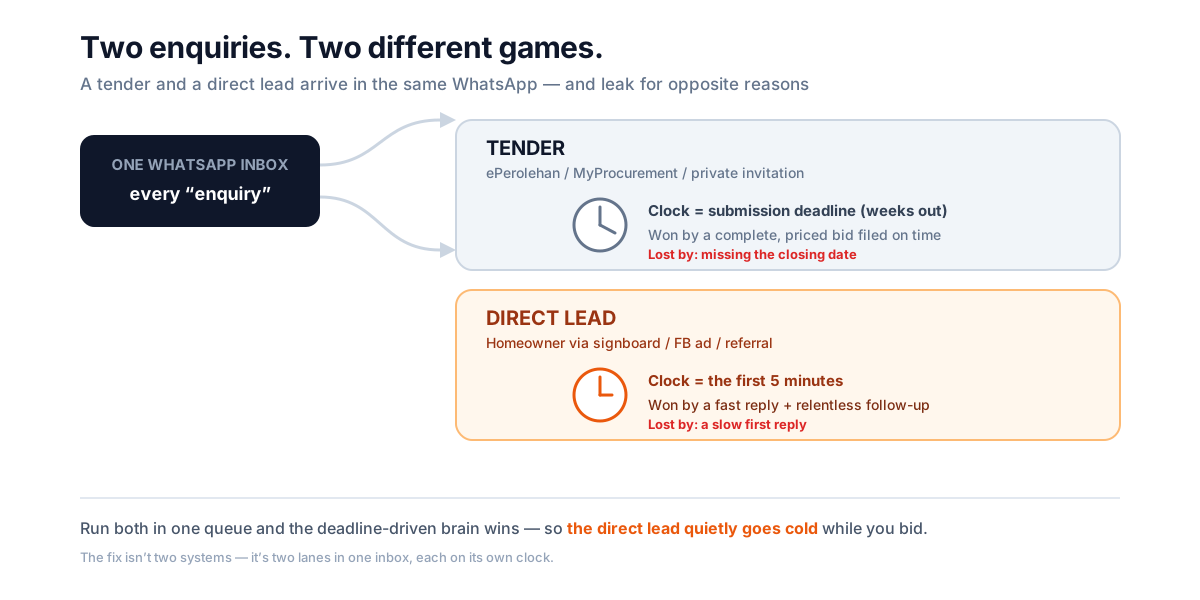
A tender is a formal bid you submit against a fixed deadline; a direct lead is a buyer messaging you straight for a quote. One is won weeks out by a complete, competitive submission. The other is won in the first hour by a fast reply. Same English word — "enquiry" — but two different games with opposite clocks.
A tender usually comes through a process. Government work flows through ePerolehan, the federal e-procurement portal, with opportunities also advertised on the Ministry of Finance's MyProcurement site. You register, download the document, price a Bill of Quantities, and submit electronically before a hard deadline. Private and developer tenders work similarly — an invitation, a BQ, a closing date, a long list of competitors. Nobody scores you on how fast you said "noted." They score the bid.
A direct lead is the homeowner from the JB story. They saw your signboard, your Facebook ad, or got your number from a friend, and they messaged WhatsApp. There's no document, no deadline, no formal process — just a buyer deciding, often within the same afternoon, which contractor feels responsive enough to trust. (This is the whole front of the funnel we cover in the complete guide to managing renovation leads in Malaysia.)
Why does treating them the same lose you both?
Because the reflexes cancel out. The urgency a tender feels like it deserves gets spent on a bid that doesn't reward speed, while the direct lead that genuinely needed a reply in minutes sits cold. You over-react to the one with weeks of runway and under-react to the one with minutes.
Watch the two clocks side by side and the problem is obvious:
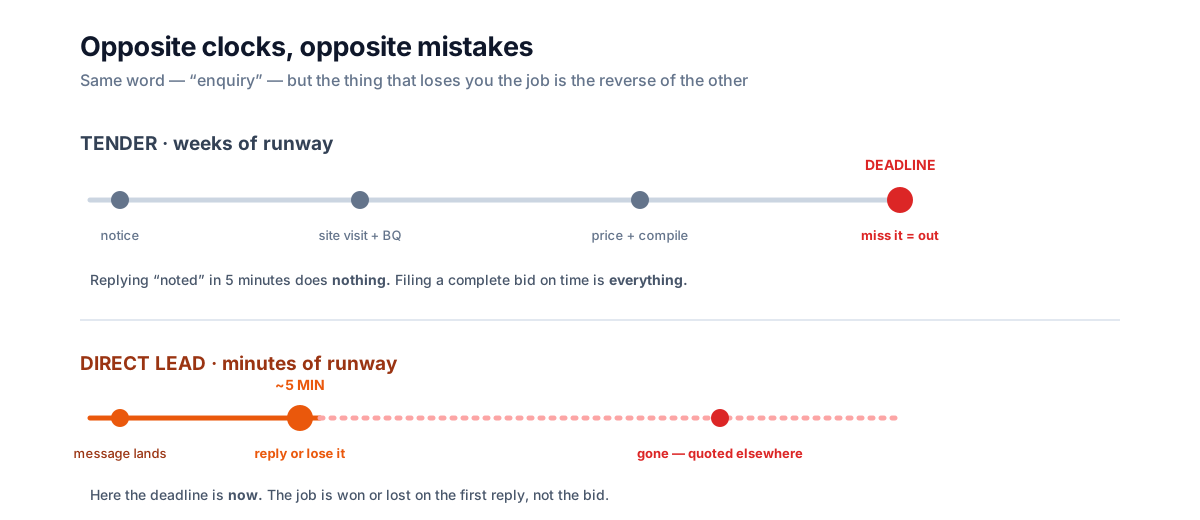
A tender is won or lost on the submission deadline — a date often two to four weeks out. What matters is a complete, correctly priced bid filed on time. Replying to the invitation in five minutes does nothing; missing the closing date by five minutes disqualifies you completely.
A direct lead is the mirror image. It's won or lost on the first reply. The renovation industry's worst-kept secret — the five-minute reply window that makes you roughly 100× more likely to connect (MIT/HBR lead-response research) — is real and it's brutal. A homeowner who waits two days for your quote has already been quoted by two competitors.
How the two sales motions actually differ
Lay them next to each other and you can see why they need different handling, not the same chat. This is the table I wish that JB contractor had taped above his desk:
| Tender enquiry | Direct project lead | |
|---|---|---|
| Where it comes from | ePerolehan, MyProcurement, developer/private invitation | WhatsApp from a signboard, FB/IG ad, referral |
| What the buyer wants | A complete, compliant, competitive bid | A fast, trustworthy quote and a human who replies |
| What wins it | A correctly priced BQ filed before the deadline | Speed to first reply + relentless follow-up |
| What loses it | Missing the closing date; pricing wrong; bidding above your grade | A slow reply; no follow-up after the quote |
| The clock that matters | Submission deadline (often 2–4 weeks out) | The first 5 minutes, then the next 5 follow-ups |
| Win rate | Low by design — often 1 in 5 to 1 in 10 | Much higher — you're often one of two or three |
| Who should own it | Whoever prices and compiles bids | One salesperson, instantly, end to end |
These aren't shades of the same task. They're two jobs that happen to arrive in the same WhatsApp — and the moment you treat the inbox as one queue, the faster, deadline-driven part of your brain wins, and the direct leads quietly rot.
Why your CIDB grade decides which tenders are even real
Before you spend an hour on a tender, your CIDB grade tells you whether you're allowed to win it at all. Contractors register from G1 to G7, and each grade caps the project value you can tender for — so a tender above your limit isn't a lead, it's a non-starter.
The ceilings, per CIDB's grading, run like this:
| Grade | Tender value limit |
|---|---|
| G1 | up to RM200,000 |
| G2 | up to RM500,000 |
| G3 | up to RM1 million |
| G4 | up to RM3 million |
| G5 | up to RM5 million |
| G6 | up to RM10 million |
| G7 | no limit |
A G3 contractor eyeing a RM4 million tender is wasting the whole team's week — they can't be awarded it. With roughly 90% of Malaysia's registered contractors being SMEs (the smaller G1–G5 bands), this is a live filter for most firms, not a technicality. Knowing your grade is the first, cheapest "no-bid" decision you can make — it kills the wrong tenders before they steal time from a direct lead you'd actually close.
Why chasing every tender is the expensive habit
Tenders feel like progress — there's a document, a deadline, a process, so it feels like real work. But the win rate is unforgiving, and most contractors never measure it. Across the industry, a healthy bid-hit ratio for public or heavily-competed work sits around one win for every ten bids (roughly a 15% win rate); for less-competed private work, around one in four. And in a survey of over 2,000 construction firms, fewer than 6% actually knew and tracked their own ratio.
Sit with that. If you win one tender in eight, then seven out of every eight tender weeks produced no revenue — they were a cost. That cost is paid in the exact hours your direct, higher-probability leads needed. The discipline that separates contractors who grow from contractors who just stay busy is a cold bid/no-bid decision: is this tender within my grade, in my zone, against beatable competition, and worth more than the direct leads it'll cost me to chase? If not, no-bid it and put the hours where they convert.
This is the same "where do my jobs actually leak" thinking we apply to the numbers every reno firm should track — except here the most expensive leak is the attention a low-odds tender drains from leads you'd win.
How do you split the pipeline without buying two systems?
You don't need two CRMs — you need two lanes in one inbox. The fix is to tag each enquiry by type the moment it lands, then run each lane on its own clock. Five steps:
- Tag on arrival: tender or direct. The first decision on any enquiry is which game it is. A tender goes into the deadline lane; a direct lead goes into the fast-reply lane. One word, decided immediately, stops the two from blurring.
- Give every direct lead one owner, instantly. No "anyone free to take this?" in a group — that's how leads die (we wrote a whole piece on it). One named salesperson owns each direct enquiry the second it lands, even when the team's on-site.
- Put a follow-up clock on direct leads. The first reply gets the lead; the follow-up wins the job — most close on the fifth touch or later. A next-action date and an overdue flag carry it there so it doesn't depend on memory.
- Run tenders off a deadline calendar, not your inbox. Each tender needs a submission date, a site-visit date, and a bid-ready checkpoint — driven by the closing date, not by whoever scrolls past it. The deadline is the boss.
- Make a bid/no-bid call on every tender — fast. Check the grade, the zone, the competition. No-bid the wrong ones without guilt and hand those hours to the direct leads. A quick no is cheaper than a slow loss.
How HotLead helps a contractor run both lanes
HotLead sits as a light layer on top of the WhatsApp your enquiries already land in — nothing changes for the person messaging you — and it's built to keep these two lanes from collapsing into one:
- Captures and source-tags every enquiry the moment it arrives, so a direct homeowner lead never sits unseen while the team is buried in a bid.
- Routes each direct lead to one owner instantly — round-robin, manual, or custom rules we set up (by area or job type) during onboarding — so there's no group-chat scramble and the five-minute window actually gets hit.
- Keeps a next action and flags overdue follow-ups, so both the fast first reply and the fifth follow-up happen — and a tender's submission date can sit on the same clock so it never sneaks up on you.
- Shows your funnel and per-channel ROI, so you can finally see whether direct leads or tenders actually produce paid jobs — and stop pouring weeks into a bid lane that loses nine times in ten.
If your firm keeps losing the homeowner jobs you'd easily win because the whole team is heads-down on a tender, the leak isn't effort — it's that both are fighting in one inbox. Start with the contractor lead-management hub, see the complete guide to managing renovation leads in Malaysia, or see how HotLead works.
Sources: CIDB contractor grades and tender value limits (G1–G7) from Infraconcrete — CIDB Grading G1 to G7 Explained and GetFoundation — CIDB Grade G1–G7 Requirements; SME share of registered contractors (~90%) from MISHU — A Glance at CIDB Contractor Grades. Government tendering via ePerolehan and MyProcurement. Bid-hit ratio benchmarks and the <6% who track theirs from DownToBid — Bid-Hit Ratio and Construction Business Owner — Improve Your Bid-Hit Ratio. Five-minute reply window from the MIT / Dr. James Oldroyd study via Harvard Business Review. The JB contractor scenario is illustrative; the pattern is one we see repeatedly.
Frequently asked questions
What's the difference between a tender enquiry and a direct project lead for a contractor?
A tender is a formal invitation to bid — usually government (via ePerolehan) or a larger private or developer project — where you submit a priced Bill of Quantities against a fixed deadline and compete with a long list of contractors. A direct project lead is a homeowner or business messaging you straight on WhatsApp for a quote. The tender is won by a complete, competitive submission filed on time; the direct lead is won by a fast first reply and relentless follow-up. They look like the same word — "enquiry" — but they are two different sales motions.
Should I reply to a government tender as fast as I reply to a WhatsApp lead?
No — and that confusion is the trap. A formal tender is scored on your submitted bid, not on how fast you acknowledged it, so the clock that matters is the submission deadline, often weeks away. A direct homeowner lead is the opposite — the five-minute reply window decides whether you even get to quote. Use the same reflex on both and you over-react to the tender and under-react to the lead that was actually slipping away.
Why do contractors lose direct homeowner leads while chasing tenders?
Because tenders feel urgent and important — there's a deadline, a document, a process — so they pull all the attention. Meanwhile a homeowner who messaged "can you quote my extension?" sits unanswered because the whole team is heads-down on a bid. The homeowner messages two other contractors, one replies within the hour, and the job is gone before anyone on your side even saw the chat. The tender had weeks of runway; the direct lead had minutes.
How do I separate tender enquiries from direct project leads without buying two systems?
Tag every enquiry by type the moment it lands — tender or direct — so they live in two clear lanes inside one inbox instead of one messy chat. Give direct leads a single owner and a follow-up reminder so the five-minute window and the fifth follow-up both get hit. Give tenders a deadline-driven checklist so the submission date, not your memory, drives the work. That's a process and a light layer on top of WhatsApp, not two separate CRMs.
Does my CIDB grade affect which leads I should chase?
Yes, for tenders specifically. CIDB grades run G1 to G7 and each caps the project value you're allowed to tender for — G1 tops out around RM200,000 and only G7 has no limit. So a tender above your grade isn't a lead at all; it's wasted effort before you price a single line. Direct private jobs aren't graded the same way, but knowing your limit stops you pouring bid hours into work you can't legally be awarded.
Keep reading
- Can AI Write the Weekly Lead Report a Renovation Owner Will Actually Act On? I Built It, Then Killed ItYou've finally got the dashboard — funnel, per-channel numbers, who's fast. You look at it on Sunday night and think, now what? So the 2026 reflex is to ask AI to read it all and write you a weekly report. I built that bot, ran it for a month, and killed it. Here's why an AI-narrated report is a trap for a small reno firm — it restates what you can see, invents causes it can't know, and calls random noise a trend — and the boring version that actually moved something.
- How Long Does It Take to Close a Renovation Lead in Malaysia? The Sales-Cycle Clock Owners Never WatchMost owners track their conversion rate and ignore the other half of the picture — how long a deal actually takes. In home improvement the sales cycle has doubled from 30 days to 60-plus, and a Malaysian reno runs longer still because of loan approval and vacant-possession keys. Here is what a healthy time-to-close looks like, why you should not try to shorten the buyer's half of it, and how deal age tells you a stalled lead from one that is simply marinating.
- The JMB Enquiry Isn't a Homeowner Lead — Why Contractors Lose Strata Building WorksA WhatsApp from a JMB chairman asking you to quote a condo repaint or waterproofing job looks like any other lead — so contractors answer it like a homeowner, and lose. The buyer is a committee that votes over months, not a person deciding this afternoon. Here's how to win the strata job.