

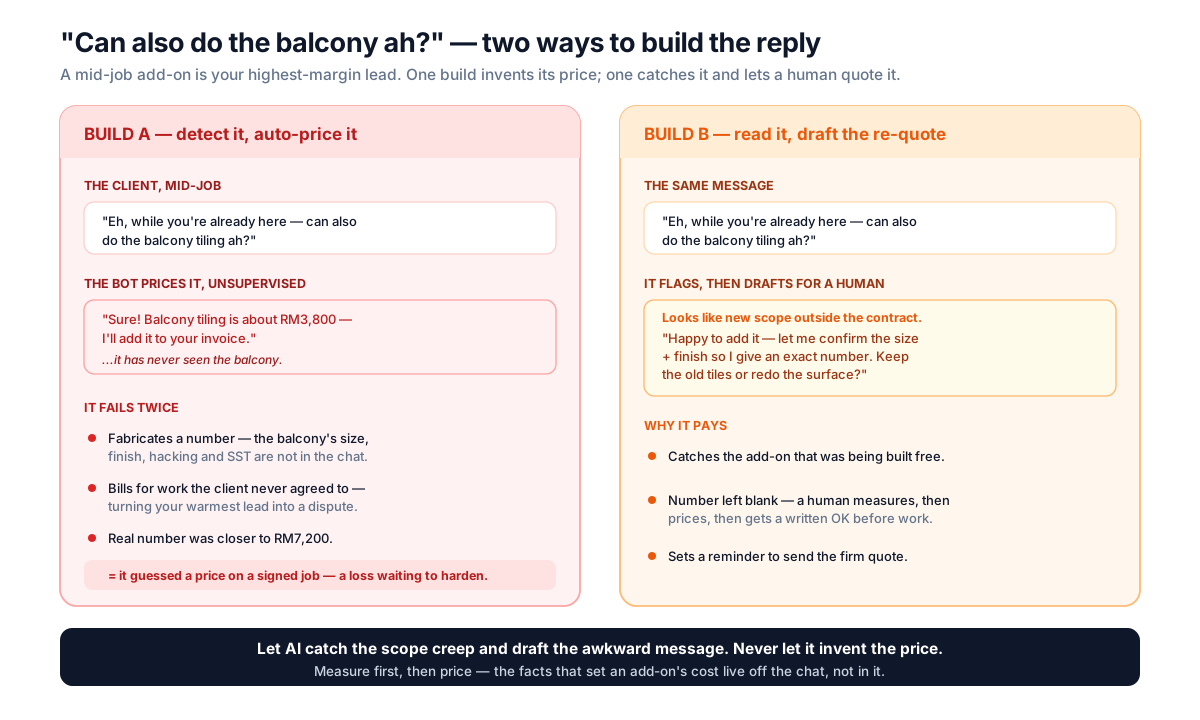
Three weeks into an RM80,000 condo renovation in Ampang, the kitchen is coming along and the client is happy. One evening she messages: "Eh, while you're already here — can also help do the balcony tiling ah? And maybe a feature wall in the living room."
Watch what most owners do with that message. The reflex is a cheerful "boleh boleh, no problem, later we settle" — and in that one line, a firm has just agreed to build a balcony and a feature wall without a scope, without a price, and without anyone deciding whether it's even profitable. The work happens. Then on invoice day comes "wait, I thought the balcony was included?" — and the owner either eats it or fights for the money at the single worst moment, right before final payment and the Google review.
That message wasn't an interruption. It was a lead — the warmest, cheapest, highest-margin lead the firm will get all month — and it leaked because it arrived through a side door dressed as friendly chat. So the 2026 reflex writes itself: "Can't AI just watch my job chats, spot when a client asks for extra work, price it, and drop it onto the invoice before I forget?"
I built it. Within an hour it had read "can also do the balcony ah?" and confidently replied "Sure! Balcony tiling is about RM3,800, I'll add it to your invoice." It had never seen the balcony. Here's why that number is the most expensive thing AI can do to a renovation job — and the version of the build that catches the scope creep without guessing a price it can't know.
Why is "while you're already here" the most dangerous message you'll get?
Because it's the highest-margin lead in your business and the easiest one to build for free — at the same time. A fresh enquiry comes through the front door: a stranger on Qanvast, a Facebook-ad form, a referral. It gets quoted, because quoting is obviously what you do with an enquiry. The add-on comes through a side door — a WhatsApp from a client you're already working for, mid-job, wrapped in a friendly sentence about how nice the kitchen's turning out. The commercial decision is hiding inside a casual conversation, so it never triggers the quoting reflex. It triggers the keep-the-client-happy reflex instead, which says "boleh."
The money this leaks is real and it's local. Malaysian variation-order research is remarkably consistent on one point: the owner's own changes to scope are a leading driver of cost and time overruns on local projects. A case study of terrace-housing projects in Selangor (Mohammad, Che-Ani & Rakmat, 2017) found variation orders inflated project cost by around 14% and the build time by around 63%; a separate study of residential projects published in Planning Malaysia found owner-initiated changes to scope, materials and specification were statistically significant causes of exactly those cost and duration blow-outs. These are measured, published numbers — not a vendor's scare stat.
Now put it in SME terms. On that RM80k job at a 20% gross margin, your whole profit is RM16,000. The balcony add-on, done properly, costs you maybe RM4,000 in tile, waterproofing, labour and an extra site day. Build it for free and you haven't lost RM4,000 of revenue — you've lost RM4,000 of profit, a quarter of the job's entire margin, on one "boleh." Two or three such "can also" moments across a job and your 20% margin is quietly a 12% margin. And since 1 July 2025, construction services carry 6% SST (registration threshold RM1.5 million), so a properly-quoted add-on isn't just lost margin when you skip it — it's a taxable supply you were supposed to charge for and remit, waved away in a one-word reply.
So what did the flashy build do? (Build A)
It auto-priced the add-on and dropped it onto the invoice — and to do that, it invented a number it had no way of knowing. Build A is the one everyone pictures: "AI, watch my job chats; when a client asks for extra work, price it and add it to the bill." Hands-off, instant, never forgotten. In practice it walked straight into the one trap that matters.
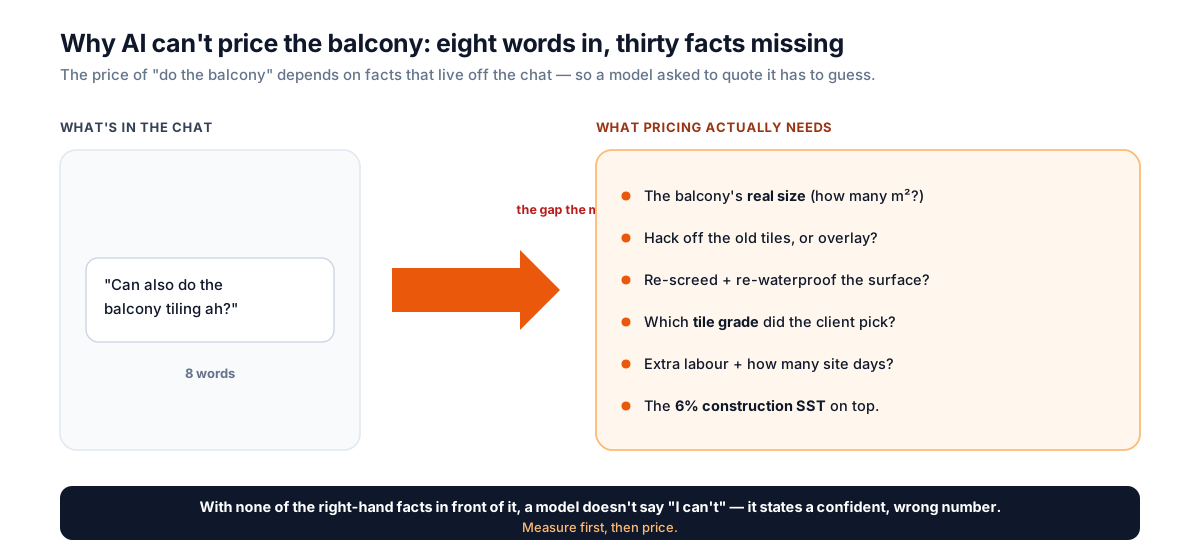
The price of "do the balcony" depends on a stack of facts, and almost none of them are in the chat: how many square metres the balcony actually is, whether the existing tiles have to be hacked off, whether the screed and waterproofing membrane need redoing, what grade of tile the client wants, how much extra labour and how many site days it adds, and the SST on top. The client wrote eight words. Build A needed thirty data points and had zero.
So what did it do? It did what a language model always does with a missing fact: it produced a confident, plausible one anyway. "About RM3,800." Not because it reasoned about the balcony — it hadn't seen the balcony — but because "balcony tiling" pattern-matches to a number in that range. This is the failure mode every build in this series eventually hits, and it has a name in the research: fabrication. Recent 2026 evaluations of models on input-bound tasks (where the only honest answer is "use what's in front of you") found something sobering — fabrication rates swung from near-zero to over 50% between models with almost identical grounding scores (see the document-QA study and the RIKER evaluation, both 2026). In plain terms: whether your model invents the balcony price or admits it can't know is close to a coin toss that depends on which model you happened to wire in. That's not a risk you want sitting between a client and an invoice.
And fabrication is only half of Build A's problem. The other half is that it billed for work the client never confirmed. "I'll add it to your invoice" turns a casual "can also?" into a line item the client never said yes to — which is the fastest way to turn your warmest lead into a dispute and a one-star review.
Why can't AI just price the add-on itself?
Because the facts that set the price live off the chat — on the balcony, in the tile shop, and in the owner's head — not in the message a model is reading. This is the same wall as every other build in what AI still can't do in a contractor's lead process: the deciding information isn't written down anywhere the model can see it. "Do the balcony" is a single phrase hiding wildly different jobs:
- A small, straightforward overlay — new tiles over sound existing ones, no hacking. Cheap, half a day.
- A full strip-out — hack the old tiles, re-screed, re-waterproof, re-tile. Several times the cost and three or four extra days.
- A premium finish the client saw on Pinterest — imported tile at RM180/m² and a specialist installer, nothing like the house-standard rate.
The words are identical. What separates them is the balcony's actual condition and the client's actual taste — neither of which is in the thread. This is the same scope-ambiguity trap as having AI read a supplier or subcon quote or turn a site voice note into a scope record: the number is meaningless without facts that aren't on the page. The one-question test from earlier in the series settles ownership cleanly — is the answer written in the chat? No. So AI's job is to catch the request and draft the reply; a human who can measure the balcony sets the price.
What did the build that actually paid look like? (Build B)
It reads the thread, flags "this looks outside your signed scope," and drafts the warm priced-add-on reply with the number left blank and one scope question — then it stops. Same shape as every build in this series that's earned its keep: AI reads and drafts the awkward part; the person who can see the balcony decides the number and sends.
Pointed at the same message, Build B doesn't quote anything. It says: "Heads up — this looks like a new scope item outside the signed contract (balcony tiling + a feature wall). Here's a draft you can price and send: 'Love that idea — happy to add the balcony and the feature wall. Let me confirm the size and finish so I give you an exact number, not a rough one — I'll send it by tomorrow. Quick q: do you want to keep the existing balcony tiles or redo the surface? Once you reply OK to the figure I'll slot it into the schedule.' Want me to set a reminder to send the firm quote tomorrow?" Then it waits. The difference between the two builds reads small and is the whole game:
| Build A — "detect it, auto-price it" | Build B — "read it, draft the re-quote" | |
|---|---|---|
| What it sends | A price + an invoice line, instantly, unsupervised | A priced-reply draft with the number blank — a human sends it |
| Where the price comes from | Invented from a phrase it can't ground | A person who measures the balcony |
| On a missing fact | Fabricates a confident number | Asks the one scope question that resolves it |
| Who agrees the charge | Nobody — it's billed, not agreed | The client, in writing, before work starts |
| Risk it creates | Underpriced work + a disputed invoice | Thirty seconds of mild formality |
| The follow-up | Forgotten once it's "handled" | A dated reminder to send the firm quote |
| What it costs per draft | — | ~0.1 sen, illustrative |
Why does the modest version pay? Because it fixes the leak that actually loses money — the add-on built for free — without creating a worse one. The expensive mistakes here aren't failures of speed; they're failures of knowing. Build B never pretends to know the balcony. It does the two things AI genuinely is good at — noticing that a message crossed the line into new scope, and writing the slightly awkward "that's an add-on" sentence an owner keeps putting off — and hands the one judgement that needs a human (the number, and whether to goodwill it for a loyal client) back to the human.
What should an owner actually do with a mid-job add-on?
Run it like the lead it is: capture it, price it properly, and get a written yes before you build it. Most of the win is a habit plus a thin layer of software; the AI is a drafting assistant, not an estimator.
- Capture it as a lead, not a chore. The moment a client asks for extra work, it's an opportunity with its own scope, price and yes/no — log it where you'll see it, don't leave it buried in a chat you'll scroll past. This is the same add-on lead Sarah writes about from the ops side; the AI angle is just catching it automatically.
- Never say "free." "Boleh, no charge lah" feels generous and costs you a slice of the job's whole margin. If you choose to goodwill a small extra for a great client, do it as a deliberate decision with eyes open — not as a reflex to dodge an awkward sentence.
- Measure before you price. The single rule that beats Build A: don't fire back a fast number to seem responsive. "Let me confirm the size and finish, firm number tomorrow" wins more than a wrong napkin figure. A low guess you're then stuck with is the costliest kind of fast.
- Re-quote in one line, get the OK in writing. Scope, price, extra days, SST, "reply OK to proceed." Thirty seconds of typing is the entire gap between your highest-margin sale and your ugliest dispute — the same discipline as chasing an unsigned quote, applied to the add-on.
- Don't let the re-quote get forgotten. The add-on dies the same way the original lead does — nobody owns the next step. Put a due date on "send the balcony quote" so it surfaces itself instead of living in your memory until invoice day.
How HotLead fits — honestly
I'll be straight, the way I try to be in all of these, because over-claiming is the exact hype I keep arguing against. HotLead does not detect scope creep, and it does not price or bill variation orders for you — auto-pricing an add-on is the experiment in this piece, and the piece is the argument for keeping your own hand (and your tape measure) on that number. What it ships is the plumbing that stops the add-on from leaking:
- The whole thread on one lead record. So "can also do the balcony?" lands somewhere you'll see it and can quote against, instead of being buried in a chat between messages about tile colours. The same single record that keeps a long quote thread straight is what makes an add-on visible as a real opportunity.
- A next action and an overdue flag on every lead. So "send the firm balcony quote tomorrow" is a due step in plain sight, not a good intention you lose by invoice day. The add-on gets chased like any other open quote.
- One owner per job, by rule. So the add-on isn't orphaned mid-conversation — the person running the job holds the re-quote, and the decision to charge or goodwill it lands on someone, not into a void.
- A funnel that treats the add-on as its own opportunity. So a mid-job extra is a tracked yes/no with a value attached — not unpaid work you discover at final payment. You can see how many add-ons you're actually converting, instead of how many you quietly ate.
The judgement of what the balcony really costs, and whether to wave a small one through for a client you love, stays with you — because you're the one who can see the surface, read the tile grade, and weigh the relationship, and the model will just reach for a plausible number. If the deeper problem is leads and money slipping out the side doors of your business, start with the complete guide to managing renovation leads in Malaysia, see how it fits a renovation firm or a construction and contracting outfit, and read the companion builds on the honest limits of AI in a contractor's lead process and having AI read a supplier or subcon quote into a job cost.
Sources: Malaysian variation-order impact is drawn from published academic work: the terrace-housing case study reporting variation orders inflated cost by 14% and build time by ~63% is M.Z. Mohammad, A.I. Che-Ani & R.A.O.K. Rakmat, "Causes and effects of variation orders in the construction of terrace housing projects: A case study in the State of Selangor, Malaysia," International Journal of Supply Chain Management (2017); the finding that owner-initiated changes to scope, materials and specification are statistically significant causes of cost and duration overruns is from "Control of Variation Orders in the Construction of Residential Projects in Malaysia," Planning Malaysia journal. The 6% service tax on construction services (effective 1 July 2025, registration threshold RM1.5 million, with an exemption for contracts signed before that date extended to 30 June 2027) is per Malaysian SST guidance summarised by EY Malaysia and BDO Malaysia. The AI "fabrication" failure mode — that models produce confident outputs for facts not present in the input, and that fabrication rates vary dramatically between models even at similar grounding — is documented in recent evaluations including "How Much Do LLMs Hallucinate in Document Q&A Scenarios?" (arXiv 2026), which found fabrication rates from ~3% to ~50% across models with comparable grounding, and the RIKER evaluation (arXiv 2026), reporting fabrication from 0% to 53.4% across ~20 models on input-bound tasks. WhatsApp's dominance as the first-contact channel (90%+ of Malaysian internet users) is a house figure reused across this series. The RM80k job, ~20% gross margin, the balcony add-on economics, the 20%→12% margin erosion and the ~0.1 sen per AI draft are typical operating numbers reused across this series and labelled illustrative; the Ampang scenario and the AI experiment are described from practice and labelled illustrative, not a controlled trial. No variation price, fabrication rate or conversion figure is invented here — the balcony numbers are labelled illustrative and the model's failure mode is described using the cited 2026 evaluations, not a number of my own.
Frequently asked questions
Can AI automatically price a mid-job add-on request from a WhatsApp chat?
No — and letting it try is the expensive mistake this article is about. The price of an add-on depends on facts that are almost never in the chat: how big the balcony actually is, what grade of tile the client picked, whether the existing surface has to be hacked off and re-waterproofed, how much extra labour and how many site days it adds, and now the 6% construction SST. A model asked to “price this” with none of that in front of it will not say “I can’t” — it will produce a confident, plausible number anyway, because that is what language models do when a fact is missing. Published 2026 evaluations found fabrication rates swinging from near-zero to over half, depending on the model, even when grounding scores were similar. So AI can reliably spot that an add-on was requested and draft the reply; it cannot be trusted to set the number. Measure first, then price.
Why is a mid-renovation add-on request so easy to lose money on?
Because it doesn’t arrive looking like a sale. A fresh enquiry comes through the front door and gets quoted properly. The add-on comes through a side door — a WhatsApp from a client you’re already working for, mixed in with friendly chat about how the kitchen’s looking — so the commercial decision hides inside a casual conversation. The reflex to protect goodwill (“boleh boleh, we settle later”) is exactly what destroys it, because doing the work is not the same as agreeing the price. You build the balcony, then on invoice day you hear “I thought that was included,” and now you’re fighting for money at the worst possible moment — right before final payment and the online review. Malaysian variation-order studies consistently find owner-requested scope changes are a leading driver of cost and time blow-outs; unmanaged, they are a quiet margin killer.
How should I reply when a client asks for extra work mid-job?
Happily, but never silently. Treat it as the warm lead it is, and re-quote it in one WhatsApp line before you touch it: the scope, the price, any extra days, the SST, and “reply OK and I’ll slot it in.” The one rule that saves you is measure before you price — don’t fire back a napkin number to seem fast, because a wrong low number is worse than a slightly slower accurate one. “Happy to add the balcony — let me check the size and finish, I’ll send you a firm number by tomorrow” is a professional on top of the job. “Boleh, free lah” is a firm giving away its profit to avoid thirty seconds of mild awkwardness.
Does charging for every small add-on make me look greedy?
The opposite — the ambush looks greedy, the upfront number looks professional. “Yes, we can add the feature wall, that’s about RM2,400 and two extra days, reply OK and I’ll slot it in” reads as a firm that runs a tight job. Staying quiet, building it, then surprising the client with a bigger final bill they never agreed to is what reads as greedy, and it’s also what Malaysian homeowners — primed by years of renovation-scam headlines — are most primed to distrust. A clear price up front builds trust; a surprise charge at the end destroys it. The smaller the add-on feels, the more important the one-line confirmation is, because small “can also” requests are exactly the ones people skip the paperwork on, and they stack up into the death-by-a-thousand-cans that eats a job.
Does HotLead detect scope creep and price add-ons for me?
No, and I won’t pretend it does — auto-detecting and auto-pricing scope creep is the experiment in this article, and the article is the argument against running it unsupervised. What HotLead ships is the plumbing that stops the add-on from leaking: the whole WhatsApp thread sits on one lead record, so the add-on is captured where you’ll see it instead of buried in chat; a next action and an overdue flag mean “send the balcony re-quote” surfaces as a due task rather than a good intention you forget by invoice day; one owner holds the job by rule; and the funnel lets you treat the add-on as a tracked opportunity with its own yes or no. The judgement — what the work really costs, and whether to goodwill it for a good client — stays with you.
Keep reading
- Quote Turnaround Time — The Renovation Benchmark (and What Each Day Costs)You measure how fast you reply in minutes. You never measure how fast you quote in days — yet that's where the money actually moves. Here's the quote-turnaround benchmark for a Malaysian renovation firm, and the ringgit value of every day you shave off it.
- "Boss, Berapa?" The Renovation Lead That Lands on the Wrong ChannelYour hottest organic leads often arrive where they found you — a comment under a project post, or a DM to your personal account — not the business WhatsApp you actually watch. Here's why those leads leak at the capture step, why an ignored public comment costs more than a missed message, and how to catch a lead no matter which door it walks in.
- "We Went With Another Contractor" — I Built an AI to Win Back a Lost Renovation Lead Instead of Slamming the DoorA Shah Alam firm quotes a RM70k job, chases it for three weeks, and finally gets the message every owner dreads — "thanks, we've decided to go with another contractor." The reflex is a terse "ok, all the best 🙏" and a closed chat. The 2026 reflex is to ask AI to detect the rejection and auto-fire a win-back discount. I built it, and it begged. Here's the version that keeps a near-free option on a re-win without ever chasing a no.