

Ask a renovation-firm owner how the business is doing and you'll usually hear two numbers: revenue this month, and how many enquiries came in. Both feel important. Neither tells you a single thing you can act on tomorrow.
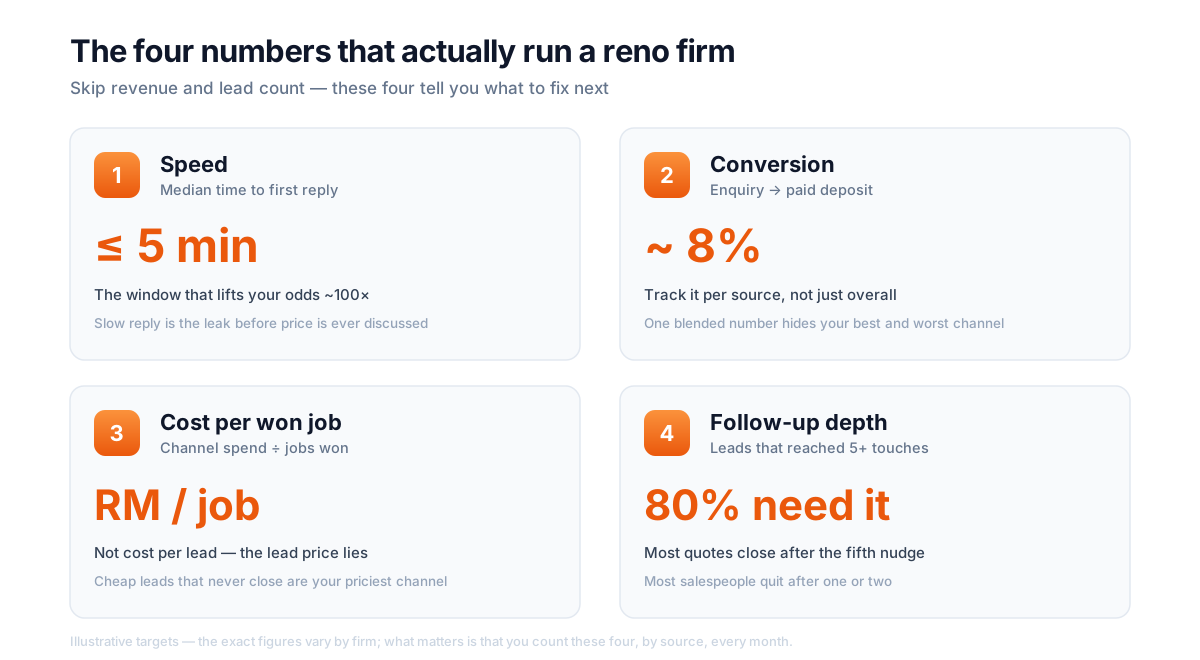
Revenue is a result, not a lever, and total lead count is a vanity number — they describe how the month went, not what to fix next. The four numbers below are different: each one points at a specific leak in your pipeline, and each one tells you exactly where to spend your next hour. Three of them you can pull from a tally sheet; none of them need a data analyst.
Why are revenue and lead count the wrong numbers to lead with?
Because neither one tells you what to do. Revenue is downstream of everything — by the time it moves, the decisions that moved it are weeks old. Lead count rewards the wrong instinct: when sales feel slow, the reflex is "buy more leads," which is the most expensive fix there is if the leak is somewhere else entirely.
Here's the trap in one line. If you only watch leads-in and revenue-out, every problem looks like "we need more leads." But most renovation leads are lost long before price is discussed — in the silent gaps between reply, qualify, consult and quote. Pouring more enquiries into a pipe that leaks at the second stage just means you pay to lose more of them. The four numbers below exist to show you where the pipe leaks, so you fix that before you buy a single extra lead.
Number 1 — Speed: what's your median time to first reply?
Track the median number of minutes between an enquiry landing and a human replying. This is the single highest-leverage number in a reno firm, because the firm that answers first usually wins, and almost nobody answers fast.
The evidence is blunt. Research originating from Dr. James Oldroyd's MIT study (via InsideSales) found the odds of qualifying a lead are roughly 100 times higher when you respond within five minutes versus thirty. Leads contacted in under five minutes close at about 32%, against 12% for those reached after a day. And around 78% of customers buy from the first firm that responds — while the average business takes the better part of two days to reply at all.
Don't track your average reply time — one salesperson on leave for a fortnight will skew it into nonsense. Track the median, and separately, the share of enquiries you answered within, say, an hour. That second number is your speed leak, in plain percentage terms.
Number 2 — Conversion: what share of enquiries become a paid deposit?
Count the percentage of enquiries that end in a cleared deposit — and split it by source. Across home-improvement and remodeling firms, overall conversion sits around 7–8%, with remodeling in the 3–7% band, but the blended figure is the least useful version of this number.
The reason is that your sources don't convert anything alike. A homeowner who found you on Qanvast — the platform over 95,000 Malaysian homeowners have used since 2013 to shortlist a designer — arrives warm, having already seen your portfolio. A cold lead from a boosted Facebook post is often just price-shopping. Blend them into one average and you learn nothing; split them and you discover which channels deserve more budget and which are quietly wasting it.
| What you track | Blended (the lazy version) | Per source (the useful version) |
|---|---|---|
| Enquiry-to-deposit % | "We close about 8%" | Qanvast 14% · referral 22% · FB boost 3% |
| What it tells you | Nothing actionable | Double down on referrals; fix or cut the FB boost |
| The decision it drives | "Buy more leads" | "Buy better leads, and plug the cheap-lead leak" |
The honest definition of a conversion is the deposit clearing — not a verbal "okay let's go ahead," and not a sent quote. Malaysian renovation work is paid in stages starting with a deposit on signing, and everything before the money can still evaporate. Count "won" at the deposit and your conversion number stays honest.
Number 3 — Cost per won job: why does cost per lead lie?
Stop tracking what a lead costs. Track what a won job costs — your spend on a channel divided by the jobs that channel actually produced. Cost per lead is one of the most misleading numbers in marketing, because a cheap lead that never closes is the most expensive lead you can buy.
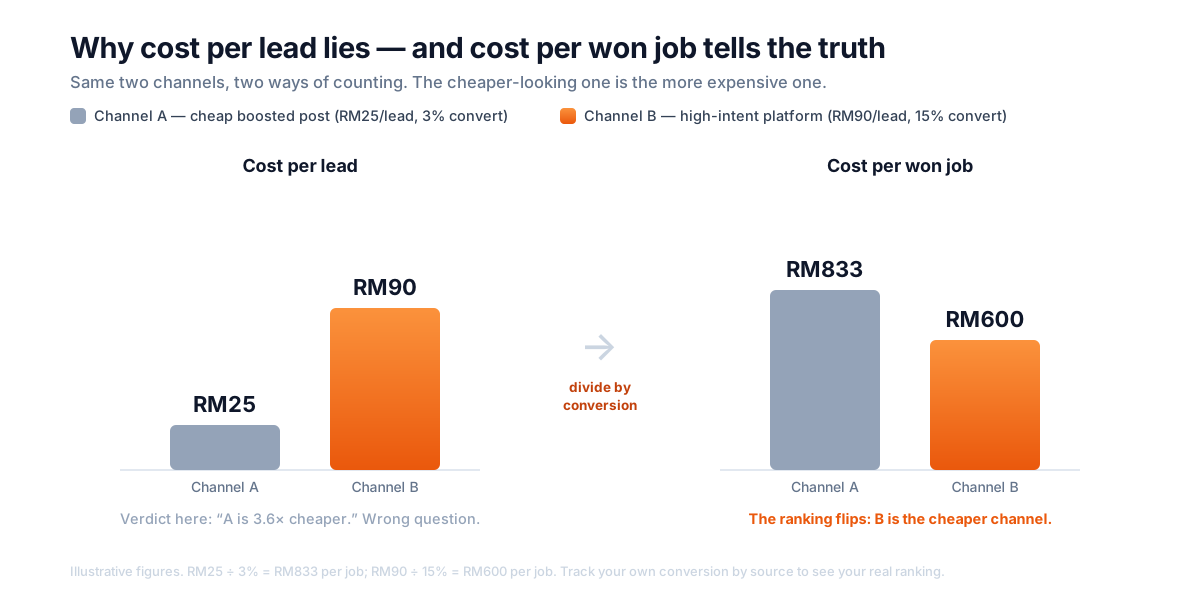
Watch how the ranking flips with real arithmetic. Suppose Channel A (a cheap boosted post) costs RM25 a lead but converts at 3%, and Channel B (a high-intent platform) costs RM90 a lead but converts at 15%:
- Channel A: RM25 ÷ 3% = RM833 per won job
- Channel B: RM90 ÷ 15% = RM600 per won job
Channel A looked 3.6× cheaper per lead. By the only measure that pays your bills — cost per job — it's the more expensive channel. An owner watching cost-per-lead would pour budget into A and slowly starve the business.
For context, US home-services benchmarks put the average cost per lead near USD 91, with construction and contractors around USD 166 and roofing past USD 200 (WebFX / LocaliQ 2025). Useful as a directional reference — but your Malaysian ringgit cost per won job, by channel, is the number that should decide where next month's budget goes. (This is the same logic behind judging software by cost-per-saved-job, not the monthly sticker.)
Number 4 — Follow-up depth: how many leads reach a fifth contact?
Track the share of your live leads that received five or more follow-up contacts before going cold or closing. It's the most overlooked number on this list, and it sits on top of one of the most consistent findings in sales: around 80% of sales require five or more follow-ups, yet most salespeople give up after one or two.
Renovation makes this gap especially expensive. The home-services sales cycle averages around 60 days, and full renovations run longer — clients compare quotes, sort financing, and align the family on scope. A quote that's gone quiet for a week hasn't said no; the client is mid-decision. The firm still gently in front of them at week three is the one holding the deal when they finally commit.
If your follow-up depth number is low, you don't need better salespeople or cheaper quotes. You need a system that keeps the next contact in front of the team so quotes reach the fifth nudge instead of dying at the first.
How do you actually start tracking these — without software?
Run a one-month tally. You don't need a dashboard; you need a sheet and the discipline to fill it in:
- Speed — for every enquiry, jot the minutes to first reply. At month-end, take the median and the share answered within an hour.
- Conversion — count enquiries and deposits, tagged by source. Divide to get a per-channel rate.
- Cost per won job — for each paid channel, divide the month's spend by the jobs it produced.
- Follow-up depth — for each lead, count the contacts. What share reached five?
The biggest gap between target and reality is your priority for next month. Fix the earliest leak first — speed feeds conversion, which feeds cost-per-job — so a one-minute reply lifts every number downstream of it.
The honest catch: a shared WhatsApp number and a manual spreadsheet give you none of these reliably, because the spreadsheet only works if a busy salesperson updates it religiously — which is exactly what collapses in a busy month, precisely when the numbers matter most. That's the practical case for a lightweight system: not more metrics, just honest ones, captured automatically.
How HotLead fits in
HotLead is built to make these four numbers visible for Malaysian renovation, interior-design and construction firms, on top of the WhatsApp you already use. It:
- Captures every enquiry with one clear owner and timestamps the first reply, so your speed number stops depending on memory.
- Shows the funnel and per-channel ROI — enquiries, quotes, wins and drop-offs by source — so conversion and cost per won job are read off a screen, not reconstructed from chat history.
- Keeps the next follow-up in front of your team with overdue nudges, so follow-up depth climbs past the first contact — and surfaces team performance so you can see who's keeping up.
Start with the complete guide to managing renovation leads in Malaysia, see the renovation lead playbook, or read how the six-stage funnel these numbers measure actually works.
Sources: Estatehub and WebFX 2026 home-services lead-conversion benchmarks (overall 7.8%; remodeling 3–7% band); WebFX and LocaliQ 2025 home-services marketing benchmarks (average cost per lead ~USD 91; construction/contractors ~USD 166; roofing USD 200+); MIT / Dr. James Oldroyd and InsideSales on the five-minute response-time advantage (100× odds; 32% vs 12% close rates); Harvard Business Review, "The Short Life of Online Sales Leads" on the first-responder advantage; industry follow-up research (Brevet / Marketing Donut) on the share of sales needing five or more follow-ups; WebFX on home-services sales-cycle length (~60 days); Qanvast Malaysia (homeowners served since 2013).
Frequently asked questions
What numbers should a renovation business track?
Four that lead to a decision. First, speed — your median time to first reply, because the firm that answers first wins most deals. Second, conversion — the share of enquiries that become paid deposits, ideally split by source. Third, cost per won job — what each channel costs divided by the jobs it actually produced, not its cost per lead. Fourth, follow-up depth — the share of leads that received five or more contacts. Revenue and total lead count feel important but tell you nothing you can act on.
What is a good lead-to-sale conversion rate for a renovation firm?
Across home-improvement and remodeling firms, industry benchmarks put overall enquiry-to-sale conversion around 7 to 8 percent, with remodeling specifically in the 3 to 7 percent band. Your own number matters far more than the benchmark, and the useful version is per source — a Qanvast or referral lead typically converts several times better than a cold boosted-post lead, and a blended average hides that completely.
Why is cost per lead a misleading metric?
Because a cheap lead that never closes is expensive. If Channel A costs RM25 a lead but only 3 percent convert, each won job cost you about RM833 in lead spend. If Channel B costs RM90 a lead but 15 percent convert, each won job cost RM600 — so the channel that looked nearly four times pricier is actually the cheaper one. Cost per won job, which is channel spend divided by jobs won, is the only version that ranks your sources honestly.
How many times should you follow up a renovation lead?
More than most firms do. Around 80 percent of sales need five or more follow-ups, yet most salespeople stop after one or two. For renovation, where the sales cycle runs weeks and clients compare several quotes, persistence is often the whole difference between a won job and a ghosted quote. Tracking the share of your leads that actually reached a fifth contact tells you whether your follow-up is a system or a good intention.
Do I need software to track these numbers?
No — you can start with a tally sheet for one month. Count enquiries, how many you replied to quickly, how many became deposits by source, what each source cost, and how many leads got a fifth follow-up. The catch is that a shared WhatsApp number and a spreadsheet only stay accurate if a busy salesperson updates them religiously, which is exactly what breaks in a busy month. That is the practical case for a lightweight system — not more numbers, just honest ones kept automatically.
Keep reading
- Did We Already Say RM68k? Using AI to Stop Quote Drift Across a Long Renovation ThreadOver a weeks-long WhatsApp thread with two or three quote revisions, a rep re-states a number that contradicts an earlier promise — and re-opening a settled price quietly invites a discount that eats a whole job's profit. So I pointed AI at the drift. It works beautifully as a flag, and dangerously as an auto-corrector.
- The Warranty as a Closing Lever: Why a Longer Guarantee Beats a Discount on a Renovation DealA quote is stalling and the buyer wants a reason to say yes. Before you drop the price, look at the other lever in your hand — a longer workmanship warranty. It is the same expected-value decision as a discount, but the math runs the opposite way — a price cut costs you thousands with certainty, while extending the defects cover costs you a couple of hundred ringgit in expectation, for arguably more trust with a scam-wary buyer. Here is the EV case for the non-price concession, the trap that turns it into a hidden liability, and which leads it actually moves.
- "Can You Just Build It, My Neighbour Also Did" — Handling the Renovation Lead That Needs Council Approval FirstSome renovation enquiries can't legally start next month, no matter how ready the buyer is — a kitchen extension, a hacked-through wall, a roofed-over air well all need the council's written approval first. Quote a fast build price to win the job and you either lose it to a "boss, can start" cowboy, or win it and inherit the stop-work order, the RM50,000 fine and a client who later can't sell the house. Here's how to spot the permit-first lead and sell the approval as protection.