

Ask a renovation-firm owner how they price a job and you'll often hear a version of this: "I take my cost, add 20 percent, and that's my profit." It sounds disciplined. It sounds like someone who knows their numbers. And it quietly leaves money on the table on every single quote they send.
Here's the problem in one line: a 20 percent markup is not a 20 percent margin — it's a 16.7 percent margin. Markup is measured against your cost; margin is measured against your price. They are two different numbers, and if you calculate your quote one way while thinking about your profit the other way, you underprice yourself by a few points on every job — a leak that never shows up in any single deal but drains six figures a year across a full calendar.
This piece does the arithmetic with Malaysian renovation numbers, gives you a markup-to-margin conversion table you can pin above your desk, and shows why this quiet error becomes genuinely dangerous when it stacks with the "boleh kurang?" discount reflex — the point at which owners end up keeping less than a third of the profit they thought they'd priced in.
What's the actual difference between markup and margin?
Markup is your profit as a percentage of your cost. Margin is that same profit as a percentage of your selling price. Same ringgit of profit, two different bases — and because your price is always bigger than your cost, the margin percentage is always the smaller of the two.
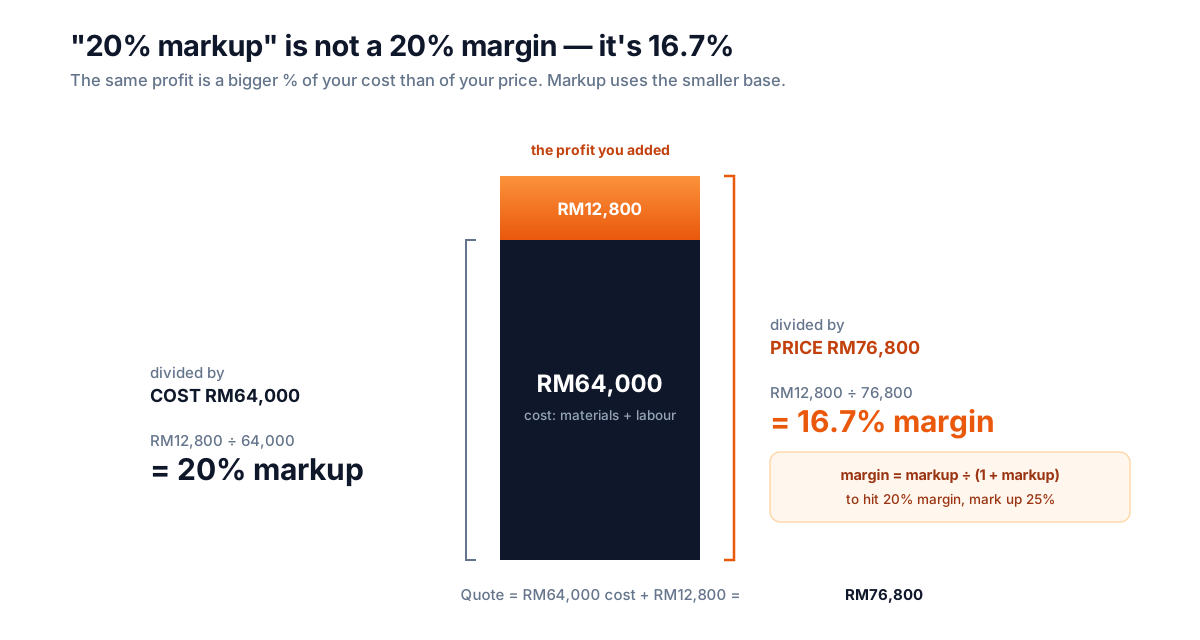
Walk it through with a figure consistent across this series. Your cost on a mid-band condo job — materials plus subcontracted labour — is RM64,000. You "add 20 percent":
- Markup added: 20% of your RM64,000 cost = RM12,800
- Price quoted: RM64,000 + RM12,800 = RM76,800
- Your profit: RM12,800
Now measure that RM12,800 profit the way your bank account actually experiences it — against the RM76,800 you invoiced, not the cost:
- Margin: RM12,800 ÷ RM76,800 = 16.7%
So the "20 percent" you added is a 20 percent markup but only a 16.7 percent margin. You thought you built in 20 points of profit; you built in 16.7. On this one job that's a RM3,200 gap versus pricing properly — and it repeats, unseen, on every job you quote the same way.
This isn't a Malaysian quirk — it's basic pricing arithmetic that trips up contractors everywhere. As Procore and JobTread both spell out for builders, "aiming for a 20 percent margin but applying a 20 percent markup only results in a 16.7 percent margin" — and they call it one of the most common causes of underbidding in construction. What makes it bite harder here is the combination of thin local margins and a price-shopping, discount-asking buyer culture, which we'll get to.
Why does the gap between markup and margin matter so much?
Because the gap isn't fixed — it widens as your numbers grow, and it's invisible on any single job. A few points of margin lost on one RM77k quote feels like nothing. Multiply it across fifteen or twenty jobs a year and you've quietly removed tens of thousands of ringgit of profit you never knew you were entitled to.
Here's the full conversion table for the range renovation firms actually work in. Read it as: "if I add this markup, this is the margin I truly keep."
| Markup you add (on cost) | True gross margin (on price) | The gap |
|---|---|---|
| 10% | 9.1% | −0.9 pts |
| 15% | 13.0% | −2.0 pts |
| 20% | 16.7% | −3.3 pts |
| 25% | 20.0% | −5.0 pts |
| 30% | 23.1% | −6.9 pts |
| 40% | 28.6% | −11.4 pts |
| 50% | 33.3% | −16.7 pts |
| 100% | 50.0% | −50.0 pts |
Two things jump out. First, at the low markups a competitive renovation market pushes you toward, the gap is small but real — a 20 percent markup costs you 3.3 points of margin. Second, the gap accelerates: by the time you're adding 50 percent (as you might on a small, fiddly, high-handling job), your "50 percent" is really 33 percent. Anyone quoting on markup while their targets, benchmarks and cashflow planning are all in margin is comparing two numbers that drift further apart the bigger the job.
What number should you actually price on?
Price from your target margin, not a markup — and to do that you need to know the margin your business actually requires. The mechanical fix is one formula: price = cost ÷ (1 − your target margin).
Take the same RM64,000 cost and say your business genuinely needs a 20 percent gross margin to cover overhead and leave a real profit:
- Wrong (markup habit): RM64,000 × 1.20 = RM76,800 → 16.7% margin
- Right (priced for margin): RM64,000 ÷ 0.80 = RM80,000 → 20.0% margin
That RM3,200 difference per job is the markup error, made visible. Note that RM80,000 is exactly the mid-band condo quote used throughout this series — priced honestly for a 20 percent margin, not markup-ed to something that looks like 20 percent.
But the formula is the easy half. The harder, more important half is knowing what your target margin should even be — and that's where the markup habit does its real damage, because it hides your true overhead. As the construction-finance writers put it, markup is a percentage of cost while your overhead is a percentage of revenue, so pricing on markup makes it dangerously easy to add a number that feels healthy but doesn't actually cover the office, the vehicles, the estimator's time and the one job a year that goes wrong. Malaysian residential renovation runs on a gross margin of roughly 18–25 percent — the lower end of the 20–30 percent international remodelers report (BuildBook, Projul) — precisely because the market is competitive. In that thin band, a 3-point margin leak from mis-pricing is the difference between a firm that builds a buffer and one that's one bad job away from trouble.
How the markup mistake compounds with "boleh kurang?"
This is where a quiet arithmetic error turns into a serious one: the markup mistake and the discount reflex stack on top of each other, and neither is visible while it's happening. You underprice once by quoting on markup, then discount off the already-shrunken margin — and the two leaks multiply.
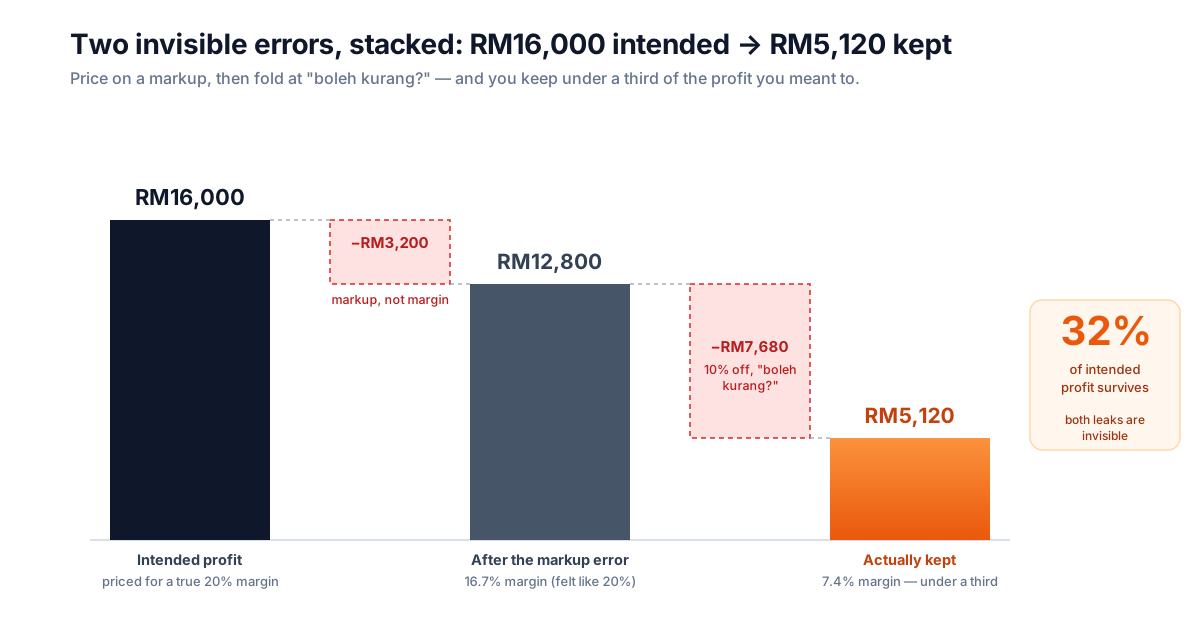
Follow the same job all the way through. You meant to make a 20 percent margin on your RM64,000 cost — a clean RM16,000 profit.
- Error one — you price on a markup. You add 20 percent to cost and quote RM76,800. Your profit is already only RM12,800, not RM16,000. You've lost RM3,200 and don't know it.
- Error two — you fold at "boleh kurang?" The buyer asks for 10 percent off. You knock RM7,680 off the RM76,800. New price: RM69,120. Your cost is still RM64,000. Profit: RM5,120.
You set out to earn RM16,000 and kept RM5,120 — under a third of it — while feeling like you did nothing more than "add a fair markup and give a small discount." That's a 7.4 percent margin on a job you believed was a 20 percent one.
This is the same lesson as the margin math behind discounting, seen from one step earlier in the process. That piece showed a discount lands entirely on your margin; this one shows that if you built the margin wrong to begin with, the discount is eating an even smaller slice than you think. The two errors share a root cause: pricing against the wrong number. Fix the markup habit and you're discounting from a real 20 percent; keep it and every "boleh kurang?" is more damaging than the last article warned.
Why this is a lead-management problem, not just a spreadsheet one
The markup formula lives in your quote, but whether you can hold the price you priced is decided in your inbox. A correctly-priced RM80,000 quote only earns its 20 percent margin if it survives the negotiation — and how hard that negotiation gets depends almost entirely on which lead you're talking to.
A warm referral or repeat client rarely grinds you on price; a cold, price-shopping lead comparing five quotes will push on your number the hardest — and is, as the cost-per-won-job math shows, the least likely to close anyway. If you can't tell which is which at the moment you're quoting, you'll defend your carefully-priced margin inconsistently — holding firm with the buyer who'd have paid and folding with the one who was never going to sign. Fix your markup arithmetic and you've protected the margin on paper; managing the lead is how you protect it in practice.
That's where a system earns its place. HotLead doesn't set your prices — the markup-versus-margin decision is yours, and no software will make it for you. What it does is capture and tag every enquiry by source so that when the quote goes out and "boleh kurang?" comes back, you already know whether you're holding a warm referral worth a genuine goodwill gesture or a cold price-shopper you should hold firm on. Its funnel and per-channel views show you which sources actually convert at full price, so you spend your discount discipline where it pays. Price for a real margin, then defend it with the right lead — that's the whole game.
The renovation firms that quietly make money aren't the ones charging the most. They're the ones who know the difference between a markup and a margin, price from the number that pays their bills, and don't give the second half back at "boleh kurang?"
Getting your pricing right is one half; managing the leads that test it is the other. Start with the complete guide to managing renovation leads in Malaysia, then read what a discount really costs you and what a lost lead is actually worth.
Sources: Procore, JobTread and Bidi Contracting on markup-versus-margin arithmetic and the 20%-markup / 16.7%-margin underbidding trap; Projul markup-to-margin conversion; BuildBook and Projul profit-margins guide on remodeling gross-margin ranges (~20–30%); FindContractor.my and Coohom on Malaysian interior-design material markups (20–40%) and contractor project-management fees (10–15%). House figures (RM80k condo job, RM64k cost, ~RM1,280 expected gross profit per enquiry) are consistent across this series and cross-referenced, not sourced to any single external claim.
Frequently asked questions
What is the difference between markup and margin in renovation pricing?
Markup is your profit as a percentage of your cost; margin is your profit as a percentage of your selling price. They describe the same ringgit of profit against two different bases. Since your selling price is always larger than your cost, the margin percentage is always smaller than the markup percentage for the same job. If your cost is RM64,000 and you add a 20 percent markup, you quote RM76,800 and keep RM12,800 — that is a 20 percent markup but only a 16.7 percent margin. Confusing the two makes you think you are earning more than you are.
Why is a 20 percent markup only a 16.7 percent margin?
Because the two percentages are measured against different numbers. A 20 percent markup means you added 20 percent of your cost. But margin measures that same profit against the bigger selling price, so the fraction shrinks. The exact conversion is margin equals markup divided by one-plus-markup — so 0.20 divided by 1.20 equals 0.167, or 16.7 percent. The higher the markup, the wider the gap grows, which is why owners who quote on markup while targeting a margin quietly underprice every job.
How do I price a renovation job to hit a target profit margin?
Price from the margin, not from a markup. The formula is price equals cost divided by one-minus-your-target-margin. If your cost is RM64,000 and you want a 20 percent margin, divide RM64,000 by 0.80 to get RM80,000 — not RM64,000 times 1.20, which only gives RM76,800 and a 16.7 percent margin. Put another way, to earn a 20 percent margin you need a 25 percent markup, and to earn a 25 percent margin you need a 33 percent markup. Decide the margin your business needs first, then work back to the markup that delivers it.
What is a healthy gross margin for a renovation firm in Malaysia?
Malaysian residential renovation typically runs on a gross margin of roughly 18 to 25 percent, at the lower end of the 20 to 30 percent gross margin international remodelers report, because the local market is competitive and price-shopped. The problem is that common Malaysian pricing habits — "add 20 percent on material," a "10 to 15 percent project-management fee" — are markups on cost, so taken literally they deliver only about 9 to 17 percent margin, several points below the band a firm needs to cover overhead and survive a bad job. Knowing whether your quote is built on markup or margin is the difference between hitting that band and missing it.
Does a discount make the markup mistake worse?
Yes, and the two errors stack invisibly. Suppose you meant to earn a 20 percent margin on an RM64,000 cost. Pricing on a 20 percent markup instead of a 20 percent margin already drops your profit from RM16,000 to RM12,800. If the buyer then asks "boleh kurang?" and you knock 10 percent off the RM76,800 quote, your price falls to RM69,120 while your cost stays RM64,000 — leaving just RM5,120 of profit, barely a third of what you intended. You underpriced once with the markup, then discounted off the smaller margin, and never saw either leak.
Keep reading
- "My Contractor Ran Away — Can You Take Over?" Why the Rescue Job Is Your Most Dangerous LeadA WhatsApp from a homeowner whose contractor vanished mid-job looks like the easiest lead you'll get all week — desperate, committed, half-done. It's actually the most dangerous job in your inbox, and quoting fast to win it is how you inherit someone else's disaster and their blame. Here's how a renovation or contracting firm should handle the takeover lead.
- Can AI Brief Your Estimator Before a Renovation Site Visit?A site visit is one of the most expensive things a renovation firm does — and one in five turns into a second trip because someone forgot to ask something on-site. So can AI read the messy WhatsApp thread and brief your estimator well enough to make the visit one-and-done? I built it two ways. The flashy version is the one that sends you back out.
- What a Discount Really Costs a Renovation Firm: The Margin Math Behind 'Boleh Kurang?'A buyer asks "boleh kurang?" and dropping 10 percent feels harmless — you're still making money, right? Not really. On a thin-margin renovation job, a 10 percent discount hands over half your profit, not a tenth. Here's the leverage math with Malaysian numbers, why the reflex to discount is the most expensive answer, and which leads are even worth cutting price for.