

Here is a loss that feels worse than a slow reply, because you did the hard part right. A Puchong design-and-build firm gets a solid WhatsApp enquiry — a Bukit Jalil condo, kitchen job, buyer is warm and ready. The estimator books a visit, fights an hour of MEX traffic each way, measures the kitchen, drives back. Good visit. Then he sits down to build the quote and the gaps open up one by one: the thread only ever said "kitchen" — is this a wet-and-dry setup, so two rooms? Are the existing cabinets staying or getting hacked? What are the condo management's rules for hacking and debris removal, and is there a renovation deposit? He never confirmed any of it on-site, because thirty scattered WhatsApp messages over four days never made those questions obvious before he left.
So he WhatsApps back. Half the answers come slowly and vaguely. And to price it properly he ends up driving out a second time — another hour each way, another half-day gone — and by the time his quote lands, the buyer has signed with the firm that came prepared and quoted on day four.
That second trip is the leak. And it raises a very 2026 question, the kind this column exists for: now that AI can read a whole messy conversation in seconds, can it brief the estimator well enough to make the visit one-and-done — profitably? I built it two ways. Here is the problem, what the second visit really costs, what the two builds did, and what an owner should actually do on Monday.
What does an under-briefed site visit actually cost?
A renovation site visit is a truck roll, and it should be measured like one. Field-service teams — the aircon, telco and appliance crews who live and die by dispatch efficiency — track a number called the first-time-fix rate: the share of jobs finished in a single visit. The industry average sits around 80 percent, which means roughly one in five jobs needs a second trip. When a call is not resolved first time, it takes an average of about 1.6 extra dispatches to close, and each truck roll runs a couple of hundred US dollars once you count labour, vehicle and lost time.
A reno firm never calls it a truck roll, but that is exactly what a site visit is — and in the Klang Valley the "truck" is stuck on the Federal Highway. This series has already put a number on one wasted visit: about RM300 once you count the hours, not the petrol. The petrol is ~RM12; the real bill is the three hours door-to-door for a 45-minute measurement, in a valley where commuters lose around 528 hours a year to traffic. So a second, avoidable visit is not a minor annoyance — it is another ~RM300 of your most expensive hours, spent to collect information you could have collected the first time.
And the second trip is only half the damage. It also stalls the quote. A renovation buyer is holding three to five quotes at once, and the first complete one tends to win — so every day you lose re-driving to a site feeds straight into the slow-quote leak. The gap that forced the return visit was almost never something exotic. It was a basic fact nobody flagged before the estimator left the office.
So can I just tell AI to write me the site-visit report? (Build A)
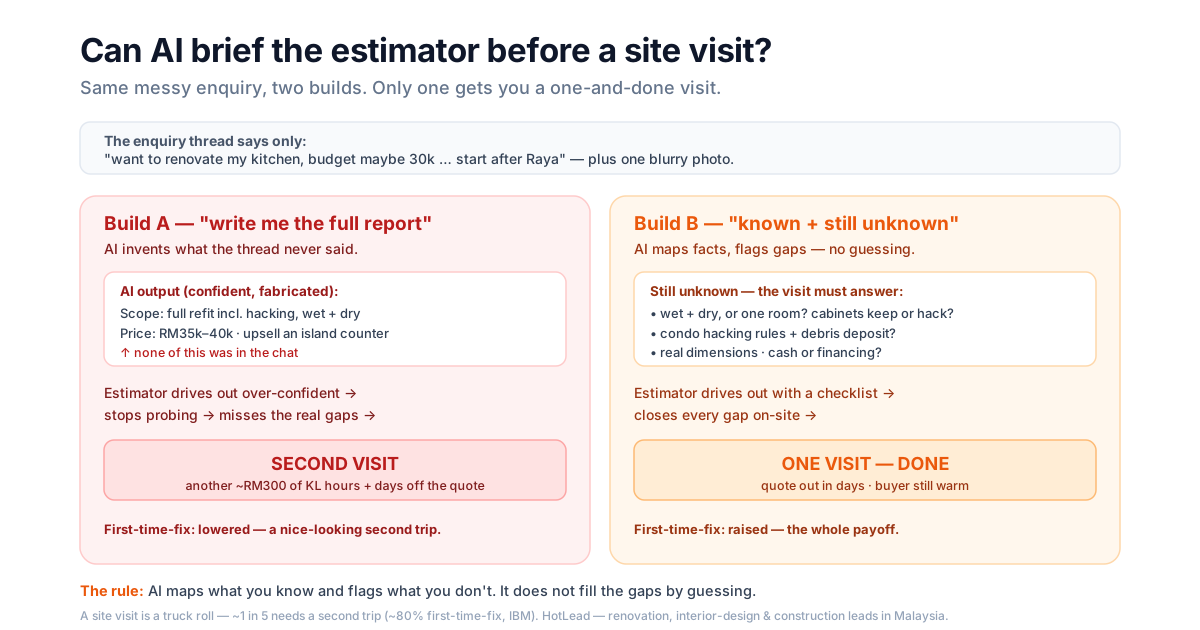
This is the build everyone reaches for first, and it demos beautifully. Build A: point the model at the entire WhatsApp thread — messages, photo descriptions, the voice note you transcribed — and prompt it "you are a senior renovation estimator, read this enquiry and write me a full pre-visit report: the scope of works, the likely job value, and what to quote." And it delivers. Instantly, fluently, formatted like something a consultant charged you for: "Scope: full kitchen refit including hacking of existing cabinetry, new wet-and-dry layout, RM35,000–RM40,000 range. Recommend proposing an island counter upsell."
It looks like preparation. It is theatre — and the specific, expensive kind, because the report invents the two things the estimator most needs to verify.
Look at what the thread actually said: "want to renovate my kitchen, budget maybe 30k." That is it. There was no mention of hacking, no wet-and-dry layout, no island. The model manufactured all of it by pattern-matching to kitchens it has seen, then dressed the guess as a finding. It is the same failure mode as letting AI quote a square footage from a photo or narrate a cause into a weekly report it can't actually know: a fluent, confident answer to a question the input never contained.
That is the trap in one line. The whole point of a brief is to make the visit one-and-done. A brief that confidently fills the gaps instead of flagging them does the reverse: it hands your estimator a false sense of completeness, he asks fewer questions in the unit, and the missing fact — the management's debris rules, the wet-and-dry scope — only surfaces back at the desk. Now he is driving out again. Build A didn't raise the first-time-fix rate; it lowered it, with a nice-looking PDF.
What actually worked: AI maps what you know, and what you don't (Build B)
Build B kept the half AI is genuinely good at and cut the half that invents. Same thread, but the prompt flipped: "summarise only what this conversation actually tells us — unit type, area, stated scope, budget signal, timeline, decision-maker. Do not infer anything not stated. Then list what we still do NOT know that a site visit must answer before we can quote. Then draft one confirmation message for the appointment." No scope invention. No price. Just an honest map and a gap list.
And that, AI does well, because it is a reading job, not a judgment job. For the Bukit Jalil enquiry it returns something like:
- What we know (from the thread): Bukit Jalil condo; buyer says "kitchen"; budget signalled ~RM30k; wants to start after Raya; the wife is in the chat and appears to be co-deciding.
- What we still need to find out on-site: Is this a wet-and-dry kitchen (one room or two)? Are the existing cabinets being kept, refaced or hacked? What are the management's hacking hours, debris-disposal rules and renovation deposit? Actual dimensions of both areas. Is the buyer financing or paying cash (affects the timeline)?
- Confirmation draft: "Hi! Confirming our visit tomorrow 3pm for your Bukit Jalil kitchen. I'll bring rough costing — quick one so I come prepared: is it a wet + dry kitchen, and do you know your condo's renovation rules? See you then!"
The most valuable thing on that page is the middle section — the list of what the thread never told you. That is not a limitation of the AI; it is the entire product. The estimator now drives out with a checklist of exactly the facts that force a second trip when missed, closes them in the one visit, and comes back able to quote. The visit went from a hopeful measure-and-see to a one-and-done. And notice the confirmation draft even pulls the two biggest gaps forward into the appointment message, so some answers arrive before he leaves.
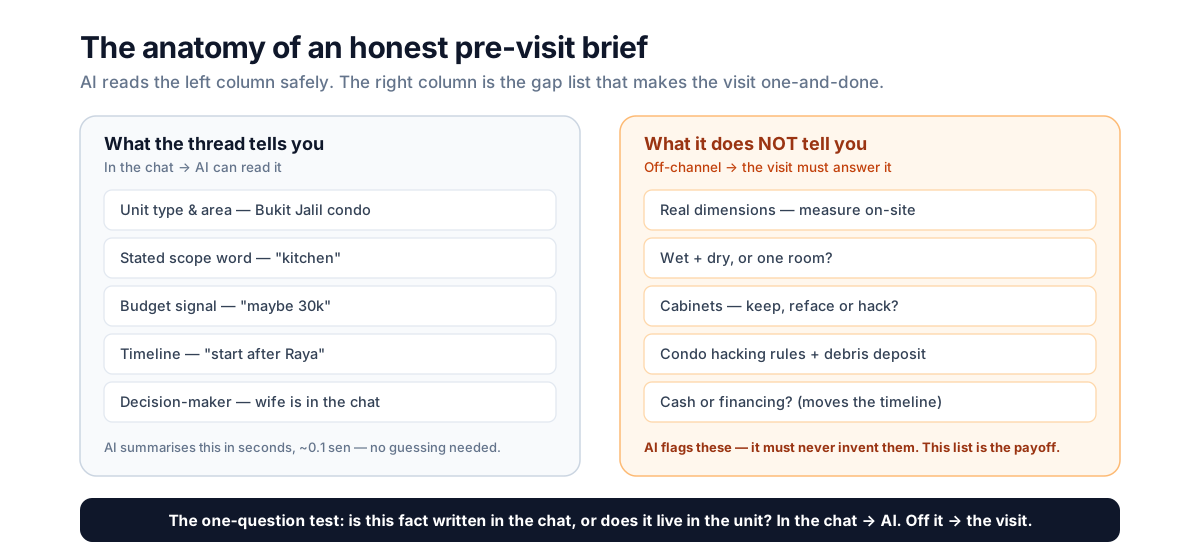
There is a clean test underneath this, the same one every honest AI-in-the-lead-process build lands on: does this fact live in the chat, or off it? What the buyer stated — unit, budget signal, timeline, who's deciding — is in the thread, so AI can read it. The real dimensions, the hacking rules, the hack-or-keep decision — not in the thread, they live in the unit and the management office — so the visit exists to capture them, and AI's job is only to point at them. Build A crossed that line and paid for it. Build B respects it, and every bit of the value is on the right side.
| Build A — AI writes the full report | Build B — AI maps known + unknown | |
|---|---|---|
| Summarises what the buyer actually said | Yes | Yes |
| States a scope of works | Yes — invented, not in the thread | No — only what was stated |
| States a likely price | Yes — anchors a number nobody measured | No — quote stays post-visit |
| Lists what's still missing to quote | No — it "already knows" | Yes — the most useful output |
| Effect on the estimator | Over-confident, probes less on-site | Prepared, closes the gaps on-site |
| Effect on first-time-fix | Lowers it — a nice-looking second trip | Raises it — one visit, done |
Why is this the honest answer for a Malaysian firm right now?
Because the gains from a pre-visit brief are real but they come from preparation, not prediction — and the market data agrees. Field-service firms that adopted AI and modern tooling did see first-time-fix rates rise: about 75 percent of them reported higher FTFR after doing so. But the lift comes from technicians arriving with the right information and the right parts — the digital equivalent of Build B's gap list — not from a model guessing what the job is. Moving first-time-fix from 75 to 85 percent cuts your rework roughly in half; on a small reno firm doing, say, eight visits a week, turning one recurring second-trip a week into a one-and-done is ~RM300 and a slice of a lost job recovered every week, for a tenth of a sen in compute.
There is also a very local reason the gap list matters more here than a generic checklist would. Malaysian renovation gaps are dated and rule-bound: a strata unit has management hacking hours and a debris deposit; a landed extension may need a shared-wall conversation with the neighbour; a handover unit's defect-liability period changes the sequence. These are exactly the facts a buyer never volunteers on WhatsApp and an estimator kicks himself for forgetting. A brief that reliably surfaces "you don't yet know this condo's hacking rules" is worth far more than one that confidently invents the kitchen layout.
What should an owner actually do on Monday?
You do not need to build software to get most of this — you need one discipline and, if you want, one small prompt:
- Never let AI state the scope or the price before the visit. If you use a model to prep, prompt it to summarise only what the buyer actually said and to list what's still unknown. Treat any invented scope or number as a red flag, not a head start — it will make your estimator probe less.
- Turn the brief into a gap checklist, not a report. The useful output is the short list of facts this visit must capture — access and hacking rules, hack-or-keep, real dimensions, who signs. Print it, screenshot it, whatever — carry the questions, not a prediction.
- Pull the two biggest gaps into the confirmation message. The day-before confirmation you should already be sending is free real estate — ask the one or two questions that most often force a return trip, so some answers beat you to the site.
- Keep the whole thread on one record. A brief is only as good as the raw material. If the enquiry's messages, photos and floor plan are scattered across a chat nobody scrolls, even a human can't prep well. One lead, one record, one owner — the context problem an under-briefed visit is really a symptom of.
How HotLead fits — and what it deliberately does not do
I'll be straight, because over-claiming is the hype I keep arguing against. HotLead does not ship an auto-brief generator, and this piece is an experiment, not a feature tour. What HotLead does is own the part the experiment proved actually matters — the raw material and the follow-through:
- Captures the whole enquiry on one record — every WhatsApp message, photo, PDF and floor plan, source-tagged, so the story isn't scattered across a chat your estimator has to reconstruct before every visit.
- Collects scope and budget in text up front — the optional AI assistant can warm and qualify a new enquiry the moment it lands, so fewer gaps reach the site in the first place.
- One owner and a next action on every lead, so the confirmation message actually gets sent and the visit is prepped, not improvised on a bad site day.
- A funnel view that shows whether jobs stall at the visit or later at the quote — so you can see if second trips are quietly your leak.
In other words, HotLead keeps the material a good brief needs in one place and makes the prep a tracked step — the human still decides what to capture and what to quote. If under-briefed visits and second trips are quietly costing you jobs, start with the complete guide to managing renovation leads in Malaysia, see how it fits a renovation firm or a construction outfit, or read the companion build on reading a photo or floor-plan enquiry with AI.
Sources: first-time-fix rate definition and the 80% industry average from PTC — What is First-Time Fix Rate; the ~1.6 extra dispatches per unresolved job, per-truck-roll cost, and the finding that ~75% of firms saw higher FTFR after adopting AI and modern field tech from Fieldservicely — field service industry statistics; the reality that incomplete initial site measurements force a second visit and downstream rework from 4inch Studio — why site measurements need a second check and Scene3D — why quick site measurements cost more long-term, with the broader cost of rework in construction for context; the ~RM300 wasted-visit figure, Klang Valley traffic hours (528/year) and day-before-confirmation habit are as built and sourced in the free site-visit trap (The Vibes / UiTM via paultan.org). Illustrative compute cost (~0.1 sen per thread) uses current small-language-model pricing and is labelled illustrative. Shortlisting norms (three-to-five firms), job values and the slow-quote dynamic are as cited across the complete guide and its siblings.
Frequently asked questions
Can AI prepare a site-visit brief from a WhatsApp renovation enquiry?
Usefully, yes — if you point it at the right job. AI is genuinely good at reading a long, scattered WhatsApp thread with photos and voice-note transcripts and pulling out what the buyer actually told you — unit type, area, stated scope, budget signal, timeline, who is deciding — into one page in seconds for about a tenth of a sen. The valuable part is the next step — having it list what the thread does not tell you that the visit must answer, so your estimator drives out with a checklist of gaps to close rather than reconstructing the story from a scrolling chat. What it should not do is invent the scope or a price the conversation never contained.
Why does a renovation site visit sometimes need a second trip?
Almost always because the first visit closed the wrong gaps. The estimator measured the kitchen but never confirmed the management's hacking and debris rules for that condo, or missed that the job is a wet-and-dry kitchen rather than one room, or forgot to check whether the existing cabinets are staying. Field service calls the one-visit success rate the first-time-fix rate, and the industry average is roughly 80 percent — so about one in five jobs needs an extra dispatch. On a renovation, that second trip is the same cost as the first, plus the days it adds to your quote while a competitor who came prepared has already sent theirs.
Should AI estimate the renovation scope or price before the site visit?
No. That is the exact line to hold. Given a thread that says renovate my kitchen, budget maybe 30k, a model will happily write a confident scope and a price range — full refit including hacking, roughly RM35k to RM40k — that the buyer never said and nobody has measured. It reads as analysis, so a busy estimator half-believes it, drives out with a fixed picture in mind, and stops probing. The value of a pre-visit brief is the opposite — an honest map of what you know and a sharp list of what you still need to find out. Keep the scope and the number for after the tape measure.
How much does it cost to have AI summarise an enquiry thread?
Almost nothing in compute. Summarising a long WhatsApp thread plus a couple of photo descriptions is a small language-model job — on the order of a tenth of a sen per lead at current pricing. As with every build in this series, the tokens were never the cost. The cost is the second site visit an under-prepared estimator makes, or the wrong quote a fabricated brief anchors. The compute is rounding error against a RM300 wasted trip.
Does HotLead write a site-visit brief for me?
HotLead does not ship an auto-brief generator, and I would not claim it does — this piece is an experiment, not a feature tour. What HotLead does is keep the raw material a good brief needs in one place — every WhatsApp message, photo, PDF and floor plan for a lead captured on a single record with its source, one owner and a next action, instead of scattered across a chat you have to scroll. Its optional AI assistant can also collect scope and budget in text up front, so fewer gaps reach the site in the first place. The brief itself, and the judgment about what to quote, stay with your estimator.
Keep reading
- Did We Already Say RM68k? Using AI to Stop Quote Drift Across a Long Renovation ThreadOver a weeks-long WhatsApp thread with two or three quote revisions, a rep re-states a number that contradicts an earlier promise — and re-opening a settled price quietly invites a discount that eats a whole job's profit. So I pointed AI at the drift. It works beautifully as a flag, and dangerously as an auto-corrector.
- The Warranty as a Closing Lever: Why a Longer Guarantee Beats a Discount on a Renovation DealA quote is stalling and the buyer wants a reason to say yes. Before you drop the price, look at the other lever in your hand — a longer workmanship warranty. It is the same expected-value decision as a discount, but the math runs the opposite way — a price cut costs you thousands with certainty, while extending the defects cover costs you a couple of hundred ringgit in expectation, for arguably more trust with a scam-wary buyer. Here is the EV case for the non-price concession, the trap that turns it into a hidden liability, and which leads it actually moves.
- "Can You Just Build It, My Neighbour Also Did" — Handling the Renovation Lead That Needs Council Approval FirstSome renovation enquiries can't legally start next month, no matter how ready the buyer is — a kitchen extension, a hacked-through wall, a roofed-over air well all need the council's written approval first. Quote a fast build price to win the job and you either lose it to a "boss, can start" cowboy, or win it and inherit the stop-work order, the RM50,000 fine and a client who later can't sell the house. Here's how to spot the permit-first lead and sell the approval as protection.