

A homeowner messages you a scope, you send a careful quote, and back comes the two words every renovation owner in Malaysia hears daily: "boleh kurang?" You do the quick sum in your head — it's an RM80,000 job, 10 percent off is RM8,000, still a big number, still making money. You knock it off to close the deal.
That instinct just gave away half the profit on the job.
A discount doesn't come out of the price — it comes out of the thin slice of profit sitting on top of the price. Your materials and subcontractors cost the same whether you quote RM80,000 or RM72,000, so the entire discount lands on your margin. This article does the leverage math with real Malaysian numbers, shows why the reflex to discount is almost always the most expensive answer to "boleh kurang?", and gets to the part that actually matters for your inbox — which leads are even worth cutting price for.
How much does a 10% discount really cost a renovation firm?
It costs you the discount divided by your margin — which on a renovation job is a much bigger number than the discount itself. Because your costs don't move when your price does, every ringgit of discount is a ringgit straight off profit. Divide it by a thin margin and the proportional damage is brutal.
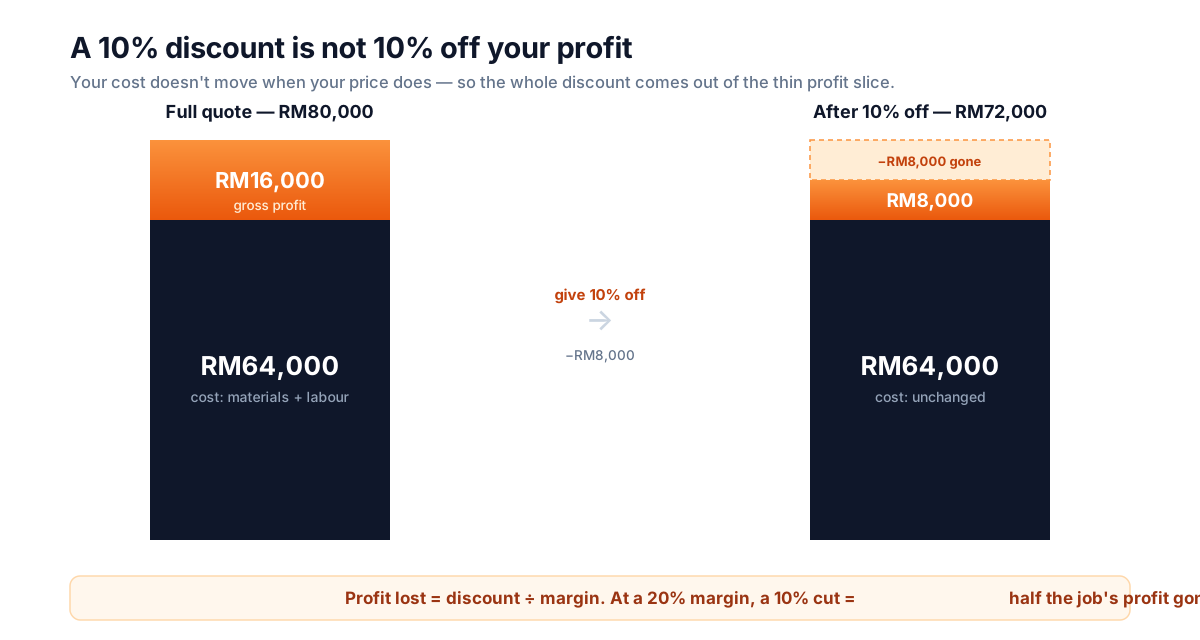
Here's the chain with figures consistent across this whole series. Take a mid-band condo renovation at RM80,000. Malaysian residential renovation runs on a gross margin of roughly 18–25 percent — call it 20 percent, in line with the international remodeling data (US remodelers average around 20–30 percent gross, per BuildBook and ServiceTitan, and Malaysian residential typically lands at the lower, more competitive end). That means:
- Price quoted: RM80,000
- Your cost (materials + subcontracted labour): RM64,000
- Gross profit: RM16,000
Now the buyer asks for 10 percent off and you agree:
- New price: RM72,000
- Your cost: still RM64,000 — nothing about the job got cheaper
- New gross profit: RM8,000
That RM8,000 you gave away isn't a rounding error — on this series' expected-value math, it's more than six times the roughly RM1,280 of expected gross profit riding on a single fresh enquiry. You handed over, in one soft "okay lah," what six leads are worth.
Why does such a small discount destroy so much profit?
Because you're discounting off the big number (the price) but the money comes out of the small number (the profit on top). A renovation quote is mostly cost — around 75–82 percent of it is materials and labour you must pay regardless. The margin is the sliver above that. When you take 10 percent off the whole quote, that 10 percent has to come from somewhere, and the only place it can come from is the sliver.
The thinner your margin, the more violent the effect. Here's the full picture at a 20 percent renovation margin, on that RM80,000 job:
| Discount you give | Ringgit off the price | Gross profit left | Share of profit lost | Jobs to earn it back |
|---|---|---|---|---|
| 0% | RM0 | RM16,000 | — | 1 |
| 5% | RM4,000 | RM12,000 | 25% | ~1.3× |
| 10% | RM8,000 | RM8,000 | 50% | 2× |
| 15% | RM12,000 | RM4,000 | 75% | 4× |
| 20% | RM16,000 | RM0 | 100% | never |
Read the last column slowly, because it's the one owners never calculate. To make back the profit a 10 percent discount gave away, you don't need 10 percent more work — you need to win a whole second job at full price. A 15 percent discount means four full-price jobs to replace one. This is the same trap the general small-business finance writers describe: GrowthForce and Phoenix Strategy Group both walk through how a 10 percent discount on a 25 percent-margin business cuts profit 40 percent and needs roughly 50 percent more volume to break even. Renovation's thinner margin makes it worse, not better.
So why do owners keep discounting anyway?
Because the discount is compared against the wrong number, and because it feels like the fastest way to end a stalled conversation. Three specific reasons:
- The number looks small next to the total. RM8,000 off RM80,000 reads as "just 10 percent." Nobody instinctively re-bases it against the RM16,000 of profit, where it reads as "half."
- "I'm still making money." True, but barely — and the point of the job was the RM16,000, not the RM8,000. You didn't take on a two-month site to earn a thin RM8,000.
- It ends the awkwardness. "Boleh kurang?" creates a moment of tension, and a quick yes dissolves it. Discipline is uncomfortable in the moment; the margin damage is invisible until year-end.
There's a fourth, sneakier cost. The moment you discount, you've told the buyer your price is negotiable — so they push again. On a renovation that's not a one-time event: they'll push on the deposit, then on every variation order, then on the retention. A firm that folds at "boleh kurang?" trains its own clients to keep asking. This is the flip side of the advice in our piece on drafting a quote follow-up that doesn't re-open the number — once the number is re-opened, it rarely closes at full value again.
But the buyer is comparing five quotes — don't I have to match the cheapest?
Usually not — and matching it is one of the worst trades you can make. Malaysian homeowners are advised everywhere to gather three to five itemised quotes and negotiate the line items, so price-shopping is normal and you should expect it (FindContractor.my, My Reno Service). But here's the part the panic ignores: the cheapest quote is a warning sign in this market, not an advantage.
Malaysia has a thick, well-read ecosystem of renovation-scam content, and it all says the same thing — beware the lowball. Recommend.my and iHome.my both warn that a bid far below the others is a classic red flag, often ending with a final bill 50–100 percent over the quote. Real cases anchor the fear: The Star reported five Rawang homeowners losing over RM127,000 to a fake contractor, and NST reported another group swindled of nearly RM1 million. So when you slash your price to match the cheapest firm, you don't just halve your margin — you move yourself into the exact price band buyers have been trained to distrust. You look less credible and earn less.
The better responses to a real price gap almost never involve cutting the number:
- Hold and justify. Send an itemised quote and walk the buyer through what your number buys — brand and spec of materials, who does the electrical, what the warranty covers. A buyer comparing five quotes is looking for a reason to trust one; give them the breakdown the lowball can't.
- Trim scope, not price. If they genuinely can't stretch, reduce the cost alongside the price — a more modest cabinet finish, phasing the wet works to a second stage. Now the discount comes off your cost too, so your margin survives. This is honest and preserves the relationship.
- Add value that's cheap to you. Throw in something with a high perceived value and a low real cost — an extra design revision, a longer defects-liability window, free minor touch-ups. It answers "boleh kurang?" without touching the price.
Which leads are even worth discounting for?
This is where the margin math meets your inbox: whether a discount is worth it depends on the lead, not the job — and the deciding factor is where the lead came from. A discount is a tool with a real cost, so spend it only where it changes an outcome worth changing.
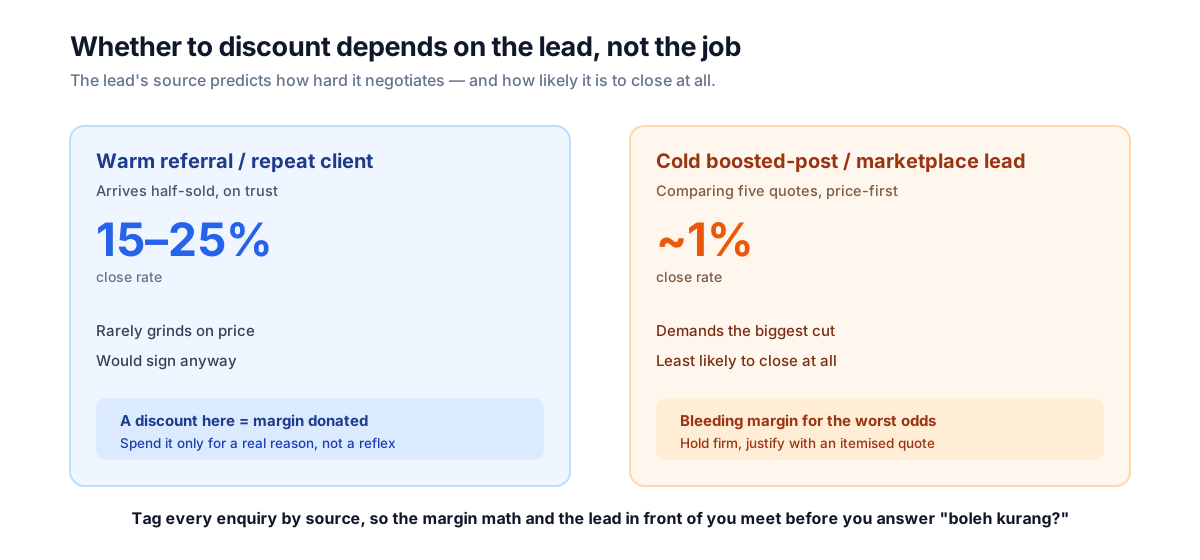
The lead source predicts both how hard they'll negotiate and how likely they are to close at all:
- Referrals and repeat clients arrive warm, half-sold, and convert at roughly 15–25 percent. They rarely grind you on price because they came on trust. Discounting here is pure margin donated to someone who'd have signed anyway.
- Cold boosted-post and marketplace leads convert near 1 percent and are the ones most likely to be comparing five quotes and demanding the biggest cut. Bleeding margin for the lead least likely to close — and most likely to be a pure price-shopper — is the worst trade on the board.
That's the same lesson as cost per lead versus cost per won job: the cheapest, most price-sensitive channel is often your most expensive once you count what you give away to win it. A discount earns its keep for a real reason — filling a genuinely quiet quarter, rewarding a fast paid deposit, or honouring a referral you want to keep — never as a reflex.
To decide with your head instead of the awkward-moment reflex, you need to know each lead's source and history at the moment you're quoting. That's a lead-management question, not a spreadsheet one. A system like HotLead captures and tags every enquiry by source, so when "boleh kurang?" lands you can see at a glance whether this is a warm referral worth a goodwill gesture or a cold price-shopper you should hold firm on — and its per-channel and team-performance views show you which sources actually convert without a discount, so you stop training your best channels to expect one. The tool doesn't set your price. It makes sure the margin math and the lead in front of you meet before you answer.
The renovation firms that keep their margin aren't the ones who never discount. They're the ones who know, to the ringgit, what a discount costs — and who spend it on purpose, for a reason, on a lead worth it.
Working out the numbers behind your pipeline? Start with the complete guide to managing renovation leads in Malaysia, then see what a lost lead is really worth and why the cheapest lead is often the most expensive job.
Frequently asked questions
How much does a 10 percent discount actually cost a renovation firm?
Far more than 10 percent of your profit. A discount comes entirely out of your margin, because your material and labour costs do not fall when you drop the price. The share of profit you give up equals the discount divided by your gross margin. Malaysian residential renovation runs on roughly an 18 to 25 percent gross margin, so at 20 percent a 10 percent discount is 10 divided by 20, or 50 percent of the job's profit gone. On an RM80,000 job carrying about RM16,000 of gross profit, a 10 percent cut hands over roughly RM8,000 — half the profit — for a price change that looked minor.
Why does a small discount destroy so much profit in renovation?
Because renovation margins are thin and the discount lands entirely on the profit, not spread across the whole price. If a job costs you RM64,000 in materials and subcontracted labour and you quote RM80,000, your profit is the RM16,000 on top. Cutting the price to RM72,000 does not reduce your costs — they are still RM64,000 — so your profit drops straight to RM8,000. The 10 percent came off the small profit slice, not the big cost base, which is why the proportional hit is always the discount divided by your margin.
How many more jobs do I need to win to make up for a discount?
More than most owners expect. To keep the same total profit after cutting price, you divide your margin by your margin-minus-the-discount. At a 20 percent margin, a 10 percent discount leaves you 10 percent margin, so you need 20 divided by 10 — twice as many jobs — for the same money. A 15 percent discount at that margin means you need four jobs to replace one. Discounting to "win volume" quietly asks you to do two to four times the work for the same profit.
Do I have to match a competitor's lower renovation quote?
Usually not, and matching it is expensive. Buyers in Malaysia commonly gather three to five itemised quotes and negotiate, but the cheapest bid is widely treated as a warning sign — renovation scam guides and real cases of homeowners losing tens of thousands to lowball contractors have trained buyers to distrust the lowest number. Chasing a rival to the bottom both halves your margin and drops you into the price band buyers are taught to fear. Better to hold your price and justify it with an itemised quote, trim scope to lower the cost honestly, or add something cheap-to-you than to cut the number.
When is it actually worth giving a renovation discount?
When there is a real reason and the lead is worth it. A discount earns its keep to fill a genuinely quiet quarter, to reward a fast paid deposit, or to honour a referral or repeat client you want to keep — not as a reflex to a price-shopper. The lead source is the tell. A warm referral or repeat buyer converts at 15 to 25 percent and rarely negotiates hard; a cold boosted-post lead comparing five quotes converts near 1 percent and demands the biggest cut. Bleeding margin for the lead least likely to close is the worst trade, which is why knowing where each lead came from should drive whether you discount at all.
Keep reading
- "My Contractor Ran Away — Can You Take Over?" Why the Rescue Job Is Your Most Dangerous LeadA WhatsApp from a homeowner whose contractor vanished mid-job looks like the easiest lead you'll get all week — desperate, committed, half-done. It's actually the most dangerous job in your inbox, and quoting fast to win it is how you inherit someone else's disaster and their blame. Here's how a renovation or contracting firm should handle the takeover lead.
- Can AI Brief Your Estimator Before a Renovation Site Visit?A site visit is one of the most expensive things a renovation firm does — and one in five turns into a second trip because someone forgot to ask something on-site. So can AI read the messy WhatsApp thread and brief your estimator well enough to make the visit one-and-done? I built it two ways. The flashy version is the one that sends you back out.
- Why Your Warmest Renovation Leads — Referrals and Repeat Clients — Leak the FastestA cold Facebook lead gets jumped on in five minutes. A referral from a happy past client sits two days because "they already trust us, they'll wait." That instinct is backwards — your warmest, highest-closing leads leak fastest precisely because you feel no urgency. Here's the complacency trap, and how to stop treating your best leads worst.