

Here is a leak that hides inside a job you did right. A Puchong contractor sends his estimator to a Bukit Jalil condo — good enquiry, warm buyer, a proper site visit. The estimator does everything well on-site: measures the kitchen, taps the walls, fires off a string of WhatsApp voice notes to himself as he walks — "kabinet ni, one run, tiga belas kaki… hack this wall… wet kitchen kat sini, dry kitchen sana" — and snaps a dozen photos. Solid visit.
Then, three sites and eleven hours later, he sits down at 10pm to build the quote. He plays the voice notes back over the sound of his own kitchen, half-remembers the rest, and re-types it all into a costing sheet. Somewhere in that transfer, thirteen feet of cabinetry becomes thirty, or a wet-and-dry detail drops off entirely. The quote goes out. It's wrong — and nobody will know until the client signs and the carpenter turns up to a run less than half the length that was priced.
That re-typing step is the leak. And it raises the very 2026 question this column exists for: now that AI can transcribe and tidy a rambling voice note in seconds, can it turn the raw site notes into a clean scope record — and save the re-typing — without quietly inventing a number the estimator never spoke? I built it two ways. Here's the problem, what the re-typing really costs, what the two builds did, and what an owner should actually do on Monday.
What does re-typing your site notes actually cost?
More than the hour it takes, and the hour is not free either. A site visit produces a scatter of raw inputs — voice notes, photos, a scribbled measurement on the back of a business card — that only becomes useful once someone turns it into a structured scope you can price. On a small reno firm that someone is usually the owner or the estimator, doing it late at night from memory, which is exactly where details fall out.
The industry numbers are unkind to manual transfer. Roughly a quarter of construction data carries wrong entries and a fifth has details recorded incorrectly, with manual re-entry a primary cause — every transcription step is a new opportunity for error. And those errors are not cosmetic: estimating errors account for about 32% of construction cost overruns, and manual quantity takeoffs are one of the main causes of inaccurate estimates. A number that goes into the sheet wrong doesn't announce itself — it silently sets your price too low (and you eat the gap) or too high (and you lose the job).
So the instinct to throw AI at this is reasonable. Re-typing is real work that produces real errors, and a machine that never gets bored transcribing sounds like exactly the fix. It ties straight to two leaks this series has already put numbers on — the slow-quote leak, where a job sits unquoted because the owner is drowning, and the owner-operator bottleneck, where one person is the only one who can turn a visit into a price. If AI can carry the transcribing, the estimator gets his evening back and the quote goes out faster.
So can I just tell AI to write the costing sheet from my voice notes? (Build A)
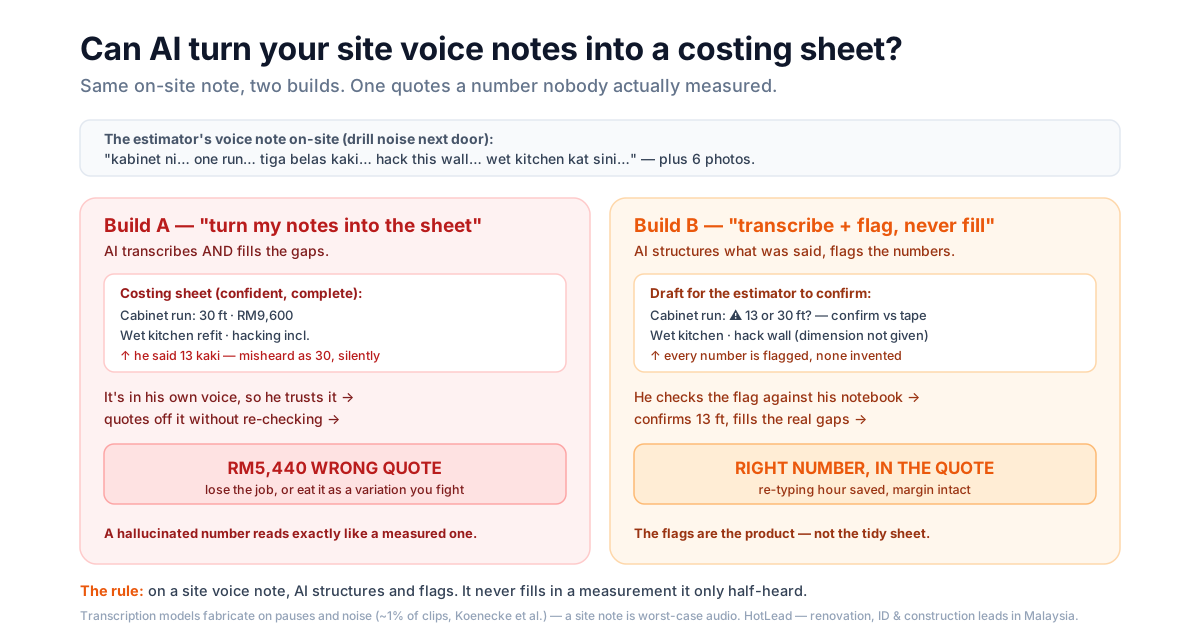
This is the build everyone reaches for, and it demos beautifully. Build A: point the model at the voice notes and photos and prompt it "you are my estimator, listen to these site notes, read the photos, and write me a complete scope-of-works and costing sheet — dimensions, materials, quantities, a price." And it delivers. Instantly, in clean lines that look like something you'd send a client: "Kitchen — wet and dry. Cabinet run 30 ft. Hacking of existing wall included. Full refit, RM32,000–RM38,000."
It looks like your notes, typed up. It is your notes plus fiction — and the fiction is the expensive part, because the payload of a site note is numbers, and that is precisely what speech-to-text handles worst.
Start with mishearing. On clean audio the best transcribers are excellent, but a Malaysian site voice note is nowhere near clean. Speech recognition accuracy collapses with a non-standard accent — one study measured a word error rate near 30% for accented speech versus under 6% for standard — and it degrades further with background noise and technical jargon, while a standard smartphone mic can't isolate a voice from high-decibel site noise in the first place. Now add the specific enemy: numbers. Thirteen and thirty sit one dropped consonant apart, and a model that's 94% right on words in general is not 94% right on the two syllables that decide your price.
Then the darker failure — outright invention. Researchers led by Allison Koenecke, presenting at the ACM FAccT conference, analysed over 13,000 speech clips and found a leading transcription model fabricated entirely fictitious phrases in about 1% of them — and the trigger was pauses and silences between speech. Think about how an estimator records a site note: a phrase, a pause while he measures, another phrase, a pause while he moves. That halting, gap-filled rhythm over site noise is the exact input most likely to make a transcriber make up words that were never said.
So Build A doesn't just risk copying a number wrong — on the worst audio you'll feed it, it can quietly manufacture one. It's the same failure mode as letting AI quote a square footage from a photo or narrate a cause into a weekly report it can't know: a fluent, confident answer the input never actually contained.
Put a ringgit on it. Kitchen cabinetry in Malaysia is quoted per foot run. Take a run the estimator measured at 13 feet and priced at, illustratively, RM320 a foot — RM4,160. Let Build A hear thirty and it's RM9,600 on the sheet. That single misheard syllable is a RM5,440 swing: quote it high and a competitor with the real number wins the job; quote it low and you've under-priced a job you'll build at a loss or fight over as a variation. Nobody measured 30 feet. A machine misheard it, and a tidy sheet laundered the mistake into a price.
What actually worked: transcribe, structure, and flag — never fill (Build B)
Build B kept the half AI is genuinely good at and cut the half that invents. Same voice notes, but the prompt flipped: "transcribe these site notes verbatim. Then structure ONLY what was actually spoken into scope items — do not add anything I didn't say. For every measurement or quantity, mark it UNCONFIRMED and show the exact words you heard. Then list what's missing that we still need to price — any scope item mentioned without a dimension, any room measured without a scope. Do not fill anything in." No invented scope. No confident number. A structured draft with every figure wearing a warning label.
And that, AI does well, because it's a reading-and-organising job, not a judgment one. For the Bukit Jalil visit it returns something like:
- Scope, as spoken: wet + dry kitchen; one cabinet run; hack one wall; new wet-kitchen layout. (Structured from your words — verify nothing was dropped.)
- Numbers — confirm against your tape before pricing: cabinet run — heard "tiga belas kaki" (13 ft) — but low confidence, could be 30; please confirm. Wall to hack — no dimension given in the notes. Wet-kitchen floor area — not measured aloud.
- Gaps to close before this can be quoted: dimension of the wall being hacked; wet-kitchen floor area for tiling; are existing cabinets being kept or fully hacked; the condo's hacking hours and debris deposit.
The most valuable things on that page are the flags and the gap list — the number it wasn't sure of, and the measurements it noticed were never spoken. That is not a limitation of the AI; it is the entire product. The estimator now spends two minutes confirming a flagged figure against his notebook instead of an hour re-typing and a week not knowing he fumbled one. He catches the 13-not-30 because Build B put a spotlight on it instead of smoothing it into a sheet.
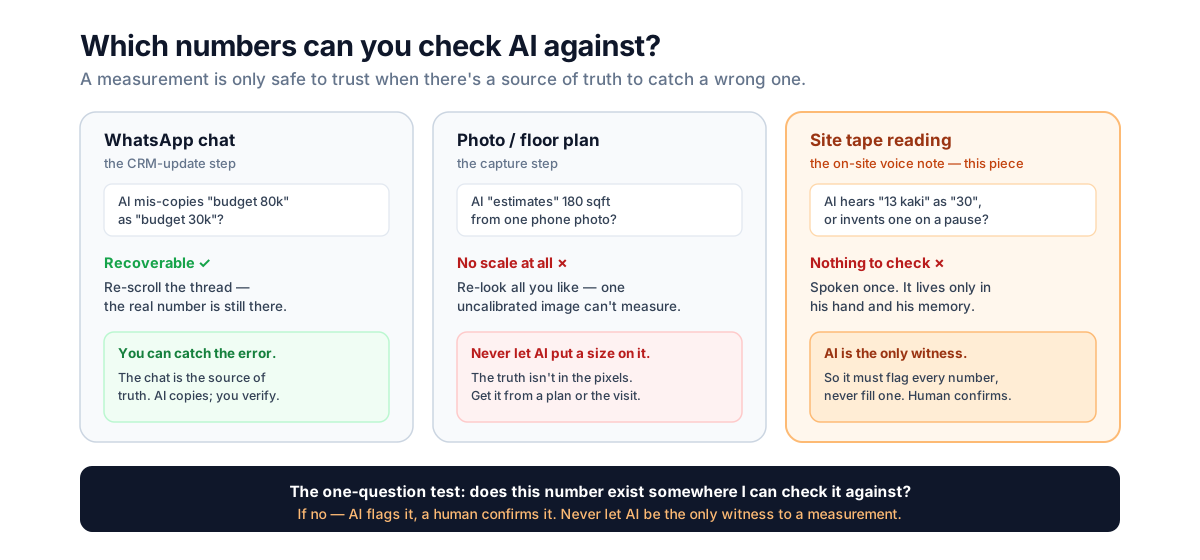
There's a clean test underneath this, the same one every honest AI-in-the-lead-process build lands on, sharpened for numbers: does this figure exist somewhere I can check it against? The scope words the estimator spoke are in the audio, so AI can structure them and you can replay to confirm. But the measurement's real home is the tape in his hand and the number in his head — so AI's job is only to surface it, flag it, and hand it back for confirmation. Build A crossed that line and priced the fiction. Build B respects it, and every bit of its value sits on the safe side.
| Build A — AI writes the costing sheet | Build B — AI transcribes, structures, flags | |
|---|---|---|
| Transcribes what was said | Yes | Yes |
| Structures scope items | Yes — plus ones you never said | Only what was actually spoken |
| Handles measurements | States them as fact — misheard or invented | Flags every one as unconfirmed |
| Lists what's still missing to price | No — the sheet "looks complete" | Yes — the most useful output |
| Effect on the estimator | Trusts his own voice, skims, quotes | Confirms flags against the tape, then quotes |
| Worst case | A RM5,000 pricing error, laundered as a sheet | Two minutes checking a flag |
Why is a site voice note the most dangerous place to trust AI?
Because it's the one input in the whole lead chain with no recoverable source of truth — and that's the un-Googleable part, so it's worth being precise. Walk the chain. When AI mis-copies a fact from a WhatsApp chat, you can re-scroll the thread and catch it — the chat is the source of truth and it's still sitting there. When AI is tempted to size a room from a photo, the honest answer is that a single uncalibrated image can't measure at all, so you simply never let it put a number there. But a tape reading is different from both. The estimator physically measured it, spoke it once into a voice note, and the only other copy is in his hand and his memory. If AI mishears or invents that figure and nobody flagged it, there is nothing left to check it against. AI becomes the only witness to a measurement — and you're quoting on the testimony.
There's also a very local reason the audio is stacked against you. A Malaysian estimator's site note is a code-switch — English, Malay, a bit of Cantonese or Hokkien trade slang — recorded over a drill next door, with dimensions mixed across units in the same breath: "tiga kaki setengah" here, "3 meter something" there, "10 by 12" somewhere else, and everything ultimately priced per square foot or per foot run. A transcriber that's shaky on accent, allergic to noise, and prone to inventing on pauses is being handed the hardest possible clip and asked to get the numbers exactly right. That's not a knock on the tool — it's a reason to use it for the job it can do (organise the words) and not the one it can't (be trusted on an unverifiable figure).
What should an owner actually do on Monday?
You don't need to build software to get most of this — you need one rule and, if you want, one prompt:
- Never let AI be the last word on a measurement. If you use it to write up site notes, prompt it to transcribe verbatim, structure only what was spoken, and flag every number as unconfirmed. Treat any dimension or price it states as fact — rather than flags — as a red light, not a time-saver.
- Make the flags the output, not the tidy sheet. The useful thing is the short list of numbers to confirm against your tape and the gaps it noticed you never measured. Confirm those two minutes' worth before a single figure touches a quote.
- Speak your site notes for the machine. If you're going to transcribe them, help it: say numbers slowly and once, state the unit every time ("thirteen feet, one-three"), and avoid recording mid-drill. You're not just talking to yourself anymore — you're dictating to a transcriber that mishears on noise and invents on silence.
- Keep the whole visit on one record. Voice notes, photos, the floor plan and the chat belong on one lead, not scattered across a personal phone — so when you write up the scope, nothing is missing and the quote actually goes out fast. This is the mirror of briefing the estimator before the visit: AI helps at both ends, and at both ends its job is to organise and flag, never to invent.
How HotLead fits — and what it deliberately does not do
I'll be straight, because over-claiming is the hype I keep arguing against. HotLead does not ship a voice-note-to-costing transcriber, and this piece is an experiment, not a feature tour. What HotLead owns is the part the experiment proved actually matters — keeping the raw material together and the follow-through tracked:
- Captures the whole enquiry and visit on one record — every WhatsApp message, photo, PDF, floor plan and voice note, source-tagged, so your site notes aren't scattered across a personal phone you have to reconstruct at 10pm.
- One owner and a next action on every lead, so turning a visit into a quote is a tracked step that gets done, not a forgotten intention — the fix for the slow-quote leak.
- Collects scope and budget in text up front — the optional AI assistant can qualify a new enquiry the moment it lands, so more of the job is in writing before anyone drives out.
- A funnel view that shows whether jobs stall at the quote stage — so you can see if slow or botched write-ups are quietly your leak.
In other words, HotLead keeps the material a good scope record needs in one place and makes the write-up a tracked step — the estimator still owns the tape, the numbers and the quote. If site notes turning into slow or wrong quotes is quietly costing you jobs, start with the complete guide to managing renovation leads in Malaysia, see how it fits a renovation firm or a construction outfit, or read the companion build on briefing your estimator before the site visit.
Sources: the 24% wrong-entry and ~21% incorrectly-recorded rates for construction data, the cost of double entry and the "every transcription step is a new opportunity for error" point from Dan Cumberland Labs — the field report written twice; estimating errors as ~32% of construction cost overruns from iBeam — construction estimation mistakes to avoid; manual quantity takeoffs as a main cause of inaccurate estimates from McCormick Systems — most common construction estimating mistakes; speech-recognition word-error-rate degradation with accent (30% vs under 6%) and clean-audio accuracy ceilings from AssemblyAI — how accurate is speech-to-text; the finding that standard smartphone mics fail to isolate speech from high-decibel background noise and that jargon and noise degrade field transcription from Forensic Notes — voice-to-text for field notes; the study of 13,000+ speech clips finding a leading transcription model fabricated entirely fictitious phrases in ~1% of them, triggered by pauses and silences, led by Allison Koenecke and presented at ACM FAccT, as reported by TechTimes and Science/AAAS. The RM320-per-foot cabinetry figure and the RM5,440 swing are illustrative, labelled as such, and use per-foot-run pricing norms; the ~0.1 sen compute cost uses current small-model pricing and is labelled illustrative. Job values, per-foot and per-square-foot pricing norms, the ~RM300 wasted-visit figure and the slow-quote dynamic are as built and cited across the complete guide and its siblings.
Frequently asked questions
Can AI turn renovation site-visit voice notes into a structured scope record?
Usefully, yes — as a transcribe-and-structure job, not a fill-in-the-blanks one. AI is genuinely good at taking a rambling on-site voice note plus photos and laying out what you actually said — room, scope items, materials mentioned, the numbers you spoke — as a tidy draft in seconds for about a tenth of a sen. That saves the hour of re-typing. What it must not do is invent a measurement or a scope item you never spoke to make the sheet look complete. Point it at structuring and flagging, and have it mark every number as unconfirmed until you check it against your tape.
Why is it risky to let AI write the costing sheet straight from a voice note?
Because the payload is numbers, and speech-to-text both mis-hears and invents them. Site audio is close to worst-case — background drilling, a code-switching accent, and pauses between measurements, which is exactly when transcription models are known to fabricate text. Thirteen becomes thirty; a paused, half-caught dimension becomes a confident figure. It then lands in a clean sheet that reads like a measurement, so a busy estimator quotes off it. On a job priced per foot or per square foot, one wrong dimension is thousands of ringgit of margin or a lost job.
What is the difference between this and using AI to estimate from a photo?
They fail in opposite directions but land in the same place. A photo genuinely cannot yield a real measurement — a single uncalibrated image has no scale — so AI must never put a size on one. A voice note does contain real measurements, because the estimator physically measured on-site and spoke the numbers; the danger is that AI mis-hears or invents them in transcription. In both cases the honest rule is the same — AI structures and flags, a human owns the number that goes into the quote.
How much does it cost to have AI transcribe and structure a site voice note?
Almost nothing in compute — transcribing a few minutes of audio and structuring it is a small model job, on the order of a tenth of a sen per visit at current pricing. As with every build in this series, the tokens were never the cost. The cost is the wrong quote a misheard dimension anchors, or the second site visit when a dropped detail surfaces at the desk. The compute is rounding error against a RM5,000 pricing mistake.
Does HotLead transcribe my site voice notes into a costing sheet?
No, and I would not claim it does — this piece is an experiment, not a feature tour. HotLead does not ship a voice-note-to-costing transcriber. What it does is keep the raw material in one place — every WhatsApp message, photo, PDF and voice note for a lead on a single record with its source, one owner and a next action — so your site notes are not scattered across a personal phone, and turning them into a quote is a tracked step rather than a forgotten one. The measuring, and every number in the quote, stay with your estimator.
Keep reading
- Did We Already Say RM68k? Using AI to Stop Quote Drift Across a Long Renovation ThreadOver a weeks-long WhatsApp thread with two or three quote revisions, a rep re-states a number that contradicts an earlier promise — and re-opening a settled price quietly invites a discount that eats a whole job's profit. So I pointed AI at the drift. It works beautifully as a flag, and dangerously as an auto-corrector.
- The Warranty as a Closing Lever: Why a Longer Guarantee Beats a Discount on a Renovation DealA quote is stalling and the buyer wants a reason to say yes. Before you drop the price, look at the other lever in your hand — a longer workmanship warranty. It is the same expected-value decision as a discount, but the math runs the opposite way — a price cut costs you thousands with certainty, while extending the defects cover costs you a couple of hundred ringgit in expectation, for arguably more trust with a scam-wary buyer. Here is the EV case for the non-price concession, the trap that turns it into a hidden liability, and which leads it actually moves.
- "Can You Just Build It, My Neighbour Also Did" — Handling the Renovation Lead That Needs Council Approval FirstSome renovation enquiries can't legally start next month, no matter how ready the buyer is — a kitchen extension, a hacked-through wall, a roofed-over air well all need the council's written approval first. Quote a fast build price to win the job and you either lose it to a "boss, can start" cowboy, or win it and inherit the stop-work order, the RM50,000 fine and a client who later can't sell the house. Here's how to spot the permit-first lead and sell the approval as protection.