

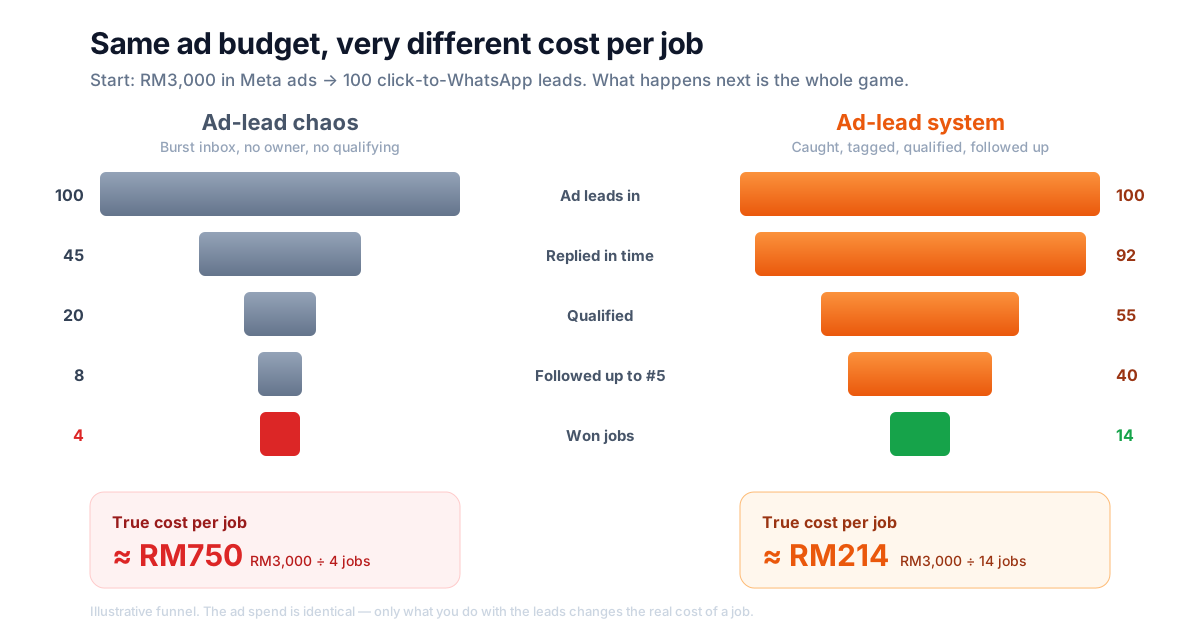
Most Malaysian renovation firms now buy their leads the same way: a Facebook or Instagram ad with a "Send WhatsApp message" button. It works — the enquiries come in. The problem is how they come in: in bursts, often at 11pm, mixed with your referrals and supplier chats, many from people just browsing, and with no clue which ad you actually paid for.
The fix isn't more budget or better targeting — it's a system that catches every ad lead the moment it lands, tags where it came from, qualifies it fast, gives it one owner, and follows up. Do that and the same ad spend quietly produces far more jobs. Here's how.
Why are FB/IG ad leads so chaotic compared to other leads?
Because they behave differently from a referral or a Qanvast enquiry. A referral trickles in warm, one at a time, from someone who already trusts you. A paid ad lead is the opposite on almost every axis:
- They arrive in bursts. When your ad is delivering, you can get ten enquiries in an hour, then nothing for a day. Manual handling that copes at five leads a week buckles under thirty.
- They land after hours. Ads run at night and on weekends — exactly when nobody's watching the WhatsApp. By morning the enquiry is buried under 40 other chats.
- Many are early-stage. A broad ad audience includes serious buyers and browsers, price-checkers, and "just asking." That's normal — it's the cost of reach.
- You can't tell what you paid for. Every lead lands in the same inbox with no label, so you can't see which ad, campaign, or audience actually produced jobs.
- They mix with everything else. The same WhatsApp number receives suppliers, past clients, and family. Hot paid leads get lost in the noise.
None of this means ads are bad. It means ad leads need handling that a chat app on its own doesn't provide.
Why do reno leads end up in WhatsApp in the first place?
Because in Malaysia, that's where buyers want to talk — and Meta built the ad format to put them there. The dominant paid format for service businesses is the Click-to-WhatsApp ad: the homeowner taps your ad and lands straight in a WhatsApp chat, skipping forms and landing pages entirely.
It maps perfectly to how Malaysians behave. According to Kantar's 2024 Business Messaging Usage Research (commissioned by Meta and reported by The Malaysian Reserve), seven in 10 Malaysians prefer to message a business over calling or emailing — and 76% say they would message a business immediately after clicking a social media ad. WhatsApp reaches around 90% of Malaysian internet users, and 98% of WhatsApp messages are opened within 3 minutes, so the channel is instant by design.
No surprise, then, that Meta has called click-to-WhatsApp one of its fastest-growing ad formats, with revenue growing roughly 60% year-on-year through 2025 in messaging-first markets like Southeast Asia. Translation: more and more of your reno-firm budget is funnelling into a WhatsApp inbox that was never built to run a sales pipeline.
The hidden cost: you're losing leads you literally paid for
Here's what makes a dropped ad lead sting more than a dropped referral: you paid cash for it. A referral that goes cold costs you goodwill. A paid lead that goes cold costs you ringgit you've already spent.
Renovation and interior design are premium categories, so a Facebook or Instagram lead — a single WhatsApp enquiry — often costs around RM20–RM50 depending on targeting, creative, and season. Ad costs are also trending up: Meta's average cost per lead rose about 21% in 2025 (WordStream's Facebook Ads benchmarks). So every enquiry that sits unseen for two days, gets no owner, or never gets a fifth follow-up is money you set on fire at the top of the funnel.
Look at the math above. The ad spend is identical in both funnels. The only thing that changes is what happens after the lead lands — and it triples the number of jobs while cutting the true cost of each one by more than half. You don't fix this with a bigger budget. You fix it with handling.
A system to tame ad-lead chaos
The good news: taming ad leads is the same five moves every time. Build the system once and every burst runs through it.
1. Catch and acknowledge every lead instantly
The second an ad lead lands, it should get a one-line acknowledgement — even automated. "Hi, thanks for reaching out to [firm]! We'll send details shortly." This stops the homeowner shopping elsewhere while your team is on-site, and it works at any hour. Acknowledging is not the same as quoting — separate the two and you buy yourself hours without losing the lead.
2. Tag the source the moment it arrives
Every ad lead should carry a label: which campaign, which ad, which audience. Click-to-WhatsApp can pass a referral note into the chat showing what the person tapped; a lead system captures it automatically. This is what lets you stop guessing and start seeing cost per job per campaign instead of just cost per lead.
3. Qualify in the first reply
Don't wait until a site visit to find out a lead is out of scope. Ask two or three quick questions up front so real buyers self-identify in minutes:
- Which area is the property in?
- Landed or high-rise — and roughly how big?
- Rough budget range you're working with?
- When are you hoping to start?
A serious buyer answers happily. A tyre-kicker goes quiet — and that's useful, because now you know where to spend your time.
4. Give each ad lead one owner
In a burst, the group-chat "who's got this one?" scramble produces double-replies and dropped leads at the same time. Assign each new enquiry to one salesperson the instant it arrives — by area, project type, or round-robin — so thirty leads become thirty owned leads, not thirty orphans. (This is also how you later see which salesperson is dropping leads.)
5. Follow up on a schedule
Ad leads are more likely to go quiet than referrals — they're comparing several firms and weren't referred by anyone. Yet around 80% of renovation sales need five or more follow-ups, while 44% of firms quit after one. Put every open ad lead on a simple rhythm (day 2, day 4, day 7, day 14, day 30), spaced 2–3 days apart, and lead with value, not "any update?" See the follow-up system that wins renovation jobs for the full cadence.
How do you qualify a paid lead without scaring off a real one?
Gently, in your own voice, and framed as helping. The goal of qualifying isn't to interrogate — it's to point the conversation somewhere useful fast. A natural Manglish opener does the job:
"Hi! Thanks for your interest 🙂 To send you the right info — is the unit landed or high-rise, and which area ah? And roughly what budget are you working with?"
That reads friendly, not like a form. A genuine buyer answers in seconds; a casual browser drifts off. Either way you've saved time. The mistake firms make is treating every ad lead as a maybe-customer for two weeks of effort, when 30 seconds of qualifying would have sorted the warm from the cold on day one.
One caution: qualify, don't gatekeep. If someone won't name a budget but is clearly serious about a project, keep going — budget questions reveal intent, they don't have to be a hard filter.
How do you survive the after-hours burst?
You stop relying on someone watching the phone. Festive periods and weekend ad flights are when bursts hit hardest — and they overlap with the busy season your most valuable leads already leak in. Three things carry you through:
- Auto-acknowledge after hours. A midnight enquiry that gets an instant "we'll be in touch first thing" beats silence until noon — the homeowner has a reply from you before your competitor's office even opens.
- Auto-assign on arrival. Owner attached the moment the lead lands, so the morning starts with a sorted list, not a 40-chat scroll.
- Pre-write your first messages. Templates for the acknowledgement, the qualifying questions, and "here's how we work" turn a 10-minute reply into a 30-second one — which matters most when fifteen leads are waiting.
The metric that actually matters: cost per won job
Stop optimising for cost per lead. A cheap lead you never close is expensive; a slightly pricier lead that becomes a RM60,000 job is the bargain of the month.
The number that should drive your ad spend is cost per won job, by source. Once every lead is tagged and tracked through to "won," you can finally answer the question that decides your budget: which campaign actually fills my calendar? Then you pour money into that one and cut the rest. Without tagging, you're flying blind — guessing at which half of your spend works, the way the chart above shows two firms spending the same and getting wildly different results.
For the full picture of where leads come from and what each channel is worth, see where renovation leads come from in Malaysia, and the complete guide to managing renovation leads.
How HotLead tames your ad leads
HotLead sits on top of your existing WhatsApp and is built for exactly this. It catches every incoming enquiry, acknowledges it, and assigns it to one owner instantly — so an after-hours burst of ad leads each gets caught and owned by morning instead of buried. It tags leads by source so you can see which campaigns turn into jobs, not just clicks, and it surfaces the follow-ups that are due so nothing paid-for slips away. See how it works.
Speed gets you into the conversation before your competitor — read how fast you should reply to a renovation lead — and the complete guide to managing renovation leads in Malaysia ties the whole system together.
Sources: Kantar 2024 Business Messaging Usage Research, commissioned by Meta, as reported by The Malaysian Reserve; Meta earnings on click-to-WhatsApp ad growth (Q3 2025), as reported by Storyboard18; WordStream Facebook Ads benchmarks 2025 on cost-per-lead trends; MIT / Dr. James Oldroyd lead-response study and Harvard Business Review, "The Short Life of Online Sales Leads"; DataReportal data on WhatsApp usage in Malaysia; WhatsApp message open-rate data.
Frequently asked questions
Why do I get so many time-wasters from Facebook ad leads?
Because ads reach a broad audience, so alongside serious buyers you get browsers and price-checkers. The fix isn't to stop advertising — it's to qualify faster. Ask two or three quick questions in your first reply (area, property type, rough budget, timeline) so real buyers self-identify within minutes and you spend your time on them.
How do I know which Facebook or Instagram ad a WhatsApp lead came from?
Click-to-WhatsApp ads can pass a referral note into the chat showing which ad the person tapped, and a lead system can capture that automatically. If you only have plain WhatsApp, the manual workaround is to ask early or run one campaign at a time. Tagging the source is what lets you measure cost per job per campaign instead of guessing.
Should renovation leads from ads go to a separate number or person?
Keep one WhatsApp entry point so customers aren't confused, but separate the stream behind the scenes — tag it as an ad lead and route it to a clear owner. Ad leads arrive in bursts and need fast, consistent handling, so a defined owner and a qualifying script matter more here than anywhere else.
How fast should I reply to a Facebook ad lead?
Within 5 minutes if you can — even more so than other leads. The homeowner just tapped an ad, is in shopping mode, and is messaging two or three firms at once. You also paid real money for that click, so a slow reply is wasted ad budget, not just a lost lead.
Keep reading
- "Boss, Berapa?" The Renovation Lead That Lands on the Wrong ChannelYour hottest organic leads often arrive where they found you — a comment under a project post, or a DM to your personal account — not the business WhatsApp you actually watch. Here's why those leads leak at the capture step, why an ignored public comment costs more than a missed message, and how to catch a lead no matter which door it walks in.
- "We Went With Another Contractor" — I Built an AI to Win Back a Lost Renovation Lead Instead of Slamming the DoorA Shah Alam firm quotes a RM70k job, chases it for three weeks, and finally gets the message every owner dreads — "thanks, we've decided to go with another contractor." The reflex is a terse "ok, all the best 🙏" and a closed chat. The 2026 reflex is to ask AI to detect the rejection and auto-fire a win-back discount. I built it, and it begged. Here's the version that keeps a near-free option on a re-win without ever chasing a no.
- The Only Three Ways to Grow a Renovation Firm — and Which Lever to Pull FirstEvery renovation firm's revenue comes down to three levers — how many leads you get, how many you close, and how big each job is. They multiply, so a modest lift on each compounds. But they cost wildly different amounts to pull, and most owners reach first for the one they should reach for last. Here's the ranking, with Malaysian numbers.