

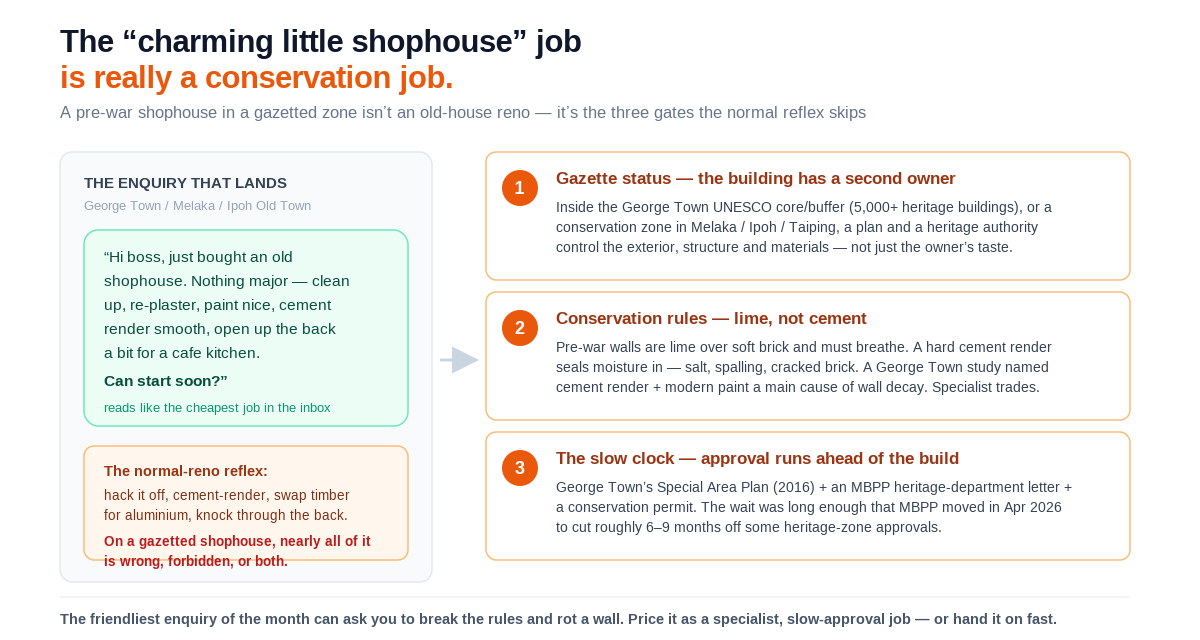
A contractor I know in Penang still winces about a shophouse off Love Lane. The enquiry could not have looked friendlier: a young couple who'd just bought a tired pre-war unit in George Town wanted to turn the ground floor into a small café and live above it. "Nothing major boss, just clean up, re-plaster, paint nice, open up the back a bit for the kitchen. Can start soon?" Photos of flaking walls, a gorgeous old tiled floor, a timber staircase. He quoted it like any other old-terrace refresh, won it, and sent his usual crew in to make it look crisp — which, to them, meant hacking off the soft crumbling plaster and skim-coating the walls in good hard cement render, nice and smooth for painting.
Within a year the fresh paint was bubbling and the plaster was blistering off in patches, pushed out by white salt crumbs. The lovely old wall was visibly rotting from behind the "upgrade." And when a neighbour's complaint about the opened-up rear brought the heritage people around, he learned that half of what he'd done — the cement, the altered rear, the swapped-out openings — was work he should have had approved first, in a zone he didn't realise had its own rulebook. The café opened late. The repair bill ate the margin. Nobody was happy.
That's the trap in this piece, and it hides inside the most charming enquiry you'll get all month. A pre-war shophouse in a gazetted heritage zone is not a small old-house reno. It's a conservation-rules, slow-approval, specialist-trade job — and the WhatsApp that starts it reads exactly like a cosmetic one. The firm that doesn't tag it as special quotes it as special's opposite: fast, cheap, and the modern way. Which, on a heritage building, is the one way that gets you a stop-work order and a wall that falls apart.
Why isn't a heritage shophouse just an old-house renovation?
Because the building isn't only your client's — it's a protected object with a public rulebook attached. Inside a gazetted zone, the exterior, the structure and often the very materials of a pre-war shophouse are governed by a conservation plan and watched by a heritage authority. You're not just satisfying a homeowner's taste and a normal building plan; you're working inside rules about what may change, what must stay, and how the work is done.
George Town is the clearest case. When it was inscribed as a UNESCO World Heritage Site in 2008 (jointly with Melaka), it came with a core zone of about 109 hectares and a buffer zone of about 150 hectares, together holding more than 5,000 heritage buildings, almost equally split between the two zones, according to George Town World Heritage Incorporated (GTWHI), the body that manages the site. A 2018 study in the International Journal of Heritage Architecture counts roughly 2,569 heritage buildings in the core zone and 2,444 in the buffer. Of those, 82 are Category I — the highest-protection tier of buildings, gateways and sites. The rest are mostly Category II, still "of special interest" and still controlled. The point for you: if the job is in that footprint, it has a second owner nobody put on the enquiry — the plan.
And it isn't only Penang. Melaka shares the same 2008 UNESCO inscription, and conservation areas govern pre-war fabric in Ipoh Old Town, Taiping and parts of Kuala Lumpur too. The specifics differ by town, but the shape is identical: a plan, a heritage authority, and a set of things you cannot just do.
What does the owner actually not know they're asking for?
Three things, usually, all at once: a slower approval, a different set of trades, and a shorter list of permitted changes than they assume. The owner sees a scruffy old building and a Pinterest board. They don't see the conservation pathway, they don't know lime from cement, and they genuinely believe "it's my building, I can gut it." Your job on the first reply is to find out which of those gaps you're dealing with before you price anything.
The approval gap is the one that wrecks schedules. Heritage work doesn't go through the normal building-plan counter alone. In George Town the governing instrument is the Special Area Plan, gazetted in 2016, which GTWHI describes as the conservation management plan for the whole site — and contractors are expected to work to its guidelines. A 2018 study of the approval process describes works passing through Majlis Bandaraya Pulau Pinang (MBPP), the city council, via its One Stop Centre, with the file needing a planning-permission letter, a letter from MBPP's Heritage Department, and a separate conservation permit on top of the ordinary plans. That's more steps, more parties, and an authority's clock — not a crew's.
How slow? Slow enough to make the news. In April 2026, MBPP announced it was streamlining some heritage-zone conversions — easing residential-to-shophouse remodels so owners submit fewer documents — a change The Star reported was expected to cut the approval process by roughly six to nine months for the cases being eased. Read that the right way round: the reform exists because the wait was long enough to matter. Even eased, heritage approval is a calendar you price in, not a formality you assume.
The cement trap: the "upgrade" that quietly rots the wall
The single most common heritage mistake is treating a lime building like a cement one. Pre-war shophouses were built with lime plaster over soft brick, and that pairing works because lime breathes. Ground moisture rises up the wall and evaporates out through the porous lime surface, so the wall stays sound. The owner — and an untrained crew — sees crumbling plaster and reaches for the modern fix: hack it off, render it hard in cement, skim it glass-smooth. It looks like an upgrade. It's the start of the decay.
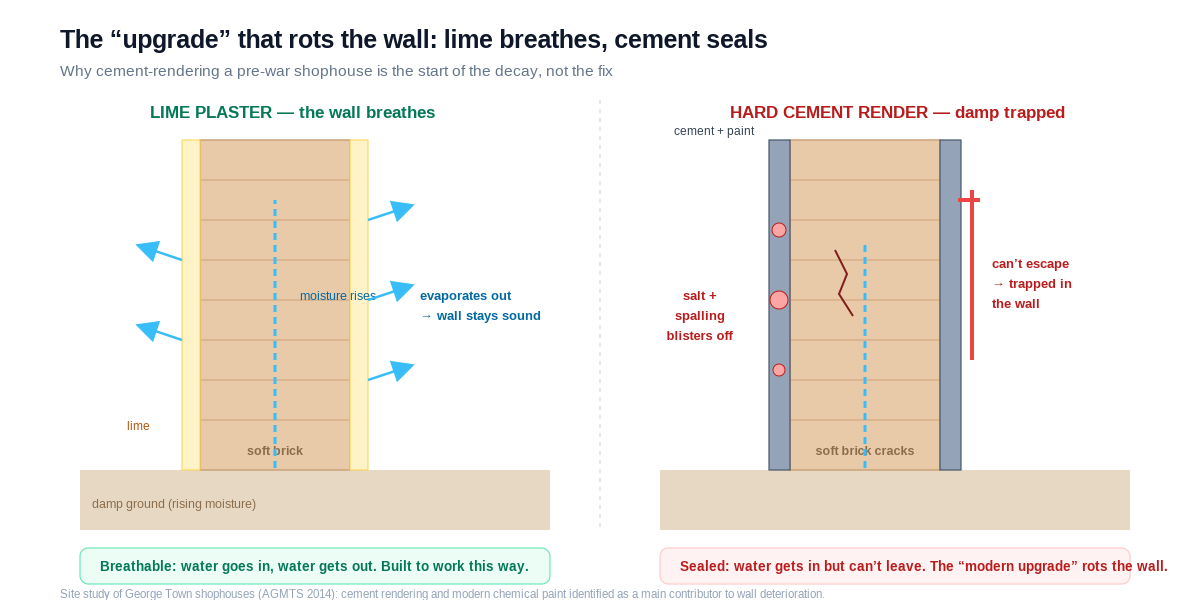
This isn't conservation theory — it's measured on the ground. A site study of George Town shophouses presented at a 2014 heritage conference found that cement rendering and modern chemical paint were a main contributor to wall deterioration across the buildings surveyed: incompatible materials trapping moisture, salts crystallising, soft brick cracking. Cement is harder than the old brick, so when the building moves, the brick cracks before the render does. Lime over cement doesn't rescue it either — the breathable top coat is useless if the sealed layer beneath it still can't let water out.
So the uncomfortable truth about this lead is that a big part of the real scope is undoing what a previous "cheap, fast, modern" contractor did — chipping off cement, re-plastering in lime, letting the wall dry and breathe again. That's slower, needs a crew that knows lime work, and costs more than a skim-and-paint. A firm that quotes it as skim-and-paint either loses the job to someone who understands it, or wins it and delivers the Love Lane disaster.
How a heritage lead differs from a normal reno lead
Almost every instinct flips. What you're really selling changes, the risk moves from taste to compliance, the timeline grows an approval tail, and "the modern way" becomes the warning sign instead of the selling point. It's worth laying side by side, because the enquiry in your WhatsApp looks the same either way.
| Normal old-house reno | Heritage shophouse lead (this piece) | |
|---|---|---|
| What you're really selling | Finish, taste, speed, price | Conservation competence the owner can't see |
| Who controls the changes | Your client | A gazetted conservation plan + heritage authority |
| The materials | Whatever's cheap and modern | Lime, timber, clay tile — specialist, prescribed |
| The owner's "upgrade" | An actual improvement | Often the exact thing that damages the building |
| The approval | One building plan | Plan + heritage letter + conservation permit |
| The timeline | Quote, win, start | Quote, approve (months), then start |
| "Cheapest and fastest" means | A keener price | Cutting the lime, the trades and the approvals |
| Getting it wrong costs | A snag list | A stop-work order, a fine, a devalued asset |
Read that and the move is obvious: tag it the moment it lands. A pre-war shophouse, a terrace in a conservation zone, anything described as "heritage," "pre-war," "old town" or named on a street you know sits in a gazetted area is not a normal reno lead. It's a heritage restoration lead, and it belongs in a lane that remembers the plan, the approvals and the lime exist.
So what do you actually do with a heritage enquiry?
Qualify the zone and the rules first, price the real scope and the slow clock honestly, and be ready to decline fast if you're not resourced for it. None of this is about working harder — it's a short discipline that turns the most dangerous enquiry of the month into either a well-priced specialist job or a clean, fast "not us, but here's who."
- Qualify the gazette status on the first reply. Before anything else, find out exactly where the building sits — core zone, buffer zone, a conservation area in Melaka or Ipoh — and whether it's Category I or II. That single fact changes what's allowed and how you quote. It's the same qualify-on-the-first-reply discipline every lead needs, pointed at the one question that reshapes this whole job.
- Map what's actually protected before you promise anything. Facade, roof form, air well, timber structure, party walls — assume more is controlled than the owner thinks, and never agree to "tear down the back" or "change the front" over WhatsApp. Confirm it against the plan, not the vibe.
- Quote the specialist trades, not the generic ones. Lime plastering, timber repair, clay roof tiles and the undoing of past cement work are a different line, a different crew and a different price from skim-and-paint. If you don't carry those trades, say so now.
- Run the approval as its own clock. Price the heritage-department letter, the conservation permit and the planning submission as real time and real line items, scheduled in parallel and ahead of the build — the way we lay out for the modern-council version in the permit/authority-approval lead, and the way a two-approver job runs in the condo management-approval lead.
- Sell the conservation route as protection, then decline cleanly if it's not you. For a buyer whose shophouse is a serious asset, "done the heritage way, approved properly" is the pitch — getting it wrong risks a stop-work order and devaluing the building. And if you're genuinely not set up for lime-and-timber conservation work, the fast, warm, reasoned no on day one beats the slow disaster that burns your name in a small heritage community.
Two more notes worth catching early. Many of these enquiries are really a commercial fit-out against a lease or opening clock — a café, boutique or guesthouse operator who also has a heritage rulebook stacked on top of the opening deadline, which only makes the approval timing more important to own. And the prize on a well-handled heritage job is rarely the one building: core-zone George Town shophouses have reportedly traded around RM2,000 to RM2,500 per square foot as the adaptive-reuse boom turned pre-war units into boutique hotels and cafés, and the owners and architects in that scene refer work to the few firms who are known to do it the right way.
Where HotLead fits — and where it doesn't
Let's be straight about the tool, because this is a conservation-and-trade problem, not a software one. HotLead cannot file your Special Area Plan submission, pull a conservation permit, source a lime plasterer, or tell you what's gazetted — that's your expertise, the authority's process, and a specialist crew's hands. What it does is make sure a heritage lead never leaks at the capture-and-follow-up step, which is exactly where a slow, multi-month job slips when you're busy on site:
- Capture and tag the enquiry as a heritage restoration lead the moment it lands, so it's handled as a specialist, slow-approval job from the first reply — not lumped in with cosmetic renos.
- One owner, by rule (round-robin, manual, or a custom rule), so the person who actually understands conservation work and the approval pathway owns it end to end, and the shophouse owner hears one consistent, competent voice.
- Next-action and overdue reminders that survive a months-long approval clock, so the heritage-department letter, the conservation permit and the planning submission each get a date and don't vanish while you wait on an authority.
- Funnel and per-channel reporting, so you can see whether heritage enquiries are a real pipeline worth building the specialist trades for, or a trickle you should keep referring out.
That's the honest line: the software holds the lead, the tag and the long follow-up so nothing drops across a job that takes months to even begin. It doesn't make the work conservation-grade — your crew and the lime do that.
The friendliest enquiry you'll get this month might be the one that quietly asks you to break the law and rot a wall. A pre-war shophouse in a gazetted zone is a different animal from the old terrace it resembles: a public rulebook, a slow approval, a lime-and-timber craft, and an owner who doesn't yet know any of it. Win that job by being the cheapest, fastest, most "modern" firm and you haven't done the owner a favour — you've handed them a stop-work order and a devalued heritage asset with your name on it. The firms that own this niche treat the heritage lead as its own type: qualified for the zone, priced for the trades and the clock, built the conservation way, and turned down fast when it isn't theirs.
Start with the full renovation-lead playbook, and if you work old shophouses and conservation zones, see how this connects to the renovation and construction lead playbooks for the rest of the journey.
Frequently asked questions
How do I know if a shophouse renovation needs heritage approval?
Start with where it sits. If the building is inside a gazetted heritage zone — most famously the George Town UNESCO World Heritage Site core and buffer zones, but also conservation areas in Melaka, Ipoh Old Town and Taiping — then its exterior, structure and often its materials are governed by a conservation plan, and works need approval from the local authority's heritage unit, not just a normal building plan. In George Town that means the Special Area Plan, enforced through Majlis Bandaraya Pulau Pinang and advised by George Town World Heritage Incorporated. If you aren't certain of the zone, you check the gazette and the plan before you quote, because the answer changes the whole job.
Can we just cement-render the old walls to make them look clean?
Usually no, and it's one of the most damaging things you can do to a pre-war wall. These buildings were built with lime plaster over soft brick, and lime is breathable — it lets ground moisture rising up the wall evaporate out through the surface. A hard cement render seals that moisture in. The trapped water then drives salt crystallisation and spalling, and because cement is harder than the old brick, any movement cracks the brick instead of the render. A site study of George Town shophouses identified cement rendering and modern chemical paint as a main contributor to wall deterioration. So the "upgrade" the owner asks for is often the exact thing a conservation job is there to undo — with lime.
Can I tear down the back of a heritage shophouse and keep the facade?
Not freely, and treating it as a given is how firms walk into a stop-work order. In a protected zone the controls usually cover far more than the front wall — the roof form, the air well, the timber structure, the party walls and the overall footprint can all be regulated, and demolition or major structural change is exactly what needs assessment and approval first. "Facade retention, gut the rest" is a modern development move, not a safe assumption for a gazetted shophouse. Qualify what's actually protected before you promise the owner anything, because the parts they most want gone may be the parts the plan most wants kept.
How long does heritage renovation approval take in George Town?
Longer than a normal reno, and that gap is the whole scheduling problem. Heritage work runs through a conservation approval pathway on top of the usual building plan — a heritage-department letter, a conservation permit, planning permission — and it moves at an authority's pace, not a crew's. The delay is real enough that in April 2026 Majlis Bandaraya Pulau Pinang announced it was streamlining some heritage-zone conversions specifically to cut the approval wait, which reports put at roughly six to nine months in the cases being eased. Price that calendar in and run it as a separate clock from the build, or you'll have a crew booked and a job that legally can't start.
How is this different from the permit/authority-approval lead you already wrote about?
They rhyme, but the rulebook and the trades are different. The permit/authority-approval lead is a modern council submission — an extension or structural hack that needs a DBKL, MBPJ or MBSA building plan and often an engineer's endorsement. The heritage lead adds a second, stricter layer on top of that — a conservation plan that governs materials, facade and form, a dedicated heritage unit, and specialist lime-and-timber trades that a general reno crew doesn't carry. A permit lead is "can this be approved." A heritage lead is "can this be approved, built the conservation way, by people who know how" — and if the answer to the last part is no, it's a lead to hand on, not to wing.
Keep reading
- Can AI Reply to Your Renovation Firm's 1-Star Review? I Built It — and the Risk Is How Fast It ApologisesA 2-star review on Google or Qanvast is the first thing your next renovation lead reads — and most firms either ignore it or fire back and make it worse. The 2026 reflex is to let AI write the reply. I built it, and drafting a calm response costs a fraction of a sen. But an AI tuned to be helpful apologises too fast — it will concede a fault in writing, promise a refund that never happened, and grovel to a fake review from a competitor. Here's the build that protects your rank instead of torching it.
- Which Lead Signals Actually Predict a Sale? Reverse-Audit Your Own Won JobsMost firms grade a renovation lead on signals that feel predictive — enthusiasm, a long message, a fast reply — and never check whether those signals actually separate won jobs from lost ones. Here is how to run a reverse-audit on your own closed deals, which signals usually survive it, and why your pipeline is too small to pretend the score is more than directional.
- The "I Only Deal With the Boss" Lead: When the Buyer Refuses Your TeamYou finally hired someone to share the load — then the buyer messages "can I deal with you direct ah, boss?" and refuses to engage your staff. Every big lead quietly re-centralises onto the one person already maxed out, and your firm can never grow past the owner. Here's why caving caps you, why a flat "my staff will assist" loses a nervous buyer, and the move that keeps both.