

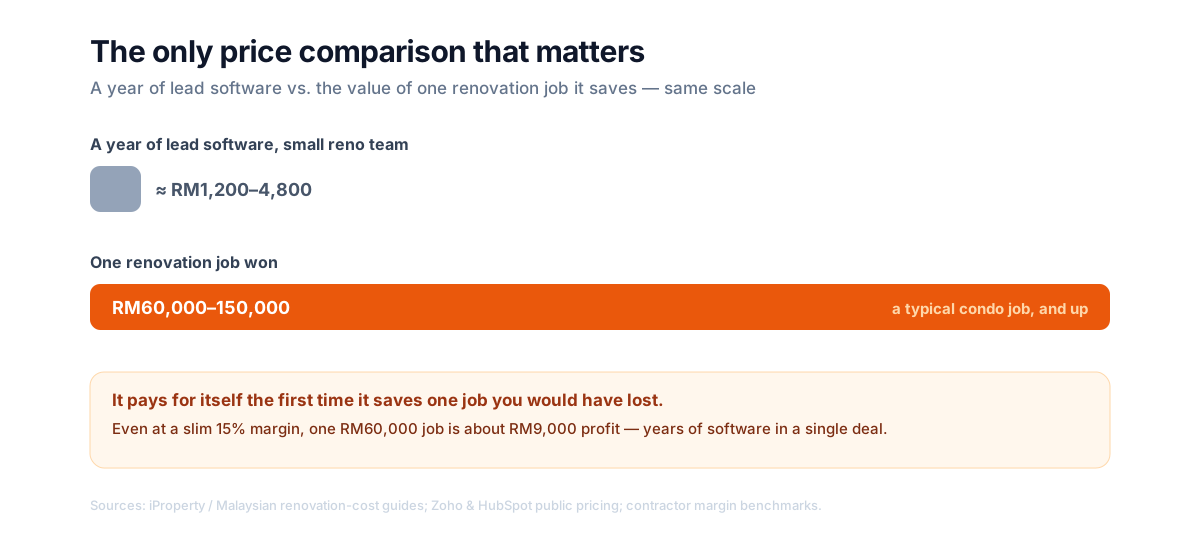
Ask "how much should lead software cost?" and every vendor will quote you a different number. It's the wrong question. The right way to price lead software for a renovation firm isn't ringgit-per-month — it's cost-per-saved-job. Measured against a single renovation job worth RM30,000 to RM150,000, almost any working tool is cheap. The expensive mistake is buying on sticker price and ending up with one your team abandons.
Here's what lead software actually costs a Malaysian reno SME, the costs nobody puts on the quote, and a simple way to know what's fair to pay.
What does lead software actually cost in Malaysia?
For a small renovation team, budget roughly RM50–400 per month, depending on how many salespeople use it and how much hand-holding you want. The market splits into three rough bands:
| Option | Typical price | The catch |
|---|---|---|
| Free tiers / spreadsheets | RM0 | Manual upkeep; dies in a busy month |
| Generic global CRM | ~USD 14–100 / user / month (≈ RM65–470) | Per-user, USD-priced, built for software sales teams |
| Local or vertical lead tool | MYR, flat or small-team pricing | Fewer bells; far higher chance your team uses it |
The middle band is where most firms look first and regret it. Zoho's entry tier is about USD 14 per user per month and HubSpot's professional tier runs closer to USD 90–100 per user per month — powerful, but priced and designed for desk-bound sales teams, not salespeople on a site visit in Kajang. And because they bill in USD, your cost quietly drifts every time the ringgit moves.
The point of the bands isn't to find the cheapest one. It's to notice that the price gap between them — a few hundred ringgit a month — is trivial next to the thing the tool is supposed to protect.
The only number that matters: cost per saved job
A renovation job in Malaysia is worth a lot. A standard condo renovation typically runs RM60,000 to RM150,000, and a full interior fit-out can reach RM250,000 (iProperty and Malaysian renovation-cost guides). Even on a slim margin — general contractors often work on 15–20% gross — the profit on one RM60,000 job is around RM9,000.
Now hold that against the software:
A tool at RM200 a month costs RM2,400 a year. One recovered job at a 15% margin returns roughly RM9,000. The software pays for itself nearly four times over — on a single deal it would otherwise have lost.
This is why speed and follow-up are where the money is. Most renovation leads are lost long before price is discussed — the first firm to reply wins about 78% of deals, and the average business takes 47 hours to respond. A tool that stops even one or two leads a year from slipping into a busy WhatsApp inbox has already out-earned its entire subscription. Stop asking what it costs per month. Ask how many ringgit it costs to never lose another job to slow follow-up.
Why per-user pricing quietly punishes a growing firm
Watch the per-user model — it's the band that surprises firms a year in. At, say, USD 23 per user per month, a solo owner pays for one seat, but a 5-salesperson interior-design studio pays five times that for the exact same software. Reno firms add and rotate sales staff constantly, so a price that looked fine when you signed up swells as you grow — exactly when cash is tightest.
Two practical defences:
- Quote the future, not today. Ask the vendor for the price at the team size you expect in twelve months, not just now.
- Prefer flat or small-team pricing where you can. Predictable beats cheap-until-you-hire.
The cost nobody quotes: total cost of ownership
The subscription is the small number. The real cost of a lead tool is what it takes to keep it running — and this is where most of the money silently leaks.
- Setup and data migration. A tool that needs a consultant and a multi-week import has a cost long before month one.
- Training and onboarding. If only one person understands it, the tool breaks the day they're on leave.
- Manual-entry time. Every field a salesperson must fill by hand is selling time spent, and the first thing dropped in a busy week.
- Abandonment — the big one. As many as 70% of CRM rollouts fail on low user adoption (CSO Insights), not missing features. A tool nobody opens costs you 100% of what you paid, plus the leads you lost trusting it.
This is the hidden math behind the abandoned-CRM trap: a "cheaper" tool that your on-site team quietly stops using is the most expensive thing you can buy. The cheapest tool over a year is the one that actually gets used — which is why simplicity, not feature count, is the spec that matters most.
Can a grant cover it?
Often, yes — Malaysia actively subsidises SME digitalisation. The MSME Digital Grant MADANI has offered a matching grant of 50% or up to RM5,000 toward digital tools, with CRM software among the eligible categories, claimed through approved Digitalisation Partners (Funding Societies, MDEC).
The eligibility rules are specific — broadly, at least 60% Malaysian-owned, registered with SSM, operating for at least six months, and an average annual turnover of roughly RM50,000 — and each intake closes once the allocation runs out (the 2025 round, for instance, closed in September 2025). So treat it as a "check the current intake" bonus that can halve your first year, not a permanent discount you can bank on.
So what's a fair price to pay?
Here's the whole decision in one test. If a year of the software costs less than the profit on one renovation job, it's effectively free the moment it saves a single deal. For most Malaysian reno SMEs that puts the fair range comfortably under a few hundred ringgit a month — and well within reach of a tool that does the four jobs that move money: capture, assign, remind, and show the funnel.
A few honest guardrails on top of the price:
- Cheaper but USD-priced isn't really cheaper — budget for the ringgit drifting against you.
- "Free" that depends on manual upkeep isn't free — budget for the busy month it dies in.
- Powerful but complex isn't a deal — budget for the day your team reverts to WhatsApp.
Spend less energy negotiating the sticker price and more on the only thing that determines your real return: whether your busiest, least tech-keen salesperson will still be using it in month three.
How HotLead approaches price
HotLead is priced in MYR, for Malaysian renovation firms — no USD drift, no per-seat surprise that punishes you for hiring. It does the four jobs on top of the WhatsApp you already use, with a done-for-you setup so there's no migration project, and a money-back guarantee — a full refund if you're not happy after a month. That structure exists for exactly the reason this article is about: the risk that you pay for a tool your team won't use is on us to disprove, not on you to gamble. See how it works.
New to the whole question? Start with the complete guide to managing renovation leads in Malaysia, or read what to look for in a lead-management tool before you compare a single price.
Sources: iProperty.com.my and Malaysian renovation-cost guides (2025–2026) on typical renovation and condo job values; ServiceTitan / Autodesk construction profit-margin benchmarks; Zoho and HubSpot public pricing (2026); CSO Insights on CRM implementation failure and user-adoption rates; MSME Digital Grant MADANI (Funding Societies / MDEC) grant terms and eligibility; DataReportal on WhatsApp usage in Malaysia.
Frequently asked questions
How much does lead-management software cost for a renovation firm in Malaysia?
For a small reno team, budget roughly RM50–400 per month depending on how many salespeople use it. Generic global CRMs run about USD 14–100 per user per month (Zoho's entry tier up to HubSpot's professional tier), which is roughly RM65–470 per seat once converted — and USD pricing swings with the ringgit. The smarter way to read any price is cost-per-saved-job — measured against one renovation job worth RM30k–150k, almost any working tool is cheap. The real question isn't the sticker price; it's whether your team will actually use it.
Is per-user pricing or flat pricing better for a reno firm?
Watch per-user pricing as you grow. At, say, USD 23 per user per month, a 5-salesperson studio pays roughly five times a solo owner for the same software — and reno firms add and rotate sales staff often. Flat or small-team pricing is more predictable. Either way, ask the vendor to quote the price at the team size you expect in a year, not just today.
Can a government grant cover lead software in Malaysia?
Often, yes. The MSME Digital Grant MADANI has offered a matching grant of 50% or up to RM5,000 toward digital tools, with CRM software among the eligible categories, claimed through approved Digitalisation Partners. Intakes open periodically and carry eligibility rules (60% Malaysian-owned, SSM registration, at least six months operating, roughly RM50k minimum turnover), and a given round closes once funds run out — so confirm the current intake before you count on it.
Is free lead software or a spreadsheet good enough?
Free can be the most expensive option. A spreadsheet or a free tool that depends on manual updating quietly dies in a busy month — which is precisely when leads are most valuable. If "free" costs you one dropped job worth tens of thousands of ringgit, it was never free. Pay for the thing your team will keep using; that's the only version that pays you back.
What is a fair monthly budget for lead software for a reno SME?
A simple test — if a year of the software costs less than the profit on one renovation job, it's effectively free the moment it saves a single deal. For most Malaysian reno SMEs that puts the fair range comfortably under a few hundred ringgit a month. Spend less time negotiating the price and more time checking it'll actually get used.
Keep reading
- Did We Already Say RM68k? Using AI to Stop Quote Drift Across a Long Renovation ThreadOver a weeks-long WhatsApp thread with two or three quote revisions, a rep re-states a number that contradicts an earlier promise — and re-opening a settled price quietly invites a discount that eats a whole job's profit. So I pointed AI at the drift. It works beautifully as a flag, and dangerously as an auto-corrector.
- The Warranty as a Closing Lever: Why a Longer Guarantee Beats a Discount on a Renovation DealA quote is stalling and the buyer wants a reason to say yes. Before you drop the price, look at the other lever in your hand — a longer workmanship warranty. It is the same expected-value decision as a discount, but the math runs the opposite way — a price cut costs you thousands with certainty, while extending the defects cover costs you a couple of hundred ringgit in expectation, for arguably more trust with a scam-wary buyer. Here is the EV case for the non-price concession, the trap that turns it into a hidden liability, and which leads it actually moves.
- "Can You Just Build It, My Neighbour Also Did" — Handling the Renovation Lead That Needs Council Approval FirstSome renovation enquiries can't legally start next month, no matter how ready the buyer is — a kitchen extension, a hacked-through wall, a roofed-over air well all need the council's written approval first. Quote a fast build price to win the job and you either lose it to a "boss, can start" cowboy, or win it and inherit the stop-work order, the RM50,000 fine and a client who later can't sell the house. Here's how to spot the permit-first lead and sell the approval as protection.