

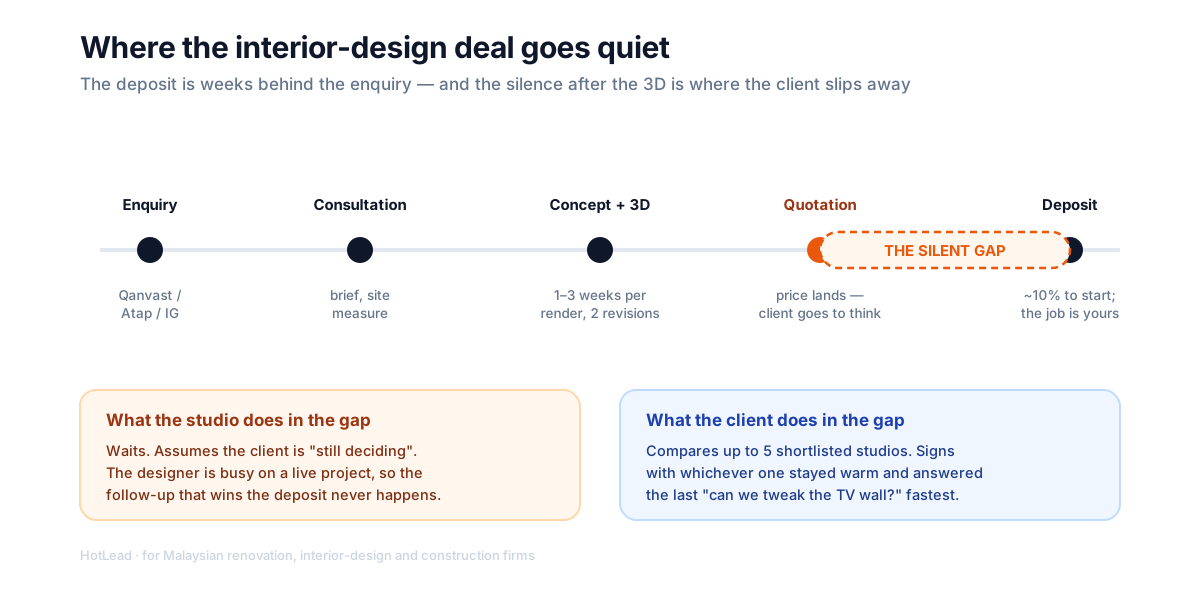
The interior-design studio owners I have sat with tell a different version of the same story, and it almost never starts with money. It starts like this: "The client loved the 3D. We spent three weeks on it, she said it was perfect, we sent the quotation — and then nothing. I followed up once, she said she'd discuss with her husband, and I never heard back. We found out two months later she signed with another studio."
Notice where that job died. Not at the brief. Not at the concept. It died in the quiet stretch between the quotation and the deposit — the longest, most fragile window in the whole built-environment business. Renovation contractors lose leads in the first hour to a slow reply. Interior-design studios lose them weeks later, in a silence everyone mistakes for "the client is thinking about it."
This is an ID-specific problem, and it has an ID-specific fix.
What is the quote-to-deposit drop-off in interior design?
It is the work you lose after the client has seen and approved your design but before they pay a deposit to start the build. The quote is on the table, the 3D got a "wow" — and then the lead goes cold during the days or weeks it takes the client to actually commit. That gap is unique to how interior design is sold.
In renovation, the painful leak is at the top of the funnel: a homeowner messages, nobody replies in time, the lead is gone before you ever quote. (We cover that in the complete guide to managing renovation leads in Malaysia.) Interior design has that leak too — but it also has a second, slower one near the bottom of the funnel, after you have already invested the most expensive hours. Losing a client there hurts far more, because you have already spent the concept time, the site measure and the 3D.
Why is the interior-design sales window the longest in the built-environment business?
Because design is iterative, and iteration takes weeks. A contractor can survey a site and send a quote in a day or two. An ID studio has to move a client through a staged creative process before a number is even meaningful — and each stage adds quiet days where a lead can drift.
The Malaysian ID process, as described by firms on platforms like Recommend.my and Livspace, runs roughly like this:
| Stage | What happens | Typical duration | Where it goes quiet |
|---|---|---|---|
| Enquiry | Lands from Qanvast, Atap, IG or referral | Minutes to reply, ideally | If no one owns it, it sits |
| Consultation | Brief, lifestyle, site measure | A meeting or two | Slow scheduling cools it |
| Concept + 3D | Mood board, layout, 3D render | 1–3 weeks per render, ~2 revisions | Revision back-and-forth stalls |
| Quotation | Price for the build lands | Days to prepare | The silent gap opens here |
| Deposit | ~10% to start; the job is yours | Whenever the client commits | Studio waits, competitor chases |
The design phase as a whole "could last anything between one week to three months, depending on the amount of back and forth," as Livspace Malaysia puts it. Stretch a sale across that many weeks and the thing that decides who wins is no longer the design — it is who stayed present the whole way through.
Why do studios lose clients after the 3D presentation, not at the price?
Because the silence after the 3D is misread. The designer assumes the client has gone quiet to weigh the price, so they back off to "not be pushy." In reality the client has gone quiet to do their normal life — consult a spouse, check the parents, compare the other studios still in the running. Silence is rarely a no. It is a "not yet" that a follow-up would convert.
This is the contrarian bit, and I will say it plainly: most studios think they lose the deposit on price. They lose it on attention. The quote that wins is usually not the cheapest — it is the one attached to the studio that answered "can we move the TV feature wall?" within the hour, three weeks after the presentation, when two other studios had already gone silent.
And remember the platform mechanic underneath all this. On Qanvast, a homeowner who requests quotes is shortlisted with up to five firms in one go. So the client in your silent gap is not sitting alone with your quote — they are sitting with yours and up to four others. The studio that disappears for two weeks is simply handing those weeks to the four firms that did not.
The two commitment moments only interior design has
Here is the structural quirk that makes ID different from renovation, and it is worth designing your whole follow-up around: interior design asks the client to commit twice. There is a small design commitment early — a design fee or 3D fee — and then the larger build deposit later, after the 3D is approved. A lead can drop at either gate, and most studios only guard the second one.
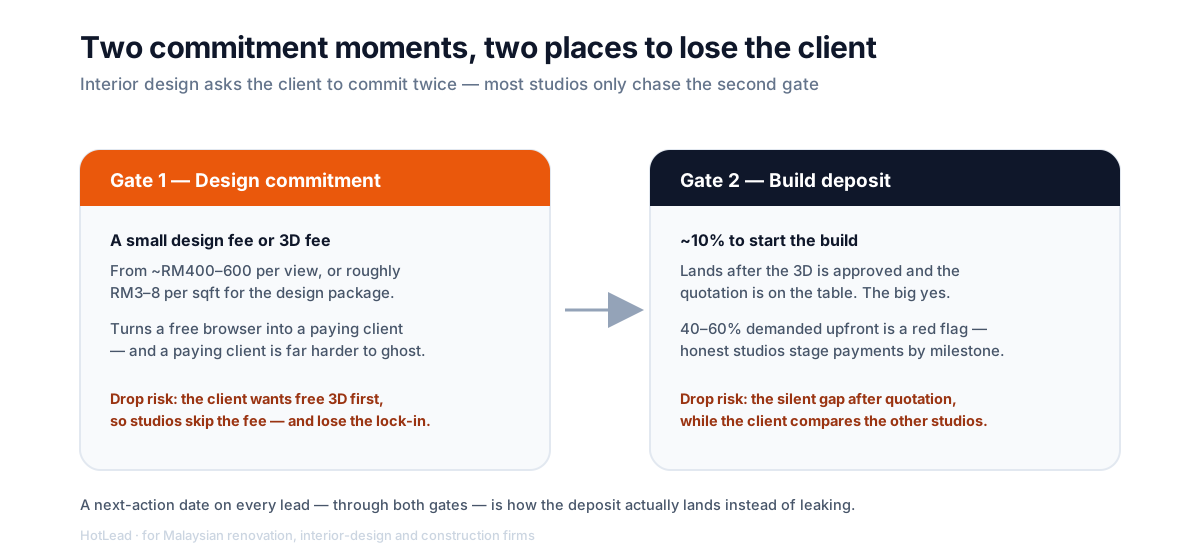
Gate 1 — the design commitment. Charging a small fee for the design package or the 3D — market figures start from around RM400–600 per view, or roughly RM3–8 per square foot for a design package — does something a free render never will: it turns a browser into a paying client. And a paying client is far harder to ghost, because they have skin in the game and a reason to see it through. The trap is that Malaysian homeowners often expect free 3D, so many studios skip the fee to win the enquiry — and lose the psychological lock-in that would have carried the client to the deposit.
Gate 2 — the build deposit. This is the big yes: commonly around a 10% deposit to start, with the rest staged against milestones like carpentry delivery and final completion. (A studio demanding 40–60% upfront before any work is widely flagged as a warning sign, so keep this gate reasonable — you want the lowest sensible barrier at the exact moment the client is finally ready.) This gate sits right after the quotation, which means it sits right inside the silent gap. No surprise it is where the most work leaks.
What does the silent gap actually cost a studio?
More than any single lost job — it costs you the most expensive leads you have. A dropped enquiry on day one costs you a five-minute reply. A client lost after the 3D costs you the consultation, the concept, the measure, and the one-to-three weeks of render work you already poured in. You paid the full price of the sale and collected none of the revenue.
That is why the bottom-of-funnel leak deserves more attention than studios give it. The math is uncomfortable: the leads furthest down your pipeline are the ones you have invested the most in, and the silent gap is precisely where you are least likely to be following up — because by then the designer has moved on to a live project and the quoted client is "waiting to decide". The cost of a lost lead is highest exactly where your attention is lowest. (We break the ringgit logic down further in the real cost of a lost renovation lead.)
How do you keep momentum through the quote-to-deposit window?
You make the follow-up a system, not a feeling. The studios that close the gap do not "remember to chase" — they have a process that keeps every quoted client warm on a schedule, so no lead goes quiet just because a project is slow or a designer is busy. Five things, in order:
- Give every enquiry one owner the moment it lands. Qanvast, Atap, IG and referral leads should not scatter across three inboxes. One designer owns each lead, end to end, so nobody assumes "someone else is on it."
- Put a next-action date on every lead — and keep it alive past the quote. The deposit window is where dates get dropped. A quoted client without a "follow up by Friday" is a client you are about to lose.
- Treat the post-3D silence as a follow-up cue, not a verdict. A "still deciding?" nudge with one fresh, helpful detail (an option, a swatch, a slot you can hold) is how you stay the easiest studio to say yes to.
- Decide your design-fee position deliberately. Whether you charge for 3D or not, make it a choice — because that first gate is a commitment device, not just a line item.
- Watch where consultations actually stall. If you cannot see whether leads die at concept, 3D or quote, you cannot fix the right leak. Make the funnel visible.
Most of this is the same discipline that wins renovation jobs — fast first reply, one owner, relentless polite follow-up — applied to a longer, two-gate timeline. If you have not nailed the front of the funnel yet, start with how to qualify a lead in the first WhatsApp reply; the back of the funnel only matters once the front is solid.
How HotLead helps interior design studios close the gap
HotLead is built for exactly this long, leaky window — for Malaysian studios specifically. It sits on top of your WhatsApp, so nothing changes for the client, and it makes the follow-up happen on every lead instead of only the ones a designer remembers:
- Captures every enquiry — Qanvast, Atap, Instagram, referral — and tags the source, so you can see which platform actually produces deposits, not just enquiry counts.
- Routes each lead to one designer the moment it arrives, so there is no group-chat scramble and no lead without an owner.
- Keeps a next action and flags overdue follow-ups through the entire concept-to-deposit window — this is the bit that beats the silent gap, because a quoted client never just sits there going cold.
- Shows your funnel — enquiries, consultations, quoted, won — so you can finally see whether clients stall at concept, 3D or quote, and per-channel ROI so you know if Qanvast or Atap is really paying off.
If your studio keeps losing clients who loved the design, the leak is almost certainly the quote-to-deposit gap — and that is the leak a follow-up system fixes. See how HotLead works, read the complete guide to managing renovation leads in Malaysia, or see how it fits an interior design studio specifically.
Sources: Recommend.my — The interior design process in Malaysia and Recommend.my — 3D interior design service prices (process stages, 3D render timing and pricing, revisions); Livspace Malaysia — Interior design in Malaysia answered (design phase running one week to three months); Spaciz Design — Interior design cost in Malaysia (design fee as a share of budget, per-sqft design pricing); FindContractor.my — Interior design cost in Malaysia 2026 (10% deposit norm and the 40–60% upfront red flag); Qanvast Malaysia — free reno quotes (shortlist of up to five firms). Speed-to-lead and follow-up figures as cited in the complete guide.
Frequently asked questions
Why do interior design clients go quiet after the 3D presentation?
Usually not because of price. After a 3D presentation a client has options to weigh, family to consult, and often two or three other studios still in the running. They go quiet to think, not to say no. The studios that lose the job are the ones that read that silence as a decision and stop following up — while a competitor keeps the conversation warm and books the deposit.
How long does the interior design process take in Malaysia before a client pays a deposit?
Longer than most owners plan for. The design phase alone can run from about one week to three months depending on how much back-and-forth happens, with a single 3D render often taking one to three weeks to produce. The whole journey from enquiry to a signed build deposit commonly stretches across several weeks — which is exactly why a lead needs a next-action date that does not depend on anyone's memory.
Should an interior design studio charge a design fee before doing 3D renders?
Often yes. A small design or 3D fee — figures in the market start from around RM400 to RM600 per view, or roughly RM3 to RM8 per square foot for a design package — converts a free browser into a paying client, and a paying client is far harder to ghost. The risk is that homeowners expect free 3D, so the fee has to be framed as value and credited toward the project. It is a commitment device, not just income.
How much deposit is normal for an interior design project in Malaysia?
The common industry practice is around a 10% deposit to start, with the rest staged against milestones such as carpentry delivery and completion. A studio demanding 40% to 60% upfront before any work is widely treated as a red flag. Keeping the deposit reasonable lowers the barrier at the moment the client is finally ready to commit.
How do I stop losing interior design leads during the long design phase?
Give every enquiry one owner and a next-action date the moment it lands, and keep that date alive through concept, 3D and quotation so no lead goes quiet just because the project is slow. Track where consultations stall — concept, 3D or quote — so you can see the leak instead of guessing. That is the gap a lightweight lead system on top of WhatsApp is built to close.
Keep reading
- The 'Quick Question Ah?' Lead: When a Buyer Uses You as a Free Second Opinion for Someone Else's RenoSome of your busiest WhatsApp threads are with buyers who already have a builder — a cousin, a part-time reno friend — and are messaging you only to sanity-check his price, his tile, his scope. Every question you answer in full is a free consult that de-risks the other guy's job. Here's how to spot the sanity-check lead, why answering everything loses you the work, and how to convert a real doubt without becoming the unpaid QA department.
- Did We Already Say RM68k? Using AI to Stop Quote Drift Across a Long Renovation ThreadOver a weeks-long WhatsApp thread with two or three quote revisions, a rep re-states a number that contradicts an earlier promise — and re-opening a settled price quietly invites a discount that eats a whole job's profit. So I pointed AI at the drift. It works beautifully as a flag, and dangerously as an auto-corrector.
- The Warranty as a Closing Lever: Why a Longer Guarantee Beats a Discount on a Renovation DealA quote is stalling and the buyer wants a reason to say yes. Before you drop the price, look at the other lever in your hand — a longer workmanship warranty. It is the same expected-value decision as a discount, but the math runs the opposite way — a price cut costs you thousands with certainty, while extending the defects cover costs you a couple of hundred ringgit in expectation, for arguably more trust with a scam-wary buyer. Here is the EV case for the non-price concession, the trap that turns it into a hidden liability, and which leads it actually moves.