

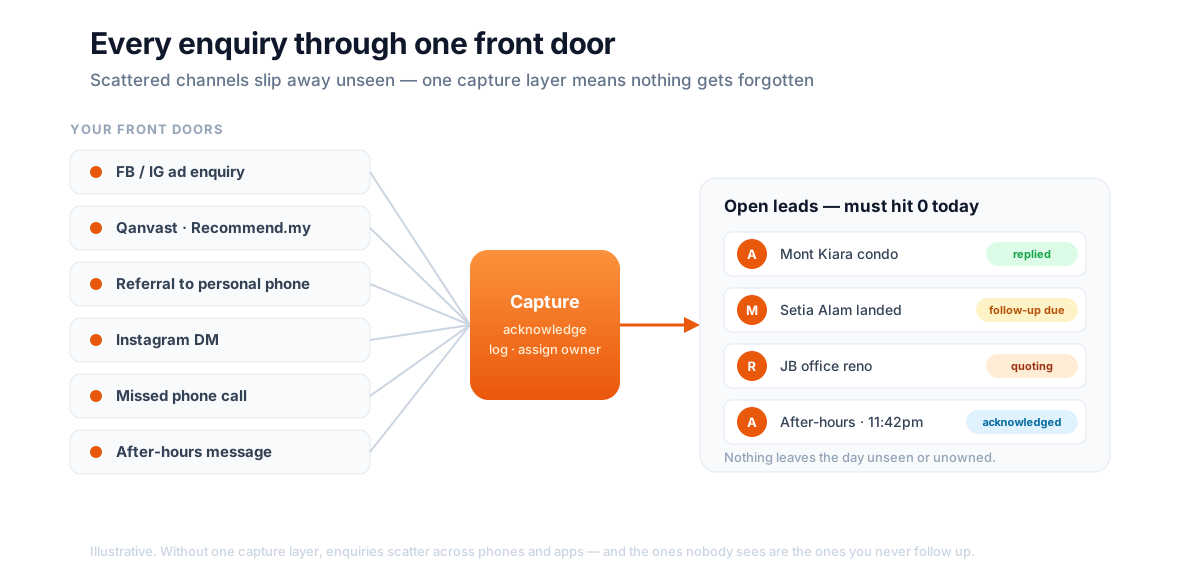
Ask a Malaysian renovation-firm owner where they lose deals and they'll usually say price. But the leads that quietly cost the most aren't the ones who said your quote was too high. They're the enquiries nobody ever saw — the WhatsApp message read on a site visit and swiped away, the Instagram DM nobody checks, the 11pm enquiry buried under 40 chats by morning, the referral sitting in the boss's personal phone.
You can't follow up a lead you never logged. The fix isn't working harder on the leads you see — it's making sure every enquiry gets captured in the first place. Here's how reno firms in Malaysia let enquiries slip, and a simple zero-missed-enquiry system to plug it.
Why do renovation enquiries get forgotten in the first place?
Because enquiries arrive through too many doors, at the worst times, into places nobody is reliably watching. It's not laziness — it's structure. Five blind spots account for most of the loss:
- Too many front doors. Your FB/IG ads point to one number, your Qanvast and Recommend.my profiles to another, referrals land in your personal WhatsApp, and Instagram sends DMs to a third app entirely. No single person sees all of them.
- After-hours bursts. Ads run at night and on weekends, so enquiries pile up when nobody's on the phone. By the time the office opens, the new message is buried under supplier chats, family messages, and yesterday's threads.
- Read but not actioned. Someone opens the message on a site visit, thinks "I'll reply later," swipes it away — and the blue ticks now make it look handled. It isn't.
- The personal-phone trap. Leads live on individual salespeople's phones. When that person is busy, on leave, or leaves the company, the lead — and the entire chat history — goes with them.
- No single list. There's no one place that says "here is every open enquiry." So "did anyone reply to the Bangsar lady?" has no answer, and the honest one is usually no.
Each gap is small. Together they mean a chunk of the leads you already paid for never even enter your pipeline.
Where exactly do enquiries disappear?
They disappear at the front door — before anyone could reply, follow up, or quote. It helps to see every channel as a door that must feed one tracked list, not a separate inbox someone hopefully checks.
| Front door | How it slips away | What closes the gap |
|---|---|---|
| FB / IG ad enquiry | Arrives in bursts, often after hours, into a noisy inbox | Auto-acknowledge + auto-assign on arrival |
| Qanvast / Recommend.my | Notifications missed inside the platform app | Forward or log into your one list daily |
| Referral | Lands in a personal phone, never recorded | Capture into a shared system, not a private device |
| Instagram DM | A separate app nobody watches | Point IG to your WhatsApp front door |
| Missed phone call | No message left, no record, never returned | Log every missed call as a lead to call back |
| After-hours message | Buried by morning, looks "read" | Instant acknowledgement, sorted list at 9am |
Notice the pattern: in Malaysia almost everything funnels toward WhatsApp eventually — it reaches around 90% of internet users and 98% of messages are opened within 3 minutes. WhatsApp is the right place to receive leads. It's just not built to guarantee every one of them gets seen and owned.
What does a forgotten enquiry actually cost?
More than most owners realise, because the loss is invisible — there's no angry customer, no rejected quote, just silence. The hard data is blunt: across thousands of leads, as few as 27% are ever contacted at all, meaning up to 73% are simply wasted (MIT researcher Dr. James Oldroyd's study, popularised by Harvard Business Review).
For a reno firm, the missed enquiry is doubly expensive when it came from a paid ad. A Facebook or Instagram enquiry in a premium category like renovation often costs RM20–RM50 before anyone even says hello. An enquiry that's never seen is that ringgit set on fire, plus the RM30k–RM80k job behind it.
And it compounds. The renovation deal is usually won at the fifth follow-up — but you can't send follow-up #1, let alone #5, on a lead that never made it onto a list. Capture is the gate every other good habit depends on. Speed, routing, and follow-up all assume the enquiry was seen in the first place.
How do you build a zero-missed-enquiry system?
Make every enquiry pass through one capture layer that sees, records, and owns it — automatically — before any human has to decide anything. Four moves do it:
1. One front door
Pick a single WhatsApp number as your official entry point and aim everything at it: your FB/IG ad button, your Qanvast and Recommend.my profiles, your website, your name cards, your Instagram bio. Customers should never wonder where to message you, and you should never wonder where to look. One door is far easier to watch than five.
2. Capture every enquiry the moment it lands
The instant a message arrives, it should be acknowledged and logged — not left to "whoever sees it." Even a one-line auto-reply ("Hi, thanks for reaching out to [firm]! We'll be in touch shortly.") does two jobs: it stops the homeowner shopping elsewhere, and it creates a record that this lead exists. Acknowledging is not the same as quoting — separating the two is what lets you capture a lead in seconds even when the full reply comes hours later. (More on this in how fast you should reply to a renovation lead.)
3. Give every enquiry one owner, instantly
A captured lead with no owner is a lead everyone assumes someone else has. Assign each new enquiry to one salesperson the moment it arrives — by area, project type, or round-robin — so it's caught and owned. This is also what later tells you which salesperson is dropping leads.
4. Keep one open-leads list — and clear it to zero
This is the habit that ties it together: a single list of every open enquiry, and a rule that it must reach zero by end of day. Not "zero unread chats" — zero leads without a clear next action. Every enquiry is either replied to, scheduled for follow-up, quoted, or marked won/lost. Nothing is allowed to just sit. Think of it as inbox-zero, but for leads instead of emails.
A daily and weekly ritual that makes "nothing slips" automatic
Systems only work if there's a rhythm behind them. Two simple rituals keep the list honest:
- Daily (5 minutes, every morning): open the list. Did every enquiry from the last 24 hours — including the after-hours burst — get acknowledged and assigned? Is there a next action on each? Clear the list to zero.
- Weekly (10 minutes): count enquiries in versus enquiries captured with an owner. If they don't match, you have a leak at the front door — usually a channel pointing somewhere nobody watches. Fix that channel before it costs you another month.
These two checks cost a quarter of an hour a week and catch the exact failure that loses the most jobs: an enquiry that arrived and was never seen.
What about after-hours and weekends?
That's when the most enquiries arrive and the fewest people are watching — so it's where capture matters most. You stop relying on someone happening to glance at the phone:
- Auto-acknowledge around the clock. A midnight enquiry that gets an instant "we'll be in touch first thing" beats silence until noon — the homeowner has a reply from you before your competitor's office even opens.
- Auto-assign on arrival. An owner is attached the moment the message lands, so the morning starts with a sorted, owned list — not a 40-chat scroll where two leads are already lost.
- Pre-write your first messages. Templates for the acknowledgement and your opening questions turn a 10-minute reply into a 30-second one, which matters most when a weekend's worth of enquiries is waiting on Monday.
This is the same pressure that makes your busy-season leads leak the most: volume rises exactly when attention is thinnest. A capture layer doesn't get tired or go on a site visit.
Why a personal phone is the riskiest place for a lead
Because the lead isn't yours — it's the phone's. If enquiries and quotes live in an individual salesperson's WhatsApp, then when that person is on leave, busy, or leaves the firm, the leads, the chat history, and the warm relationships walk out the door with them. You're left rebuilding context you already paid to create.
Capturing every enquiry into a shared system the firm owns fixes this quietly. Staff can change; the pipeline, the history, and the follow-ups stay. It's the difference between leads being a company asset and being scattered across private devices you don't control.
How HotLead makes sure nothing gets forgotten
HotLead is the capture layer this whole system needs, built for Malaysian renovation firms. It sits on top of your existing WhatsApp and catches every incoming enquiry, acknowledges it, and assigns it to one owner the moment it lands — so an after-hours burst each gets seen and owned by morning instead of buried. Every lead lands on one shared list with a clear next action and an overdue-follow-up nudge, so nothing sits unseen and nothing leaves with a staff member's phone. See how it works.
Capturing the enquiry is step one. For the full picture — speed, routing, follow-up, and the funnel metrics that show where you leak — start with the complete guide to managing renovation leads in Malaysia, or read why renovation firms lose leads in WhatsApp and how to stop it.
Sources: MIT / Dr. James Oldroyd lead-response study and Harvard Business Review, "The Short Life of Online Sales Leads"; DataReportal data on WhatsApp usage in Malaysia; WhatsApp message open-rate data; industry benchmarks on Facebook/Instagram cost per lead in premium service categories.
Frequently asked questions
How do I stop missing WhatsApp enquiries when my team is on-site all day?
Separate seeing a lead from replying to it. Every enquiry should be auto-acknowledged and assigned to one owner the moment it lands, then it sits on a single open-leads list that someone clears to zero each day. That way an on-site team still can't lose a lead — the system saw it and owns it even before anyone is free to type a full reply.
How do I capture leads coming from different channels into one place?
Pick one WhatsApp number as your single front door and point every channel at it — FB and IG ads, your Qanvast and Recommend.my profiles, your website, your name cards. Enquiries from Instagram DMs or phone calls get logged into the same list manually or via a lead tool. The goal is one tracked list, not one lead in WhatsApp, one in a DM, and one on someone's personal phone.
What happens to leads when a salesperson leaves and takes their phone?
If leads live in a personal phone, they leave with that person — chat history, quotes, and warm follow-ups gone. That is why enquiries should be captured into a shared system the firm owns, not a private device. You keep the relationship and the history even when staff change.
Should I use one WhatsApp number or several?
For customers, one front door is simplest — they are never confused about where to message you. Behind the scenes you can still split the stream by tagging and routing each enquiry to the right owner. One entry point, clear ownership underneath, beats several numbers nobody fully watches.
Keep reading
- Did We Already Say RM68k? Using AI to Stop Quote Drift Across a Long Renovation ThreadOver a weeks-long WhatsApp thread with two or three quote revisions, a rep re-states a number that contradicts an earlier promise — and re-opening a settled price quietly invites a discount that eats a whole job's profit. So I pointed AI at the drift. It works beautifully as a flag, and dangerously as an auto-corrector.
- The Warranty as a Closing Lever: Why a Longer Guarantee Beats a Discount on a Renovation DealA quote is stalling and the buyer wants a reason to say yes. Before you drop the price, look at the other lever in your hand — a longer workmanship warranty. It is the same expected-value decision as a discount, but the math runs the opposite way — a price cut costs you thousands with certainty, while extending the defects cover costs you a couple of hundred ringgit in expectation, for arguably more trust with a scam-wary buyer. Here is the EV case for the non-price concession, the trap that turns it into a hidden liability, and which leads it actually moves.
- "Can You Just Build It, My Neighbour Also Did" — Handling the Renovation Lead That Needs Council Approval FirstSome renovation enquiries can't legally start next month, no matter how ready the buyer is — a kitchen extension, a hacked-through wall, a roofed-over air well all need the council's written approval first. Quote a fast build price to win the job and you either lose it to a "boss, can start" cowboy, or win it and inherit the stop-work order, the RM50,000 fine and a client who later can't sell the house. Here's how to spot the permit-first lead and sell the approval as protection.