

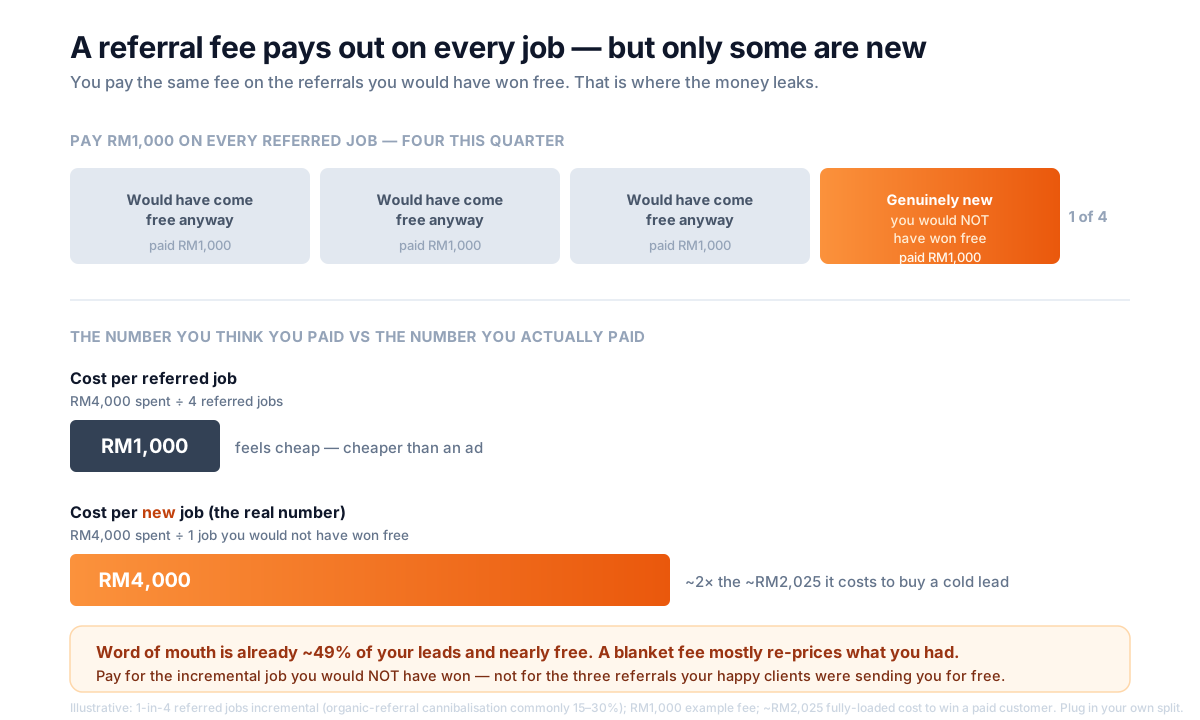
Word of mouth is roughly 49% of how Malaysian renovation buyers find a firm — effectively the number-one channel — and a referred client closes several times better than a cold one at close to zero acquisition cost. Once you've done the maths on what a happy client is really worth, the referral chain alone adds thousands of ringgit of expected value on top of the job. So the reflex is obvious: if referrals are this good, let's pay for them and get more.
Here's the problem with that reflex. A referral is only worth paying for at the margin it creates — the incremental jobs you would not have won anyway — but a blanket fee pays out on every referred job, including the large share your happy clients were already sending you for free. Worse, on a friend's recommendation, cash can actually shrink the channel it was meant to grow. This is a decision with real downside, not a free lever. Let's put the numbers on it and work out who to pay, how much, and when a fee quietly corrupts your cheapest channel.
Why does paying for referrals feel like an easy win?
Because every number about referrals is excellent, so multiplying them looks like free money. A referred lead arrives pre-sold, closes in the 15–25% band versus roughly 1% for a cold boosted post, and costs almost nothing to acquire. Set that against a paid customer who costs you about RM2,025 all-in once you count ad spend and sales time, and the logic writes itself: pay a past client RM1,000 to send you a job, and you've "bought" a better lead for half the price of a cold one.
The flaw isn't in any single number. It's in the assumption hiding underneath: that the referral only exists because you paid for it. In a market where word of mouth is already half your leads, most of those referrals were coming anyway — and the moment you attach a fee to all of them, you start paying full price for something you were getting free.
The incrementality problem: what a fee actually buys
You pay on every referred job, but only some of those jobs are genuinely new. That gap is where the money leaks, and it's the single most important number in this decision.
Marketers who run referral programmes at scale have a name for it — cannibalisation — and a rule of thumb: for a business with any meaningful organic word of mouth, 15–30% of "referred" customers would have bought anyway (referral-attribution research; Mention Me, ATTN Agency). A renovation firm doesn't have "any meaningful" organic word of mouth — it has a channel that is half its leads. So the cannibalisation rate isn't 15–30% at the margin; for a firm that already lives on referrals, the share of paid referrals that would have come free is plausibly much higher.
Run it through the arithmetic on the cover diagram. Say you pay RM1,000 per referred job and four referred jobs land this quarter:
| Referred jobs | Fee paid | What you actually bought | |
|---|---|---|---|
| Looks like | 4 jobs | RM4,000 | RM1,000 per referred job — "cheaper than an ad" |
| Actually is | 1 genuinely new | RM4,000 | RM4,000 per new job — the other 3 came free |
The number that matters is cost per incremental job, not cost per referred job — the same discipline as cost per won job rather than cost per lead. At one-in-four incremental, your RM1,000 fee is really costing ~RM4,000 to win one extra job — about double the ~RM2,025 it costs to buy a cold lead outright. You've made your cheapest channel more expensive than your most expensive one.
The trap underneath the trap: cash can shrink your referrals
Even setting incrementality aside, there's a second effect that turns the whole idea upside down on your closest relationships: paying for a referral can produce fewer referrals, not more. This is the part owners almost never see coming, and it's the reason "just start a referral programme" is a genuinely risky move rather than a neutral one.
Two well-documented effects stack here:
- Motivation crowding-out. Behavioural economics is clear that paying people to do something they already do for free can reduce how much they do it, because an external reward displaces the internal reason (the "overjustification effect"). A happy client recommends you because your kitchen made them proud to have found you — that pride is the engine. Turn the favour into a paid task and you can switch the engine off.
- The metaperception problem. Referral research (Verlegh, Ryu & Feick, on monetary versus in-kind rewards) finds that a cash reward makes the referrer worry their friend will assume they had an ulterior motive — so on close relationships, monetary referral rewards can lower referral likelihood. The recommendation that was worth so much precisely because it was disinterested becomes "he gets paid to say that."
Put those together and you get the counter-intuitive core of this whole question, drawn out in the diagram below: the same fee has opposite effects depending on who you pay.
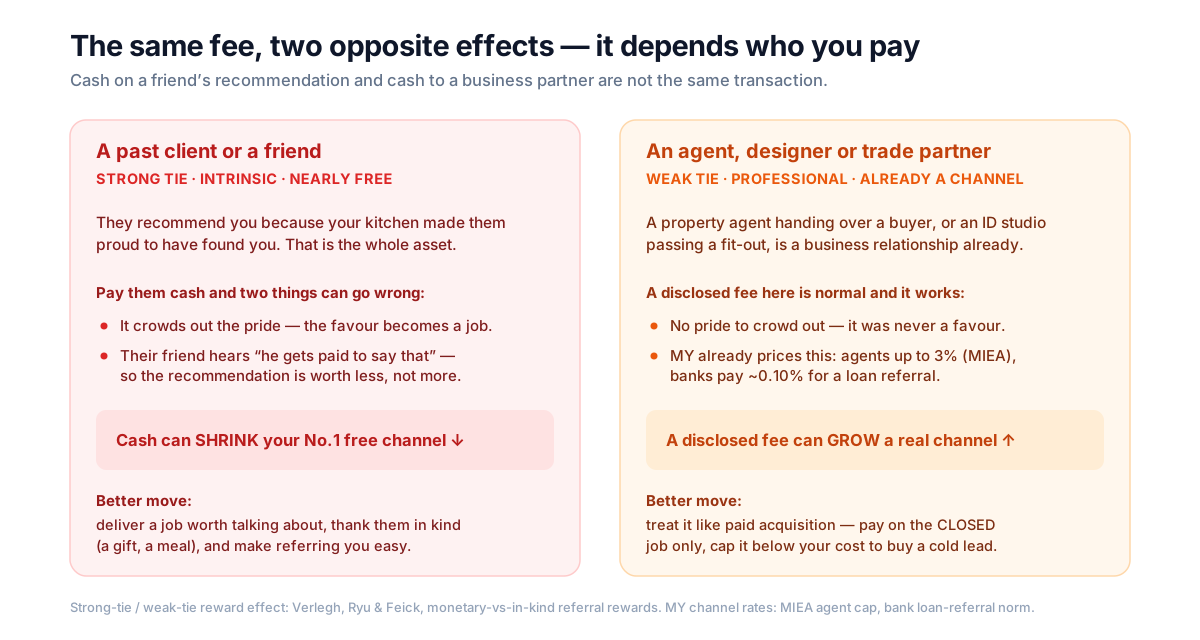
So who should you pay — and who shouldn't you?
Split every potential referrer by the strength of the relationship, because that single distinction decides whether a fee helps or hurts.
| Referrer | Relationship | Pay a cash fee? | Better move |
|---|---|---|---|
| Past client / friend | Strong, personal | No — risks crowding out the pride and the metaperception hit | Deliver a job worth talking about; thank in kind (a gift, a meal); make referring easy |
| Property agent | Weak, professional | Yes, disclosed, on close | Treat as a channel; cap the fee below your cold-lead CAC |
| Interior designer / complementary trade | Professional, often reciprocal | Yes, disclosed, mutual | Structured and two-way; pay on the closed job only |
| A cold "introducer" middleman | Transactional | Careful | Often just re-prices leads you'd get; highest kickback-perception risk |
The logic is consistent: pay where the relationship was already transactional, and don't pay where the value came from it not being transactional. Malaysia already prices the professional side of this cleanly — the Malaysian Institute of Estate Agents caps a property agent's commission at 3%, and banks routinely pay agents a referral fee of around 0.10% of an approved loan. Nobody thinks worse of an agent for earning a disclosed introduction fee, because that was never a favour between friends. An interior designer passing you a fit-out, or another contractor handing over a job outside their scope, sits in the same category — a real channel a modest, disclosed fee can genuinely grow.
If you do pay, how much — and out of which number?
Out of gross profit, and never on a lead — only on a job that actually closes. The mistake that turns a sensible partner fee into a margin leak is sizing it against the job value, because a small-sounding percentage of a big job is a large slice of your thin profit.
Take the house figures we use across this playbook — an RM80,000 condo job at a ~20% gross margin, so ~RM16,000 of gross profit:
| "Referral commission" | On RM80k job value | As a share of your RM16k gross profit |
|---|---|---|
| 1% | RM800 | 5% |
| 3% | RM2,400 | 15% |
| 5% | RM4,000 | 25% |
A "3% referral commission" sounds trivial next to an RM80k job. Against the profit that actually pays your overhead, it's 15% of your margin — and, like a discount, it comes entirely out of the profit slice, not the price. A 5% fee eats a quarter of your gross profit before a single ringgit of overhead is covered. That's why the sane way to size a partner fee is as a modest share of gross profit — a flat RM500–1,500 on a job carrying ~RM16,000 of profit is roughly 3–9% of it, defensible when the introduction is genuinely incremental — with two hard rules:
- Pay on the closed job, not the lead. A referral fee on an enquiry pays middlemen to fire names at you; a fee on a signed deposit pays for actual business.
- Cap it below your cold-lead CAC (~RM2,025). The moment a fee approaches what it costs to buy a customer from scratch, the referral has lost its cost advantage — and if it's cannibalising a free referral, you're now paying more than a cold lead for a job you'd have won anyway.
The Malaysian kickback problem you can't put on a spreadsheet
There's a cost to a visible referral fee that never shows in the margin table, and in Malaysia specifically it's a big one: a kickback perception devalues the recommendation itself. An undisclosed referral fee is, commercially, a hidden markup on the introduction — and buyers here are trained by a thick renovation-scam-warning ecosystem to be suspicious of exactly that. The question a wary buyer asks is fatal to the asset you paid for: "Is she recommending them because they're good, or because she gets a cut?" The recommendation that closed at 20% because it was trusted now closes like a cold lead, because it's no longer trusted.
This is why the safe place for a fee is a disclosed, professional arrangement — an agent or a designer whose role as an introducer is understood by everyone, including the buyer — and the dangerous place is the personal relationship, where the fee has to be either hidden (a trust risk) or awkward (a crowding-out risk).
What actually grows referrals — and what it costs
The highest-return "referral programme" for a small reno firm is almost never a fee. It's two things you're probably already underinvesting in, both cheaper than any incentive:
- Stop leaking the referrals you already earn. The warm referral you leave until tomorrow because "they already trust us, no rush" is your highest-value lead getting your slowest reply — the single most common way firms lose free referrals. Fixing your response to warm leads wins more referred jobs than any fee, at zero marginal cost.
- Make the free channel visible. You cannot grow, or sensibly price, a channel you can't measure — and a referral arrives as an anonymous "my friend used you" with no source tag. Tag every enquiry with its source and you can finally see which past clients and which partners actually send you work, which is the difference between rewarding your real advocates and paying a flat fee into a black box. It's also why where your leads come from is one of the four numbers every reno firm should track.
Then, beyond measurement: deliver a clean handover so the job is worth talking about, and stay reachable for the dated future job so a happy client can find you when their next project lands. That's not a programme with a payout — it's the referral engine itself, and it runs on delivery and attention, not fees.
How HotLead fits in
HotLead is built so Malaysian renovation, interior-design and construction firms can win more of the referrals they already earn — on top of the WhatsApp they already use — which is almost always a better return than paying for new ones. It captures every enquiry with its source attached, so a referral doesn't arrive as an anonymous "my friend used you": you can finally see which past clients and which partners send you real work, and whether a paid partner arrangement is bringing incremental jobs or just re-pricing ones you'd have won free. It keeps first replies fast and every lead owned with a next action and overdue flags, so the warm referral — your highest-value, highest-converting lead — doesn't leak into a slow reply while you chase colder ones. And its funnel and per-channel view shows, over time, whether word of mouth and any referral partners actually convert to closed jobs, so you can spend referral money where it creates business instead of guessing.
To be clear about the boundary: HotLead is a lead-management tool, not a loyalty or referral-program platform — it won't run a rewards scheme or automate a referral payout, and it won't decide your fee for you. What it does is make the referral channel you already have visible and fast, which is the cheapest referral growth on offer, and give you the source-level evidence to judge whether paying a partner is worth it.
Start with the complete guide to managing renovation leads in Malaysia, see the renovation lead playbook, or read the worth side of this coin in what a renovation client is really worth and what it costs to win one.
Sources: Cannibalisation / incrementality of referral programmes (15–30% of "referred" customers would have bought anyway for brands with organic word of mouth; cost per incremental activation; launching too early cannibalises organic referrals and raises blended CAC) — referral-attribution and unit-economics write-ups from Mention Me, ATTN Agency and Viral Loops. Motivation crowding-out / the overjustification effect (paying for an intrinsically motivated behaviour can reduce it) — established behavioural-economics and psychology literature (overjustification effect; motivation crowding theory). Monetary vs in-kind referral rewards and relationship strength (cash rewards raise metaperception concern and can lower referral likelihood on strong ties; in-kind and symbolic rewards fare better) — Verlegh, Ryu, Tuk & Feick, "When giving money does not work: the differential effects of monetary versus in-kind rewards in referral reward programs," International Journal of Research in Marketing (2013). Malaysian referral-fee anchors (property agent commission capped at 3% by the Malaysian Institute of Estate Agents, minimum RM1,000; bank loan-referral fee 0.10% of the approved amount) — MIEA schedule via PropertyGuru Malaysia and Malaysian property-agency guides. Interior-design fee norms (8–15% of project budget) — Malaysian interior-design pricing guides (Latitude, FindContractor.my). Kickback/disclosure and trust (an undisclosed referral fee is a hidden markup that damages trust; disclosure matters) — real-estate and construction referral-fee/RESPA commentary, applied directionally to the reputational risk in a scam-wary market. Malaysian buyer-discovery channels (~49% word of mouth) — ZenWeb Malaysian renovation buyer discovery-channel survey. Job-value, margin, close-rate, CAC and referral-value figures (mid condo ~RM80k at ~20% margin, ~RM16k gross profit, warm referral 15–25% close vs ~1% cold, ~RM2,025 fully-loaded CAC) reuse the house figures established across this playbook. All ringgit fee and cost-per-job figures in this article are illustrative worked examples anchored to these ranges — plug in your own job values, margin, close rate and referral split for your real number.
Frequently asked questions
Should a small renovation firm pay for referrals?
Not with a blanket cash fee to everyone. Split the referrer by relationship. For a past client or a friend (a strong tie), cash tends to backfire — it crowds out the pride behind the recommendation and can make their friend distrust it, so you're better off delivering well, thanking them in kind, and making it easy to refer you. For a professional partner (a property agent, an interior designer, a complementary trade), a disclosed fee is a normal, legitimate channel cost that works — but treat it like paid acquisition: pay only on a job that actually closes, and cap the fee below what it costs you to buy a cold lead.
How much is a fair referral fee for a renovation or interior-design job in Malaysia?
There's no regulated rate the way property agents are capped at 3% by the Malaysian Institute of Estate Agents, so the discipline has to come from your own margin. Size the fee against gross profit, not job value, and pay it only on a closed job. On an RM80,000 job at a ~20% margin you make ~RM16,000 gross profit; a fee of RM500–1,500 is roughly 3–9% of that profit and defensible if the job is genuinely incremental. Once a fee approaches your ~RM2,025 cost to win a paid customer, you might as well just buy cold leads — and if you're paying it on referrals you'd have won free, your real cost per new job is higher still.
Can paying for referrals actually reduce word of mouth?
Yes, and this is the trap most owners miss. Behavioural-economics research on motivation crowding-out shows that paying people to do something they were already doing for free can reduce how much they do it, because an external reward displaces the internal reason. Referral research adds a second effect: a monetary reward makes the referrer worry that their friend will think they had an ulterior motive, so on close relationships cash referrals can lower referral likelihood rather than raise it. In a market where word of mouth is roughly 49% of how buyers find a firm, turning that free channel transactional is a real risk, not a theoretical one.
Is a referral fee the same as a kickback?
Commercially they overlap, and perception is what matters. An undisclosed referral fee is effectively a hidden markup on the recommendation, and when it comes out it damages trust in exactly the relationship you were relying on. In a Malaysian market already primed to fear bad contractors, a buyer who learns their friend or agent was paid to recommend you will discount the recommendation — the asset you paid for loses its value. If you do run a partner referral arrangement, keep it disclosed and modest, so it reads as a normal introduction fee, not a secret cut.
What's a better use of the money than a referral fee?
Plugging the leaks that lose the referrals you already earn, and making the free channel visible. The warm referral you leave until tomorrow because 'they already trust us' is your highest-value lead getting your slowest reply — fixing that wins more referred jobs than any fee. Beyond that: deliver a clean handover so the job is worth talking about, stay reachable for the dated future job, and tag every enquiry with its source so you can finally see which past clients and partners actually send you work. You can't grow — or sensibly pay for — a channel you can't measure.
Keep reading
- Did We Already Say RM68k? Using AI to Stop Quote Drift Across a Long Renovation ThreadOver a weeks-long WhatsApp thread with two or three quote revisions, a rep re-states a number that contradicts an earlier promise — and re-opening a settled price quietly invites a discount that eats a whole job's profit. So I pointed AI at the drift. It works beautifully as a flag, and dangerously as an auto-corrector.
- The Warranty as a Closing Lever: Why a Longer Guarantee Beats a Discount on a Renovation DealA quote is stalling and the buyer wants a reason to say yes. Before you drop the price, look at the other lever in your hand — a longer workmanship warranty. It is the same expected-value decision as a discount, but the math runs the opposite way — a price cut costs you thousands with certainty, while extending the defects cover costs you a couple of hundred ringgit in expectation, for arguably more trust with a scam-wary buyer. Here is the EV case for the non-price concession, the trap that turns it into a hidden liability, and which leads it actually moves.
- "Can You Just Build It, My Neighbour Also Did" — Handling the Renovation Lead That Needs Council Approval FirstSome renovation enquiries can't legally start next month, no matter how ready the buyer is — a kitchen extension, a hacked-through wall, a roofed-over air well all need the council's written approval first. Quote a fast build price to win the job and you either lose it to a "boss, can start" cowboy, or win it and inherit the stop-work order, the RM50,000 fine and a client who later can't sell the house. Here's how to spot the permit-first lead and sell the approval as protection.