

Here is the question almost every Malaysian renovation and interior-design owner eventually asks a marketing agency, a WhatsApp group of peers, or an AI assistant at 11pm: do I pay for a Qanvast or Atap listing, or do I pump the money into Facebook and Google ads?
The usual answer compares them on cost per lead — and that answer is close to useless, because a Qanvast listing, an Atap credit and a Meta ad are not three prices for the same thing. They are three different financial instruments. One is a fixed subscription, one is pay-per-lead on a shared enquiry, one is a lead you own outright. They carry different intent, different ownership and different cost shapes, and the right choice depends on which of those matches your firm right now — not on whose sticker price is lowest.
Should you pay for a directory listing or for social ads?
Neither is automatically better — the decision turns on who owns the intent, whether you own or share the lead, and whether the cost is fixed or variable. The sticker cost per lead answers none of those three questions, which is why firms that optimise it keep buying the wrong channel.
Start with what each one actually is. A buyer on Qanvast or Atap went to a renovation platform on purpose — they are already shopping, already comparing firms, already thinking in budgets and timelines. A person who clicked your boosted post was scrolling between reels and you interrupted them. Both can become a paying job, but they enter your pipeline at different depths, and that depth gap shows up as a close-rate gap that is usually far wider than the price gap. This is the same engine behind why the cheapest lead is often your most expensive job: intent, not price, drives conversion.
So before you compare ringgit, sort your options by what you are buying.
What are you actually buying — the three lead-source models?
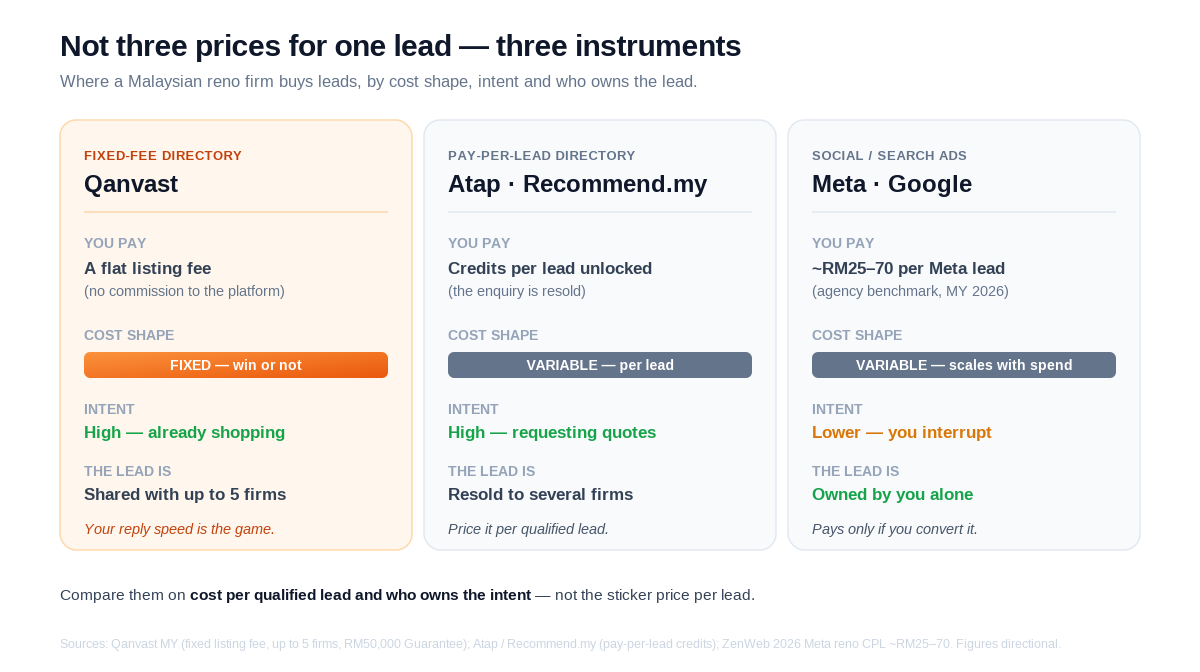
There are three distinct models on the Malaysian market, and conflating them is the root mistake. A fixed-fee directory sells you presence; a pay-per-lead directory sells you individual enquiries; social ads sell you reach you convert into leads you own. Here is how they compare on the things that matter.
| Fixed-fee directory | Pay-per-lead directory | Social / search ads | |
|---|---|---|---|
| Examples (MY) | Qanvast | Atap, Recommend.my, ServisHero | Meta, Google, TikTok |
| You pay | A fixed listing fee / subscription | Credits per lead unlocked | Per click / per lead form |
| Cost shape | Fixed — same whether you win or not | Variable — scales with leads taken | Variable — scales with spend |
| Buyer intent | High — actively shortlisting firms | High — actively requesting quotes | You create it — interrupt, lower by default |
| Who owns the lead | Shared — up to 5 firms per enquiry | Shared — enquiry resold to several | Yours — not resold |
| The real cost driver | Your reply speed vs the other 4 | Cost per qualified lead after duplicates | Whether you convert cheap volume |
Qanvast is the fixed-fee model: the company says it takes no commission from firms and instead charges listed firms a fixed listing fee, then matches each homeowner with up to five recommended firms through a Qanvast Guide. Its distinctive asset for a high-ticket buyer is trust infrastructure — reviews on a firm's profile are verified against the homeowner's renovation contract, and buyers are covered by the RM50,000 Qanvast Guarantee, which safeguards their deposits if a firm becomes insolvent.
Atap and Recommend.my are the pay-per-lead model. On Atap, designers buy non-expiry credits to unlock or bid on homeowner enquiries that match their profile; Recommend.my's professional side runs on credits too, deducting them when a customer engages with your quote (the platform has signalled a shift toward a commission-on-payment model, so confirm the current terms before you budget). ServisHero works the same prepaid-credit way — and, as its own early coverage admitted, buying credits has never guaranteed you win the job.
Meta, Google and TikTok are the owned-lead model. You pay to reach people and convert some of them into enquiries that are yours alone, not resold. The trade is intent: a Google searcher typed "renovation contractor KL" and is looking now; a boosted-post viewer was not.
Why is cost-per-lead the wrong comparison here?
Because cost per lead measures how cheap a source is to feed, not how much qualified, winnable demand it puts in front of you. The honest comparison is cost-per-qualified-lead — and on that measure a "pricey" directory lead and a "cheap" ad lead move toward each other.
Take the Malaysian numbers at face value first. Agency benchmarks put Meta reno leads at roughly RM25–70 (with residential renovation near RM25, and reno/interior in the RM30–70 band), and Google Search reno/ID leads higher at roughly RM35–150 — both drifting upward year on year as the cheap audience gets used up (ZenWeb, 2026; treat as directional agency data). Against a per-lead directory credit that can run into the tens or low hundreds of ringgit, social looks cheaper per lead almost every time.
Now divide by intent. A chunk of those RM40 Meta enquiries are price-curious scrollers who will never deposit; the ZenWeb construction benchmark itself only claims around a fifth of reno/interior Meta leads turn into an appointment. A Qanvast or Atap enquiry came from someone who walked into a renovation platform and asked for firms. When you re-price both on cost per qualified lead — the ones with a real budget, a real timeline and a real intent to hire — the gap narrows sharply, and once you carry it all the way to cost per won job it can flip entirely.
What three questions actually decide it?
Skip "which is cheaper" and ask these three. Together they tell you which instrument fits your firm this quarter — and the honest answer is usually a mix, not a winner.
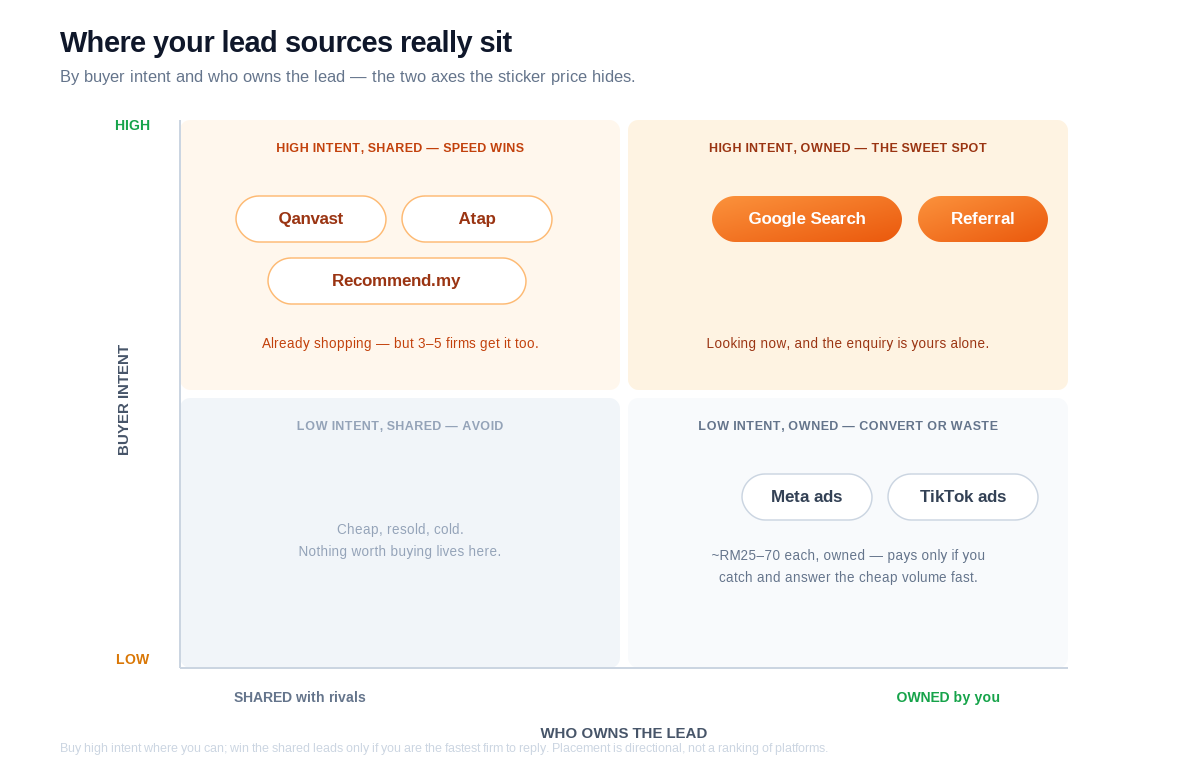
Who owns the intent? If the buyer arrived already shopping (any directory), they are deeper in the funnel and will close better for the same effort — you are paying for qualified attention. If you created the intent (social ads), you are paying for reach and your targeting and creative decide how much of it is real. High-ticket, high-consideration work — a full interior-design fit-out — leans toward intent; fast, visual, impulse-friendly offers can do well on reach.
Do you own the lead, or share it? A Qanvast shortlist of five, or a pay-per-lead enquiry sold to several firms, means your reply speed is the entire contest — the fastest credible firm usually wins before the others finish typing. An owned social lead is not racing anyone, so there your capture and targeting matter more than raw speed. Know which game you are actually playing.
Is the cost fixed or variable? A fixed listing fee rewards conversion — every extra shortlist you win drives your true cost per job down, so it suits a firm with a tight close. Variable spend (ads, credits) scales — which is powerful when your funnel works and dangerous when it leaks, because it will happily scale your worst leads at 2am while nobody replies.
When does a directory win, and when do ads win?
Match the instrument to your stage, your ticket size and your capacity — not to a blanket rule. Here is the decision most Malaysian reno and ID firms should make.
- New firm, no referral engine, proving your close rate → directory first. You have no search ranking and no word-of-mouth flywheel yet, so a vertical directory is the fastest way in front of buyers already shopping, and a fixed listing fee is a predictable cost while you learn to convert. A fixed-fee directory is especially strong for interior design and high-ticket work, where Qanvast's contract-verified reviews and the RM50,000 Guarantee answer the nervous, scam-wary first-timer's biggest fear directly — trust they cannot get from a cold ad.
- You convert fast and reliably, and want more volume → add social ads. Once you can catch and answer a burst of enquiries without dropping any, Meta and Google let you turn up the tap on leads you own and are not sharing with four rivals. The cheaper, lower-intent volume now pays, because your system stops it leaking.
- You are slow to reply → fix that before you buy anything. This is the contrarian core: a directory lead is only cheap if your system is fast. Pay a fixed Qanvast fee and reply in six hours and you have bought the most expensive lead on the market — you ate the fee and lost the five-way race. Spend on resold pay-per-lead credits with a slow inbox and you are literally funding competitors' wins. Speed is the multiplier on every ringgit you spend on leads, whichever instrument you choose — which is why how fast you reply decides so much of the outcome.
How do you actually measure which one pays?
You need the same three things per source, and the third is where almost every firm falls down:
- Spend by source. The Qanvast fee, the Atap credits spent, the Meta and Google spend — you already have these.
- Qualified leads by source. Not raw enquiries — the ones with a budget, a timeline and real intent. This is where a resold pay-per-lead's true cost hides.
- Won jobs by source. The missing piece. It needs every enquiry tagged with where it came from at the moment it lands and that tag carried all the way to won or lost — months later, after the quote and the site visit.
The arithmetic is trivial; step 3 is the whole problem. In Malaysia a Qanvast handoff, an Atap credit lead, a Meta click-to-WhatsApp and a referral all pour into the same WhatsApp number, and a spreadsheet only stays accurate if a busy salesperson back-fills every source and outcome — which collapses in exactly the busy months the data matters most. Without source tagging that survives to the deposit, you are choosing between directories and ads on a spend report and a gut feeling.
How HotLead fits in
HotLead does not buy your ads, place your directory listing or write your reviews — those are yours. What it does is let a Malaysian renovation, interior-design or construction firm see which lead source actually pays, on top of the WhatsApp you already use. It captures every enquiry with its source attached, so a Qanvast handoff, an Atap credit lead and a Meta ad do not blur into one anonymous inbox. Its auto-greeting and one-owner routing give every shared-shortlist and resold lead the fast, credible first reply that decides the race you are in with four other firms. Its next-action and overdue reminders stop a paid credit or a fixed-fee shortlist invite rotting unanswered. And its funnel and per-channel ROI view shows enquiries, qualified leads and won jobs by source — exactly the cost-per-qualified-lead and cost-per-won-job that tell you whether the listing fee, the credits or the ad budget is the right place for your next ringgit.
Start with the complete guide to managing renovation leads in Malaysia, map your options in where renovation leads come from in Malaysia, or go deeper on the renovation lead playbook and managing leads for an interior-design studio. If you already run paid marketplaces, pair this with handling Recommend.my and ServisHero enquiries without bleeding money.
Sources: Qanvast Malaysia — Why Qanvast / Trust Programme and list-as-a-pro / about (fixed listing fee, no commission from firms, up to 5 recommended firms per request, reviews verified against the renovation contract, RM50,000 Qanvast Guarantee safeguarding deposits in the event of a firm's insolvency); Atap.co platform and press coverage via Digital News Asia (pay-per-lead non-expiry credits for designers, plus membership listing and branding; ~500 new renovation leads/month — company figure, unaudited); Recommend.my professional help pages (credit-based pay-per-action model, with a signalled move toward commission-on-payment — verify current terms) and ServisHero prepaid-credit bidding via TechCrunch; ZenWeb — Lead Generation Cost in Malaysia 2026 and Meta Ads for Construction in Malaysia 2026 (Meta reno/home-services CPL ~RM25–70, representative ~RM40; Google Search ~RM35–150, representative ~RM85; both rising year on year; ~22% lead-to-appointment on reno/interior Meta — agency benchmarks, directional). Ringgit figures are agency ranges and the worked example is illustrative — replace them with your own spend, qualified-lead and won-job counts by source to find your real cost per job by channel.
Frequently asked questions
Is Qanvast free for renovation and interior-design firms?
It carries no per-lead fee and Qanvast says it takes no commission from firms — instead listed firms pay a fixed listing fee to be on the platform. So the cost is a subscription, not a price per enquiry. In return a homeowner is matched with up to five firms per request, reviews on your profile are verified against the homeowner's renovation contract, and buyers are covered by the RM50,000 Qanvast Guarantee, which safeguards their deposits if a firm becomes insolvent. The practical implication is that your true cost per lead falls the more of those shortlist invites you convert, and rises if you are the slow firm of the five.
How much does a renovation lead cost on Facebook in Malaysia?
Malaysian agency benchmarks put Meta (Facebook and Instagram) renovation leads at roughly RM25–70, with a representative figure near RM40 (ZenWeb, 2026), and that cost has been drifting up year on year. Google Search leads for reno and ID keywords run higher, roughly RM35–150 with a representative figure near RM85, because search intent is stronger. These are agency ranges, not quotes — your own cost depends on targeting, creative, location and how well your landing experience converts a click into a real enquiry.
Are Atap and Recommend.my leads worth paying for?
They can be, but judge them differently from a Qanvast listing because the model is different. Atap and Recommend.my are pay-per-lead — you spend credits to unlock or respond to a homeowner enquiry, and the same enquiry is usually sold to several firms, so you are buying a lead someone else qualified and that is not exclusive to you. The honest metric is cost-per-qualified-lead after you strip out the duplicates, the tyre-kickers and the ones that went cold before you replied. If a bundle of credits reliably produces jobs at an acceptable cost per won job, it pays; if it mostly buys you races you lose on speed, it does not.
Qanvast or Facebook ads — which should a reno firm choose?
It depends on three things, not on which is cheaper per lead. First, who owns the intent — directory buyers are already actively renovation-shopping and comparing firms, so they sit further down the funnel than someone who paused on a boosted post. Second, do you own the lead or share it — a directory shortlist or a resold pay-per-lead means your reply speed is the whole game, while an owned social lead means your targeting and capture are. Third, is the cost fixed or variable — a fixed listing fee rewards conversion, whereas ad spend and credits scale with volume and will happily scale your worst leads too. Most firms do not pick one; they clear the high-intent directory floor first and add social once their system can handle the cheaper volume.
Should a brand-new renovation firm start with directories or with ads?
Usually directories, for two reasons. A new firm has no referral engine and no search ranking yet, so a vertical directory is the fastest way to sit in front of buyers who are already shopping — and a fixed listing fee is a predictable cost while you are still proving your close rate. Social ads reward a firm that already has a fast, reliable way to catch and answer a sudden burst of cheaper leads; point a budget at Meta before you have that system and you mostly fund enquiries that go unanswered. Build the capture-and-speed habit on directory leads first, then open the ad tap once you can convert what you already get.
Keep reading
- Can AI Reply to Your Renovation Firm's 1-Star Review? I Built It — and the Risk Is How Fast It ApologisesA 2-star review on Google or Qanvast is the first thing your next renovation lead reads — and most firms either ignore it or fire back and make it worse. The 2026 reflex is to let AI write the reply. I built it, and drafting a calm response costs a fraction of a sen. But an AI tuned to be helpful apologises too fast — it will concede a fault in writing, promise a refund that never happened, and grovel to a fake review from a competitor. Here's the build that protects your rank instead of torching it.
- Which Lead Signals Actually Predict a Sale? Reverse-Audit Your Own Won JobsMost firms grade a renovation lead on signals that feel predictive — enthusiasm, a long message, a fast reply — and never check whether those signals actually separate won jobs from lost ones. Here is how to run a reverse-audit on your own closed deals, which signals usually survive it, and why your pipeline is too small to pretend the score is more than directional.
- The "I Only Deal With the Boss" Lead: When the Buyer Refuses Your TeamYou finally hired someone to share the load — then the buyer messages "can I deal with you direct ah, boss?" and refuses to engage your staff. Every big lead quietly re-centralises onto the one person already maxed out, and your firm can never grow past the owner. Here's why caving caps you, why a flat "my staff will assist" loses a nervous buyer, and the move that keeps both.